Questions

5 Marks Question

🎯

Test yourself on this topic

4 questions · timed · auto-graded

Question 15 Marks
Discuss various types of aggression?
Answer
The various types of aggression are:
Hostile aggression: Hostile aggression is inflicting or causing harm whether it is physical or psychological on someone else. It is sometimes referred as reactive aggression and can be accompanied by anger. In hostile aggression the main aim is to cause injury to other person. The intention is on causing pain and suffering.
Instrumental aggression: Instrumental aggression is displaying aggressive behavior in pursuit of a non-aggressive goal. It is also known as channeled aggression is not accompanied by anger. Instrumental aggression is behavior that has intent to hurt in order to achieve money, praise or victory.
Assertive behavior: Assertive behavior is different type of aggression/aggressive behavior. This is defined as behavior that involves the use of legitimate physical or verbal force to achieve one's purpose. In Assertive behavior, the intention is to establish dominance rather than to harm the opponent.
View full question & answer
Question 25 Marks
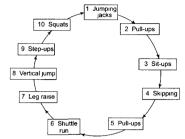
Draw ten stations circuit training programme for improving the jumping ability of a player.
Answer
Circuit training is a form of body conditioning or resistance training using high-intensity aerobics. It targets strength building and muscular endurance. An exercise 'circuit' is one completion of all prescribed exercise in the programme. When a circuit is complete, one begins the first exercise again for the new circuit. A specific circuit however, can consist of several exercises evolving the same muscle groups.
An example of circuit training is given below
Image
View full question & answer
Question 35 Marks
What are the physical impairments in Paralympics?
Answer
There are eight different types of physical impairments. These are
Impaired Muscle Power: In this impairment, the force generated by muscles, such as the muscles of one limb, one side of the body or the lower half of the body is reduced. For e.g., spinal cord injury, spina bifida and post-polio syndrome.
Impaired Passive Range of Movement: In this impairment, range of movement in
one or more joints is reduced in a systematic way. Acute conditions such as arthritis are not included in this category.
Loss of Limb or Limb Deficiency: In this impairment, a total or partial absence of
bones or joints from partial or total loss due to illness, trauma, or congenital limb deficiency can be observed. For e.g., amputation and dysmelia.
Leg-length Difference: In this impairment, significant bone shortening occurs in one leg due to congenital deficiency or trauma.
Short Stature: In this impairment, standing height is reduced due to shortened legs, arms and trunk, which are due to a musculoskeletal deficit of bone or cartilage structures. For e.g., achondroplasia, growth hormone deficiency, osteogenesis imperfecta.
Hypertonia: In this impairment, hypertonia is marked by an abnormal increase in muscle tension and reduced ability of a muscle to stretch. Hypertonia may result from injury, disease, or conditions which involve damage to the central nervous system. For e.g., cerebral palsy.
Ataxia: Ataxia is an impairment that consists of a lack of coordination of muscle movements. For e.g., cerebral palsy, Friedreich's ataxia, multiple sclerosis.
Athetosis: Athetosis is generally characterised by unbalanced, involuntary movements and a difficulty maintaining a symmetrical posture. For e.g., cerebral palsy, choreoathetosis.
View full question & answer
Question 45 Marks
Which are the Asanas practiced for preventing Hypertension? Write in detail about any two of them.
Answer
The asanas practiced for preventing hypertension are:
Tadasana: In this asana, body imitates like a palm tree known as Tada in Sanskrit.
Procedure:
i. Stand erect, legs together, hands by the side of the thighs.
ii. Stretch the arms upward, over the head and parallel with each other, with palms facing each other.
iii. Slowly raise the heels and stand on the toes. Stay for a few seconds in this final position.
Benefits:
1. It strengthens thighs, knees and ankles.
ii. It helps in improving height of growing children.
iii. It helps to remove laziness.
Contraindication: Those who have complaints of reeling sensation should not practice this.
Ardha Chakrasana:
Procedure:
i. Stand straight with feet together and arms alongside the body.
ii. Balance your weight equally on both feet.
iii. Breathing in, extend your arms overhead, palms facing each other.
iv. Breathing out, gently bend backwards pushing the pelvis forward, keeping the arms in line with ears, elbows and knees straight, head up and lifting your chest towards the ceiling.
Benefits:
i. It stretches the front upper torso.
ii. It tones the arms and shoulder muscles.
Contraindications:
i. Pregnant women should avoid this pose.
ii. Hernia patient should avoid this pose.
Bhujangasana: Bhujanga in Sanskrit means 'Cobra'. In Bhujangasana, one imitates a cobra with its hood fully expanded.
Procedure:
i. Bend the arms at the elbow, place the palms by sides of the shoulders on the floor.
ii. Inhaling slowly, raise the head, neck and shoulders. Raise the trunk up to navel and arch the back. Maintain the posture for 10-15 seconds.
Benefits:
i. This asana makes spine flexible.
ii. It solves many digestive problems.
iii. It helps in enhancing focus.
Contraindications: Person suffering from peptic ulcer, hernia and intestinal tuberculosis should not practice this asana.
View full question & answer
5 Marks Question - Physical Education STD 12 Commerce Questions - Vidyadip