Questions

4 Marks Question

🎯

Test yourself on this topic

24 questions · timed · auto-graded

Question 14 Marks
Classify sports injuries. Explain ‘P.R.I.C.E.’ procedure as a treatment of soft tissue injuries.
Answer
Sports injuries:
  1. Soft tissue injuries.
  2. Bone injuries.
  3. Joint injuries.
‘P.R.I.C.E.’ procedure as a treatment of soft injuries:
  1. P-Protection.
  2. R-Rest.
  3. I-Ice.
  4. C-Compression.
  5. E-Elevation.
View full question & answer
Question 24 Marks
Write in detail about the dislocation and fractures among the bones and joints injuries.
Answer
Fracture: Breaking of a bone/bone injury -
  1. Simple or closed fracture.
  2. Transverse fracture.
  3. Spiral fracture.
  4. Comminuted fracture.
  5. Impacted fracture.
  6. Green stick fracture.
  7. Oblique bone fracture.
  8. Complicated fracture.
Dislocation: Joint injury -
Injuries of Joint - Dislocation: Bones are displaced from their original position. (Lower jaw, shoulder joint, hip joint and wrist joint)
View full question & answer
Question 34 Marks
Explain any five common soft tissue injuries in the game/sport of your choice.
Answer
Three common sports injuries and their prevention:
Common sports injuries: It is fact that no one is immune to injuries in the field of games and sports. The various types of injuries may occur to the football players. The most common injuries are contusion, strain, sprain, abrasion, dislocation of joints, bleeding, fracture, etc., in the game of football.
Preventions:
  1. The player should do proper conditioning during the preparatory period.
  2. Cooling down session should be performed after the training or competition.
  3. Overloading should not be increased spontaneously, but it should be increased gradually.
View full question & answer
Question 44 Marks
Enlist common sports injuries in the game/sport of your choice and suggest preventive measures for those sports injuries in detail.
Answer
  1. Various sports injuries are as follows:
  1. Head and face injuries (occur in contact sports).
  2. Soft tissue injuries (sprain and strain).
  3. Join injuries such as neck injury, elbow, wrist and knee injuries.
  4. Bone injuries which include different fractures.
  1. Preventions:
  1. Always do warming up exercises before start of any activity.
  2. Use safety equipments related to the game.
  3. Always check the equipments before its use.
  4. Always drink lot of liquid or fluid.
  5. Do not train when you are very tired.
View full question & answer
Question 54 Marks
What are the causes of ‘Sports-Injuries’? How Sports-Injuries can be prevented? Explain briefly.
Answer

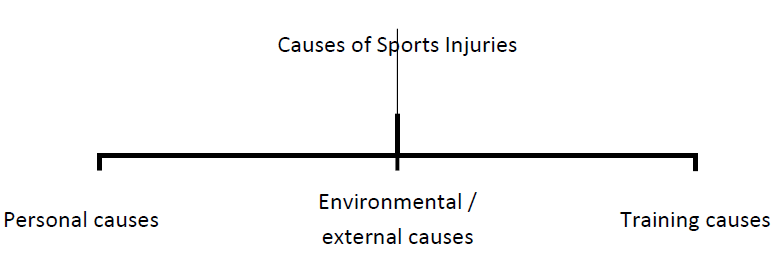
Personal causes:
  • Improper warm up– and cool- down.
  • Not following the rules and regulation.
  • Protective clothing and equipment.
  • Knowing the limits.
  • Improper rest and relaxation.
  • Healing previous injury or inadequate rehabilitation.
  • Lack of conditioning.
  • Drug abuse.
Environmental/external causes:
  • Improper ground or poorly maintained facilities.
  • Extreme cold or heat.
  • Inadequate first– aid care.
  • Expectation of spectators.
  • ack of medical check- up.
  • Improper diet.
Training causes:
  • Without considering individual differences.
  • Lack of proper supervision.
  • Wrong method of training/poor coaching.
  • Lack of Systematic and scientific training.
  • Lack of psychological preparation.
  • Improper load and recovery.
Prevention of Sports Injuries:
  • Overall conditioning.
  • Pre participation physical examination/medical check-up.
  • Coaching under expert trainer/physio/coach.
  • Stress on proper physical fitness.
  • Balance diet.
  • Acclimatization with environment/coaching according to climatic conditions.
  • Training according to periodisation.
  • Intake of sufficient fluid.
  • Adequate clothing and equipments.
  • Standardized play field/court.
  • Documentation of injuries.
  • Knowledge of First aid.
  • Protective sport gears.
View full question & answer
Question 64 Marks
What do you understand by fracture? How can fractures be classified? Explain.
Answer
Fracture: Broken or cracked bone is known as Fracture. It is a very common injury in games and sports.
Classification of Fracture:
  1. Simple Fracture.
  2. Compound Fracture.
  3. Green stick Fracture.
  4. Impacted Fracture.
  5. Communicated Fracture.
  6. Stress Fracture.
  7. Complicated Fracture.
  8. Transverse Fracture.
  9. Oblique Fracture.
View full question & answer
Question 74 Marks
What are the effects of exercise on Respiration System? Write in detail.
Answer
Effects of exercise on respiratory system:
  1. Strengthens will power to push beyond the capacity of regular training.
  2. Decreases rate of respiration during exercise and at rest.
  3. Strengthen muscles of Diaphragm and chest.
  4. Increase in Tidal capacity.
  5. Activates unused Alveoli since more oxygen is required for endurance activities.
  6. Avoid second wind.
  7. Efficient Gaseous exchange.
  8. Increase in residual air volume.
  9. Increase in size of lungs and chest.
  10. Increase in vital air capacity.
  11. Increase in endurance.
  12. Exhale and inhale in fast pace prevents accumulation of waste in lungs and prevents lungs diseases.
View full question & answer
Question 84 Marks
What do you mean by joint injuries? Discuss various types of dislocations.
Answer
Joints are the places in the body where different parts of your skeleton come together. Joint injuries occur at these intersections.
There are the following types of dislocations:
  1. Dislocation of Lower Jaw: Generally, it occurs when the chin strikes any other object forcefully. It may also occur if mouth is opened wide.
  2. Dislocation of Shoulder Joint: Dislocation of shoulder joint may occur due to sudden jerk or a fall on hard surface. The end of the humerus comes out from the socket.
  3. Dislocation of Hip Joint: Putting maximum strength spontaneously may cause dislocation of hip joint. The end of the femur is displaced from the socket.
  4. Dislocation of Wrish: A sportsperson who participates in a sport or game in which he may fall, runs the risk of getting a dislocated wrist. A miscalculated landing can also cause a dislocated wrist.
View full question & answer
Question 94 Marks
Discuss the concept of sports medicine.
Answer
Sports medicine is related to such human problems which usually arise during training and competition in sports and games. The main objective of sports medicine is not only related to the world-Ievel performance but also to the adjustment of appropriate environment and the health of sportspersons. Sports medicine is a branch of medical science in which various sub-disciplines are included such as preventive sports medicine' physiology of exercise, therapeutic exercise, clinical medicine, athletic medicine, etc.
Indeed, sports medicine is related to the medical science which deals with the treatment and preventive care of athlete. A sports medicine team, especially, includes physicians, surgeons, athletic trainers, physical therapists, coaches, other athletes, etc. Usually, sports medicine refers to treating, preventing and diagnosing sports injuries of players who get injured while playing sports. It provides quick recovery from injuries. The following definitions may provide a clear meaning of sports medicine.
View full question & answer
Question 104 Marks
What do you mean by joint injuries? Enumerate the types of dislocations of joints.
Answer
Joints are the places in the body where different parts of your skeleton come together. Joint injuries occur at these intersections.
There are the following types of dislocations:
  1. Dislocation of Lower Jaw: Generally, it occurs when the chin strikes any other object forcefully. It may also occur if mouth is opened wide.
  2. Dislocation of Shoulder Joint: Dislocation of shoulder joint may occur due to sudden jerk or a fall on hard surface. The end of the humerus comes out from the socket.
  3. Dislocation of Hip Joint: Putting maximum strength spontaneously may cause dislocation of hip joint. The end of the femur is displaced from the socket.
  4. Dislocation of Wrist: A sportsperson who participates in a sport or game in which he may fall, runs the risk of getting a dislocated wrist. A miscalculated landing can also cause a dislocated wrist.
View full question & answer
Question 114 Marks
What do you mean by joint injuries? Discuss the types and preventive measures of joint injuries.
Answer
Joints are the places in the body where different parts of your skeleton come together. Joint injuries occur at these intersections.
There are the following types of dislocations.
  1. Dislocation of Lower Jaw: Generally, it occurs when the chin strikes any other object forcefully. It may also occur if mouth is opened wide.
  2. Dislocation of Shoulder Joint: Dislocation of shoulder joint may occur due to sudden jerk or a fall on hard surface. The end of the humerus comes out from the socket.
  3. Dislocation of Hip Joint: Putting maximum strength spontaneously may cause dislocation of hip joint. The end of the femur is displaced from the socket.
  4. Dislocation of Wrist: A sportsperson who participates in a sport or game in which he may fall, runs the risk of getting a dislocated wrist. A miscalculated landing can also cause a dislocated wrist.
View full question & answer
Question 124 Marks
What is incision? Discuss its management in brief.
Answer
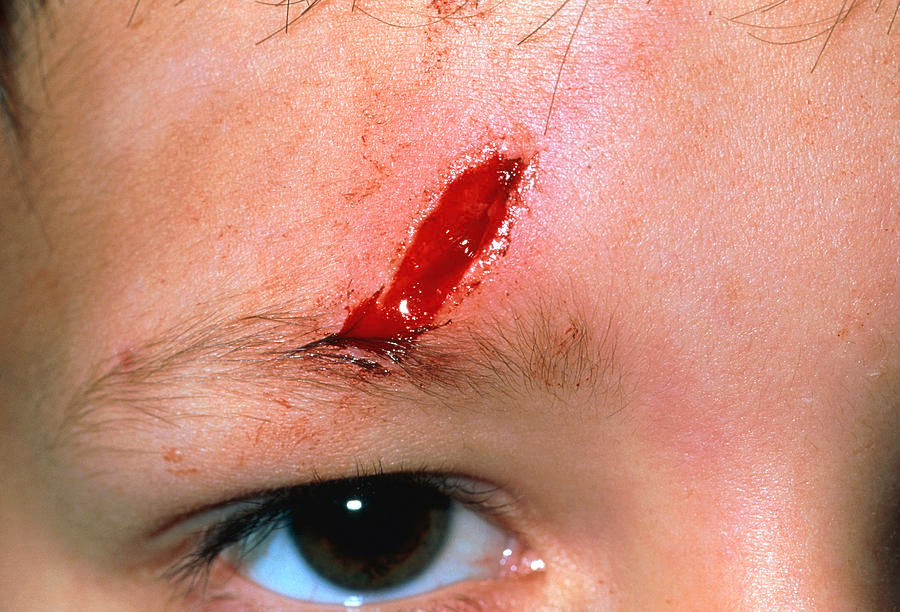
Incision: Incision may also occur due to sharp-edged objects of sports equipment or spikes, etc. Sometimes, arteries or veins may be cut. Blood usually comes out freely from incisions.
Management of Incision: If the wound is not deep, let the blood come out. In this process, germs also come out with the blood. Such wounds should be cleaned with iodine tincture or spirit. Then, after placing a piece of cotton on the wound, a bandage should be applied. In such process, dirt should not enter into the wound. In case of excessive bleeding, the bandage should be kept tight. If the wound is too deep, a doctor should be consulted immediately.
View full question & answer
Question 134 Marks
What do you mean by oblique fracture? Briefly mention its management.
Answer
Oblique Bone Fracture: An oblique bone fracture occurs when the bone is broken diagonally to the axis of the bone. Mostly these fractures occur at the humerus or femur bones, i.e., in long bones of our body.
Management of Oblique Bone Fracture: The method of treatment of oblique bone fracture usually depends on the amount of damage to the bone. If the damage is minimum, a plaster cast may be used to treat the fracture. However, in most of the oblique fractures surgical treatment is required. If the damage is extensive, metal rods and screws are used to hold the bone in place.
View full question & answer
Question 144 Marks
Explain about any three causes of sports injuries.
Answer
There are various causes of sports injuries which are described below.
Improper Conditioning: For better performance in sports, it is necessary to do proper conditioning. If proper conditioning is not done, there may be maximum chances of acquiring injuries. Without proper conditioning, it is but natural to get injured in sports.
Improper Warming-up: Due to improper warming-up, an athlete or sportsperson may get injured during training or competition. In fact, he/ she should be properly warmed-up to avoid injuries.
Unscientific way of Training: There are maximum chances of occurrence of sports injury to the athlete/ player who performs training in an unscientific way. It means an athlete should have proper knowledge about training. He should have knowledge about overtraining and undertraining. Due to ignorance of scientific laws, sportspersons may be easily injured.
View full question & answer
Question 154 Marks
What is greenstick fracture? Elucidate its management.
Answer
Greenstick Fracture: A greenstick fracture is that fracture when a bone bends and cracks instead of breaking completely into separate pieces. This type of fracture usually occurs in children because their bones are soft and more flexible than the adults.
Management of Greenstick Fracture: Most of these fractures involve arms and legs which require immobilization to make the bone grow back together in proper or natural position. A removable splint is the most recommended one among children. The swelling that occurred on the site of the fracture may be reduced with anti-inflammatory drugs. Pain can be relieved by taking pain relievers. Generally, it takes eight weeks for complete bone healing. High impact activities should be avoided in the beginning.
View full question & answer
Question 164 Marks
What is transverse fracture? How will you manage transverse fracture?
Answer
Transverse Fracture: It is a break in one of the bones of the spine or a part of it. It is shaped like a wing. Most probably, these injuries occur in the thoracic spine (the upper and middle parts of the vertebra and lumbar region)/ low back area.
Management of Transverse Fracture: If the injury is limited to a break of a transverse process with no other injury, hospital care is not necessary. Medication for pain control should be given. Limit the various activities. In intricate or multiple fractures of backbone (spine) there can be damage to spinal cord and may require operation. There can be pain and stiffness in the back for some weeks after transverse fracture. Complete rest should be given to the person. After that the affected person should not join in any activity. Neck and back braces may also be helpful in reducing pain and increasing mobility. Exercise should be done to improve motion and to strengthen back.
View full question & answer
Question 174 Marks
What is stress fracture? Mention its management.
Answer
Stress Fracture: A stress fracture is a crack in a bone. It can be common injury in high impact sports such as long distance races or basketball, etc. Such types of fractures can be very painful. However, these fractures usually heal themselves if proper rest is taken for appropriate duration which may be up to two months. Usually, these fractures occur in leg bones.
Management of Stress Fracture:
  1. First of all elevate the extremity and rest while the bone heals itself.
  2. Apply ice to the affected area for 24 to 48 hours.
  3. If pain persists, give some painkillers.
  4. If there is any need of immobilization of the affected area, use a splint.
  5. When swelling is reduced, start putting partial weight on the affected area. Crutches or walking stick may be used in the beginning. After two weeks start putting normal weight.
  6. For 6 to 8 weeks, avoid the activity that caused stress fracture. Then start doing the activity slowly.
View full question & answer
Question 184 Marks
Discuss the causes and prevention of fractures.
Answer
Causes of a Fracture: Fracture usually occurs due to a high impact on the bone. It can be caused by overuse. The most common causes of fracture are given below.
  1. In sports events where there is a high impact.
  2. Traumatic, forceful and unnatural movements.
  3. Prolonged long distance walking or running.
  4. Sudden fall on hard surface.
  5. Direct strike or hit with any solid sports equipment.
  6. Osteoporosis.
Prevention:
  1. Players should perform adequate warm-up before participating in sports and games. All the parts of body should be exercised well.
  2. Proper conditioning must be done in the preparatory phase.
  3. Players should not continue to play during the state of fatigue.
  4. Good offrciating quality of official is essential for preventing fractures.
  5. Players should be very careful and alert during practice and competition.
  6. Sports equipment should be of good quality.
  7. Scientific knowledge is essential for maintaining bone health and preventing fractures.
  8. Protective equipment according to the requirement of game/ sport should be used.
  9. Balanced diet should be taken because deficiency of calcium and vitamin D may weaken the bones. Bone density may also decrease.
  10. Training and competition areas should be clear of hazards.
View full question & answer
Question 194 Marks
Discuss the objectives of first aid in brief.
Answer
Objectives of First Aid: The following are the objectives of first aid.
  1. To Preserve Life: To preserve or to save the life of the victim or wounded person is the significant objective of first aid. However, there are limitations of first aid but even then every possible effort is done to save the life of a wounded person or victim with the help of first aid.
  2. To Alleviate Pain and suffering: The second important objective of first aid is to alleviate pain and suffering of the victim or wounded person. Pain is natural in any type of accident. Pain becomes unbearable in case of fracture or dislocation of joint during accident. So, it is a major objective to reduce such unbearable pain.
  3. To Prevent the Condition from Worsening: Till the wounded person or victim does not get the help of a doctor, to prevent the condition from worsening becomes the major objective of first aid. According to this objective, the victim's condition should not be worsened. Generally, when first aid is provided, the wounded or victim's condition does not worsen while being taken to the doctor for treatment.
  4. To Promote Recovery: The main objective of first aid is to start the process of recovery as early as possible. Sometimes, the treatment of injury is also included in this objective.
  5. To Procure Early Medical Aid: To procure early medical aid is one of the most important objectives of first aid. In fact, there may be certain situations where there is a dire need for medical assistance. However, the first aider should pay attention to provide first aid to the victim or wounded person but efforts should also be made to seek medical aid as early as possible.
View full question & answer
Question 204 Marks
What do you mean by laceration? How can you manage laceration?
Answer
Laceration: A laceration is an irregular cut in the skin from a sharp object or sharp edged sports equipment. These wounds are more dangerous than incised wounds. Such wounds are not smooth. Bleeding is less from such wounds. These wounds may be very poisonous. Usually rough marks remain even after the treatment.

Management of Laceration:
  1. First of all you should control bleeding before anything else. To stop bleeding put pressure directly on the laceration while holding it above the level of heart for 15 minutes. If you are unable to stop bleeding try to use pressure points.
  2. Once bleeding has stopped, wash the laceration with warm water and mild soap. If bleeding starts again repeat step one.
  3. Assess and see if the laceration requires stitches. If the affected person requires stitches, take him/her to the doctor.
  4. For simple lacerations which do not require stitches, use antiseptic ointment.
  5. Cover the laceration with sterile gauze and wrap with roller gauze. Clean the laceration whenever you change the dressing.
  6. Watch the infection and change the dressing regularly.
  7. Take painkiller if pain persists.
View full question & answer
Question 214 Marks
What is abrasion? Discuss its management in brief.
Answer
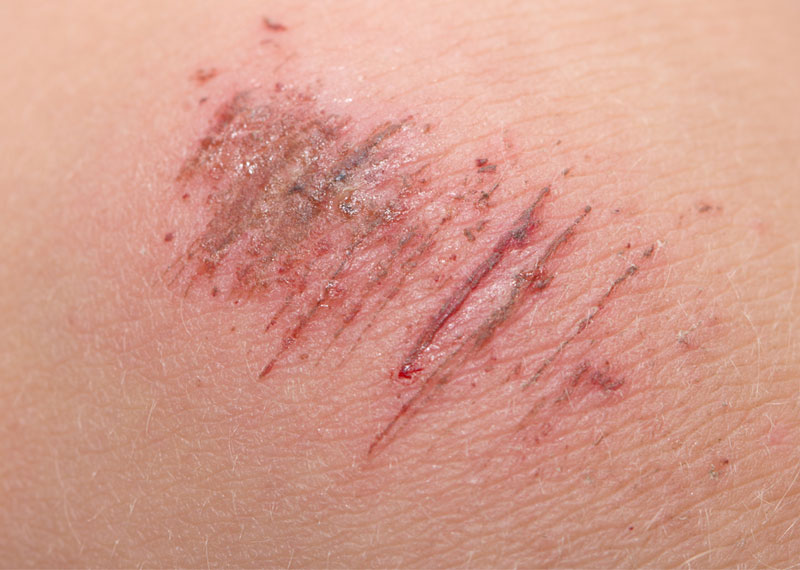
Abrasion: Abrasion is a skin injury. Abrasion usually occurs due to friction with certain equipment or a fall over the area where the bone is very close to the skin. It occurs at the upper part of the skin.

Management of Abrasion:
  1. First of all, clean the affected part with freshwater. Pick out the dead tissue, gravel and debris that might be sticking to the area of abrasion.
  2. Use clean as well as sterile gauze to wipe the dirt from the affected part. Do it very gently so that the abrasion does not hurt much. Then, dry the affected area with a clean piece of gauze.
  3. After that apply medicinal ointment so that proliferation of bacteria does not take place. Use enough ointment so that it does not stick to the abrasion. Use a big piece of gauze for dressing.
  4. Then, visit a doctor for proper dressing and tetanus injection which is required to prevent the wound from causing an infection.
  5. The dressing should be changed as per the instructions of the doctor.
View full question & answer
Question 224 Marks
Discuss the concept and definition of sports medicine.
Answer
Sports medicine is a branch of medical science that deals with the treatment of injuries related to sports and games.
Sports medicine is related to such human problems which usually arise during training and competition in sports and games. The main objective of sports medicine is not only related to the world-Ievel performance but also to the adjustment of appropriate environment and the health of sportspersons. Sports medicine is a branch of medical science in which various sub-disciplines are included such as preventive sports medicine' physiology of exercise, therapeutic exercise, clinical medicine, athletic medicine, etc.
Indeed, sports medicine is related to the medical science which deals with the treatment and preventive care of athlete. A sports medicine team, especially, includes physicians, surgeons, athletic trainers, physical therapists, coaches, other athletes, etc. Usually, sports medicine refers to treating, preventing and diagnosing sports injuries of players who get injured while playing sports. It provides quick recovery from injuries. The following definitions may provide a clear meaning of sports medicine.
View full question & answer
Question 234 Marks
What are the aims of sports medicine? Describe any three aims in brief.
Answer
There are following aims of sports medicines are:
  1. To Provide Information to Athletes (Sportspersons) About Sports Injuries. To provide knowledge about injuries to sportspersons is the foremost aim of sports medicine. Generally, sportspersons do not have complete information or knowledge about injuries which usually occur during training or competition. The type of injury is usually different in all sports. So, a sportsperson should have a proper knowledge about the concerned injuries of the game in which he/ she is taking part. A coach is expected to provide such information or knowledge to the athletes.
  2. To Provide Knowledge About the Causes of Injuries. It is a well-known fact that each injury has a specific cause. Another aim of sports medicine is to provide knowledge about the causes of injuries. There may be various causes of injuries such as improper conditioning, faulty techniques, improper warming-up, environmental factors, improper fitness, etc.
  3. To Provide Means or Treatment of Sports Injuries and Rehabilitation. Yet another significant aim of sports medicine is to provide means of treatment of sports injuries and rehabilitation. After providing first aid to the injured sportsperson, the specialist of sports medicine must be informed of providing treatment to the injured athlete. For rehabilitation, various medical treatments such as hydrotherapy, electro therapy, infrared rays may be used.
View full question & answer
Question 244 Marks
Define sports medicine. Elucidate the scope of sports medicine in details.
Answer
Sports medicine is a branch of medical science that deals with the treatment of injuries related to sports and games. It helps in preventing, diagnosing and treating sports injuries. It lays stress on improving sports performance of athletes.
Scope of Sports Medicine:
In the field of physical education and sports, various sub-disciplines of sports medicine are employed. On the basis of their study and research, different problems faced by sportspersons EIre solved or tackled. Without knowing in depth the scope of sports medicine, it is difficult as well as complex to take a sportsperson's performance to its highest point. That is why at graduation and post graduation levels the various sub-disciplines of sports medicine are included. These sub-disciplines are included not only theoretically but practically also. There are following scope of sports medicine.
  1. Human anatomy and physiolory.
  2. Sports and first aid.
  3. Prevention of accidents in sports and games.
  4. Sports injury rehabilitation.
  5. Females and sports.
  6. Study of optimal load for different age groups.
  7. Scientific promotion of sports and games.
  8. Fitness for games and sports.
  9. Illness caused by environmental, physiological and psychological disturbance.
  10. Athletic nutrition.
  11. New methods of detecting doping as well as use and abuse of drugs.
  12. Preventive and curative exercises.
  13. Sports and traumatology.
  14. Physiotherapy.
View full question & answer
4 Marks Question - Physical Education STD 12 Commerce Questions - Vidyadip