Questions

5 Marks Question

🎯

Test yourself on this topic

9 questions · timed · auto-graded

Question 15 Marks
What do you mean by coordinative abilities? Mention any four types of coordinative abilities.
Answer
"coordinative abilities" is used in place of agility. Mainly coordinative abilities depend on the central nervous system. The coordinative abilities are those abilities of an individual which enable the individual to do various related activities properly as well as efficiently.
Types:
  1. Differentiation Ability: Differentiation ability is the ability to achieve a high degree of accuracy and economy of separate body movements and movement phases in a motor action. The high level of this ability depends on experienced movement and the degree of mastery over motor action.
  2. Orientation Ability: It is the ability to determine the position of the body and its parts in time and space in relation to gravity, moving objects like ball, opponent, partner, playing field, etc. This ability depends on functional capacity of sensory organs like eyes, kinesthetic sense organs, etc.
  3. Coupling Ability: Coupling ability is the ability to combine the movements of different body parts for performing perfect sports movements. This ability is very significant for approximately all sports but specially in team games, gymnastics and combative sports (boxing, wrestling, etc.). For example, in boxing, the movements of hands, head, trunk and feet are essential to couple to achieve a certain goal.
  4. Reaction Ability: Reaction ability is the ability to react immediately or quickly and effectively to a signal. Generally, there are two types of reaction ability such as simple reaction ability and complex reaction ability.
View full question & answer
Question 25 Marks
What do you mean by flexibility? Elaborate the methods of improving flexibility.
Answer
Flexibility can be defined as the ability to execute movements with greater amplitude or range. It is affected by muscle length, joint structure tendons, Iigaments, and other factors.Flexibility can be improved or developed effectively with the help of following methods:
  1. Ballistic Method: In ballistic method, the movement is performed with a swing in a rhythmic way. The related joint is stretched with a swing.
  2. 'Static Stretching Method: Static stretching method involves gradually easing into the stretch position and holding the position. The amount of time a static stretch is held depends on one's purpose.
  3. Dynamic Stretching Method: Dynamic stretching consists of controlled leg and arm swings that take you gently to the limit of your range of motion.
  4. Proprioceptive Neuro-Muscular Facilitation Technique: This technique or method is used by advanced sportspersons for gaining flexibility. The following procedure is used for PNF technique.
  • You move into the stretch position so that you may feel the stretch sensation.
  • Your partner holds the limb in this stretched position.
  • You then push against your partner by contracting the antagonistic muscles for 6 to 10 seconds and then relax. During the contraction, your partner aims to resist any movement of the limb.
  • Your partner then moves the limb further into the stretch until you feel the stretch sensation.
  • Then again go back to no. 2 to repeat the same procedure. Repeat the whole procedure for 3 to 4 times.
View full question & answer
Question 35 Marks
Define circuit training. Discuss the main characteristics and advantages of circuit training.
Answer
"Circuit training is the training method in which certain exercies of various kinds are performed with or without apparatus, with given dosage.
Main Characteristics of Circuit Training Method:
  1. Exercises are simple to learn and simple to execute.
  2. Exercises are performed with medium resistance or with medium weight.
  3. Number of repetitions is more.
  4. Its aim is to develop endurance and strength.
  5. It involves exercises of whole body parts.
  6. It is given to sportspersons in the preparatory period for developing basic endurance and strength.
  7. Training must be performed under gradually increasing strain.
Advantages of Circuit Training:
  1. Circuit training can be performed indoors or outdoors. In rainy season, this training can be done in rooms.
  2. The equipment for exercises can be provided easily.
  3. It is easy to learn. A trainee can learn to train himself.
  4. Trainee is able to gain good result in a short period.
  5. It is an interesting method of training.
  6. It does not require long duration to perform exercises.
  7. A number of athletes can do circuit training according to the stations at the same time.
  8. The coach can easily watch and supervise the training.
  9. Amount of training can be increased or decreased according to the ability of trainees.
  10. AII body parts can be exercised.
View full question & answer
Question 45 Marks
Define strength and discuss the methods of improving strength in detail.
Answer
Strength can also be defined as the amount of force a muscle or muscle group can exert. Strength of the body can be measured in pounds or dynes. A certain level of strength is essential for a common man whereas, for a sportsman it is the most essential component.
Methods of Improving Strength:
  1. Isometric Exercises: Isometric exercises are those exercises, which are not visible. In fact, there are no direct movements, hence they cannot be observed. In these exercises, work is performed but it is not seen directly. In these exercises, a group of muscles are stretched more than the other group of muscles. When these exercises are done, muscles do not change their length. They remain fixed or constant although muscles do not remain constant or still completely. Muscles
  2. Isotonic Exercises: Isotonic exercises are those exercises in which movements can be seen directly. Work is done in these exercises. Isotonic exercises tone up the muscles. Muscles become flexible. Length of the muscles can be increased. by isotonic exercises. These exercises are of much value in the field of sports. These are the best for strength development. Calisthenics exercises, running and jumping on the spot, weight training exercises, exercises with medicine ball are the best examples of isotonic exercises. These exercises can be done with or without technical equipment.
  3. Isokinetic Exercises: Isokinetic exercises are performed on specially designed machines. These exercises were developed by Pemine in 1968. These exercises involve a specific type of muscle contraction, which is usually not applicable in sports and games except in water-sports such as rowing and swimming. In isotonic exercises, contraction of muscle applies maximum force only at a particular angle during a range of movement, whereas, in isokinetic exercises contraction of muscle applies maximum force throughout the complete range of movement.
View full question & answer
Question 55 Marks
Elucidate the importance of circuit training in detail.
Answer
Importance of Circuit Training:
  1. Maximum Results in Minimum Time: Circuit training is a perfect workout for the individuals who have very busy schedule. In the training, you can set up as many as few stations as you like and then continue through the circuit until your time runs out.
  2. Ideal for Beginners: Circuit training is ideal for beginners. It conditions the entire body and prepares you for advanced fitness programmes. It is easy to learn. A beginner can learn to train himself.
  3. Convenient: It is convenient for each individual because you can do complete workout in very short periods. You can design it with little or no exercise equipment. It can be performed indoors and outdoors. Even in rainy season, it can be done in rooms.
  4. All the Body Parts Can be Exercised: With the help of circuit training all the body parts can be exercised. It fact, at various stations different types of exercises can be arranged. Minor as well as major muscles of our body can be involved in these exercises.
  5. Amount of Training can be Changed: The amount of training can be increased or decreased according to the ability of trainees.
  6. No Feeling of Boredom: The trainees do not feel any boredom while doing this training. As a matter of fact, there are different exercises at different stations so there is no feeling of boredom. All the trainees feel fresh and energetic at every training session. The variety of exercises helps in keeping you interested and motivated.
  7. Burns Extra Calories: By doing circuit training regularly extra calories can be burnt easily and the extra body weight can be controlled.
View full question & answer
Question 65 Marks
Suggest various methods for flexibility training to improve the optimum flexibility.
Answer
Methods to Improve Flexibility
Flexibility can be improved or developed effectively with the help of following methods.
  1. Ballistic Method: In ballistic method, the movement is performed with a swing in a rhythmic way. The related joint is stretched with a swing. The stretching exercise can be performed rhythmically with a count.
  2. Static Stretching Method: Static stretching method involves gradually easing into the stretch position and holding the position. The amount of time a static stretch is held depends on one's purpose.
  3. Dynamic Stretching Method: Dynamic stretching consists of controlled leg and arm swings that take you gently to the limit of your range of motion. If an event requires a dynamic movement, it is appropriate to conduct dynamic stretching exercises. Start with the movement at half speed for a couple of repetitions and then gradually work up to full speed.
  4. Proprioceptive Neuro-Muscular Facilitation Technique: This technique or method is used by advanced sportspersons for gaining flexibility. The following procedure is used for PNF technique.
  • You move into the stretch position so that you may feel the stretch sensation.
  • Your partner holds the limb in this stretched position.
  • You then push against your partner by contracting the antagonistic muscles for 6 to 10 seconds and then relax. During the contraction, your partner aims to resist any movement of the limb.
  • Your partner then moves the limb further into the stretch until you feel the stretch sensation.
  • Then again go back to no.2 to repeat the same procedure. Repeat the whole procedure for 3 to 4 times.
View full question & answer
Question 75 Marks
Define speed and discuss the types of speed in detail.
Answer
Speed plays a vital role almost in every game and sport.
  1. Reaction Ability: Reaction ability is the ability to react effectively and quickly to any action or signal. Reaction ability can be classified into simple reaction ability and complex reaction ability.
  • Simple Reaction Ability:
  • Complex Reaction Ability:
  1. Acceleration Ability: It is the ability to achieve maximum speed from a stationary position or from low speed state. Generally, sprinters achieve their maximum speed after approximately six seconds. This ability mainly depends upon explosive strength, technique and flexibility. This ability is important in all games and sports in which maximum speeds are to be achieved quickly such as sprint races, swimming (short distance), hockey, football, gymnastics, etc.
  2. Movement Speed: It is the ability to do a movement in a minimum time. It depends upon technique, explosive strength, flexibility and coordinative abilities. It plays a vital role in boxing, wrestling, throws, jumps, gymnastics, turns in swimming and in sprinting starts. It can be measured by the time taken to complete the movement.
  3. Locomotor Ability: It is the ability to maintain maximum speed for maximum time or distance. This ability is significant in only a few sports events such as 100m, 200m, 400m races, short sprints in track cycling, speed skating, swimming, hockey, football, etc.
  4. Speed Endurance: Speed endurance is the ability to perform movements with high speed under conditions of fatigue. Speed endurance is a complicated ability which depends upon explosive strength, speed and endurance. It also depends upon technique, local muscular endurance and lactic acid tolerance ability.
View full question & answer
Question 85 Marks
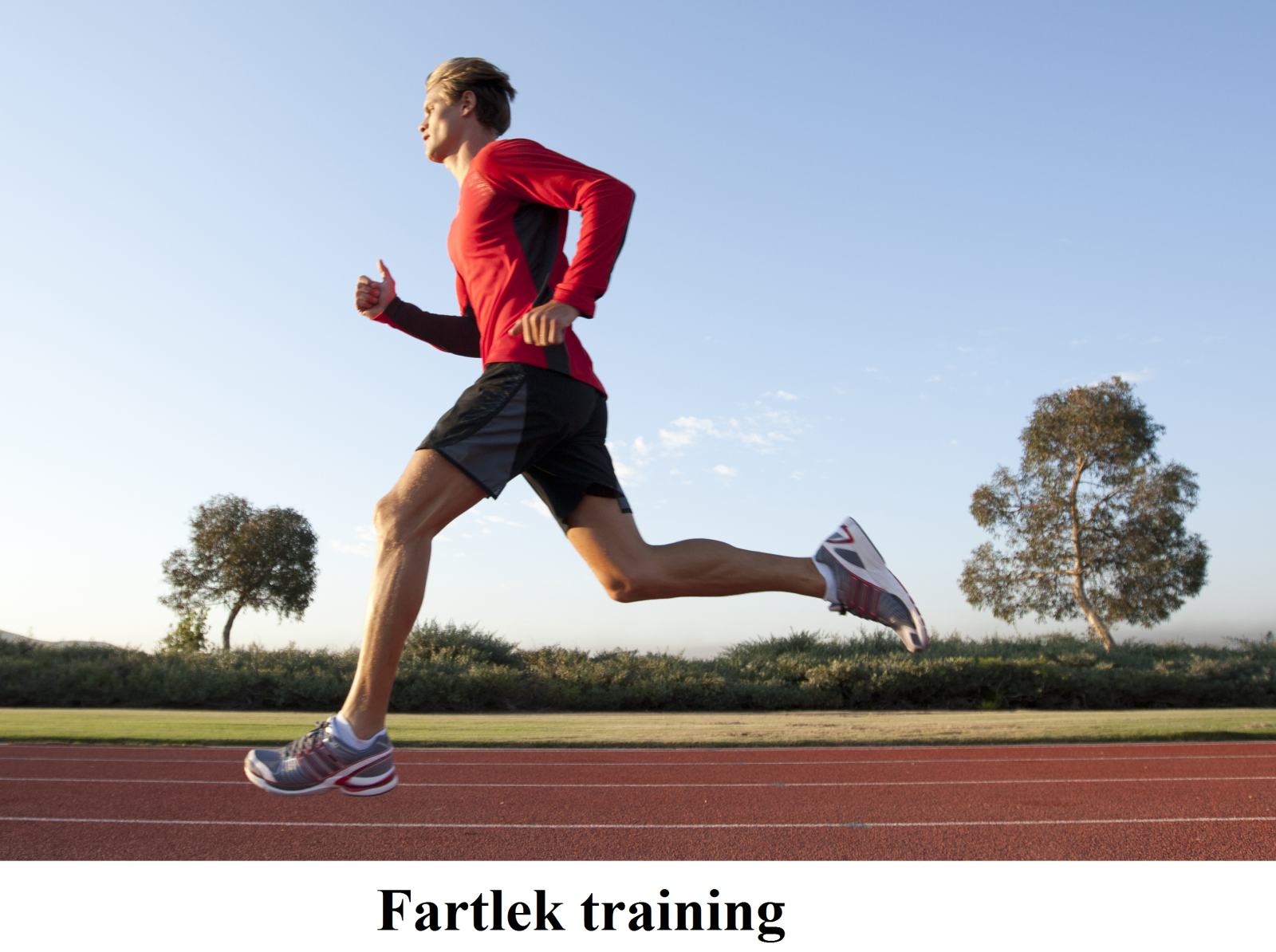
Discuss fartlek training method as a means of developing endurance.
Answer
Fartlek training method is used for developing endurance. Gosta Holmer developed Fartlek training in 1937. The word 'fartlek' is a Swedish word means 'speed play'. It is such a training method that blends continuous training with interval training. This training method lays emphasis on both aerobic and anaerobic systems. In this method, pace or speed is not pre-planned and thus it is left to the discretion of individual.
View full question & answer
Question 95 Marks
Write a detailed note on circuit training.
Answer
"Circuit training is the training method in which certain exercies of various kinds are performed with or without apparatus, with given dosage
Types of Circuit Training:
The main types of circuit training.
  1. Timed Circuit Training: In this type of training, the duration of rest and workout remains fixed.
  2. Competition Circuit Training: This type of training is approximately the same as timed circuit training but in this training emphasis is on the number of repetitions you make in 30 seconds.
  3. Repetition Circuit Training: Repetition circuit training is appropriate for those sportspersons who have different levels of physical fitness.
  4. Sports Specific or Bunning Circuit Training: Such type of training can be done in a track of 200m or 400m. In this training, exercises are selected from any specific sports.
  5. Main Characteristics of Circuit Training Method:
  • Exercises are simple to learn and simple to execute.
  • Exercises are performed with medium resistance or with medium weight.
  • Number of repetitions is more.
  1. Some Examples of Circuit Training Exercises:
  • Running on the spot.
  • Throwing medicine baII and catching it again 15 to 20 times.
  • Splits squat jumps 75 to 20 times.
  1. How to Increase the Load in Circuit Training:
Following points are important to increase the load in circuit training.
  • Number of repetitions can be increased per exercise.
  • Frequency can be increased.
  • Additional load can be increased.
  1. Advantages of Circuit Training:
  • Circuit training can be performed indoors or outdoors. In rainy season, this training can be done in rooms.
  • The equipment for exercises can be provided easily.
  • It is easy to learn. A trainee can learn to train himself.
  1. Disadvantages of Circuit Training:
  • It usually requires advance planning and lot of time and space, which can be a problem in a normal Gym.
  • It is effective for improving muscular endurance but it may have limited use in improving strength and power.
  • It can be highly fatiguing specially for the beginners. However, it can be helpful by using an effective work-rest ratio of at least 1 : 1.
Importance of Circuit Training:
  1. Burns Extra Calories: By doing circuit training regularly extra calories can be burnt easily and the extra body weight can be controlled.
  2. Amount of Training can be Changed: The amount of training can be increased or decreased according to the ability of trainees. Amount of Training can be Changed. The amount of training can be increased or decreased according to the ability of trainees.
  3. Ideal for Beginners: Circuit training is ideal for beginners. It conditions the entire body and prepares you for advanced fitness programmes. It is easy to learn. A beginner can learn to train himself.
View full question & answer
5 Marks Question - Physical Education STD 12 Commerce Questions - Vidyadip