Questions

3 Marks Each

🎯

Test yourself on this topic

15 questions · timed · auto-graded

Question 13 Marks
Differentiate between cardinality and degree of a table with the help of an example.
Answer
Cardinality is defined as the number of rows in a table.

Degree is the number of columns in a table.

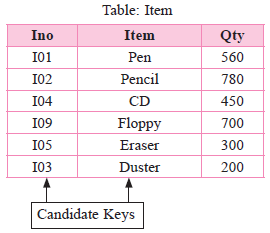
Eg: Consider the following tables:

Supposing Table : Account contains 3 rows and 2 columns.

Cardinality of Account table is : 3

Degree of Account table is :2
View full question & answer
Question 23 Marks
Observe the following table and answer the parts (i) and (ii) accordingly

Table: Product

Pno Name Qty PurchaseDate
101 Pen 102 12-12-2011
102 Pencil 201 21-02-2013
103 Eraser 90 09-08-2010
109 Sharpener 90 31-08-2012
113 Clips 900 12-12-2011

(a) Write the names of most appropriate columns, which can be considered as candidate keys.

(b) What is the degree and cardinality of the above table?

Answer
Candidate Key: Pno, Name

Degree:4

Cardinality:5

View full question & answer
Question 33 Marks
What are candidate keys in a table? Give a suitable example of candidate keys in a table.
Answer
A table may have more than one such attribute/group of attribute that identifies a tuple uniquely, all such attribute(s) are known as Candidate Keys.

View full question & answer
Question 43 Marks

Differentiate between DDL &DMLcommands. Identify DDL &DML commands from the following:

(UPDATE, SELECT, ALTER, DROP)

Answer
 

DDL stands for Data Definition language and comprises of commands which will change the structure of database object.

DML stands for Data Manipulation Language and comprises of commands which are used to insert, edit, view &delete the data stored in a database object.

DDL Commands are: ALTER, DROP

DML Commands are: UPDATE, SELECT

View full question & answer
Question 53 Marks
Differentiate between Candidate Key and Alternate Key in context of RDBMS.
Answer
Candidate Key: It is the one that is capable of becoming primary key i.e.,a column or set of columns that identifies a row uniquely in the relation.

Alternate Key: A candidate key that is not selected as a primary key is called an Alternate Key.

View full question & answer
Question 63 Marks
Write SQL queries for (a) to (d) and find outputs for SQL queries (e) to (i), which are based on the tables.

TABLE: WATCHES

Watchid Watch_name Price Type Qty_store
W001 High time 10000 Unisex 100
W002 Life time 15000 Ladies 150
W003 Wave 20000 Gents 200
W004 High fashion 7000 Unisex 250
W005 Golden time 25000 Gents 100

TABLE: SALE

Watchid Qty_Sold Quarter
W001 10 1
W003 5 1
W002 20 2
W003 10 2
W001 15 3
W002 20 3
W005 10 3
W003 15 4

(a) To display all the details of those watches whose name ends with ‘time’

(b) To display watch’s name andprice of those watches which have price range between 5000-15000

(c) To display total quantity in store of unisex type watches

(d) To display watch name and their quantity sold in first quarter

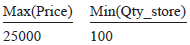
(e) Select max(price),min(qty_store) from watches;

(f) Select quarter, sum(qty_sold) from sale group by quarter;

(g) Select watch_name,price,type from watches w, sale s where w.watchid=s.watchid;

(h) Select watch_name, qty_store, sum(qty_sold),qty_store

(i) W.watch=s.watchid group by s.watchid;

Answer
(a) select * from watches where watch_name like ‘%TIME’;

(b) select Watch_name, Price from Watches where price between 5000 and 15000;

OR

Select Watch_name, Price from Watches where Price>=5000 and Price<=15000;

(c) Select sum(Price) from Watches where Type=’UNISEX’;

(d) Select Watch_name, Qty_sold from Watches, Sale where Watches. Watchid = Sale. Watchid and Quarter = 1;

(e)

(f)

quarter sum(qty_sold)
1 15
2 30
3 45
4 15

watch_name price type
HighFashion 7000 Unisex

watch_name qty_store qty_sold Stock
HighTime 100 25 75
LifeTime 150 40 110
Wave 200 30 170
GoldenTime 100 10 900
View full question & answer
Question 73 Marks
Write SQL queries for (i) to (iv) and find outputs for SQL queries (v) to (vii), which are based on the tables.

Table: Trainer

TID Tname City HireDate Salary
101 Sunaina Mumbai 1998-10-15 90000
102 Anamika Delhi 1994-12-24 80000
103 Deepti Chandigarh 2001-12-21 82000
104 Meenakshi Delhi 2002-12-25 78000
105 Richa Mumbai 1996-01-12 95000
106 Maniprabha Chennai 2001-12-12 69000

Table: Course

CID CNAME FEES STARTDATE TID
C201 AGDCA 12000 2018-07-02 101
C202 ADCA 15000 2018-07-15 103
C203 DCA 10000 2018-10-01 102
C203 DDTP 9000 2018-09-15 104
C205 DHN 20000 2018-08-01 101
C206 O LEVEL 18000 2018-07-25 105

(a) Display the Trainer Name, City and Salary in descending order of their hire date.

(b) To display the TNAME and CITY of Trainer of joined the institute in the month of December 2001.

(c) To display TNAME, HIREDATE,CNAME, STARTDATE from tables TRAINER and COURSE whose FEES is less than or equal to 10000

(d) To display number of trainer from each city

(e) select tid, tname,from trainer where city not in(‘delhi’,’mumbai’);

(f) select distinct tid from course;

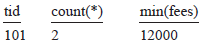
(g) select tid , count (*), min(fees) from course group by tid having count(*)>1;

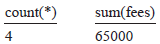
(h) Select count(*),sum(fees) from course where startdate <’2018-09-15’;

Answer
(a) select tname, city, salary from trainer order by hiredate desc;

(b) Select tname, city from trainer where hiredate between ‘2001-12-01’ and ‘2001-12-31’;

OR

Select tname, city from trainer where hiredate >= ‘2001-12-01’ and hiredate<=‘2001-12-31’;

OR

Select tname, city from trainer where hiredate like ‘2001-12%’;

(c) Select tname, hiredate, cname, startdate from trainer, course where trainer.tid=course.tid and fees<=10000;

(d) Select city, count(*) from trainer group by city;

(e) Select tid, tname, from trainer where city not in(‘delhi’, ‘mumbai’);

(f) Distinct tid

101

103

102

104

105

(g)

(h)

View full question & answer
Question 83 Marks
Write SQL queries for (i) to (iv) and find outputs for SQL queries (v) to (viii), which are based on the tables:

TABLE: SALESPERSON

CODE NAME SALARY ITCODE
1001 TANDEEP JHA 60000 I2
1002 YOGRAJ SINHA 70000 I5
1003 TENZIN JACK 45000 I2
1005 ANOKHI RAJ 50000 I7
1004 TARANA SEN 55000 I7

TABLE: ITEM

ITCODE ITEMTYPE TURNOVER
I5 STATIONARY 3400000
I7 HOISTERY 6500000
I2 BAKERY 10090000

(a) To display the CODE and NAME of all salesperson having “I7” item Type Code from the table SALESPERSON.
(b) To display all details from table SALESPERSON in descending order of SALARY.
(c) To display the number of SALESPERSON dealing in each TYPE of ITEM.(Use ITCODE for the same)
(d) To display NAME of all the salesperson table along with their corresponding ITEMTYPE from the ITEM table.
(e) Select max(salary) from salesperson;
(f) Select distinct itcode from salesperson;
(g) select code,name,i.itcode from sales persons, item i where s.itcode=i.itcode and turnover>=7000000;
(h) Select sum (salary)from salesperson where itcode=”i2”;

View full question & answer
Question 93 Marks

Write SOL queries for (i) to (iv) and find outputs for SQL queries (v) to (viii) which are based on the tables.

TABLE : CUSTOMERS

NO CNAME ADDRESS
101 Richa jain Delhi
101 Surbhi Sinha Chennai
103 Lisa Thomas Bangalore
104 Imran Ali Delhi
105 Roshan Singh Chennai

TABLE : TRANSACTION

TRNO CNO AMOUNT TYPE DOT
T001 101 1500 Credit 2017-11-23
T002 103 2000 Debit 2017-05-12
T003 102 3000 Credit 2017-06-10
T004 103 12000 Credit 2017-09-12
T004 101 1000 Debit 2017-09-05

(a) To display details of all transactions of TYPE Credit from Table TRANSACTION.
(b) To display the CNO and AMOUNT of all transactions done in the month September 2017 from the table TRANSACTION.
(c) To display the last date of transaction (DOT) from the table TRANSACTION for the customer having CNO as 103.
(d) To display all CNO,CNAME and DOT (date of transaction) of those CUSTOMERS from tables CUSTOMERS and TRANSACTION who have done transactions more than or equal to 2000.
(e) Select count(*), avg(amount) from transaction where dot>= ‘2017-06-01’;
(f) Select cno, count(*), max (amount) from transaction group by cno having count(*)> 1;
(g) Select cno, cname from customer where address not in (‘Delhi, ‘Bangalore’);
(h) Select distinct cno from transaction;

View full question & answer
Question 103 Marks

Given the following relation: STUDENT

Table: STUDENT

No. Name Age Department Dateofadm Fee Sex
1 Pankaj 24 Computer 10/01/97 120 M
2 Shalini 21 History 24/03/98 200 F
3 Sanjay 22 Hindi 12/12/96 300 M
4 Sudha 25 History 01/07/99 400 F
5 Rakesh 22 Hindi 05/09/97 250 M
6 Shakeel 30 History 27/06/98 300 M
7 Surya 34 Computer 25/02/97 210 M
8 Shikha 23 Hindi 31/07/97 200 F

Write SQL commands for the following queries
(a) To show all information about the students of History department.
(b) To list the names of female students who are in Hindi department.
(c) To list the names of all students with their date of admission in ascending order.
(d) To display student’s name, fee, age for male students only.
(e) To count the number of students with Age>23.

Answer
(a) Select * from student where department = “history”;
(b) Select * from student where department = “hindi” and sex=’f’;
(c) Select * from student order by dateofadm;
(d) Select name, fee, age from student where sex=“m”;
(e) Select count(*) from student age>23;
View full question & answer
Question 113 Marks

Consider the following table Student & Stream.

Table: Student

Admno Sname Class Sec Fee Mobile Area S_ID
1001 RAMESH XII A 2500 987654321 Madipur 10
1078 KRISHNA XII B 2400 999911111 Jawala Heri 30
1006 FARDEEN XII C 2600 987654321 Paschim Puri 40
1004 SUBHAM XII A 2500 963025874 Madipur 20
1029 KRITIKA XI C 2700 987456210 Madipur 30
1008 SAMEEKSHA XII A 2450 987123456 Mangol Puri 20
1025 SALMA XII B 2580 998877445 Madipur 30
1036 AMANDEEP XII B 2600 999333555 Khyala 40
1037 TEJAS XI C 2650 987951357 Paschim Puri 40
1029 HIMANSHU XII A 2750 951369874 Jawala Heri 10

Table : Stream

S_ID Stream_name
10 MEDILCAL
20 NON MEDICAL
30 COMMERCE WITH MATH
40 COMMERCE WITH IP
50 HUMANITIES

Write SQL commands for the statements (a) to (h) on the table: Student and Stream
(a) Display class and total fee collected from each class.
(b) Display admission no, students name and stream name.
(c) Display all the student details who have taken Commerce Stream.
(d) Count number of students who have opted for HUMANITIES stream.
(e) Display information of commerce with ip students whose name start with ‘S’. Arrange the record by admission number.
(f) Display details of all students who are in the MEDICAL stream.
(g) Display total fee of ‘Non-Medical’ Student.
(h) Change the name of the Column Sname to Student_Name.

Answer
(a) Select Class, Sum(Class) from Student group by Class;
(b) Select admno, sname, stream_name from student, stream where student.s_id=steam.s_id;
OR
Select admno, sname, stream_name from student s1, steam s2 where s1.s_id = s2.s_id;
(c) Select * from student, stream where student.s_id = stream.S_id and stream_name like ‘COMMERCE%’;
(d) Select count(Stream_Name) from student, stream where student.s_id=stream.s_id and stream_name = ‘HUMANITIES’;
(e) Select admno, sname, Class, Sec, Fee, Mobile, Area, Student.S_ID, Stream_Name from student, Stream where Student.S_ID = Stream.S_ID and Sname like ‘S%’ order by admno asc,;
(f) Select * from student, stream where student.s_id and stream_name=‘Medical’;
(g) Select sum(Fee) from Student, Stream where Student.S_ID=Stream.S_ID and Stream_name = ‘NON MEDICAL’.
(h) Alter table student change Student_Name varchar(20);
View full question & answer
Question 123 Marks
Consider the following table Student & Stream.

Table: Student

Admno Sname Class Sec Fee Mobile Area S_ID
1001 RAMESH XII A 2500 987654321 Madipur 10
1078 KRISHNA XII B 2400 999911111 Jawala Heri 30
1006 FARDEEN XII C 2600 987654321 Paschim Puri 40
1004 SUBHAM XII A 2500 963025874 Madipur 20
1029 KRITIKA XI C 2700 987456210 Madipur 30
1008 SAMEEKSHA XII A 2450 987123456 Mangol Puri 20
1025 SALMA XII B 2580 998877445 Madipur 30
1036 AMANDEEP XII B 2600 999333555 Khyala 40
1037 TEJAS XI C 2650 987951357 Paschim Puri 40
1029 HIMANSHU XII A 2750 951369874 Jawala Heri 10

Table : Stream

S_ID Stream_name
10 MEDILCAL
20 NON MEDICAL
30 COMMERCE WITH MATH
40 COMMERCE WITH IP
50 HUMANITIES

Write SQL commands for the statements (a) to (h) on the above table: Student and Stream
(a) Identify Primary Keys and Foreign Key in the table student and primary key in Stream table given above.
(b) Display stream id and stream-wise total fee collected.
(c) Count no of students from each area.
(d) Display all the student details those who belongs to Madipur Area.
(e) Increase the fees of all students by10%.
(f) Display unique area from the student table.
(g) Display details of those students whose area contains ‘Puri’.
(h) Display the information of those students who are in class XII and section is either B or C.

Answer
STREAM Table : S_ID Primary Key
(b) Select s_id, sum(Fee) from student group by s_id;
(c) Select area, count(area) from student group by area;
(d) Select * from student where area='Madipur';
(e) Update student set fee = fee+(fee*10)/100;
(f) Select distinct(Area) from student;
(g) Select * from student where Area like '%puri';
(h) Select * from student where Class = ‘XII and Sec in('B','C');
View full question & answer
Question 133 Marks

Consider the following table Bank.

Table: Bank

AccNo Cust_name FD_Amount Months Int_Rate FD_Date
1001 Arti Gupta 30000 36 6.00 2018-07-01
1002 Dilip Lal 50000 48 6.75 2018-03-22
1003 Navin Gupta 30000 36 NULL 2018-03-01
1004 D.P. Yadav 80000 60 8.25 2017-06-12
1005 Jyoti Sharma 20000 36 6.50 2017-01-31
1006 Rakesh Kumar 70000 60 8.25 2018-06-15
1007 K.D. Singh 50000 48 NULL 2018-07-05
1008 Anjali Sharma 60000 48 6.75 2017-04-02
1009 Swati Garg 40000 42 6.50 2018-06-15
1010 Rupinder Kaur 25000 36 6.50 2018-09-27

Write SQL commands for the statements (a) to (h) on the table Bank
(a) Display the details of all FD whose rate of interest is in the range 6% to 7%.
(b) Display the Customer Name and FD Amount for all the loans for which the number of Months is 24, 36, or 48(using IN operator).
(c) Display the Account Number, Customer Name and FD Amount for all the FD for which the Customer Name
ends with “Sharma”.
(d) Delete the records of “Rupinder Kaur”.
(e) Add another column Maturity_Amt of type Integer in the Bank table.
(f) To find the average FD amount. Label the column as “Average FD Amount”.
(g) To find the total FD amount which started in the year 2018?
(h) Update Maturity Amount of all bank customers.
a. Maturity Amount = (FD_Amount*Months* Int_rate)/(12*100)

Answer
(a) Select * from bank where Int_rate>=6.00 and FD_Amount<=7.00;
(b) Select cust_name,FD_Amount from Bank where Months in(36,42,48);
(c) Select AccNo, cust_name, Fd_Amount from bank where cust_name like ‘%Sharma’;
(d) Delete from Bank where cust_name=’Rupinder Kaur’;
(e) Alter table bank add Maturity_Amt int:
(f) Select avg(FD_Amount)”Average FD Amount” from bank;
(g) Select sum(FD_Int) from bank where year(FD_Date)=2018;
(h) Update Bank set Maturity_amt = ((FD_Amount)*Months*Int_rate)/(12*100);
View full question & answer
Question 143 Marks

Consider the following table Bank.

Table: Bank

AccNo Cust_name FD_Amount Months Int_Rate FD_Date
1001 Arti Gupta 30000 36 6.00 2018-07-01
1002 Dilip Lal 50000 48 6.75 2018-03-22
1003 Navin Gupta 30000 36 NULL 2018-03-01
1004 D.P. Yadav 80000 60 8.25 2017-06-12
1005 Jyoti Sharma 20000 36 6.50 2017-01-31
1006 Rakesh Kumar 70000 60 8.25 2018-06-15
1007 K.D. Singh 50000 48 NULL 2018-07-05
1008 Anjali Sharma 60000 48 6.75 2017-04-02
1009 Swati Garg 40000 42 6.50 2018-06-15
1010 Rupinder Kaur 25000 36 6.50 2018-09-27

Write SQL commands for the statements (a) to (g) on the table BANK
(a) Display details of all the FD whose rate of interest is NOT NULL.
(b) Display amounts of various FD from the table Bank. An FD Amount should appear only once.
(c) Display the number of months of various loans from the table Bank. A month should appear only once.
(d) Display the Customer Name and FD Amount for all the Bank which do not have a number of months is 36.
(e) Display the Customer Name and FD Amount for which the FD amount is less than 500000 or int_rate is more than 7.
(f) Display the details of all FD which started in the year 2018.
(g) Display the details of all FD whose FD_Amount is in the range 40000 to 50000.

Answer
(a) Select * from Bank where Int_rate IS NOT NULL;
(b) Select distinct(FD_Amount) from Bank;
(c) Select distinct(Months) from Bank;
(d) Select cust name FD Amount from Bank where Months < > 36
(e) Select cust_name, Fd_Amount from Bank where Fd_Amount<500000 and Int_rate >7.00;
(f) Select * from Bank where year(FD_Date)=2018;
(g) Select * from Bank where FD_Amount IN (40000,50000);
View full question & answer
Question 153 Marks
Consider the following table Bank.Table: Bank
AccNo Cust_name FD_Amount Months Int_Rate FD_Date
1001 Arti Gupta 30000 36 6.00 2018-07-01
1002 Dilip Lal 50000 48 6.75 2018-03-22
1003 Navin Gupta 30000 36 NULL 2018-03-01
1004 D.P. Yadav 80000 60 8.25 2017-06-12
1005 Jyoti Sharma 20000 36 6.50 2017-01-31
1006 Rakesh Kumar 70000 60 8.25 2018-06-15
1007 K.D. Singh 50000 48 NULL 2018-07-05
1008 Anjali Sharma 60000 48 6.75 2017-04-02
1009 Swati Garg 40000 42 6.50 2018-06-15
1010 Rupinder Kaur 25000 36 6.50 2018-09-27

Write SQL commands for the statements (a) to (g) on the table BANK
(a) To create the table Bank (Primary Key: AccNo)
(b) Display the structure of the table Bank.
(c) Display the details of all the bank.
(d) Display the AccNo, Cust_Name, and FD_Amount.
(e) Display the details of all the FD’s having maturity time is less than 40 months.
(f) Display the AccNo and FD amount which started before 01-04-2018.
(g) Display details of all FD whose rate of interest are NULL.

Answer
(a) Crate table Bank (
AccNo Int(4) Primary Key,
Cust_Name Varchar(15),
FD_Amount int,
Months int(3),
Int_Rate decimal(5,2),
FD_Date date );

(b) Desc Bank;
(c) Select * from Bank;
(d) SelectAccNo,Cust_Name, FD_Amount from Bank;
(e) Select * from Bank where Months < 40
(f) Select Acc_No, FD_Amount from Bank where FD_Date<’2018-04-01’;
(g) Select * from Bank where Int_rate IS NULL;

View full question & answer
Generate Paper FreeAll Database Management – SQL topics
3 Marks Each - Computer Science STD 12 Humanities Questions - Vidyadip