“IT Tech ”Company conducts workshops for employees of organizations. The company requires data of workshops that are organize(d) As a database administrator you have decided that:
Name of the Table: WORKSHOP
Attributes of Table ‘Workshop ’are as follows.
| Field | Type | Constraint |
| Workshopld | integer | Primary Key |
| Title | Varchar(50) | |
| DateWorkshop | Date | |
| NumSpeakers | Integer |
Table : WORKSHOP
| WorkshopId | Title | Date Workshop | NumSpeakers |
| 1001 | Robotics | 2020-02-21 | 3 |
| 1002 | AI | 2020-05-24 | 4 |
| 1003 | Humanoids | 2020-07-15 | 3 |
| 1004 | Block Chain | 2020-04-25 | 5 |
| 1005 | Cloud | 2020-03-03 | 4 |
(a) Which attribute can be the primary key.
(i) Title (ii) WorkshopID
(iii) NumSpeaker (iv) DateWorkshop
(b) Which command will display the structure of the table:
(i) Use workshop (ii) Desc
(iii) Desc workshop (iv) Show tables
(c) Command to display all the record in descending order of number of speakers.
(i) Select * from Workshop reverse by NumSpeakers;
(ii) Select * from workshop order by descNumSpeakers;
(iii) Select * from workshop order by NumSpeakersdesc;
(iv) Select * from workshop group by NumSpeakersdesc;
(d) What will be the cardinality and degree of the table: WORKSHOP
(i) Cardinality = 5, Degree =4
(ii) Cardinality = 4, Degree =5
(iii) Cardinality = 6, Degree =4
(iv) Cardinality = 5, Degree =5
(e) Choose the right command which will delete the record of 1004 WorkshopId
(i) Delete * from workshop where workshopid==1004;
(ii) Delete from workshop where workshopid=1004;
(iii) Drop from workshop where workshopid=1004;
(iv) Delete table from workshop where workshopid=1004;
(a) (ii) WorkshopID
(c) (iii) Select * from workshop order by NumSpeakersdesc;
(d) (i) Cardinality = 5, Degree =4
(e) (ii) Delete from workshop where workshopid=1004
| Rtno | Area_covered | Capacity | Noofstudents | Distance | T ransporter | Charges |
| 1 | Vasantkunj | 100 | 120 | 10 | Shivamtravels | 100000 |
| 2 | HauzKhas | 80 | 80 | 10 | Anand travels | 85000 |
| 3 | Pitampura | 60 | 55 | 30 | Anand travels | 60000 |
| 4 | Rohini | 100 | 90 | 35 | Anand travels | 100000 |
| 5 | Yamuna Vihar | 50 | 60 | 20 | Bhalla Co. | 58000 |
| 6 | Krishna Nagar | 70 | 80 | 30 | Yadav Co. | 80000 |
| 7 | Vasundhara | 100 | 110 | 20 | Yadav Co. | 100000 |
| 8 | Paschim Vihar | 40 | 40 | 20 | Speed travels | 55000 |
Area_covered
Yamuna Vihar
Krishna Nagar
Vasundhara
(i) select area_covered from schoolbus where transporter Yadav Co.'and transporter='Bhalla Co.';
(ii) select area_covered from schoolbus where not transporter-Yadav Co.'and transporter=Bhaila Co.';
(iii) select area_covered from schoolbus where transporter - Yadav Co.'
OR transporter'Bhalla Co.';
(iv) select area_covered from schoolbus where transporter IN("Yadav co.", -Bhalla co."):
Choose the correct option:
(i) Both (i) and (ii). (ii) Both (iii) and (iv).
(iii) Any of the options (i), (ii) and (iv) (iv) Only (iii)
(b) What will be the output of the following command?
Select * from schoolbus where distance=20 order by charges;
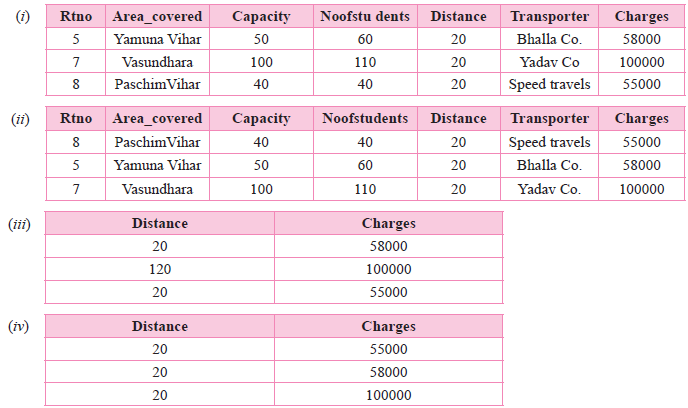
(c) Ravi has given the following command to obtain the Longest distance Select max(distance) from schoolbus where group by transporter;
But he is not getting the desired result.
Help him by writing the correct command.
(i) select max(distance) from schoolbus where group by transporter;
(ii) select transporter, max(distance) from schoolbus group by distance;
(iii) select transporter, max(distance) group by transporter from schoolbus;
(iv) select transporter, max(distance) from schoolbus group by transporter;
(d) Help Saumya to write the command to display the name of the transporter who is having lowest capacity in his schoolbus?
(i) select transporter.min(capacity) from schoolbus;
(ii) select transporter.max(capacity) from schoolbus:
(iii) select transporter.min(capacity) from schoolbus group by transporter:
(iv) select transporter.maximum(capacity)
(e) Choose the appropriate primary key.
(i) Transporter (ii) Area_covered (iii) Rtno (iv) Charges

(c) (iv) select transporter, max(distance) from schoolbus group by transporter;
(d) (iii) select transporter.min(capacity) from schoolbus group by transporter:
(e) (iii) Rtno
Consider the table LOANS given below:
Table: LOANS
| AccNo | Name | Loan Amt | EMI | IntRate | Start Date | Interest |
| 1001 | R.K. Gupta | 300000 | 36 | 12.00 | 19-07-2009 | 1200 |
| 1002 | S. P. Shanna | 500000 | 48 | 10.00 | 22-03-2008 | 1800 |
| 1003 | K.P. Jain | 300000 | 36 | NULL | 08-03-2007 | 1600 |
| 1004 | M.P. Yadav | 800000 | 60 | 10.00 | 06-12-2008 | 2250 |
| 1005 | S.P. Sinlia | 200000 | 36 | 12.50 | 03-01-2010 | 4500 |
| 1006 | P. Shanna | 700000 | 60 | 12.50 | 05-06-2008 | 3500 |
| 1007 | K.S. Dhall | 500000 | 48 | NULL | 05-03-2008 | 3800 |
(a) State the command that will give the output as:
| Name |
| S. P. Shanna |
| K.S. Dhall |
| M.P. Yadav |
| P. Shanna |
| K.S. Dhall |
(i) Select name from LOANS where Name >‘D ’;
(ii) Select name from LOANS where AccNo >1001;
(iii) Select name from LOANS where Loan_Amt >= 500000;
(iv) Select name from LOANS where Loan_Amt >500000 order Loan_AmtDESC;
(b) What will be the output of the following command:
Select name, EMI from LOANS where Loan_Amt >500000 and Int_Rate is NULL;
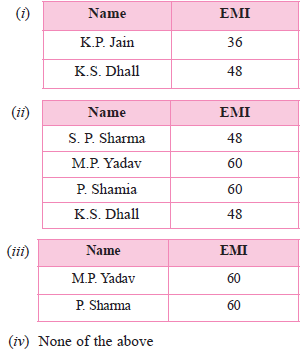
(c) John has given the following command to display the count of all loan holders whose name ends with “Sharma ”:
Select count() from LOANS where Name like ‘Sharma%’;
But he is not getting the desired result. Help him by finding out the correct command fromthe followings:
(i) Select count(*) from LOANS where name Like ‘Sharma%’;
(ii) Select count(*) from LOANS where name Like ‘%Sharma ’;
(iii) Select count( ) from LOANS where name like ‘%sharma ’;
(iv) Select count(Name) from LOANS where name ‘Sharma%’;
(d) State the command to display the maximum Loan_Amt and Cust_Name :-
(i) Select Max(Cust_Name, Loan_Amt) from LOANS;
(ii) Select Cust_Name, max(LoanAmt) from LOANS;
(iii) Select Cust_Name, max(Loan_Amount) from LOANS;
(iv) Select Cust_name, max(Loan_Amt) from LOANS;
(e) Help Ramesh to display the count of all loan holders whose interest is NULL.
(i) Select Count(*) from LOANS where Int_Rate is NULL.
(ii) Select Count() from LOANS where Interest is NULL.
(iii) Select Count(*) from LOANS where Int_rate = NULL;
(iv) Select Count( ) from LOANS where Interest = NULL;
(a) (iii) Select name from LOANS where Loan_Amt >= 500000;
(b) (iv) None of the above
(c) (ii) Select Count(*) from LOANS Where Name like ‘%Sharma ’
(d) (iv) Select Cust_name, max(Loan_Amt) from LOANS;
(e) (i) Select Count(*) from LOANS where Int_Rate is NULL.