Questions

6 Marks Question

🎯

Test yourself on this topic

18 questions · timed · auto-graded

Question 16 Marks
Explain the concept of personality. Discuss Behavioural Approach of Personality.
Answer
Concept of Personality refers to our characteristic ways of responding to individuals and situations.
Features are:
  • Both physical and psychological components.
  • Unique pattern of behaviour.
  • Main features do not easily change with time.
  • Dynamic – Adaptive to situations.
Behavioural approach:
  • States that anything which is not observable and scientifically verifiable cannot be subject matter of Psychology.
  • Personality is not biologically determined, it is learned through classical conditioning, operant conditioning and modelling.
  • Response is the structural unit of behaviour. If a particular response is positively reinforced then it is repeated again and again and becomes a part of habit.
  • Personality is basically a bundle of habits.
View full question & answer
Question 26 Marks
Explain the concept of personality. Discuss main proposition of humanistic approach to personality.
Answer
Concept of Personality refers to our characteristic ways of responding to individuals and situations.
Features are–
  • Both physical and psychological components.
  • Unique pattern of behaviour.
  • Main features do not easily change with time.
  • Dynamic–adaptive to situations.
Humanistic approach to personality–proposed by Carl Rogers & Abraham Mascow.
  • Fully functioning person, fulfilment is the motivating force for personality development.
  • Two assumptions by Rogers.
  • Behaviour is goal directed or worthwhile.
  • People choose adaptive self-actualizing behaviour.
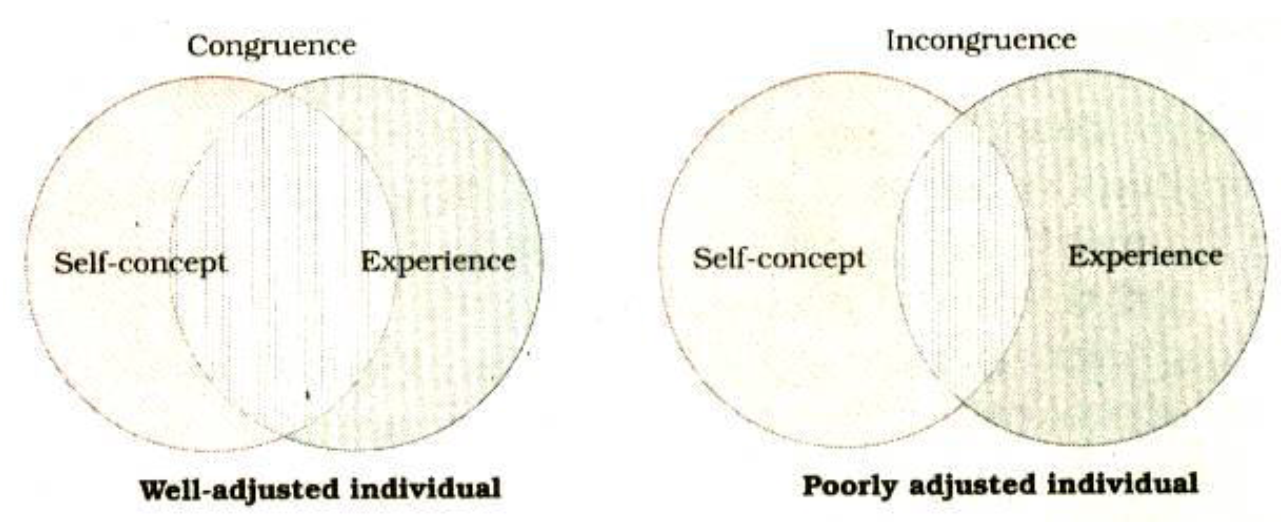
  • Discrepancy between the real self and ideal self often results in unhappiness and dissatisfaction.
  • An atmosphere of unconditional positive regard must be created in order to ensure enhancement of people’s self-concept.
  • This theory emphasises the significance of positive aspects of life.
  • May be supported by the following diagram.
View full question & answer
Question 36 Marks
Define personality. Explain assessment of personality using behavioural analysis.
Answer
Personality refers to our characteristic ways of responding to individuals and situations.
or any other appropriate definition or features of personality
Assessment of Personality
Using behavioural analysis.
Observation of behaviour serves as the basis of behavioural analysis.
Tools
  • Interview - structured - unstructured.
  • Observation.
  • Rating.
  • Nomination.
  • Situationaltests.
View full question & answer
Question 46 Marks
What do you understand by delay of gratification? Discuss the techniques used for self-control.
Answer
There are certain needs which can not befulfilled instantly and we often decide to delay or defer the satisfaction of certain needs. This is called delay of gratification.
Learning to delay or defer the gratification of needs is called self control.
Techniques for self control:
  • Observation of own behaviour.
  • Self instruction.
  • Self reinforcement.
View full question & answer
Question 56 Marks
Discuss the observational methods used in personality assessment. What problems are faced in using these methods?
Answer
Observational method for personality assessment:
  1. Commonly used method for assessment of personality.
  2. Widely applied in clinical psychology.
  3. Explanation of method.
Limitations:
  1. Professional training is required.
  2. Maturity of the Psychologist is a precondition for validation.
  3. Presence of observer may affect the behaviour of the subject.
View full question & answer
Question 66 Marks
Explain the concept of personality. Describe the cultural approach to study personality.
Answer
Concept of personality:
  1. Derived from the Latin word ‘Persona’- the mask used by actors in the Roman theatres.
  2. Personality refers to our characteristic ways of responding to individuals and situations.
Characteristics of personality:
  1. Physical and psychological components.
  2. Expression in terms of behaviour is fairly unique.
  3. Main features do not easily change with time.
  4. Dynamic in nature– some features can change due to internal or external demands.
Cultural approach:
To understand personality in relation to the features of ecological and cultural environment.
  1. Role of ‘economic maintenance system in origin of cultural and behavioural variations.
  2. Climatic conditions– economic activities, settlement patterns, social structures, division of labour etc.
  3. All these elements constitute a child’s over all learning environment– socialisation practices.
View full question & answer
Question 76 Marks
Explain the concept of personality. Discuss main propositions of humanistic approach to personality.
Answer
Personality refers to our characteristic ways of responding to individuals and situations.
Features are–
  • Both physical and psychological components.
  • Unique pattern of behaviour.
  • Main features do not easily change with time.
  • Dynamic – Adaptive to situations.
Humanistic approach to personality – Proposed by Rogers.
  • Fully functioning person, fulfilment is the motivating force for personality development.
  • Two assumptions by Rogers.
  • Behaviour is goal directed or worthwhile.
  • People choose adaptive self-actualizing behaviour.
  • Discrepancy between the real self and ideal self often results in unhappiness and dissatisfaction.
  • An atmosphere of unconditional positive regard must be created in order to ensure enhancement of people’s self-concept.
  • This theory emphasises the significance of positive aspects of life.
  • May be supported by the following diagram.
View full question & answer
Question 86 Marks
State the common features of projective techniques. Describe any one projective technique.
Answer
Projective techniques were developed to assess unconscious motives and feelings.Features of Projective Techniques are:
  • The stimuli are relatively or fully unstructured and poorly defined.
  • Person being assessed is not told about purpose of assessment and method of scoring and interpretation.
  • There are no right or wrong answers.
  • Each response could reveal significant aspect of personality.
  • Scoring and interpretation are lengthy and sometimes subjective.
Projective Techniques:
  • Rorschach Inkblot test.
  • Thematic Apperception Test.
  • Rosenzweig’s Picture–Frustration study.
  • Sentence Completion Test.
  • Draw a Person Test.
View full question & answer
Question 96 Marks
What is meant by delay of gratification? Discuss the techniques used for self­ control.
Answer
There are certain needs which cannot be fulfilled instantly and we often decide to delay or defer the satisfaction of certain needs. This is called delay of gratification.
Learning to delay or defer the gratification of needs is called self control.
Techniques for self control.
  • Observation of one's own behaviour.
  • Self instruction.
  • Self reinforcement.
Explanation of eachrequired.
View full question & answer
Question 106 Marks
What do you understand by personality? Explain assessment of personality using behavioural analysis.
Answer
Personality refers to our characteristic ways of responding to individuals and situations.
Assessment of Personality
Using behavioural analysis
Observation of behaviour serves as the basis of behavioural analysis.
Tools
  • Interview-structured-unstructured
  • Observation.
  • Ratings.
  • Nominations.
  • Situationaltests.
View full question & answer
Question 116 Marks
Distinguish between type and trait approaches to personality. Give suitable examples.
Answer
Type approach.
  • Broad behavior patterns put together constitute or type.
Trait approach.
  • Specific psychological attributes along which intend to differ in consistent and stable ways. Names & brief explanation of any two type theories. and any two trait theories.
View full question & answer
Question 126 Marks
State the techniques of assessing personality. Explain briefly any two projective techniques with examples.
Answer
Self report.
Psychometric tests.
Behavioral analysis.
Projective techniques.
(no explanation is provided for psychometric test).
Rorschach inkblot test.
Rosenzweig’s picture - frustration study.
Draw a person test.
Sentence completion test.
View full question & answer
Question 136 Marks
What is meant by delay of gratification? Why is it considered important for adult development?
Answer
  1. Learning to delay or defer from gratification of needs is called self-control. It emerges from self-regulation.
  2. Self-regulation is behavioural component of self.
  3. It refers to an ability to organize and monitor ones own behaviour. People who can change their behaviour according to the demands of the external environment are high on self-monitoring.
  4. Self-regulation leads to self-control.
  5. It plays a key role in fulfilment of long-term goals.
  6. Indian culture provides us effective mechanisms like fasting (vrata or roza) and non-attachment with worldly things to develop self-control.
  7. It is ones ability to say 'No'.
Psychological techniques to develop self-control are:
  1. Observation of Own Behaviour it provides us with necessary information that may be used to change, modify, or strengthen certain concepts of self.
  2. Self-instruction: We often instruct ourselves to do something and behave the way we want.
  3. Self-reinforcement: It involves rewarding behaviours that have pleasant outcomes (like going to see a movie with friends if we do well in exams).
  • Self-control is important for the development of mature personality. This is the reason that all cultures emphasise the self-control. It helps in the fulfilment of long-term goals. Indian cultural tradition provide us with certain effective mechanisms, e.g., fasting in varta or roja and know attachment with worldly things for developing self-control.
  • Self-control is also important for effective functioning of social network.
View full question & answer
Question 146 Marks
What is the main proposition of humanistic approach to personality? What did Maslow mean by self-actualisation?
Answer
Humanistic theories emphasis personal responsibility and innovate tendencies toward personal growth. They focus on the importance of people’s subjective attitudes, feelings and beliefs especially with regard to the self.
  • According to humanistic approach, we human beings are most creative, growing, fully functioning and self-actualizing people.
  • Fully functioning persons, according to Rogers theory, psychologically healthy persons who live life to the fullest.
  • They live in the here and now and trust their own feelings. They are sensitive to the needs of others but they do not allow society’s standards to shape their feelings or actions to an excessive degree.
  • Rogers suggests that each individual has a concept of ideal self. If there is discrepancy between real self and ideal self then individual develops maladjustment.
  • Rogers proposed two basic assumptions:
  1. Human behaviour is goal-directed and worthwhile.
  2. People always choose adaptive and self-actualizing behaviour.
  • Rogers believed that many individuals fail to become fully functioning persons because they grow up in an atmosphere of conditional positive regard and develop distorted self-concept# which interferes with personal growth. Such people fail to self-actualise.
  • All human beings desire unconditional positive regard, freedom of choice and feeling of fulfilment for attainment of self-actualization.
  • Humanistic theories don’t deny the importance of past experience but they generally focus on the present.​​​​​​​
Maslow’s Contribution to Humanistic Approach.

Maslow’s Self-Actualization.
  • It is a state which people have reached their own fullest potential.
  • He had an optimistic view of man who has potentialities for love, joy and creative work.
  • According to him, human beings are free to shape their lives and to self-actualise.
View full question & answer
Question 156 Marks
What is meant by structured personality tests? Which are the two most widely used structured personality tests?
Answer
Structured personality tests are self-report measures that have the following features:
  1. Questions are direct and structured.
  2. They are called self-report because the examinee has to respond objectively to the items of the measure and his/ her response are accepted as they are.
  3. They are objective in nature and they deal with the present state of mind.
  • Self-report measures use inventories and questionnaires to assess conscious part of personality.
  • Goal of the test may be revealed.
  • These tests assess only conscious part of personality.
  1. Their results depend on motivation and emotional state of the examinee; they are non-projective and direct inferences are made.
Some of the self-report measures are:
  1. Eysenck Personality Questionnaire (EPQ): This test was developed by Eysenck to assess two basic dimensions of personality namely introverted—extroversion and emotionally stable—emotionally unstable (Neuroticism).
  2. MMPI: Minnesota Multiphasic Personality Inventory. This test was developed by Hathaway and Mckinely.
  • It has been found very effective in detecting psycho-pathology like hypochondriasis, depression, hysteria etc.
  • The test is divided into 10 sub scales. This test helps in clinical diagnosis of various mental disorders like hypochondriasis, depression, hysteria, etc.
  • It has two sets’MMPI-I and MMPI-II. Now-a-days, MMPI-II is being used.
  • It has 567 items in the form of affirmative statements. The subject judges each item ‘statements’ as true or false.
  • MMPI is one of the very good tests for clinical purposes (diagnosis).
  • Indian version of MMPI is also available named as Jodhpur Multiphasic Personality Inventory (JMPI) by Malik and Joshi.
    16-PF Questionnaire (Delhi board 2010)
  • It is developed by Cattell.
  • It identifies large set of personality descriptions—subjected to factor analysis to identify basic personality structure.
  • Subject responds to situation by choosing from alternatives.
  • This test is being used with high school level students in India for career guidance and counselling.
Problems Faced by self-report Measures:
  • Social Desirability: It is a tendency on part of the respondent to endorse items in a socially desirable manner.
  • Acquiescence: It is a tendency of the subject to agree with items/ questions irrespective of contents.
  • Testing and understanding personality require great skill and training.
  • People become self-aware and conscious, hesitate to share thoughts and feelings and motivation. If they do it, it is done in a socially desirable manner. So, the real personality characteristics are not manifested.
View full question & answer
Question 166 Marks
Discuss the main observational methods used in personality assessment. What problems do we face in using these methods?
Answer
  • Observational method is a very powerful tool of psychological enquiry. It is an effective method of describing behaviour.
  • A scientific observation differs from day-to-day observation in many respects.
  1. Selection: Psychologists do not observe all the behaviour that they encounter. Rather, they select a particular behaviour for observation.
  2. Recording: While observing, a researcher records the selected behaviour using different means, such as marking tallies for the already identified behaviour whenever they occur, taking notes describing each activity in greater detail using short hand or symbols, photographs, video recording, etc.
  3. After the observations have been made, psychologists analyse whatever they have recorded with a view to derive some meaning out of it.
  4. Observation is a skill. A good observation is a skill. A good observer knows what he/she is looking for, whom he/ she wants to observe, when and where the observation needs to be made.
  • Observation can be of the following types:
​​​​​​​Non-Participant vs. Participant Observation:
  1. ​​​​​​​Non-participant observation:
  1. ​​​​​​​To observe the person or event from a distance.
  2. The observer may become part of the group being observed.
  3. In the first case, the person being observed may not be aware that he/ she is being observed. For example, you want to observe the pattern of interaction between teachers and students in a particular class.
  4. Install a video camera to record the classroom activities, which you can see later and analyse. Alternatively, you may decide to sit in a comer of the class without interfering or participating in their everyday activities. This type of observation is called non-participant observation.
  1. ​​​​​​​Participations observation:
  1. ​​​​​​​In participant observation, the observer becomes a part of the school or the group of people being observed.
  2. The observer takes some time to establish a rapport with the group so that they start accepting him/her as one of the group members.
  3. The degree of involvement of the observer with the group being observed would vary depending upon the focus of the study.
The advantage of the observation method is that it enables the researcher to study people and their behaviour in a naturalistic situation, as it occurs. However, the observation method is labour-intensive, time-consuming, and is susceptible to the observer's bias. Our observation is influenced by our values and beliefs about the person or the event.
View full question & answer
Question 176 Marks
How does Freud explain the structure of personality?
Answer
The Id:
  1. The Id is the original source of personality, present in the newborn infant, from which the ego and super ego later develop.
  2. It consists of everything that is inherited, including the instinctual drives—sex and aggression.
  3. It is closely linked to the biological processes and provides the energy source—the libido for the operation of all three systems.
  4. It is totally unconscious and works on pleasure principles regardless of any,external potential costs of seeking the gratification of impulses.
The Ego:
  1. The ego develops out of Id because of the necessity for dealing with the real world. The ego’s task is to hold the Id in check until conditions allows for satisfaction of its impulses.
  2. It operates on reality principles. For example, a hungry man would want to have food at any cost due to id impulses, but it is the ego which delays tl’ i hunger impulse until the appropriate conditions are found.
  3. The ego is essentially the executive of the personality. It keeps a person working for a living, getting along with people and generally adjusting to the realities of life.
  4. Ego mediates between the demands of id, the realities of the world and the demands of the super ego.
The Super Ego:
  1. It is related to the values and morals of the society as taught to us by our parents and others. It works according to social norms.
  2. It is concerned with morality—whether various ways that could satisfy id impulses are right or wrong.
The main functions of the super ego are:
  1. To inhibit the unacceptable impulses of Id such as sex and aggression.
  2. Freud assumed that Id is energised by two instinctual forces, called life instinct and death instinct. Life instinct is individuals, tendency to construct whereas death instinct is for the destruction. According to Freud, life instinct is more dominant among human beings.
According to Freud, the instinctual life force that energises the Id is called Libido.

It works on the pleasure principle, and seeks immediate gratification. It is source of energy.
View full question & answer
Question 186 Marks
Explain how projective techniques assess personality. Which projective tests of personality are widely used by psychologists?
Answer
Projective tests of personality are widely used by psychologists.
  1. Projective techniques are most indirect method to assess personality.
  2. Psycho analytic theory proposed that behaviour is also determined by unconscious forces.
  3. The projective techniques were developed to assess unconscious motives and feelings.
  • The stimulus material is relatively or fully unstructured and poorly defined.
  • The person being assessed is usually not told the purpose and the method of scoring and interpretation before the administration of test.
  • The person is informed that there are no right or wrong responses.
  • Each response is considered to reveal a true and significant aspect of personality.
  • The scoring and interpretation in projective assessment are lengthy and subjective.
Projective Techniques:
  • Developed to assess unconscious motives, feelings and conflicts.
  • A less structured or unstructured stimulus or situation will allow the individual to project his/ her feelings, desires and needs on to that situation.
  • Projections are interpreted by experts.
  • Cannot be scored objectively, require qualitative analysis for which a rigorous training is needed.
  1. The Rorschach Inkblot Test (Hermann Rorschach):
  1. Consists of 10 inkblots, 5 black and white, 2 with red ink, 3 in pastel colours.
  2. Blots are symmetrical in design with a specific shape or form, made by dropping ink on a piece of paper and then folding the paper in half (hence called inkblot test).
  3. The cards are administered individually in two phases:
  • Performance proper: The subjects are shown the cards and are asked to tell what they see in each of them.
  • Inquiry: A detailed report of the response is prepared by asking the subject to tell where, how, and on what basis was a particular response made.
  1. Fine judgment is necessary to place the subject's responses in a meaningful context. Use and interpretation of this test requires extensive training.
  1. The Thematic Apperception Test (TAT) Morgan and Murray:
  1. ​​​​​​​This test consists of 30 black and white picture cards and one blank card each picture card depicts one or more people in a variety of situations.
  2. Some cards are used specifically with adult males or females, boys or girls have been modified for the children and the aged.
  3. The cards are presented one at a time and the subject is asked to tell a story describing the situation presented in the picture what led up to the situation, what is happening at the moment, what will happen in the future, what the characters are feeling and thinking?
  4. Uma Chaudhury's Indian adaptation of TAT is also available.
  1. ​​​​​​​Rosenzweig's Picture-Frustration Study (P-F Study):
  1. ​​​​​​​This study assesses how people express aggression in the face of a frustrating situation.
  2. Presents with the help of cartoon-like pictures a series of situations in which one person frustrates another, or calls attention to a frustrating condition.
  3. The subject is asked to tell what the other (frustrated) person will say or do.
  4. The analysis of responses is based on the type and direction of aggression— examine whether the focus is on the frustrating object (environment), or on protection of the frustrated person (oneself), or on constructive solution of the problem.
  5. Pareek has adapted this test for the Indian population.
  1. ​​​​​​​Sentence Completion Test:
  1. ​​​​​​​This test makes use of a number of incomplete sentences—the starting part of the sentence is first presented and the subject has to provide an ending to the sentence.
  2. The type of endings used by the subjects reflect their attitudes, motivation and conflicts.
  3. The test provides subjects with several opportunities to reveal their underlying unconscious motivations.
  1. ​​​​​​​Draw-a-Person Test:
  1. In this test, the subject is asked to draw a person on a sheet of paper and then a figure of an opposite sex person.
  2. Finally, the subject is asked to make a story about the person as if he/ she was a character in a novel or play.
  3. Some example of interpretations are as follow:
  • ​​​​​​​​​​​​​​Omission of facial features suggests that the person tries to evade a highly conflict-ridden interpersonal relationships.
  • Graphic emphasis on the neck suggests lack of control over impulses.
  • Disproportionately large head suggests organic brain disease and preoccupation with headaches.
Limitations:
  • ​​​​​​​Interpretation of the responses requires sophisticated skills and specialized training.
  • There are problems associated with the reliability of scoring and validity of interpretations.
View full question & answer
6 Marks Question - Psychology STD 12 Humanities Questions - Vidyadip