Questions

5 Marks Questions

🎯

Test yourself on this topic

6 questions · timed · auto-graded

Question 15 Marks
Find the amount of an annuity consisting of payment of ₹ 1000 at the end of every three months for 4 years at $8 \%$ per annum, compounded quarterly. [Use $(1.02)^{16}=1.372$ ]
Answer
Each annuity = ₹ 1000 ,
$r=8 \%$ p.a. $=2 \%$ per quarter $\Rightarrow \mathrm{i}=0.02$
$\mathrm{n}=4 \times 4=16$ quarters
$\therefore$ Amount of annuity
$=\frac{1000}{0.02}\left[(1+0.02)^{16}-1\right]$
$=50000\left[(1.02)^{16}-1\right]$
$=50000(1.372-1)$
$=50000 \times 0.372=$₹ $18600$
$\therefore$ Amount of annuity $=$₹ $18,600$
View full question & answer
Question 25 Marks
Two numbers are selected at random (without replacement) from the first six positive integers. Let X denote the larger of the two numbers obtained. Find $\mathrm{E}(\mathrm{X})$.
Answer
Given: first six positive integers.
Two numbers can be selected at random (without replacement) from the first six positive integer in $6 \times 5=30$ ways. $X$ denotes the larger of the two numbers obtained. Hence, $X$ can take any value of $2,3,4,5$ or 6 .
For $\mathrm{X}=2$, the possible observations are $(1,2)$ and $(2,1)$
$\Rightarrow P(X)=\frac{2}{30}=\frac{1}{15}$
For $\mathrm{X}=3$, the possible observations are $(1,3),(3,1),(2,3)$ and $(3,2)$.
$\Rightarrow P(X)=\frac{4}{30}=\frac{2}{15}$
For $\mathrm{X}=4$, the possible observations are (1, 4), (4, 1), (2, 4), (4, 2), (3, 4) and (4, 3).
$\Rightarrow P(X)=\frac{6}{30}=\frac{1}{5}$
For $X=5$, the possible observations are $(1,5),(5,1),(2,5),(5,2),(3,5),(5,3),(5,4)$ and $(4,5)$.
$\Rightarrow P(X)=\frac{8}{30}=\frac{4}{15}$
For $X=6$, the possible observations are $(1,6),(6,1),(2,6),(6,2),(3,6),(6,3)(6,4),(4,6),(5,6)$ and $(6,5)$.
$\Rightarrow P(X)=\frac{10}{30}=\frac{1}{3}$
Hence, the required probability distribution is,
X23456
P(X)$\frac{1}{15}$$\frac{2}{15}$$\frac{1}{5}$$\frac{4}{15}$$\frac{1}{3}$
Therefore $\mathrm{E}(\mathrm{X})=2 \times \frac{1}{15}+3 \times \frac{2}{15}+4 \times \frac{1}{5}+5 \times \frac{4}{15}+6 \times \frac{1}{3}$
$\Rightarrow E(X)=\frac{14}{3}$
View full question & answer
Question 35 Marks
A box contains 4 red and 5 black marbles. Find the probability distribution of the red marbles in a random draw of three marbles. Also find the mean, variance and standard deviation of the distribution.
Answer
Total number of marbles in the box $=4+5=9$.
Three marbles are drawn at random from the box.
Let X denote the number of red marbles drawn, then X can take values $0,1,2,3$.
$\mathrm{P}(0)=\mathrm{P}(3$ black marbles $)=\frac{{ }^{5} C_{3}}{{ }^{9} C_{3}}=\frac{5.4 .3}{1.2 .3} \times \frac{1.2 .3}{9.8 .7}=\frac{5}{42}$,
$\mathrm{P}(1)=\mathrm{P}(1$ red marble and 2 black marbles $)=\frac{{ }^{4} C_{1} \times{ }^{5} C_{2}}{{ }^{9} C_{3}}=\frac{4}{1} \times \frac{5.4}{1.2} \times \frac{1.2 .3}{9.8 .7}=\frac{20}{42}$,
$\mathrm{P}(2)=\mathrm{P}(2$ red marbles and 1 black marble $)=\frac{{ }^{4} C_{2} \times{ }^{5} C_{1}}{{ }^{9} C_{3}}=\frac{4.3}{1.2} \times \frac{5}{1} \times \frac{1.2 .3}{9.8 .7}=\frac{15}{42}$,
$\mathrm{P}(3)=\mathrm{P}(3$ red marbles $)=\frac{{ }^{4} C_{3}}{{ }^{9} C_{3}}=\frac{4 \cdot 3 \cdot 2}{1 \cdot 2 \cdot 3} \times \frac{1 \cdot 2 \cdot 3}{9 \cdot 8 \cdot 7}=\frac{2}{42}$.
$\therefore$ Probability distribution of the number of red marbles drawn is $\left(\begin{array}{cccc}0 & 1 & 2 & 3 \\ \frac{5}{42} & \frac{20}{42} & \frac{15}{42} & \frac{2}{42}\end{array}\right)$.
We construct the following table:
$x _{ i }$$P _{ i }$$p _{ i } x _{ i }$$p_i x_i^2$
0$\frac{5}{42}$00
1$\frac{20}{42}$$\frac{20}{42}$$\frac{20}{42}$
2$\frac{15}{42}$$\frac{30}{42}$$\frac{60}{42}$
3$\frac{2}{42}$$\frac{6}{42}$$\frac{18}{42}$
Total $\frac{56}{42}$$\frac{98}{42}$
Mean $=\Sigma p_{i} x_{i}=\frac{56}{42}=\frac{4}{3}$;
Variance $=\frac{98}{42}-\left(\frac{4}{3}\right)^{2}$
$=\frac{7}{3}-\frac{16}{9}=\frac{5}{9}$
$\therefore$ Standard deviation $=\sqrt{\frac{5}{9}}=\frac{\sqrt{5}}{3}$.
View full question & answer
Question 45 Marks
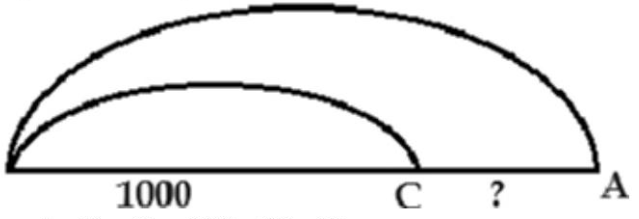
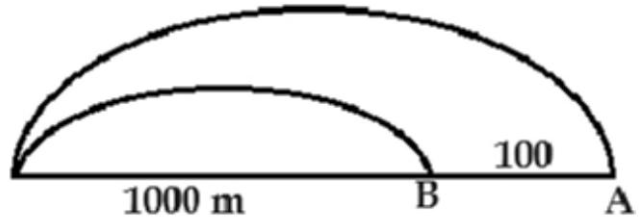
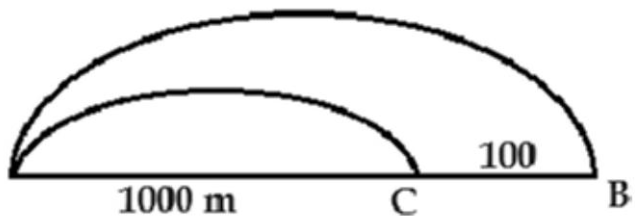
In a 1000-metre race, A, B and C get Gold, Silver and Bronze medals respectively. If A beats B by 100 metres and $B$ beats $C$ by 100 metres, then by how many metres does $A$ beat $C$ ?
Answer
Distance covered by A $=1000 \mathrm{~m}$

Image

Distance covered by B $=900 \mathrm{~m}$
Speed of A: speed of B=10:9
Distance covered by B $=1000$

Image

Distance covered by C $=900$
Speed of B: Speed of C = 10: 9
Image

$\therefore \mathrm{A}: \mathrm{B}: \mathrm{C}=100: 90: 81$
= $1000: 900: 81$
A : B = $10: 9$
10:9.
When A covers 1000 meter $C$ covers 810 metes
$\therefore$ Required distance cover $=1000-810$
= 190 metre.
View full question & answer
Question 55 Marks
Find the adjoint of the matrix $A=\left[\begin{array}{rrr}-1 & -2 & -2 \\ 2 & 1 & -2 \\ 2 & -2 & 1\end{array}\right]$ and hence show that $A(\operatorname{adj} A)=|A| I_{3}$.
Answer
Given, $\mathrm{A}=\left[\begin{array}{ccc}-1 & -2 & -2 \\ 2 & 1 & -2 \\ 2 & -2 & 1\end{array}\right]$
Let $\mathrm{A}_{\mathrm{ij}}$ be the co-factor of an element $\mathrm{a}_{\mathrm{ij}}$ of $|\mathrm{A}|$. Then, co-factors of elements of $|\mathrm{A}|$ are
$A_{11}=(-1)^{1+1}\left|\begin{array}{cc}1 & -2 \\ -2 & 1\end{array}\right|=(1-4)=-3$
$A_{12}=(-1)^{1+2}\left|\begin{array}{cc}2 & -2 \\ 2 & 1\end{array}\right|=-(2+4)=-6$
$\mathrm{A}_{13}=(-1)^{1+3}\left|\begin{array}{cc}2 & 1 \\ 2 & -2\end{array}\right|=(-4-2)=-6$
$A_{21}=(-1)^{2+1}\left|\begin{array}{cc}-2 & -2 \\ -2 & 1\end{array}\right|=-(-2-4)=6$
$A_{22}=(-1)^{2+2}\left|\begin{array}{cc}-1 & -2 \\ 2 & 1\end{array}\right|=(-1+4)=3$
$A_{23}=(-1)^{2+3}\left|\begin{array}{cc}-1 & -2 \\ 2 & -2\end{array}\right|=-(2+4)=-6$
$\mathrm{A}_{31}=(-1)^{3+1}\left|\begin{array}{cc}-2 & -2 \\ 1 & -2\end{array}\right|=(4+2)=6$
$A_{32}=(-1)^{3+2}\left|\begin{array}{cc}-1 & -2 \\ 2 & -2\end{array}\right|=-(2+4)=-6$
$A_{33}=(-1)^{3+3}\left|\begin{array}{cc}-1 & -2 \\ 2 & 1\end{array}\right|=(-1+4)=3$
Clearly, the adjoint of the matrix A is given by
$\operatorname{adj} \mathrm{A}=\left[\begin{array}{ccc}A_{11} & A_{21} & A_{31} \\ A_{12} & A_{22} & A_{32} \\ A_{13} & A_{23} & A_{33}\end{array}\right]=\left[\begin{array}{ccc}-3 & 6 & 6 \\ -6 & 3 & -6 \\ -6 & -6 & 3\end{array}\right]$
Now, $|\mathrm{A}|=\left|\begin{array}{ccc}1 & -2 & -2 \\ 2 & 1 & -2 \\ 2 & -2 & 1\end{array}\right|$
$=-1(1-4)+2(2+4)-2(-4-2)$
$=-1(-3)+2(6)-2(-6)$
$=3+12+12=27$
and A.(adj A) $=\left[\begin{array}{ccc}-1 & -2 & -2 \\ 2 & 1 & -2 \\ 2 & -2 & 1\end{array}\right]\left[\begin{array}{ccc}-3 & 6 & 6 \\ -6 & 3 & -6 \\ -6 & -6 & 3\end{array}\right]$
$=\left[\begin{array}{ccc}3+12+12 & -6-6+12 & -6+12-6 \\ -6-6+12 & 12+3+12 & 12-6-6 \\ -6+12-6 & 12-6-6 & 12+12+3\end{array}\right]$
$=\left[\begin{array}{ccc}27 & 0 & 0 \\ 0 & 27 & 0 \\ 0 & 0 & 27\end{array}\right]=27\left[\begin{array}{lll}1 & 0 & 0 \\ 0 & 1 & 0 \\ 0 & 0 & 1\end{array}\right]$
$=27 \mathrm{I}_{3}=|\mathrm{A}| \mathrm{I}_{3}$
View full question & answer
Question 65 Marks
Two factories decided to award their employees for three values of
a. adaptable to new techniques,
b. careful and alert in difficult situations and
c. keeping calm in tense situations, at the rate of ₹ x , ₹ y and ₹ z per person respectively. The first factory decided to honour respectively 2 , 4 and 3 employees with a total prize money of ₹ 29000 . The second factory decided to honour respectively 5, 2 and 3 employees with the prize money of ₹ 30500 . If the three prizes per person together cost ₹ 9500 , then
i. represent the above situation by a matrix equation and form linear equations using matrix multiplication.
ii. Solve these equations using matrices.
Answer
Let $\mathrm{x}, \mathrm{y}, \mathrm{z}$ be the prize amount per person for adaptability, carefulness and calmness respectively Accoring to question,
$2 x+4 y+3 z=29000$
$5 x+2 y+3 z=30500$
$x+y+z=9500$
These three equations can be written as
$\left[\begin{array}{lll}2 & 4 & 3 \\ 5 & 2 & 3 \\ 1 & 1 & 1\end{array}\right]\left[\begin{array}{l}x \\ y \\ z\end{array}\right]=\left[\begin{array}{l}29000 \\ 30500 \\ 9500\end{array}\right]$
A $X=B$
$|\mathrm{A}|=2(2-3)-4(5-3)+3(5-2)$
$=2(-1)-4(2)+3(3)$
$=-2-8+9$
$=-1$
Hence, the unique solution given by $x=A^{-1} B$
$C_{11}=(-1)^{1+1}(2-3)=-1$
$C_{12}=(-1)^{1+2}(5-3)=-2$
$C_{13}=(-1)^{1+3}(5-2)=3$
$\mathrm{C}_{21}=(-1)^{2+1}(4-3)=-1$
$C_{22}=(-1)^{2+2}(2-3)=-1$
$C_{23}=(-1)^{2+3}(2-4)=-2$
$\mathrm{C}_{31}=(-1)^{3+1}(12-6)=6$
$C_{32}=(-1)^{3+2}(6-15)=-9$
$C_{33}=(-1)^{3+3}(4-20)=-16$
$\operatorname{Adj} \mathrm{A}=\left[\begin{array}{ccc}-1 & -2 & 3 \\ -1 & -1 & 2 \\ 6 & 9 & -16\end{array}\right]^{T}=\left[\begin{array}{ccc}-1 & -1 & 6 \\ -2 & -1 & 9 \\ 3 & 2 & -16\end{array}\right]$
$\mathrm{X}=\mathrm{A}^{-1} \mathrm{~B}=\frac{1}{|A|}(\operatorname{Adj} \mathrm{A}) \mathrm{B}$
$X=\left[\begin{array}{ccc}1 & 1 & -6 \\ - & 1 & -9 \\ -3 & -2 & 16\end{array}\right]\left[\begin{array}{c}29000 \\ 30500 \\ 9500\end{array}\right]$
$X=\left[\begin{array}{c}29000+30500-57000 \\ 58000+30500-85500 \\ -87000-61000+152000\end{array}\right]$
$\left[\begin{array}{l}\mathrm{x} \\ \mathrm{y} \\ \mathrm{z}\end{array}\right]=\left[\begin{array}{l}2500 \\ 3000 \\ 4000\end{array}\right]$
Hence, $x=2500, y=3000$ and $\mathrm{z}=4000$
View full question & answer
5 Marks Questions - Applied Maths STD 12 Science Questions - Vidyadip