Sample QuestionsModel Paper 4 questions
One sample from each question group in this chapter. Select any group above to see the full set with answer keys.
For the given five values $15,24,18,33,42$, the three years moving averages are
- A
$19,25,33$
- ✓
$19,25,31$
- C
$19,30,31$
- D
$19,22,33$
Answer: B.
View full solution →If the marginal revenue function of a commodity is $\mathrm{MR}=2 \mathrm{x}-9 \mathrm{x}^{2}$, then he revenue function is
- A
- ✓
$x^{2}-3 x^{3}$
- C
$2 x^{2}-9 x^{3}$
- D
$18+x^{2}-3 x^{3}$
Answer: B.
View full solution →The assumed hypothesis which is tested for rejection considering it to be true is called
Answer: C.
View full solution →The solution set of system of linear inequalities $2(x+1) \leq x+5,3(x+2)>2-x, x \in R$ is
- A
$[-1,3)$
- B
$(-1,3)$
- C
$[-1,3]$
- ✓
$(-1,3]$
Answer: D.
View full solution →Corner points of the feasible region determined by the system of linear constraints $(0,3),(1,1)$ and $(3,0)$. Let $z$$=p x+q y$, where $p, q>0$. Condition on $p$ and $q$ so that the minimum of $z$ occurs at $(3,0)$ and $(1,1)$ is
Answer: D.
View full solution →The function $f$ be given by $f(x)=2 x^{3}-6 x^{2}+6 x+5$.
Assertion (A): $x=1$ is not a point of local maxima.
Reason (R): $x=1$ is not a point of local minima.
Answer: B.
View full solution →Assertion (A): If $A=\left[\begin{array}{ccc}2 & 3 & -1 \\ 1 & 4 & 2\end{array}\right]$ and $B=\left[\begin{array}{ll}2 & 3 \\ 4 & 5 \\ 2 & 1\end{array}\right]$, then $A B$ and $B A$ both are defined.
Reason ( $\mathbf{R}$ ): For the two matrices $A$ and $B$, the product $A B$ is defined, if number of columns in $A$ is equal to the number of rows in $B$.
- ✓
Both $A$ and $R$ are true and $R$ is the correct explanation of A .
- B
Both A and R are true but R is not the correct explanation of A .
- C
$A$ is true but $R$ is false.
- D
$A$ is false but $R$ is true.
Answer: A.
View full solution →Find the remainder when $2^{100}$ is divided by 11 .
View full solution →At what rate per cent, per annum compounded annually, will the sum of money become 4 times of itself in 2 years?
Mrs. Dubey borrowed ₹ $ 500000$ from a bank to purchase a car and decided to repay by monthly installments in 5 years. The bank charges interest at $8 \%$ p.a. compounded monthly. Calculate the EMI. $\left(\right.$ Given $(1.0067)^{60}=$ 1.4928)
View full solution →Evaluate: $\int_{1}^{2} \frac{3 x}{9 x^{2}-1} d x$
View full solution →A company ABC Ltd has raised funds in the form of 1,000 zero-coupon bonds worth $₹ 1,000$ each. The company wants to set up a sinking fund for repayment of the bonds, which will be after 10 years. Determine the amount of the periodic contribution if the annualized rate of interest is $5 \%$, and the contribution will be done half-yearly. Given that $(1.025)^{20}=1.6386$.
View full solution →Consider the following hypothesis test:
$\mathrm{H}_{0}: \mu=18$
$\mathrm{H}_{\mathrm{a}}: \mu \neq 18$
A sample of 48 provided a sample mean $\bar{x}=17$ and a sample standard deviation $\mathrm{S}=4.5$
i. Compute the value of the test statistic.
ii. Use the t-distribution table to compute a range for the p-value.
iii. At $\alpha=0.05$, what is your conclusion?
iv. What is the rejection rule using the critical value? What is your conclusion?
View full solution →From the following data calculate the 4-yearly moving averages and determine the trend values.
| Years | 2012 | 2013 | 2014 | 2015 | 2016 | 2017 | 2018 | 2019 | 2020 | 2021 |
| Value | 50 | 36.5 | 43 | 44.5 | 38.9 | 38.9 | 32.6 | 41.7 | 41.1 | 33.8 |
Two dice are thrown simultaneously. If X denotes the number of sixes, find the expectation and variance of X .
From a lot of 10 items containing 3 defectives, a sample of 4 items is drawn at random. Let the random variable X denote the number of defective items in the sample. If the items in the sample are drawn one by one without replacement, find:
i. The probability distribution of X
ii. Mean of X
iii. Variance of X
The marginal cost function of a product is given by MC $=\frac{x}{\sqrt{x^{2}+400}}$. Find the total cost and the average cost if the fixed cost is ₹ 1000 .
View full solution →Find the amount of an annuity consisting of payment of ₹ 1000 at the end of every three months for 4 years at $8 \%$ per annum, compounded quarterly. [Use $(1.02)^{16}=1.372$ ]
View full solution →Two numbers are selected at random (without replacement) from the first six positive integers. Let X denote the larger of the two numbers obtained. Find $\mathrm{E}(\mathrm{X})$.
View full solution →A box contains 4 red and 5 black marbles. Find the probability distribution of the red marbles in a random draw of three marbles. Also find the mean, variance and standard deviation of the distribution.
In a 1000-metre race, A, B and C get Gold, Silver and Bronze medals respectively. If A beats B by 100 metres and $B$ beats $C$ by 100 metres, then by how many metres does $A$ beat $C$ ?
View full solution →Find the adjoint of the matrix $A=\left[\begin{array}{rrr}-1 & -2 & -2 \\ 2 & 1 & -2 \\ 2 & -2 & 1\end{array}\right]$ and hence show that $A(\operatorname{adj} A)=|A| I_{3}$.
View full solution →Read the following text carefully and answer the questions that follow:
A manufacturer produces two Models of bikes Model X and Model Y. Model X takes a 6 man hours to make per unit, while Model Y takes 10 man-hours per unit. There is a total of 450 man-hours available per week. Handling and Marketing costs are ₹ 2,000 and ₹ 1,000 per unit for Models X and Y respectively. The total funds available for these purposes are ₹ 80,000 per week. Profits per unit for Models X and Y are ₹ 1,000 and ₹ 500 , respectively. The feasible region of LPP is shown in the following graph.
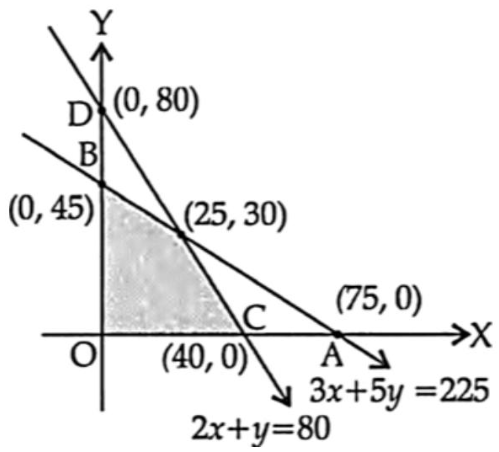
i. Find the equation of line AB .
ii. Find the equation of line CD.
iii. Find the coordinates of point E.
OR
How many bikes of model $X$ and model $Y$ should the manufacturer produce so as to yield a maximum profit? View full solution →Read the following text carefully and answer the questions that follow:
A cottage industry manufactures pedestal lamps and wooden shades, each requiring the use of a grinding/cutting machine and a sprayer. It takes 2 hours on grinding/cutting machine and 3 hours on the sprayer to manufacture a pedestal lamp. It takes 1 hour on the grinding/cutting machine and 2 hours on the sprayer to manufacture a shade. On any day, the sprayer is available for at the most 20 hours and the grinding/cutting machine for at the most 12 hours. The profit from the sale of a lamp is ₹ 25 and that from a shade is ₹ 15 .
If x is the number of lamps and y is the number of shades manufactured. Assuming that the manufacturer can sell all the lamps and shades that he produces.
i. In order to maximize the profit, what should be the objective function? (1)
ii. What are the constraints related to the given LPP: (1)
iii. The non-negative constraints associative to the given L.P.P are: (2)
OR
What are the vertices of feasible region of given L.P.P? (2)
Read the text carefully and answer the questions:
The nominal rate of return is the amount of money generated by an investment before factoring in expenses such as taxes, investment fees, and inflation. If an investment generated a $10 \%$ return, the nominal rate would equal $10 \%$. After factoring in inflation during the investment period, the actual return would likely be lower. However, the nominal rate of return has its merits since it allows investors to compare the performance of an investment irrespective of the different tax rates that might be applied for each investment.
(a) A person invests ₹ 10000 in $10 \%$ ₹ 100 shares of a company available at a premium of ₹ 25 . Find his rate of return
(b) A man invests ₹ 22500 in ₹ 50 shares available at $10 \%$ discount. If the dividend paid by the company is $12 \%$, calculate his rate of return.
(c) A person invested ₹200000 in a fund for one year. At the end of the year, the investment was worth ₹216000. Calculate his rate of return.
OR
Balwant invests a sum of money in ₹50 shares paying $10 \%$ dividend quoted at $20 \%$ discount. If his annual dividend is ₹ 600 , calculate his rate of return from the investment.
View full solution →There is a bridge whose length of three sides of a trapezium other than base are equal to 5 cm :
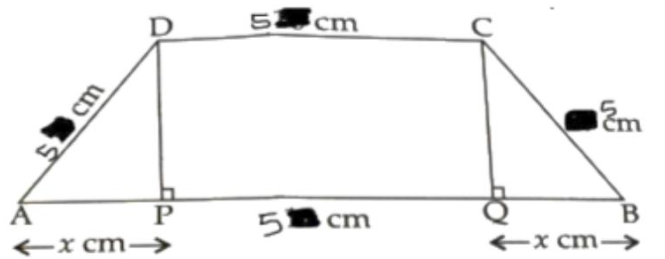
(a) What is the value of DP?
(b) What is the area of the trapezium $\mathrm{A}(\mathrm{x})$ ?
(c) $\quad A^{\prime}(x)=0$ then what is the value of $x$ ?
OR
What is the value of A"(2.5) View full solution →