Question 14 Marks
Read the following text carefully and answer the questions that follow:
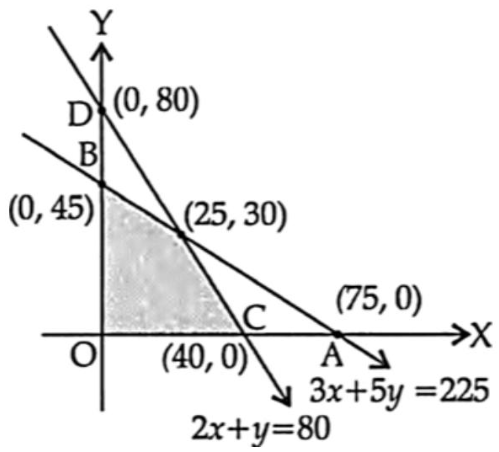
A manufacturer produces two Models of bikes Model X and Model Y. Model X takes a 6 man hours to make per unit, while Model Y takes 10 man-hours per unit. There is a total of 450 man-hours available per week. Handling and Marketing costs are ₹ 2,000 and ₹ 1,000 per unit for Models X and Y respectively. The total funds available for these purposes are ₹ 80,000 per week. Profits per unit for Models X and Y are ₹ 1,000 and ₹ 500 , respectively. The feasible region of LPP is shown in the following graph.
i. Find the equation of line AB .
ii. Find the equation of line CD.
iii. Find the coordinates of point E.
OR
How many bikes of model $X$ and model $Y$ should the manufacturer produce so as to yield a maximum profit?
A manufacturer produces two Models of bikes Model X and Model Y. Model X takes a 6 man hours to make per unit, while Model Y takes 10 man-hours per unit. There is a total of 450 man-hours available per week. Handling and Marketing costs are ₹ 2,000 and ₹ 1,000 per unit for Models X and Y respectively. The total funds available for these purposes are ₹ 80,000 per week. Profits per unit for Models X and Y are ₹ 1,000 and ₹ 500 , respectively. The feasible region of LPP is shown in the following graph.
i. Find the equation of line AB .
ii. Find the equation of line CD.
iii. Find the coordinates of point E.
OR
How many bikes of model $X$ and model $Y$ should the manufacturer produce so as to yield a maximum profit?
Answer
View full question & answer→i. From the given graph $\mathrm{OA}=75$ and $\mathrm{OB}=45$
The equation of line AB is $\frac{x}{75}+\frac{y}{45}=1$
i.e., $3 x+5 y=225$
ii. From the given graph $\mathrm{OC}=40$ and $\mathrm{OD}=80$.
The equation of line CD is $\frac{x}{40}+\frac{y}{80}=1$
i.e., $2 \mathrm{x}+\mathrm{y}=80$
iii. On solving the equations of lines AB and CD , we get the coordinates of point E i.e., $(25,30)$.
OR
The objective function for given L.P.P. is Z = 1000x + 500y
From the shaded feasible region, it is clear that coordinates of comer points are (0, 0), (40, 0), (25, 30) and (0, 45)
So, the manufacturer should produce 25 bikes of model X and 30 bikes of model Y to get a maximum profit of ₹ $40,000$.
The equation of line AB is $\frac{x}{75}+\frac{y}{45}=1$
i.e., $3 x+5 y=225$
ii. From the given graph $\mathrm{OC}=40$ and $\mathrm{OD}=80$.
The equation of line CD is $\frac{x}{40}+\frac{y}{80}=1$
i.e., $2 \mathrm{x}+\mathrm{y}=80$
iii. On solving the equations of lines AB and CD , we get the coordinates of point E i.e., $(25,30)$.
OR
The objective function for given L.P.P. is Z = 1000x + 500y
From the shaded feasible region, it is clear that coordinates of comer points are (0, 0), (40, 0), (25, 30) and (0, 45)
| Corner Points | Value of Z = 1000x + 500y |
| (0,0) | 0 |
| (40, 0) | $40,000 \leftarrow$ Maximum |
| (25,30) | $25,000+15,000=40,000 \leftarrow$ Maximum |
| (0,45) | 22500 |