Questions · Page 3 of 3

5 Marks Questions

Question 1015 Marks
Answer the following questions:
Explain the role of ovarian hormones in inducing changes in the uterus during menstrual cycle.
Answer
Rapid release of luteinising hormone ruptures Graafian follicle and release ovum (ovulation) .
Corpus luteum secretes large amount of progesterone hormone that is essential for maintenance of the endometrium required for implantation of blastocyst leading to pregnancy.
View full question & answer
Question 1025 Marks
Answer the following questions:
Explain the changes the primary oocyte undergoes while in different follicular stages before ovulation.
Answer
Changes in the primary oocyte:
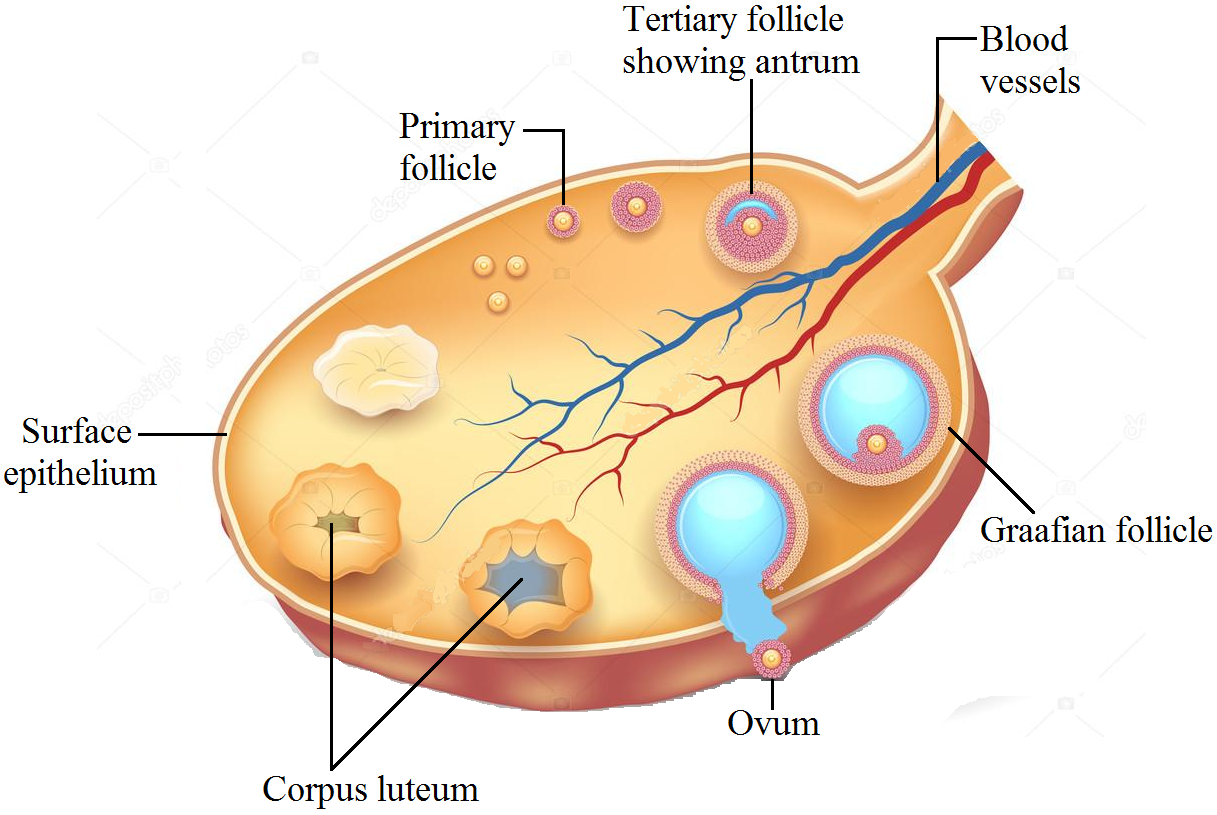
  • Each primary oocyte gets surrounded by a single layer of granulosa cells and is known as primary follicle.
  • Primary follicle get surrounded by more layers of granulosa cells and a new theca and form secondary follicle.
  • A secondary follicle transforms into tertiary follicle characterised by a fluid-filled space, the antrum.
  • Primary oocyte undergoes first meiotic division and produces two unequal haploid cells-a large haploid secondary oocyte and a tiny first polar body.
  • The tertiary follicle further changes into the mature Graafian follicle.
  • The secondary oocyte forms a new membrane called zona pellucida around it.
View full question & answer
Question 1045 Marks
The following is the illustration of the sequence of ovarian events (a – i) in a human female.
Identify the figure that illustrates ovulation and mention the stage of oogenesis it represents.
Answer
f; secondary oocyte.
View full question & answer
Question 1055 Marks
What role does pituitary gonadotropins play during follicular and ovulatory phases of menstrual cycle and also explain the shift in steroidal secretions.
Answer
Menstrual cycle is regulated by hypothalamus through the pituitary gland. At the end of menstrual phase, the pituitary FSH gradually increases resulting in follicular development within the ovaries. As the follicles mature, estrogen secretion increases resulting in a surge in FSH and LH. The surge of LH is responsible for ovulation and formation of corpus luteum that secretes progesterone which helps in maintaining the endometrium for implantation.
View full question & answer
Question 1065 Marks
The following is the illustration of the sequence of ovarian events (a – i) in a human female.
Specify the endocrine function of corpus luteum. How does it influence the uterus? Why is it essential?
Answer
Produces the hormone progesterone, causes proliferation of the endometrium which gets highly vascularised. It is essential for the implantation of the fertilised ovum and maintains the same during pregnancy.
View full question & answer
Question 1075 Marks
When and where are primary oocytes formed in a human female? Trace the development of these oocytes till ovulation (in menstrual cycle). How do gonadotropins influence this developmental process?
Answer
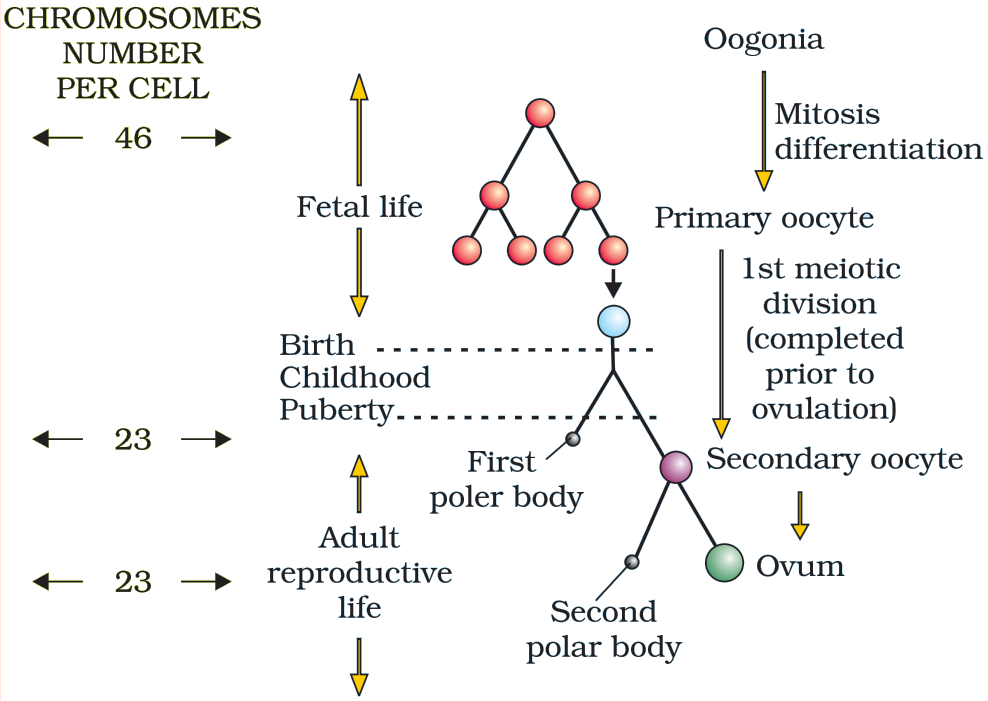
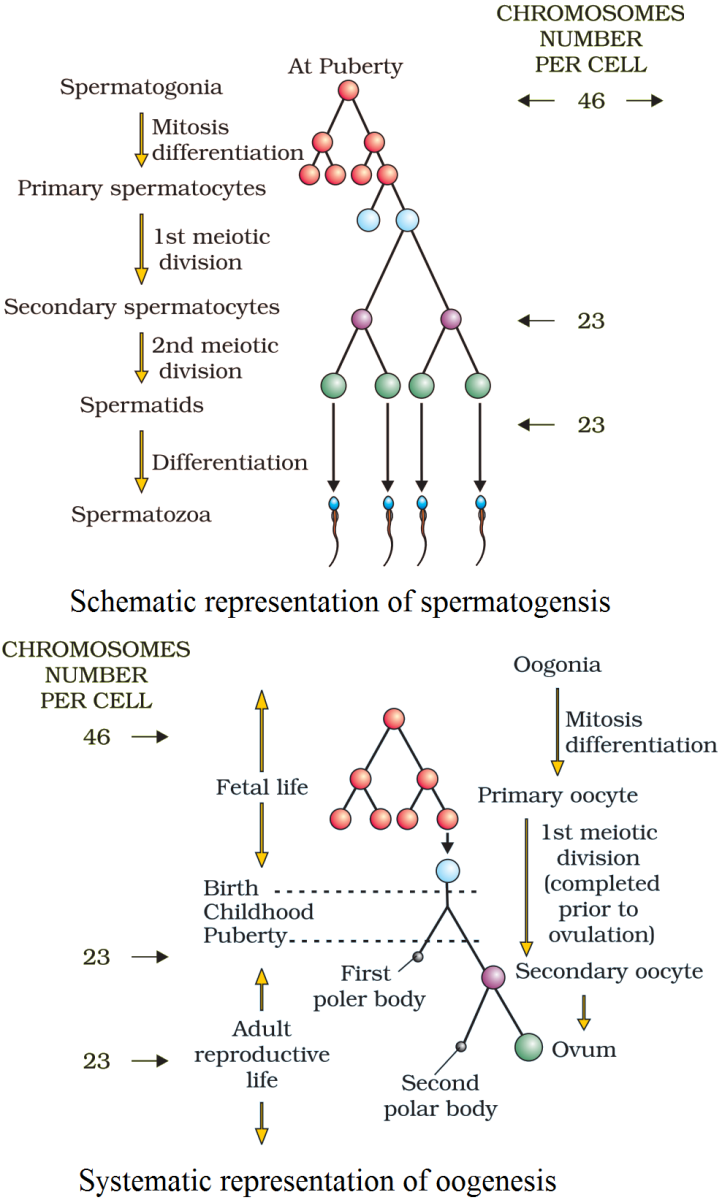
Oogenesis: The process of formation of a mature female gamete is called oogenesis. It occurs in the ovaries. It consists of the following three phases:
  1. Multiplication phase: Oogenesis is initiated during the embryonic development stage when a couple of million gamete mother cells (oogonia) are formed within each foetal ovary. No more oogonia are formed and added after birth. These cells start division and enter into prophase-I of the meiotic division. They get temporarily arrested at this stage and are called primary oocytes.
  2. Growth phase: Each primary oocyte then gets surrounded by a layer of granulosa cells. This structure is called the primary follicle. A large number of these follicles degenerate during the phase from birth to puberty. At puberty, only 60,000 to 80,000 primary follicles are left in each ovary. The primary follicles get surrounded by more layers of granulosa cells and a new theca to form secondary follicles.

Systematic representation of oogenesis.
  1. Maturation phase: In the first maturation phase, the secondary follicle soon transforms into a tertiary follicle. The primary oocyte within the tertiary follicle grows in size and completes its first meiotic division to form a large, haploid, secondary oocyte and a tiny first polar body. The tertiary follicle changes into a mature follicle-the Graafian follicle-which ruptures to release the secondary oocyte (ovum) from the ovary by a process called ovulation. The second maturation phase occurs after fertilisation when the meiotic division of the secondary oocyte is complete. This second meiotic division results in the formation of a second polar body and a haploid ovum (ootid).
View full question & answer
Question 1085 Marks
Answer the following questions:
Mention the functions of acrosome and middle piece.
Answer
Acrosome: Acrosome contains hydrolytic enzymes that help in dissolving membranes of the ovum for sperm entry ensuring fertilisation.
Middle Piece: It contains a number of mitochondria that provide energy for the movement of the tail and provides motility to sperm.
View full question & answer
Question 1095 Marks
Answer the following questions:
Explain the hormonal regulation of the process of spermatogenesis in humans.
Answer

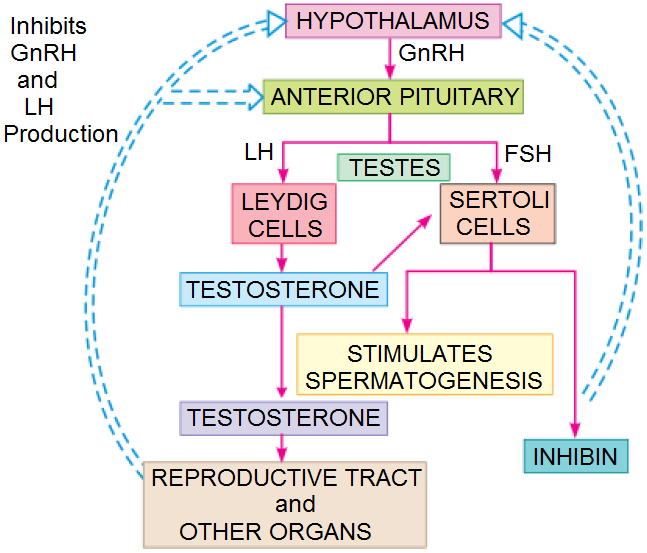
Flow chart showing the hormonal control of the human male reproductive system.
View full question & answer
Question 1105 Marks
Meiotic division during oogenesis is different from that in spermatogenesis. Explain how and why?
Answer
Unequal cytoplasmic division of the oocyte is to ensure the retention of bulk of cytoplasm in one cell called secondary oocyte instead of sharing it with two. It has to provide nourishment for the developing embryo during early stages, so it is essential to retain as much cytoplasmic materials it could in a single daughter cell.
View full question & answer
Question 1115 Marks
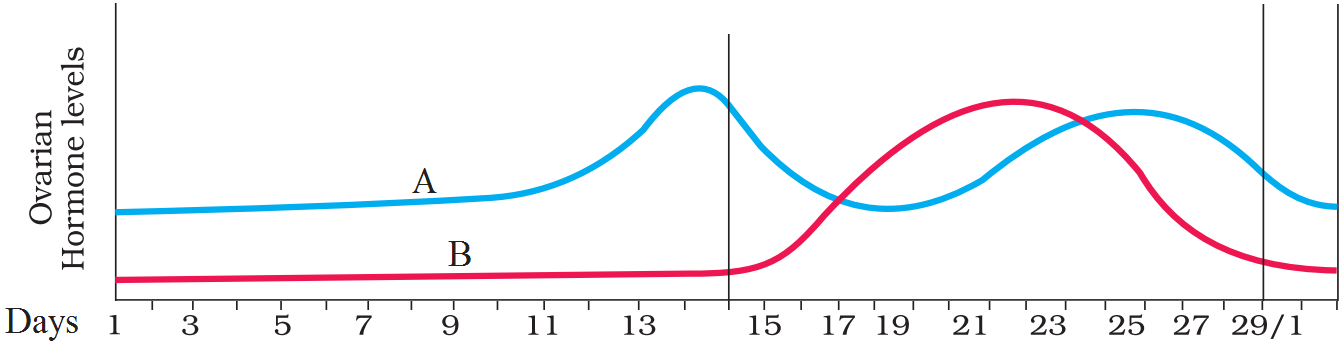
The graph given below shows the variation in the levels of ovarian hormones during various phases of menstrual cycle:
Specify the source of the hormone marked in the diagram.
Answer
A- Maturing ovarian follicle/ Graafian follicle.
B- Corpus luteum.
View full question & answer
Question 1125 Marks
Study the illustration given and answer the questions that follow:
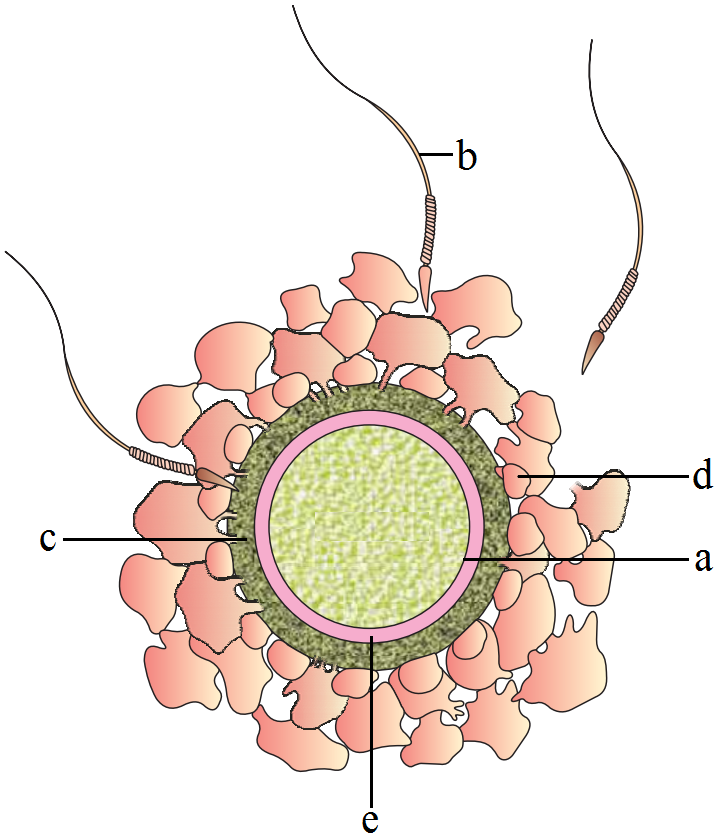
Name and state the function of ‘c’.
Answer
c- zona pellucida.
It protects ovum and regulates interaction between ovum and sperms during fertilisation.
View full question & answer
Question 1135 Marks
Arrange the following hormones in sequence of their secretion in a pregnant woman.
hCG, LH, FSH, Relaxin.
Answer
The sequence of secretion of hormones is:
  1. FSH.
  2. LH.
  3. hCG.
  4. Relaxin.
View full question & answer
Question 1155 Marks
Study the following flow chart. Name the hormones involved at each stage. Explain their functions.
Answer
Hypothalamus
$\downarrow$
Pituitary
$\downarrow$
Testes
$\downarrow$
Sperms
  1. Hypothalamus secretes gonadotropin-releasing hormone (GnRH), which stimulates the anterior pituitary gland to secrete gonadotropins like luteinizing hormone (LH) and follicle stimulating hormone (FSH).
  2. LH stimulates the Leydig cells of testes to secrete androgens (like testosterone), which control spermatogenesis.
  3. FSH acts on Sertoli cells of testes, which in response secrete certain factors necessary for spermiogenesis; the sperm heads become embedded in the sertoli cells.
View full question & answer
Question 1165 Marks
Enumerate the events in the ovary of a human female during:
Luteal phase of menstrual cycle.
Answer
In the luteal phase, following events occur:
  1. The parts of Graafian follicle remaining after the rupture, transform into the corpus luteum.
  2. The corpus luteum secretes large amounts of progesterone.
View full question & answer
Question 1175 Marks
Describe the change that occur in ovaries and uterus in human female during the reproductive cycle.
Answer
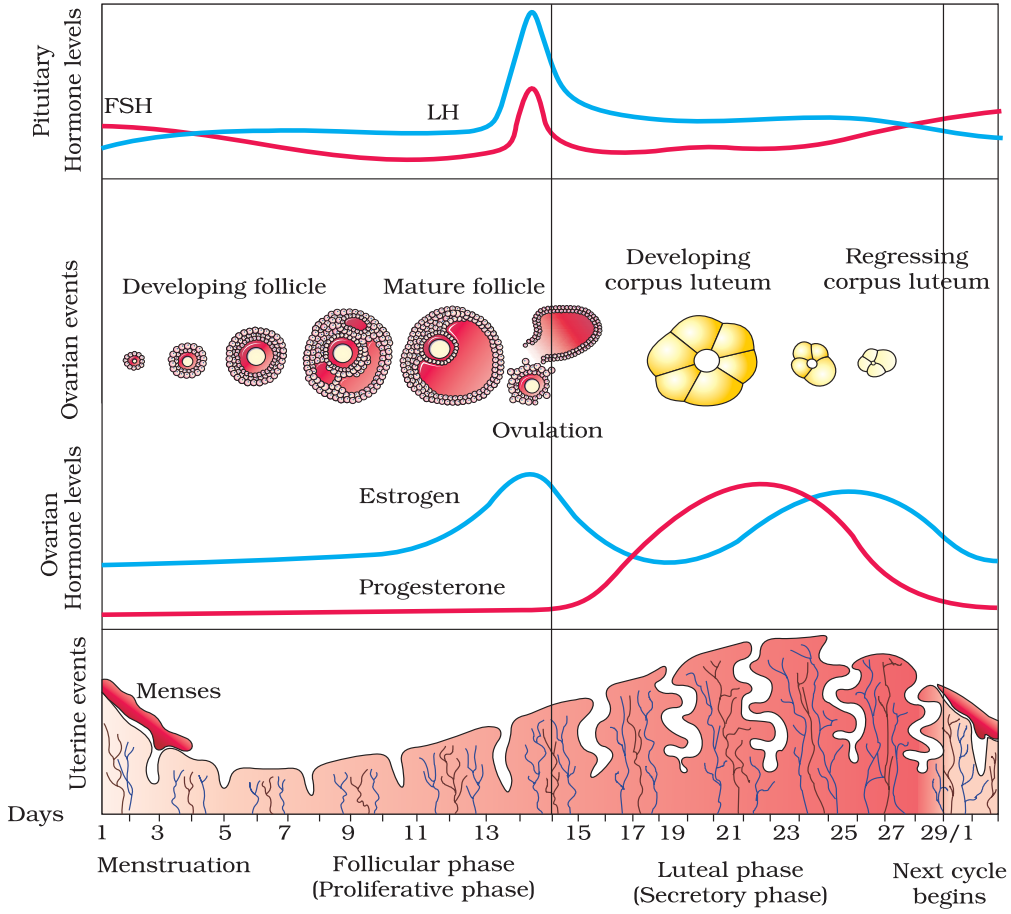
Menstrual Cycle:
  • The rhythmic series of changes that occur in the reproductive organs of female primates (monkeys, apes and human beings) is called menstrual cycle.
  • It is repeated at an average interval of about 28/ 29 days.
  • The first appearance of menstruation at puberty is called menarche.
  • The menstrual cycle has four phases. These are:
  1. Menstrual Phase:
  • The soft tissue of endometrial lining of the uterus disintegrates causing bleeding.
  • The unfertilised egg and soft tissues are discharged.
  • It lasts for 3-5 days.

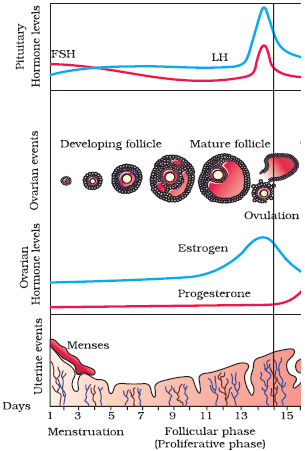
Diagrammatic presentation of various events during a menstrual cycle.
  1. Follicular Phase/ Proliferative Phase:
  • The primary follicles in the ovary grow and become a fully mature Graafian follicle.
  • The endometrium of the uterus is regenerated due to the secretion of LH and FSH from anterior pituitary and ovarian hormone, estrogen.
  • It lasts for about 10 to 14 days.
  1. Ovulatory Phase:
  • Rapid secretion of LH (LH surge) induces rupture of Graafian follicle, thereby leading to ovulation (release of ovum).
  • It lasts for only about 48 hours.
  1. Luteal Phase/ Secretory Phase:
  • In this phase the ruptured follicle changes into corpus luteum in the ovary and it begins to secrete the hormone progesterone.
  • The endometrium thickens further and their glands secrete a fluid into the uterus.
  • If ovum is not fertilised, the corpus luteum undergoes degeneration and this causes disintegration of the endometrium leading to menstruation.
  • Estrogen and progesterone levels rise during this phase.
  • It lasts for only 1 day.
  • During pregnancy all events of the menstrual cycle stop and there is no menstruation. The menstrual cycle permanently stops in females at the age of around 50 years. This is called menopause.
View full question & answer
Question 1185 Marks
What role does pituitary gonadotropins play during follicular and ovulatory phases of menstrual cycle? Explain the shifts in steroidal secretions.
Answer
FSH and LH are the two pituitary gonadotropins which play important role during follicular and ovulatory phases of menstrual cycle.
  • FSH stimulates the release of ovum from the Graafian follicle. It also stimulates the development and subsequent rupture of Graafian follicle. Thus, FSH plays major role during follicular and ovulatory phases.
  • The given figure shows varying levels of LH, FSH and steroid hormones during follicular and ovulation phases of menstrual cycle.
  • At this stage, level of estradiol (a steroid hormone) increases. This suppresses the level of Luteinizing hormone (LH). Once the level of estradiol reaches a threshold level; its effect is reversed.
  • After that, level of estrogen (another steroid hormone) increases. This stimulates a surge in levels of LH. High level of LH stimulates development of corpus luteum and proliferation of endometrium. This marks the beginning of the luteal phases.
View full question & answer
Question 1195 Marks
What are the changes in the oogonia during the transition of a primary follicle to Graafian follicle?
Answer
Oogenesis is initiated during the embryonic development stage when a couple of million gamete mother cells (oogonia) are formed within each fetal ovary (about third month of foetal ovary), no more oogonia are formed and added after birth.
These cells start division and enter into prophase-I of the meiotic division and get temporarily arrested at that stage, called primary oocytes. Each primary oocyte then gets surrounded by a layer of granulosa cells and then called the primary follicle. 10 follicle contains 10 oocyte. A large number of these follicles degenerate during the phase from birth to puberty.
The primary follicles get surrounded by more layers of granulosa cells and a new theca and called secondary follicles. The theca layer is organised into an inner theca interna and an outer theca externa. Theca internal secrete estrogen hormone. The secondary follocle soon transforms into a tertiary follicle which is characterised by a fluid filled cavity called antrum.
It is important to draw your attention that it is at this stage that the primary ococyte within the tertiary follicle grows in size and completes its first meiotic division. It is an unequal division resulting in the formation of a large haploid secondary oocyte and a tiny first polar body. The tertiary follicle further changes into the mature follicle or Graafian follicle.
View full question & answer
Question 1205 Marks
What is the significance of epididymis in male fertility?
Answer
In the epididymis sperms undergo physiological maturation, acquiring increased motility and fertilizing capacity.
View full question & answer