Questions · Page 2 of 3

5 Marks Questions

Question 515 Marks
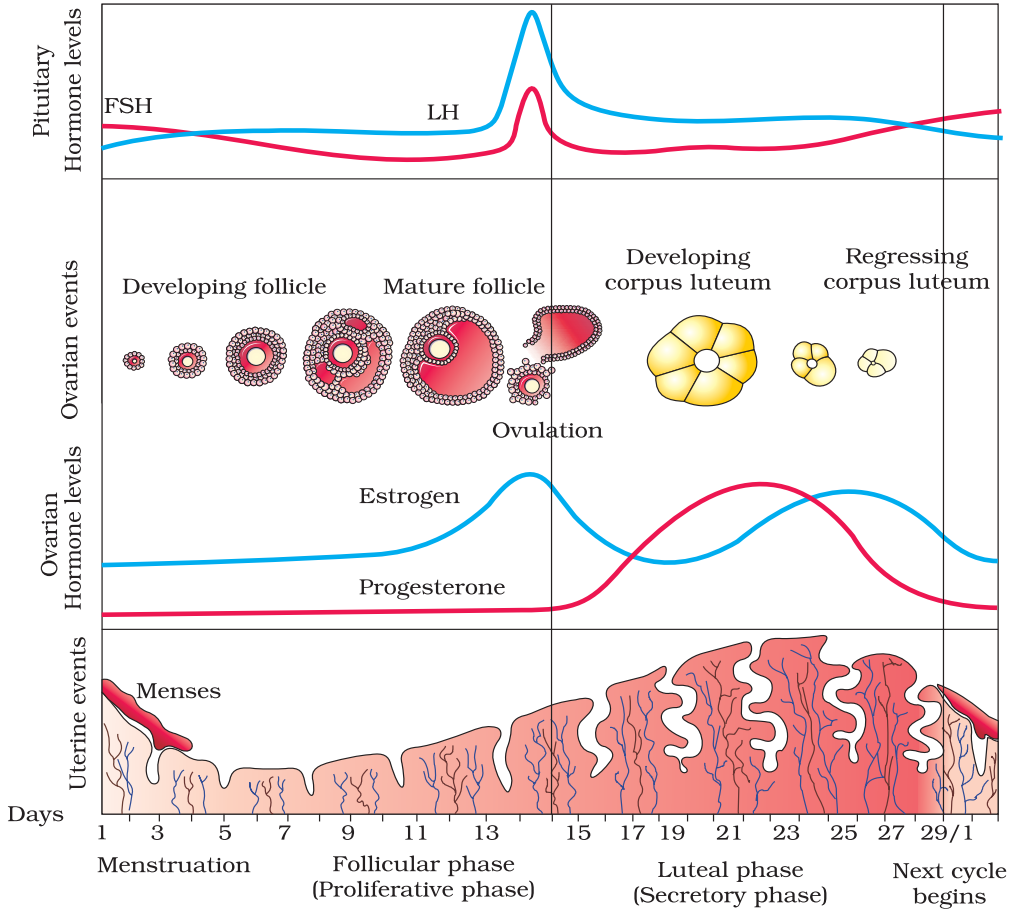
Explain the ovarian and uterine events that occur during a menstrual cycle in a human female, under the influence of Pituitary and Ovarian hormones respectively.
Answer
Release of gonodotropins (FSH and LH) from pituitary, during follicular phase or 5-14 days of menstrual cycle leads to growth of primary follicle to Graafian follicle (GF) in the ovary. Estrogen from growing follicle helps proliferation of uterine endometrium or its repair. High level of LH at middle 14th day of the menstrual cycle leads to rapture of GF causing release of ovum. This is called ovulation. The remaining cells of GF transform into corpus luteum (CL) under the influence of LH. CL secretes progesterone that maintains endometrium in preparation for pregnancy. Level of FSH and LH fall due to rise of progesterone and estrogen (25th day of the cycle), leading to degeneration of CL. Level of progesteron falls, leading to disintegration of uterine endometrium and menstruation starts (0-5 day of the cycle).
View full question & answer
Question 525 Marks
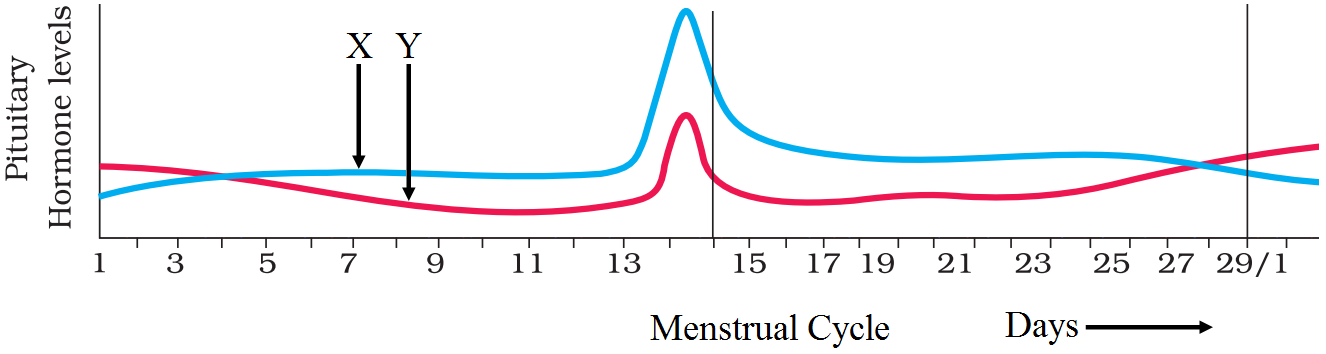
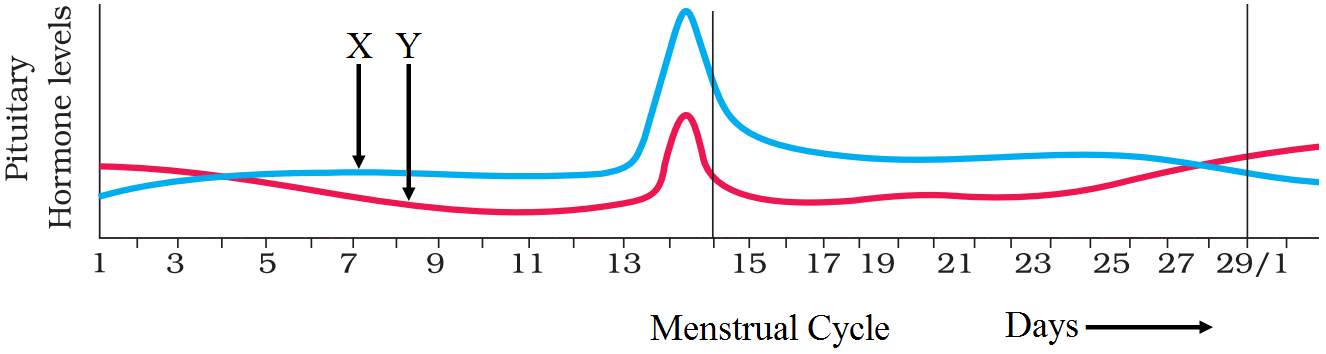
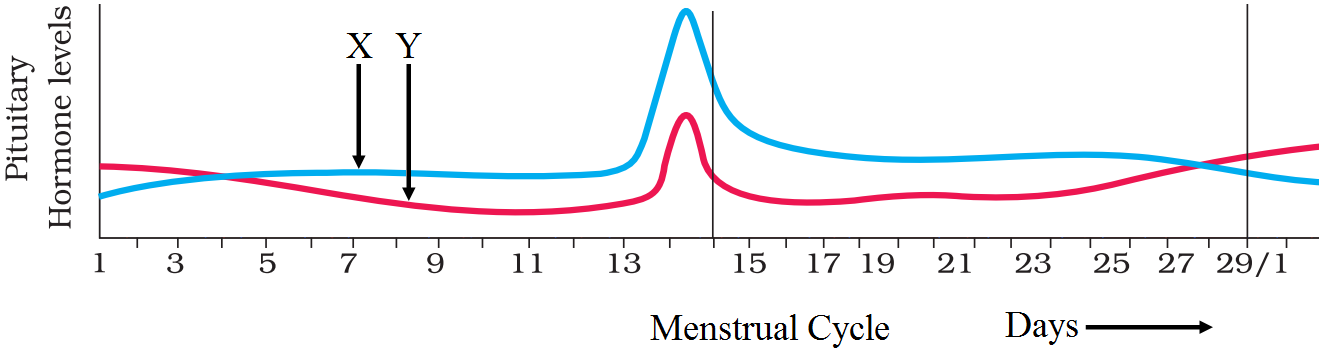
Study the graph given below and answer the questions that follow:
Name the hormones ‘X’ and ‘Y’.
Answer
Hormone ‘X’: Luteinising hormone.
Hormone ‘Y’: Follicle stimulating hormone.
View full question & answer
Question 535 Marks
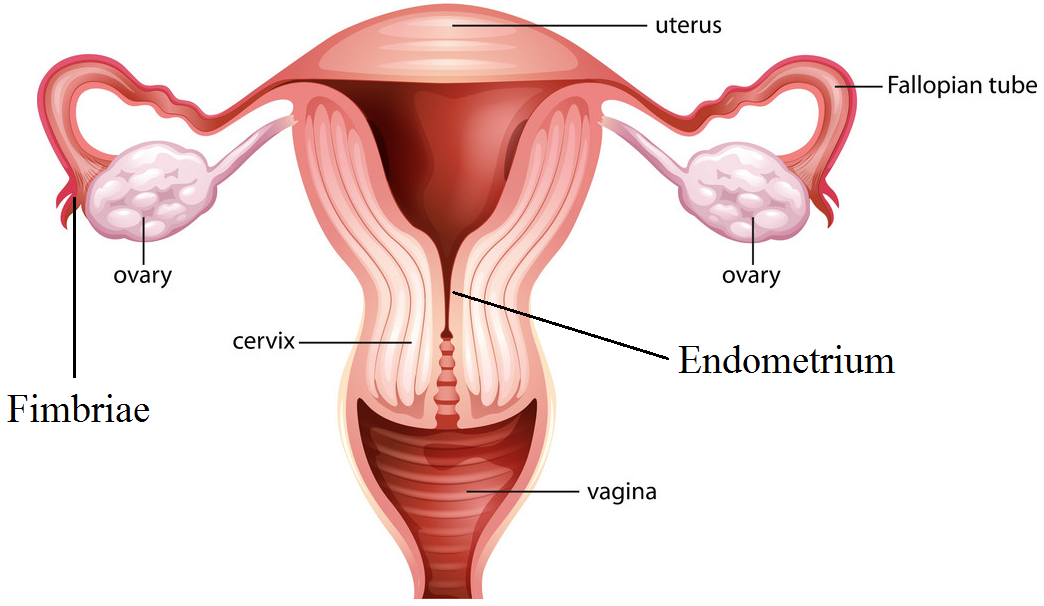
Describe female reproductive system.
Answer
The primary function of the female reproductive system is to produce the female egg cells which are essential for reproduction These are called as the ova or oocytes. It is important to know that, the entire system is designed for transporting the ova to the exact fertilization site. Further, the fertilization process of an egg after interaction with sperm usually happens in the fallopian tubes.
The later phase of the fertilized egg is associated with getting rooted into the uterus walls. This is counted as the beginning of the early stages of pregnancy. In case fertilization or implantation doesn’t occur, then the system is aimed to menstruate. Moreover, the female reproductive system is responsible for producing female sex hormones which maintain the reproductive cycle.

Parts of Female Reproductive System
The female reproductive system comprises of parts which are both internal and external to the body.
  1. External Reproductive Parts:
The external parts of the female reproductive system include:
  • Labia majora: It protects and encloses the other outside reproductive organ. The labia majora can be tagged as outsized and fleshy and is analogous to the male scrotum. It contains sweat as well as oil-secreting glands. The labia majora gets covered with hair right after puberty.
  • Labia minora: These are translated as ‘small lips’, and can be quite small close to 2 inches wide. Labia minora rest just in the interior of labia majora. It surrounds the primary opening of the vagina and urethra.
  • Bartholin’s glands: The location of these glands rest beside the vaginal opening and is responsible to manage a fluid discharge.
  • Clitoris: Both the labia minora encounter at the clitoris, which is a small and delicate protrusion that is analogous to the penis in the male reproductive system. This part of the female reproductive system is covered by a skin fold, termed as prepuce. Similar to the male penis, the clitoris is sensitive to stimulus and can turn erect.
  1. Internal Reproductive Parts:
The internal parts of the female reproductive system include:
  • Vagina: It is a canal which joins the cervix to the external portion of the body. You can even call it as the birth canal.
  • Womb or Uterus: It is a pear-shaped, hollow organ which is ‘home’ for a developing fetus. Further, the uterus separates into two parts; namely, the cervix, and the corpus. The corpus easily enlarges for holding a developing baby.
  • Ovaries: These are oval-shaped glands which are small and are located on both side of the uterus. Ovaries produce harmones and eggs.
  • Fallopian tubes: They are narrow tubes which attach to the upper portion of the uterus. Fallopian tubes act as tunnels for the egg cells. Therefore, they transport the egg cells from the ovaries the to uterus.
View full question & answer
Question 545 Marks
The following is the illustration of the sequence of ovarian events (a – i) in a human female.
Write the difference between ‘c’ and ‘h’.
Answer
c- Developing follicle;
h- Regressing corpus luteum.
View full question & answer
Question 555 Marks
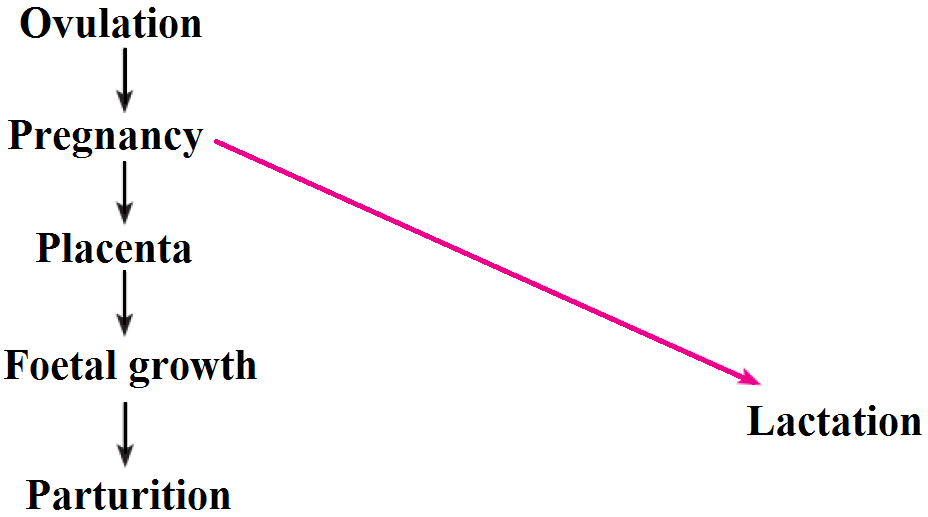
Study the flow chart given below. Name the hormones involved at each stage and explain their role.
Answer
  • Rapid release of luteinising hormone ruptures Graafian follicle and release ovum (ovulation).
  • Corpus luteum secretes large amount of progesterone hormone that is essential for maintenance of the endometrium required for implantation of blastocyst leading to pregnancy.
  • Placenta produces several hormones like human chorionic gonadotropin (hCG), human placental lactogen (hPL). Relaxin is also produced during later phase of pregnancy. Level of other hormones like estrogens, progestogens, cortisol, prolactin and thyroxine also increases which is essential for supporting fetal growth, metabolic changes in mother and maintenance of pregnancy.
  • Parturition signals originate from the fully developed foetus and the placenta induce mild uterine contractions which triggers release of oxytocin from pituitary. Oxytocin acts on the uterine muscle causing stronger uterine contractions.
View full question & answer
Question 565 Marks
Answer the following questions:
Name the stages in a human female where:
  1. Corpus luteum and placenta co–exist.
  2. Corpus luteum temporarily ceases to exist.
Answer
  1. During pregnancy.
  2. During menstruation.
View full question & answer
Question 575 Marks
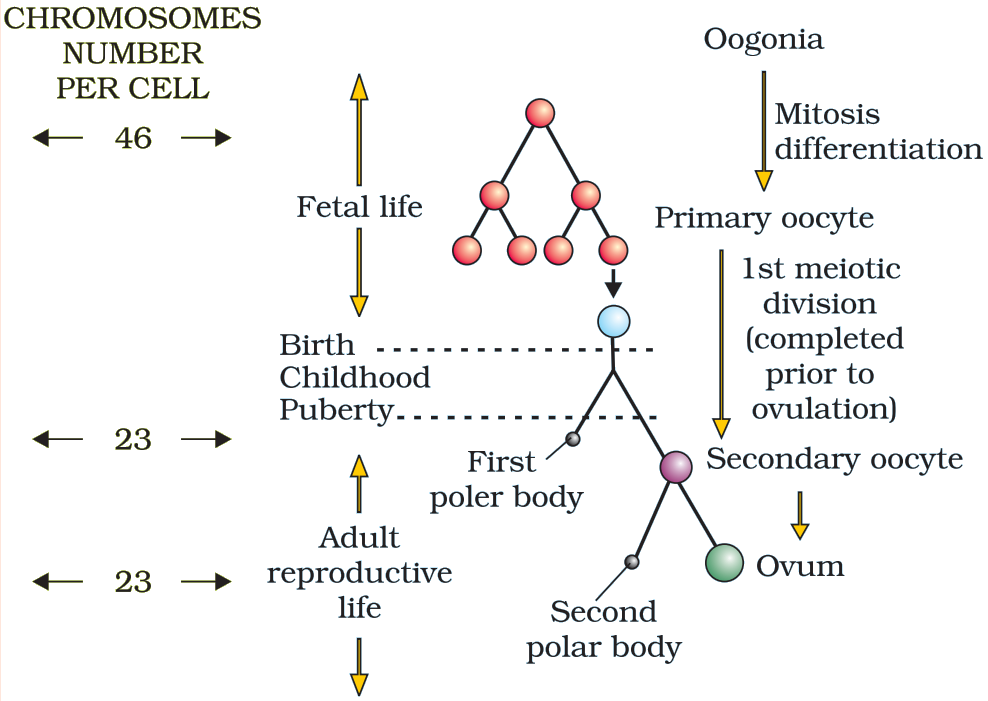
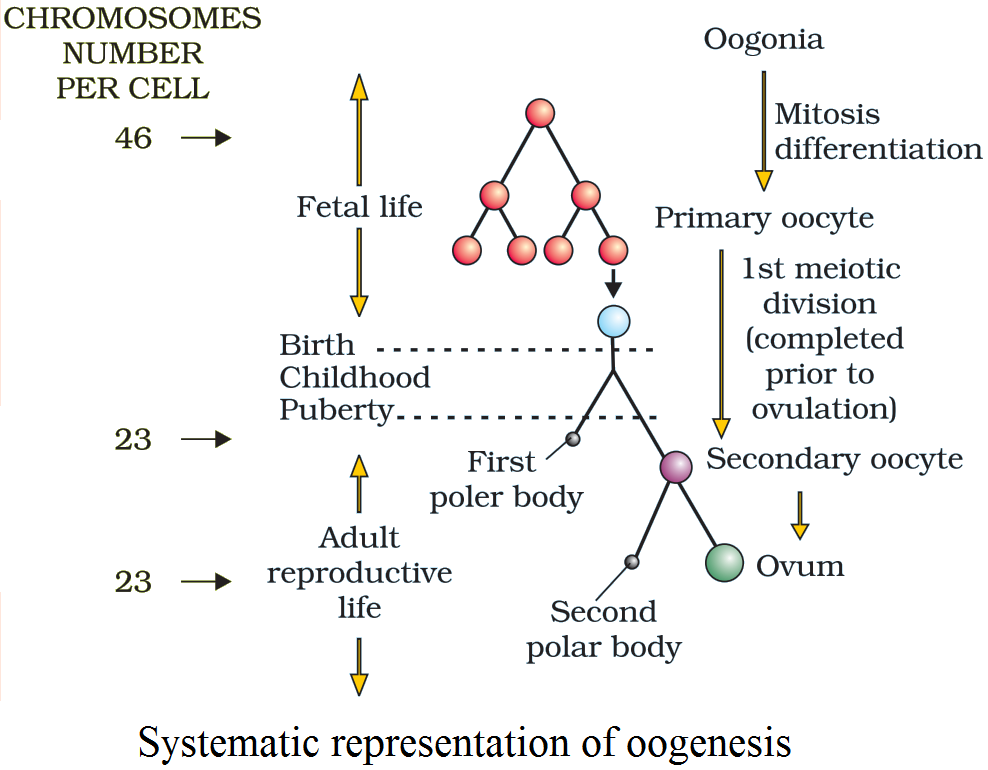
Explain the different stages of oogenesis in humans starting from foetal life till its completion. When and where in the body is oogenesis completed?
Answer
Oogenesis: The process of formation of a mature female gamete is called oogenesis. It occurs in the ovaries. It consists of the following three phases:
  1. Multiplication phase: Oogenesis is initiated during the embryonic development stage when a couple of million gamete mother cells (oogonia) are formed within each foetal ovary. No more oogonia are formed and added after birth. These cells start division and enter into prophase-I of the meiotic division. They get temporarily arrested at this stage and are called primary oocytes.
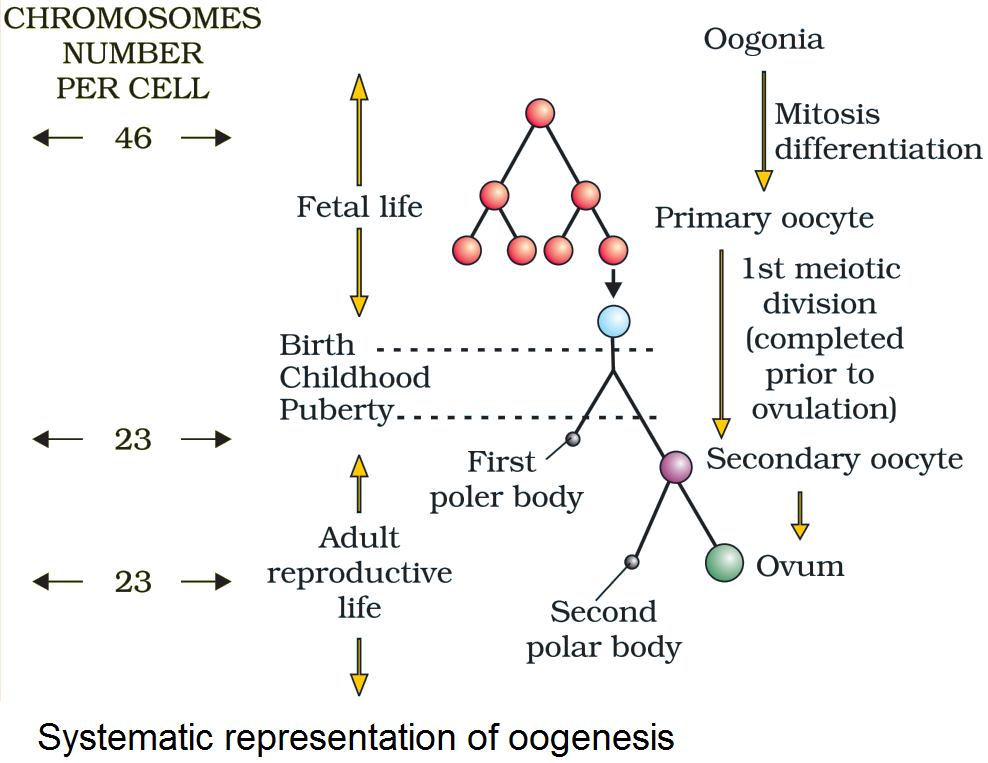
  2. Growth phase: Each primary oocyte then gets surrounded by a layer of granulosa cells. This structure is called the primary follicle. A large number of these follicles degenerate during the phase from birth to puberty. At puberty, only 60,000 to 80,000 primary follicles are left in each ovary. The primary follicles get surrounded by more layers of granulosa cells and a new theca to form secondary follicles. Systematic representation of oogenesis.
  1. Maturation phase: In the first maturation phase, the secondary follicle soon transforms into a tertiary follicle. The primary oocyte within the tertiary follicle grows in size and completes its first meiotic division to form a large, haploid, secondary oocyte and a tiny first polar body. The tertiary follicle changes into a mature follicle-the Graafian follicle-which ruptures to release the secondary oocyte (ovum) from the ovary by a process called ovulation. The second maturation phase occurs after fertilisation when the meiotic division of the secondary oocyte is complete. This second meiotic division results in the formation of a second polar body and a haploid ovum (ootid).
View full question & answer
Question 585 Marks
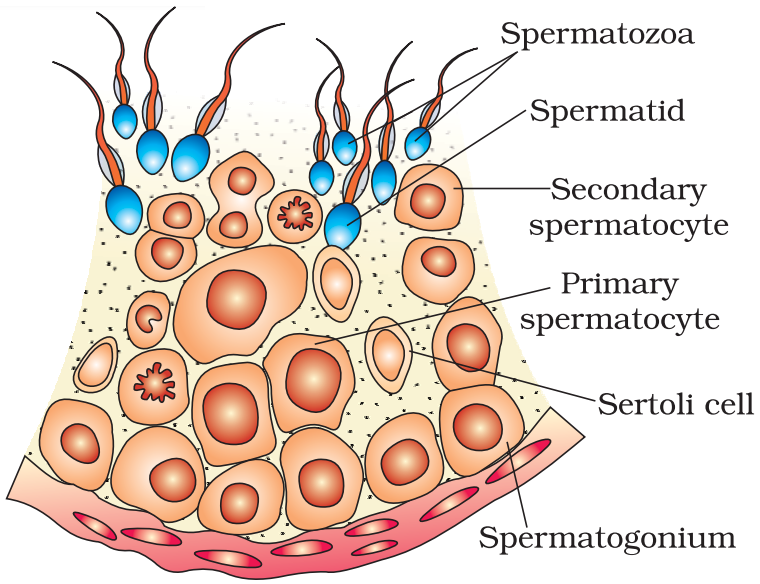
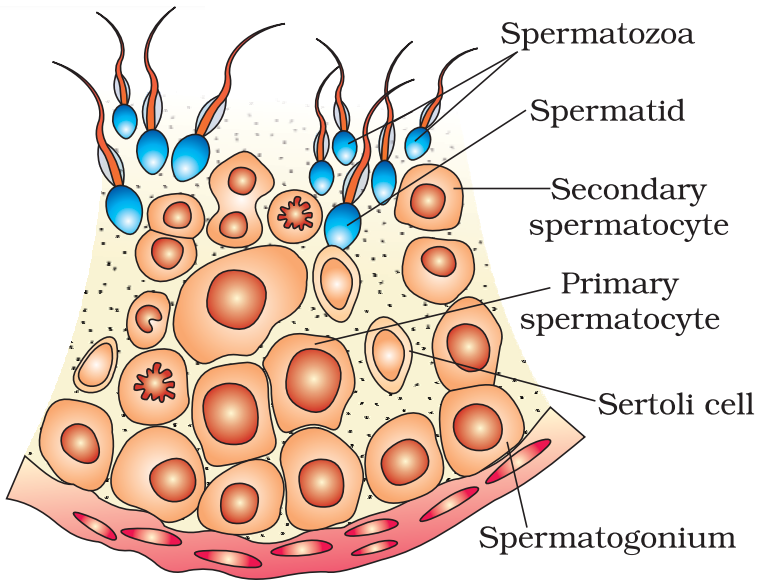
Draw a diagrammatic labelled sectional view of a seminiferous tubule of a human.
Answer

Diagrammatic sectional view of a seminiferous tubule (enlarged)Hormonal control of spermatogenesis.
View full question & answer
Question 595 Marks
Answer the following questions:
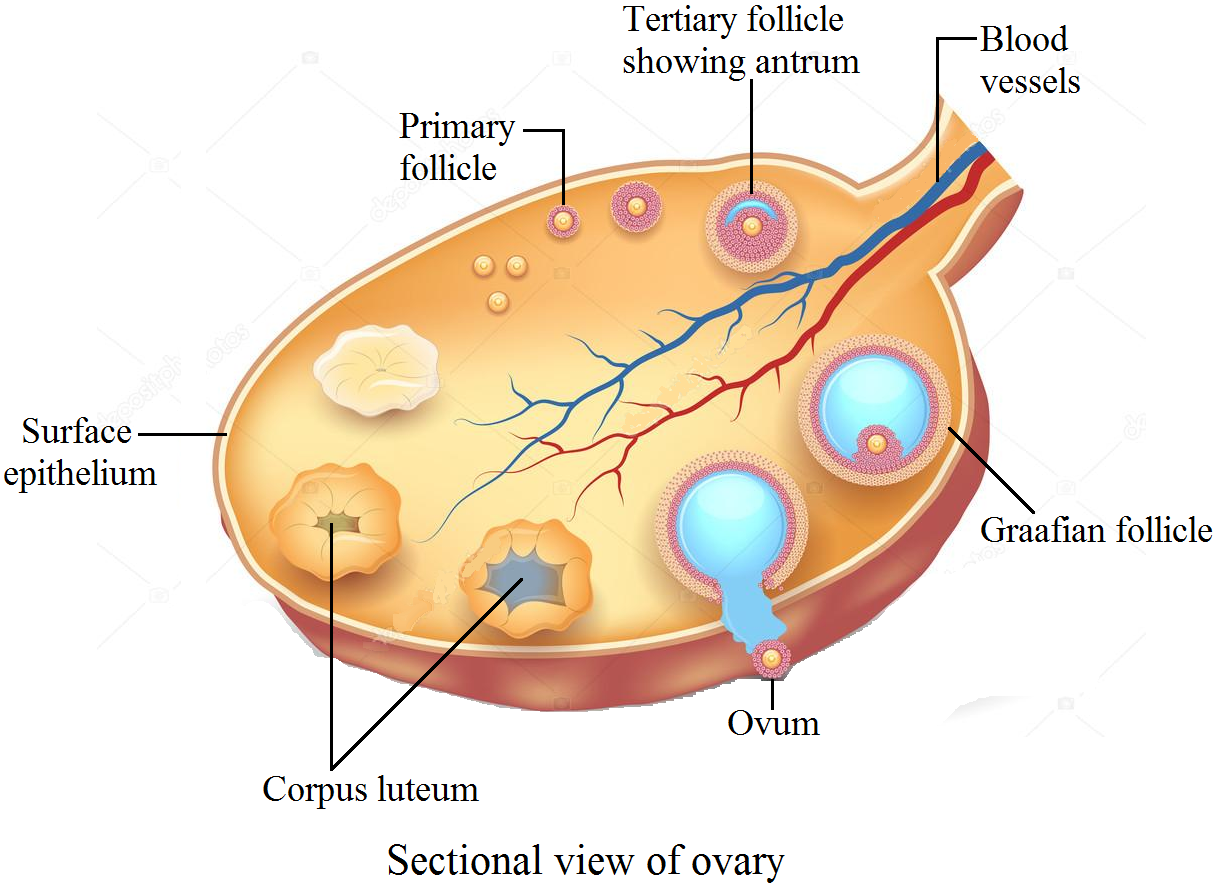
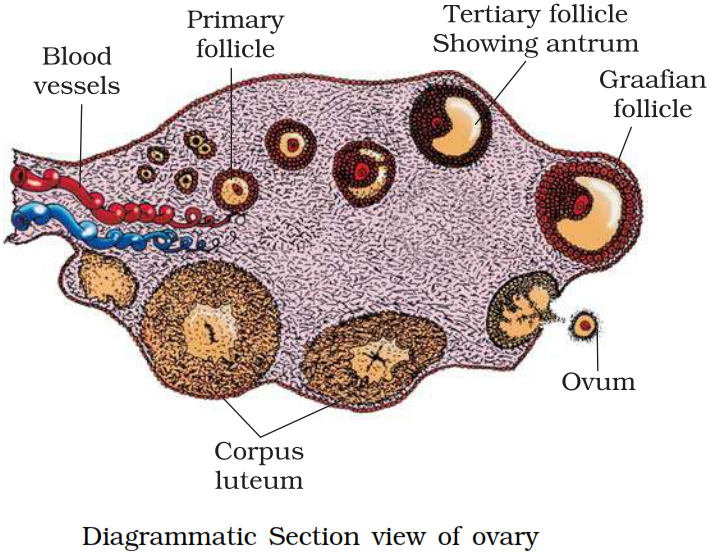
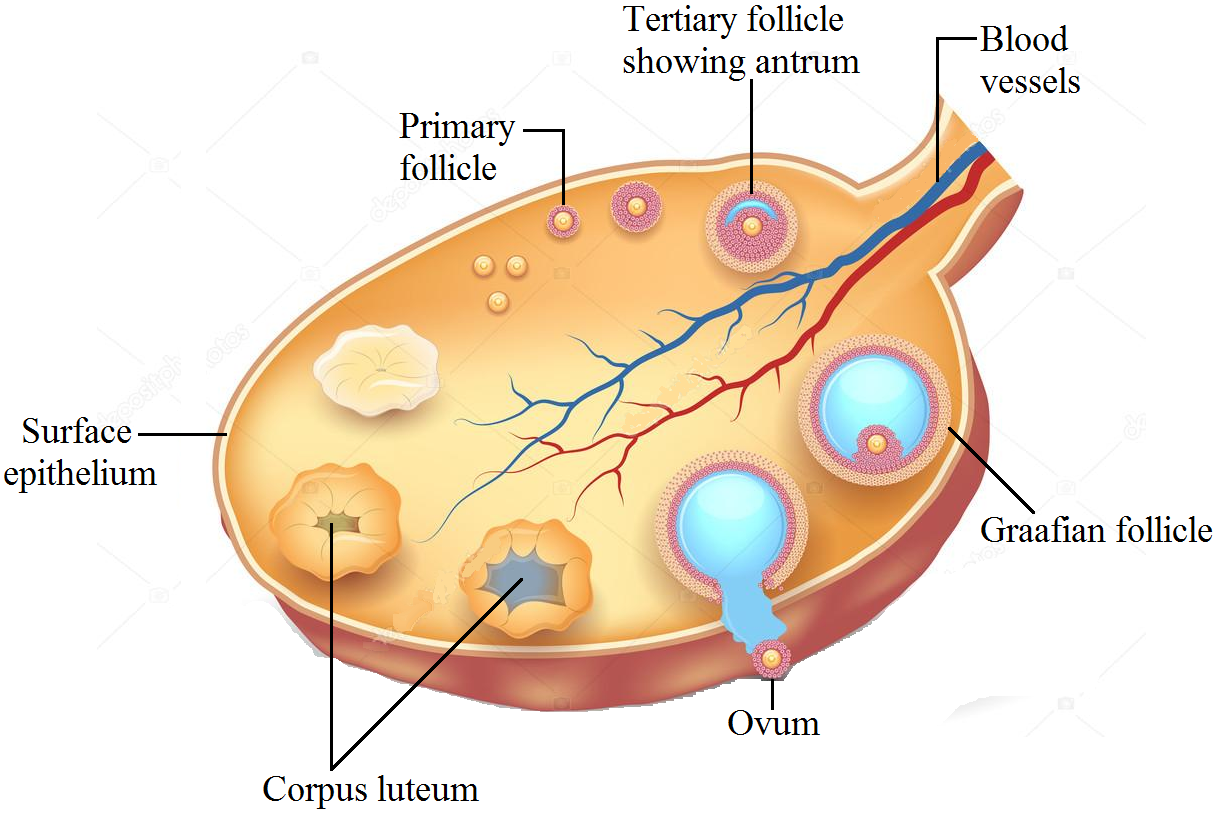
Draw a sectional view of human ovary and label the different follicular stages, ovum and corpus luteum.
Answer

Sectional view of ovary.
View full question & answer
Question 605 Marks
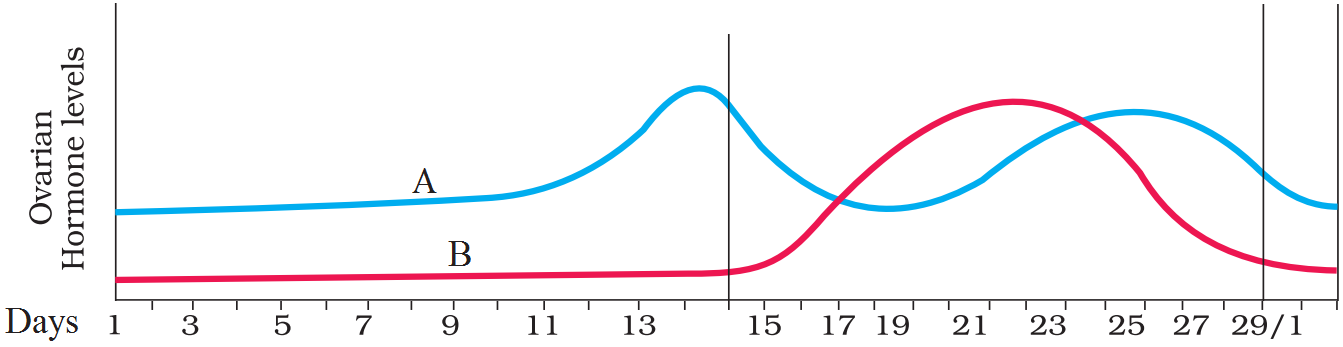
The graph given below shows the variation in the levels of ovarian hormones during various phases of menstrual cycle:
Identify ‘A’ and ‘B’.
Answer
A- Estrogen.
B- Progesterone.
View full question & answer
Question 615 Marks
Answer the following questions.
Explain the events taking place at the time of fertilisation of an ovum in a human female.
Answer
Fertilisation: The process of fusion of a sperm (male gamete) with an ovum (female gamete) is called fertilisation. During coitus, semen is released by the penis into the vagina (insemination). The motile sperms swim rapidly through the cervix, enter into the uterus and reach the ampullary – isthmic junction of the oviduct. A sperm comes in contact with the zona pellucida layer of the ovum and induces changes in the membrane to block the entry of additional sperms. The enzymes of the acrosome of sperm help to dissolve zona pellucida and plasma membrane of the ovum and sperm head is allowed to enter into the cytoplasm of the ovum, i.e., secondary oocyte.
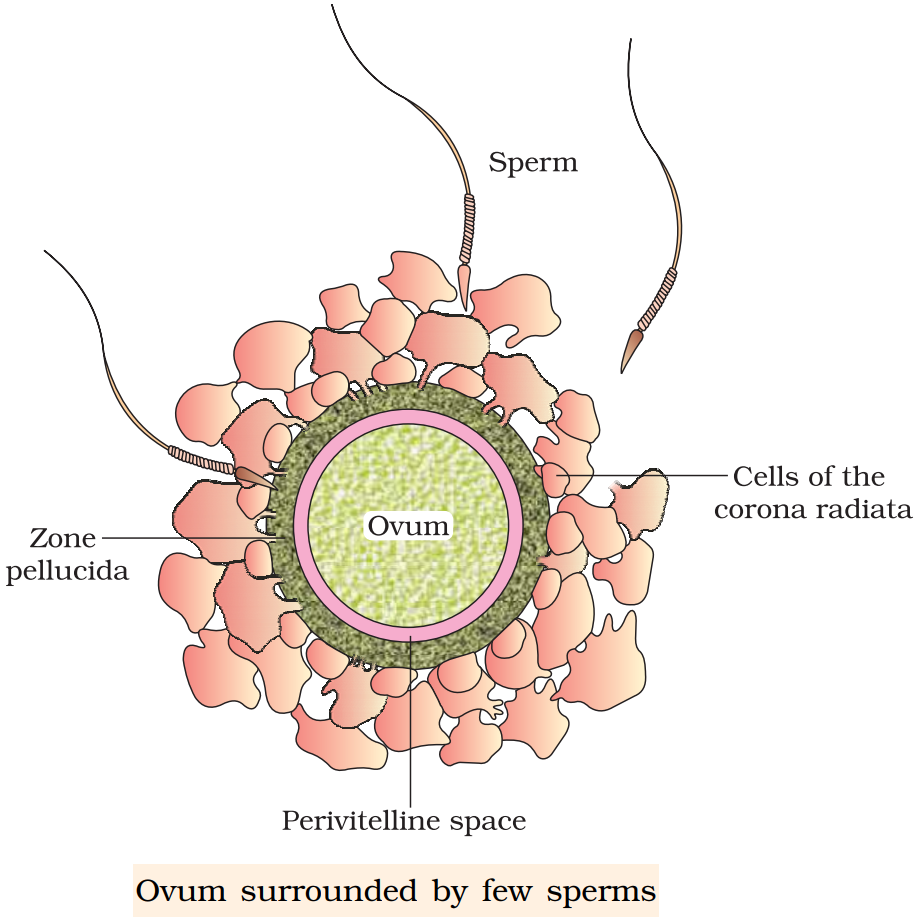
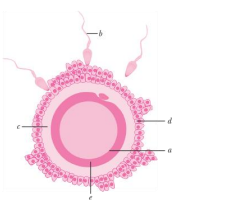
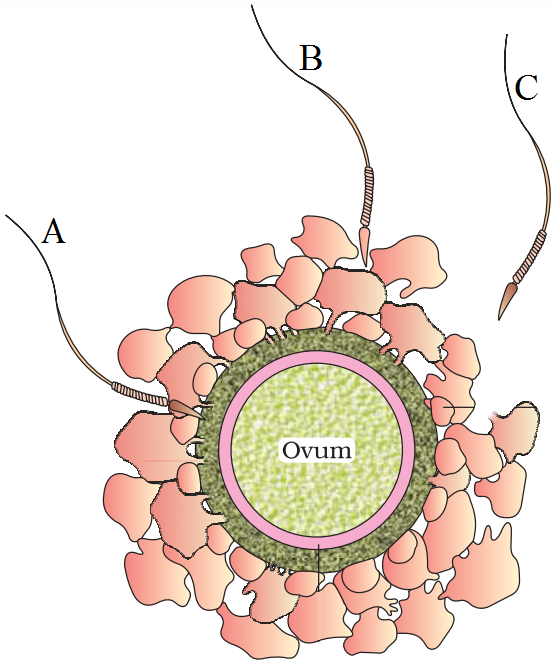
Ovum surrounded by few sperms Ultimately diploid zygote is produced by the fusion of a sperm and an ovum.
View full question & answer
Question 625 Marks
Placenta acts as an endocrine gland. Explain.
Answer
The placenta also acts as an endocrine gland as it secretes the following hormones:
  1. Human chorionic gonadotropin (hCG) .
  2. Human placental lactogen (hPL) .
  3. Progestogens.
  4. Estrogens.
The increased production of these hormones during pregnancy is essential for supporting the fetal growth and metabolic changes in the mother.
View full question & answer
Question 635 Marks
Describe the functions of the following:
Trophoblast.
Answer
Trophoblast: It is the outer layer of blastocyst which sends finger-like projections called chorionic villi into uterine stroma. Chorionic villi and uterine tissues jointly form the placenta.
View full question & answer
Question 645 Marks
During the reproductive cycle of a human female, when, where and how does a placenta develop? What is the function of placenta during pregnancy and embryo development?
Answer
After implantation, uterus, chorionic villi and uterine tissue become interdigitated (physically fused) to form a structural and functional unit between the developing embryo and the maternal body called placenta.
Functions:
  1. Placenta facilitates supply of oxygen and nutrients to the embryo.
  2. Removes carbon dioxide, waste material and excretory material produced by the embryo.
  3. Produces hCG/ hPL, estrogens and progestrogens.
View full question & answer
Question 655 Marks
Give the term/ reason:
Why does zona pellucida layer block the entry of additional sperms?
Answer
To ensure the fusion of one sperm.
View full question & answer
Question 665 Marks
Answer the following questions:
Explain the events that occur in a graafian follicle at the time of ovulation and thereafter.
Answer
Graafian follicle ruptures to release the ovum (secondary oocyte) and remaining parts of the Graafian follicle transform into corpus luteum.
View full question & answer
Question 675 Marks
Describe the functions of the following:
Seminiferous tubules.
Answer
Seminiferous tubules: Sperms are produced here by the process of spermatogenesis.
View full question & answer
Question 685 Marks
Answer the following questions:
Draw a labelled diagram of a sectional view of human seminiferous tubule.
Answer

Diagrammatic sectional view of a seminiferous tubule (enlarged) . Hormonal control of spermatogenesis.
View full question & answer
Question 695 Marks
Study the graph given below and answer the questions that follow:
Identify the ovarian phases during a menstrual cycle:
  1. 5th day to 12th day of the cycle.
  2. 14th day of the cycle.
  3. 16th day to 25th day of the cycle.
Answer
  1. 5th day to 12th day of the cycle: Follicular phase (Proliferative phase).
  2. 14th day of the cycle: Ovulatory phase (release of ovum) followed by luteal phase.
  3. 16th day to 25th day of the cycle: Luteal phase.
  4. FSH is secreted by the anterior pituitary which stimulates the ovarian follicle to secrete estrogen, which in turn stimulates the proliferation of the endometrium of the uterine wall.
View full question & answer
Question 705 Marks
Explain the development of a secondary oocyte (ovum) in human female from the embryonic stage upto its ovulation. Name the hormones involved in this process.
Answer

Systematic representation of oogenesis.
Hormones involved are:
LH/ Luteinising hormone.
FSH/ Follicle stimulating hormone.
Estrogen.
View full question & answer
Question 715 Marks
Study the following flow chart. Name the hormones involved at each stage. Explain their functions.
Hypothalamus → Pituitary → Testes → Sperms.
Answer

Hypothalamus secretes gonadotropin releasing hormone (GnRH) which stimulates the anterior lobe of pituitary gland to secrete LH (Luteinising hormone) and FSH (Follicle stimulating hormone).
LH stimulates Leydig cells for the secretion of testosterone from the testes.
FSH stimulates Sertoli cells of the testes to secrete an androgen-binding protein (ABP) that concentrates testosterone in seminiferous tubules. It also causes the secretion of some factors which help in spermiogenesis.
View full question & answer
Question 725 Marks
Study the flow chart given below. Name the hormones involved at each stage and explain their functions.
Hypothalamus
$\downarrow$
Pituitary
$\downarrow$
Ovary
$\downarrow$
Pregnancy
Answer
  1. Gonadotropin releasing hormone is released by the hypothalamus; it stimulates the pituitary to release follicle stimulating hormone (FSH) and luteinising hormone (LH), both of which act on the ovary.
  2. FSH stimulates the development of ovarian follicle into mature Graafian follicle and also secretion of estrogens by the follicle cells.
  3. LH stimulates ovulation, formation of corpus luteum from the ruptured follicle and secretion of progesterone by the corpus luteum.
  4. Progesterone is necessary to maintain the endometrium for implantation of the embryo and other events of pregnancy.
View full question & answer
Question 735 Marks
Human female is not fertile after menopause whereas males can produce gametes at any age after puberty. Analyse the statement and schematically represent a comparison between gametogenesis in males and females.
View full question & answer
Question 745 Marks
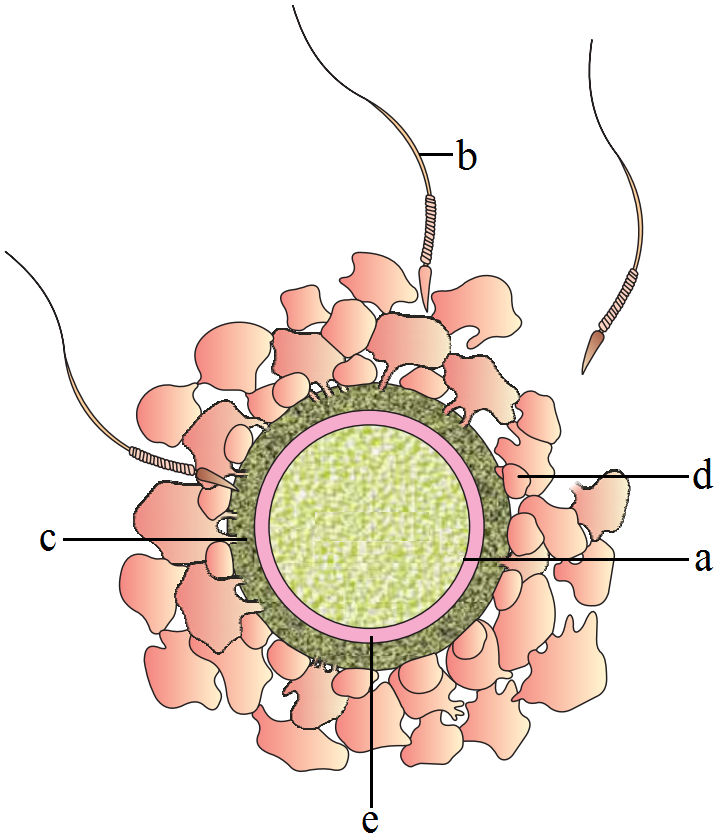
Study the illustration given and answer the questions that follow:

Draw a diagram of ‘b’ separately and label the parts:
  • That help its entry into ‘a’;
  • That carry genetic material;
  • That help in its movement.
View full question & answer
Question 755 Marks
Answer the following questions:
Explain the role of pituitary and the ovarian hormones in menstrual cycle in human females.
Answer
  1. Pituitary hormone:
  • FSH stimulates maturation of follicle.
  • Rapid secretion of LH (LH surge) induces rupture of Graafian follicle, thereby leading to ovulation (release of ovum).
  1. Ovarian hormone:
  • Estrogen stimulates follicular development.
  • Progesterone produced by corpus luteum helps to maintain endometrium.
In the absence of fertilisation corpus luteum degenerates and the endometrium disintegrates leading to menstruation.
View full question & answer
Question 765 Marks
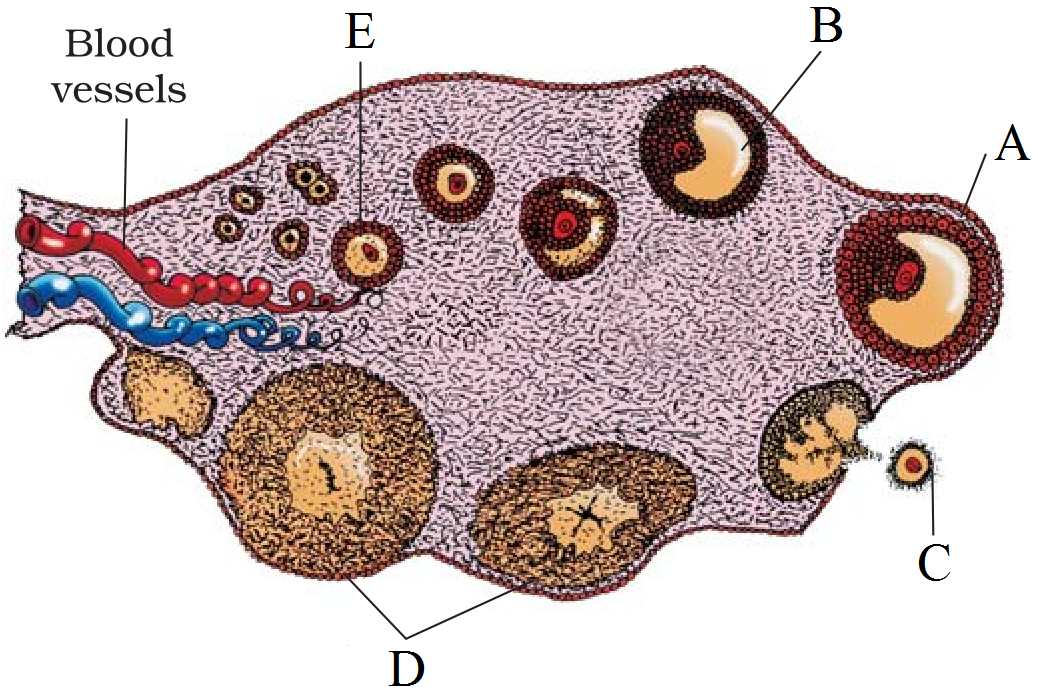
  1. Given below is the TS of human ovary. Identify the following in the diagram:
  • Corpus luteum.
  • Secondary oocyte.
  • Antrum.
  • Primary follicle.
  • Primary oocyte.
  1. Explain the changes the primary oocyte undergoes while in different follicular stages before ovulation.
​​​​​​​
Answer
  1.  
  1. ln human embryo, the primary oocyte grows in size, completes meiosis-I and forms a larger cell, the secondary oocyte and a smaller cell, the first polar body.
View full question & answer
Question 775 Marks
Enumerate the events in the ovary of a human female during:Follicular phase.
Answer
In the follicular phase, following events occur:
  1. The primary follicles in the ovary grow to form a fully mature Graafian follicle.
  2. The endometrium of uterus regenerates through proliferation.
  3. The secretion of gonadotropins (LH and FSH) gradually increases.
View full question & answer
Question 785 Marks
Study the illustration given and answer the questions that follow:
Identify ‘d’.
Answer
d – cells of corona radiata.
View full question & answer
Question 795 Marks
Explain the development of a secondary oocyte (ovum) in a human female from the embryonic stage upto its ovulation. Name the hormones involved in this process.OR
When does oogenesis start in humans? Name the three hormones and their sources, linked with oogenesis. How do they influence the process of oogenesis? Explain.
Answer
The process of formation of a mature female gamete is called oogenesis. Oogenesis starts during embryonal stages where millions of gamete mother cells-oogonia are formed in foetal ovary. Oogonia starts division and enters prophase-I and gets temporarily arrested at this stage to form primary oocytes. Each primary oocyte gets surrounded by a layer of granulosa cells forming primary follicle. From birth to puberty, large number of follicles degenerate (follicular atresia) and at puberty 60,000-80,000 follicles are left in each ovary. Primary follicles form secondary follicles, surrounded by more layers of granulosa cells. Secondary follicle transforms into tertiary follicle with a fluid-filled cavity called antrum, having theca externa and theca interna and primary oocyte completes Ist meiotic division (grows in size) forming two very unequal haploid cells, large haploid secondary oocyte and a tiny first polar body. Tertiary follicle transforms into mature Graafian follicle which bursts to release ovum/secondary oocyte (ovulation). The hormones involved are FSH (Follicle Stimulating Hormone) and LH (Luteinising Hormone) secreted by anterior pituitary in response to production of GnRH. (Gonadotropin Releasing Hormone). FSH stimulates follicular growth and maturation of oocyte. Granulosa cells of follicles produce oestrogen. In the presence of both LH and oestrogen ovulation occurs.
View full question & answer
Question 805 Marks
Give the term/ reason:
Mechanism responsible for parturition.
Answer
The complete neuro-endocrine mechanism.
View full question & answer
Question 815 Marks
Answer the following questions:
Name the organs where gametogenesis gets completed in human male and female, respectively.
Answer
In human males, the process is completed in the testes (seminiferous tubules) whereas in females, it is completed in the fallopian tube (oviduct).
View full question & answer
Question 825 Marks
Answer the following questions:
Explain the menstrual phase in a human female. State the levels of ovarian and pituitary hormones during this phase.
Answer
Menstrual Phase:
  • The soft tissue of endometrial lining of the uterus disintegrates causing bleeding.
  • The unfertilised egg and soft tissues are discharged.
  • It lasts for 3-5 days.

Diagrammatic presentation of various events during a menstrual cycle.
View full question & answer
Question 835 Marks
Write briefly the changes in the following organs in the different phases of the menstrual cycle:
  1. Ovaries.
  2. Uterus.
  3. Fallopian tube.
Answer
Ovaries: During the first phase of menstrual cycle, growth of follicles occur and primary oocyte matures in the follicle. The mature Graafian follicle bursts to release the ovum. In luteal phase, the remaining follicle forms corpus luteum, an endocrine gland that produces progesterone.
Uterus: The inner walls of the uterus are highly vascularised and muscular in nature and is known as endometrium. This wall takes active part in menstrual cycle because it breaks down due to the lack of progesterone. As a result, bleeding occurs. In the follicular phase, uterus enlarges in size.
Fallopian tube: The wall of the fallopian tubes thickens and its cilia and their movements are increased.
View full question & answer
Question 845 Marks
Mention their source and the function they perform:
hCG, LH, FSH, Relaxin.
Answer
S. No.
Hormone
Source
Function
(i)
FSH
Anterior pituitary lobe.
Stimulates growth of ovarian follicles and maturation of primary oocytes.
(ii)
LH
Anterior pituitary lobe.
Induces ovulation and maintains corpus luteum.
(iii)
hCG
Chorionic cells of placenta.
Maintains the corpus luteum and stimulates it to secrete progesterone.
(iv)
Relaxin
Ovary.
Helps during child birth by relaxing the pelvic muscles as well as muscles of the cervix.
View full question & answer
Question 855 Marks
Describe the functions of the following:
Vagina.
Answer
Vagina: It receives the semen from the male during coitus. It serves as the birth canal during parturition.
View full question & answer
Question 865 Marks
Given below is the diagram of a human ovum surrounded by a few sperms. Observe the diagram and answer the following questions:
Compare the fate of sperms shown in the diagram.
Answer
A is able to penetrate/ fertilize the ovum, whereas B and C are unable to penetrate/ fertilise B and C will degenerate.
View full question & answer
Question 875 Marks
Give the term/ reason:
Role of oxytocin during expulsion of the baby out of uterus.
Answer
Oxytocin acts on uterine muscle for stronger contraction.
View full question & answer
Question 885 Marks
The following is the illustration of the sequence of ovarian events (a-i) in a human female.
Name the ovarian hormone and the pituitary hormone that have caused the above mentioned event.
Answer
Estrogen and Luteinising hormone (LH).
View full question & answer
Question 895 Marks
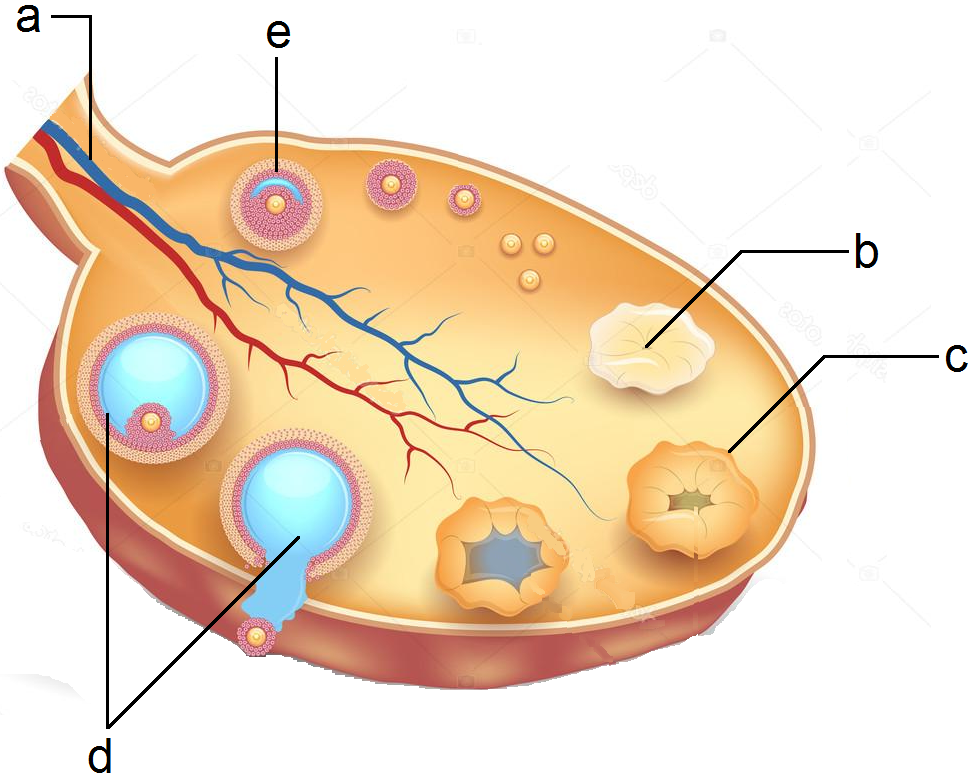
Answer the following questions: Given below is the T.S. of human ovary. Identify the following in the diagram:
  1. Corpus luteum.
  2. Secondary oocyte.
  3. Antrum.
  4. Primary follicle.
  5. Blood vessels.
Answer
  1. Corpus luteum-d.
  2. Secondary oocyte-c.
  3. Antrum-b.
  4. Primary follicle-e.
  5. Blood vessels-a.
View full question & answer
Question 905 Marks
Answer the following questions:
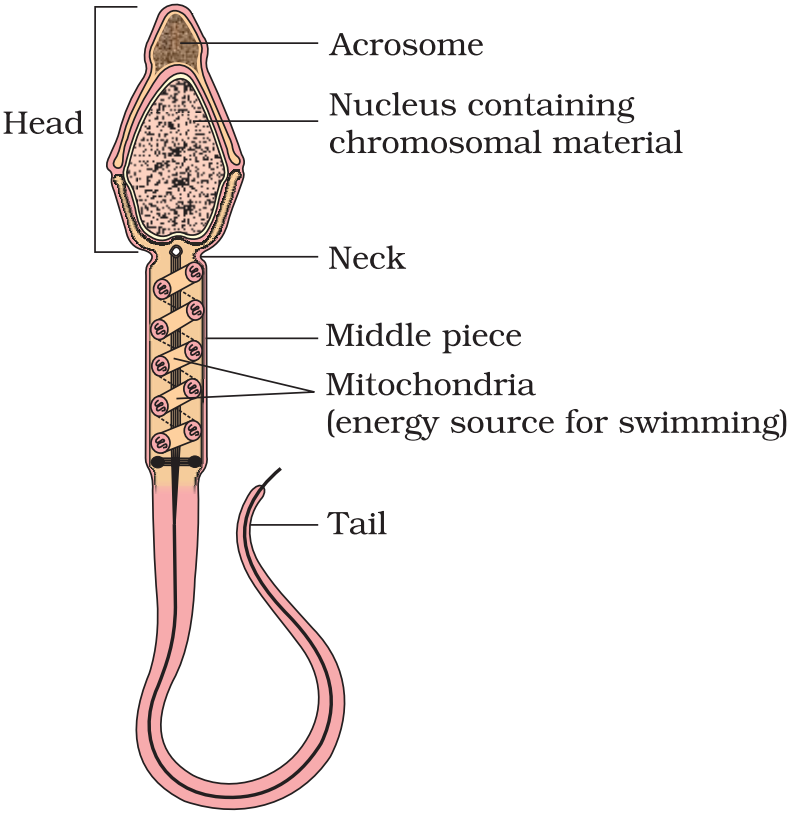
Draw a schematic diagram of a human sperm and label the cellular components. Give the functions of any three parts.
Answer
Structure of a sperm (Spermatozoa):It consists of four parts–head, neck, middle piece and tail-enveloped by a plasma membrane.
Head: It is the enlarged end of a sperm, containing the large haploid nucleus, i.e., condensed chromatin body and is capped by acrosome. The acrosome contains hydrolytic enzymes that help in dissolving membranes of the ovum for fertilisation.
Neck: It contains proximal centriole which is necessary for the first cleavage division of zygote and the distal centriole that is connected to the tail filament.
Middle Piece: It contains a number of mitochondria that provide energy for the movement of the tail that facilitate sperm motility, essential for fertilisation.
Tail: It consists of axial filaments surrounded by the plasma membrane. It helps the sperms to swim in a fluid medium.
A human male ejaculates about 200-300 million sperms during a coitus. Seminal plasma along with the sperms constitute the semen.

Structure of a sperm.
View full question & answer
Question 915 Marks
The following is the illustration of the sequence of ovarian events (a – i) in a human female.
Draw a labelled sketch of the structure of a human ovum prior to fertilisation.
View full question & answer
Question 925 Marks
Answer the following questions:
Where is morula formed in humans? Explain the process of its development from zygote.
Answer
Morula is formed in the upper portion of oviduct, i.e., isthmus. The haploid nucleus of the sperms and that of the ovum fuse together to form a diploid zygote. Zygote divides rapidly as it moves through the isthmus of the oviduct by mitotic division called cleavage and as a result 2, 4, 8, 16 daughter cells are produced, which are termed as blastomeres. The embryo with 8-16 blastomeres is called a morula.
View full question & answer
Question 935 Marks
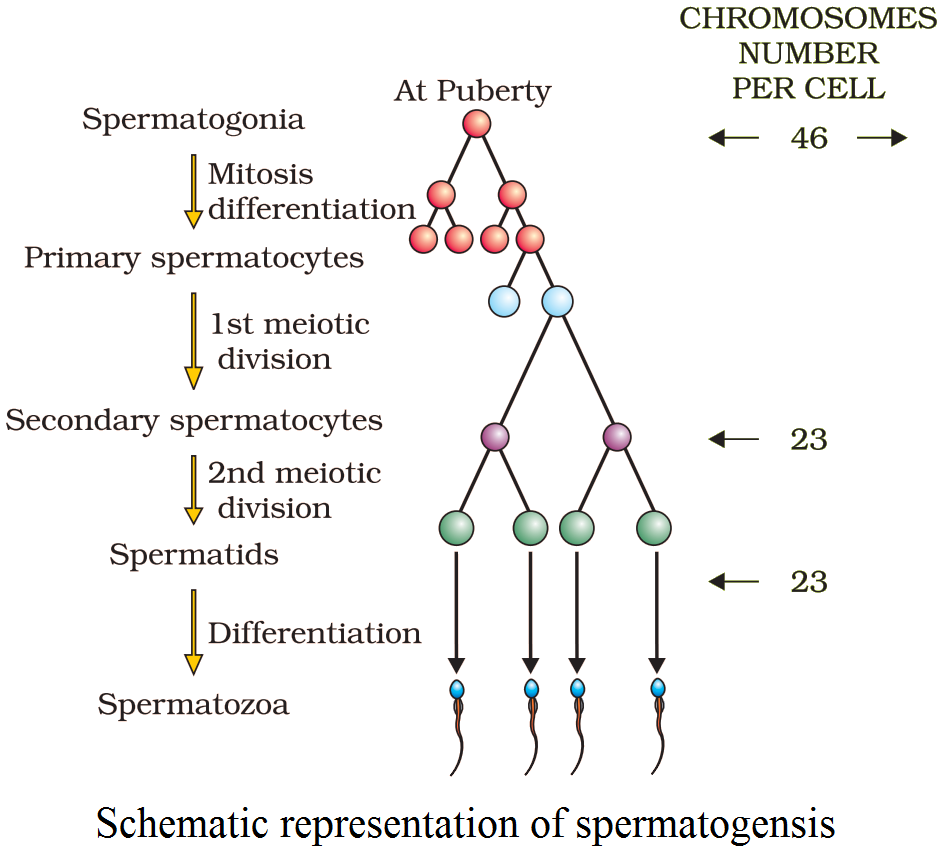
Where does spermatogenesis occur in human testes? Describe the process of spermatogenesis upto the formation of spermatozoa.
Answer
Spermatogenesis occur in seminiferous tubules.
Schematic representation of spermatogensis.
View full question & answer
Question 945 Marks
Give the term/ reason:
Sperm cannot reach ovum without seminal plasma.
Answer
Seminal plasma is a liquid medium which helps the sperm to move and nourishes it.
View full question & answer
Question 955 Marks
What are the major features of embryonic development at various months of pregnancy?
Answer
Month 1: Human development starts when a sperm fuses with an egg to create a zygote. A zygote is a single-cell that contains two copies of chromosomes-one copy from each parent. In the week following fertilization, the zygote undergoes rapid cell division and becomes a mass of cells known as a blastocyst. After more cell division, the blastocyst splits in half.
Month 2: This month, the embryo’s development shifts into high gear. Its tongue, teeth and eyelids start to form. Its limbs grow longer and stronger, and its palate is nearly complete. Also in this time period, the embryo’s gastrointestinal tract separates from its urogenital organs and its heart begins beating-twice as fast as yours, in fact.
Month 3: This is the month of the heartbeat. Using a special tool called a Doppler monitor, doctors can detect the tiny thump-thumps of a 10-week-old fetus.
Month 4: Get out the headphones and tune the radio dial to Mozart-this month, the fetus can hear its mother’s heartbeat, her voice and other outside noises. The fetus is also developing at warp speed; by now, all its major organs are complete.
Month 5: Finally, the baby really starts kicking! “Quickening” is when a mother senses her potential punter in action for the first time, and this milestone moment usually happens during pregnancy’s fifth month.
Month 6: Month 6 marks the end of the second trimester. At this point, the fetus’s essential organs-its kidneys, heart and lungs-are fully formed. The facial features are becoming more recognizable. It also can hiccup and react to loud “outside” noises by blinking, shifting or kicking. By month’s end, the fetus will measure about 12 or 13 inches long and weigh roughly 2 pounds.
Month 7: The 7-month-old fetus can blink, and its eyes may even remain open for short period of time. Hands and feet are becoming even more active. Also in this phase: Taste buds form and protective fat tissue makes its debut. The fetus’s hearing is fully developed and, in boys, its testicles have moved to the groin. By month’s end, the baby-to-be will measure 14 to 16 inches long and weigh anywhere from 2 ½ to 3 ½ pounds.
Month 8: This month, the fetus’s brain develops rapidly, and all of its organs except the lungs are mature. An 8-month-old fetus stretches 16 to 18 inches long and weighs between 4 and 6 pounds. And as the baby-to-be grows larger, space in the womb becomes scarce. Expectant mothers should still count on catching a few elbows every day, but the elaborate somersault sequences should stop until delivery day. Other exciting changes during this period? The fetus’s fingernails now reach beyond its fingertips and its skin is starting to smooth.
Month 9: The finish line is in sight! In this final month of development, the fetus’s fat layers thicken to help keep it warm outside the womb, and the protective layers of vernix caseosa and lanugo largely disappear. By now, the fetus’s lungs are mature, its skin pink and smooth, and its toenails fully grown. The baby-to-be can also execute an array of reflexes, such as head turning, blinking and grasping. At this late stage, it stretches between 20 to 22 inches long, and weighs about 7½ pounds.
View full question & answer
Question 965 Marks
Answer the following questions:
Describe the stages of oogenesis in human females.
Answer
Oogenesis:The process of formation of a mature female gamete is called oogenesis. It occurs in the ovaries. It consists of the following three phases:
  1. Multiplication phase: Oogenesis is initiated during the embryonic development stage when a couple of million gamete mother cells (oogonia) are formed within each foetal ovary. No more oogonia are formed and added after birth. These cells start division and enter into prophase-I of the meiotic division. They get temporarily arrested at this stage and are called primary oocytes.
  2. Growth phase: Each primary oocyte then gets surrounded by a layer of granulosa cells. This structure is called the primary follicle. A large number of these follicles degenerate during the phase from birth to puberty. At puberty, only 60,000 to 80,000 primary follicles are left in each ovary. The primary follicles get surrounded by more layers of granulosa cells and a new theca to form secondary follicles.

Systematic representation of oogenesis.

  1. Maturation phase: In the first maturation phase, the secondary follicle soon transforms into a tertiary follicle. The primary oocyte within the tertiary follicle grows in size and completes its first meiotic division to form a large, haploid, secondary oocyte and a tiny first polar body. The tertiary follicle changes into a mature follicle – the Graafian follicle – which ruptures to release the secondary oocyte (ovum) from the ovary by a process called ovulation. The second maturation phase occurs after fertilisation when the meiotic division of the secondary oocyte is complete. This second meiotic division results in the formation of a second polar body and a haploid ovum (ootid).

Sectional view of ovary Oogenesis is completed when the sperm penetrates the ovum.
View full question & answer
Question 975 Marks
The following is the illustration of the sequence of ovarian events (a – i) in a human female.
Explain the changes that occur in the uterus simultaneously in anticipation.
Answer
Endometrium proliferate (glands become cork-screw shaped) highly vascularised, high regeneration anticipating implantation of the fertilised ovum.
View full question & answer
Question 985 Marks
Describe the functions of the following:
Scrotum.
Answer
Scrotum: Testes are situated in scrotum where the temperature remains 2-2.5°C less than the internal body temperature, which is essential for the formation of sperms.
View full question & answer
Question 995 Marks
Answer the following questions:
Write the specific location and the functions of the following cells in human males:
  1. Leydig cells.
  2. Sertoli cells.
  3. Primary spermatocyte.
Answer
S. No.
Cells
Location
Function
i.
Leydig cells
Outside seminiferous tubules in interstitial space.
Synthesis and secretion of testicular hormones called androgens.
ii.
Sertoli cells
Inside the seminiferous tubules.
Provide nutrition to the germ cells.
iii.
Primary spermatocyte
Inner wall of seminiferous tubules.
Undergo meiotic divisions to form secondary spermatocyte and then haploid sperms.
View full question & answer
Question 1005 Marks
Study the graph given below and answer the questions that follow:
Explain the ovarian events (i), (ii) and (iii) under the influence of hormones ‘X’ and ‘Y’.
Answer
Both LH and FSH attain a peak level in the middle of cycle (about 14th day).
Rapid secretion of LH leading to its maximum level during the mid-cycle called LH surge induces rupture of Graafian follicle and thereby the release of ovum (ovulation).
The remaining cells of ovarian follicles are stimulated by the LH to transform into corpus luteum. The corpus luteum secretes large amount of progesterone which is essential for maintenance of the endometrium.
View full question & answer
5 Marks Questions - Page 2 - Biology STD 12 Science Questions - Vidyadip