Questions

3 Marks Question

🎯

Test yourself on this topic

10 questions · timed · auto-graded

Question 13 Marks
List the Salient Features of Human Genome
Answer
→ Some of the salient observations drawn from human genome project are as follows:
(i) The human genome contains 3164.7 million bp.
(ii) The average gene consists of 3000 bases, but sizes vary greatly, with the largest known human gene being dystrophin at 2.4 million bases.
(iii) The total number of genes is estimated at 30,000 - much lower than previous estimates of 80,000 to 1,40,000 genes. Almost all (99.9 per cent) nucleotide bases are exactly the same in all people.
(iv) The functions are unknown for over 50 per cent of the discovered genes.
(v) Less than 2 per cent of the genome codes for proteins.
(vi) Repeated sequences make up very large portion of the human genome.
(vii) Repetitive sequences are stretches of DNA sequences that are repeated many times, sometimes hundred to thousand times. They are thought to have no direct coding functions, but they shed light on chromosome structure, dynamics and evolution.
(viii) Chromosome 1 has most genes (2968), and the Y has the fewest (231).
(ix) Scientists have identified about 1.4 million locations where single-base DNA differences (SNPs - single nucleotide polymorphism, pronounced as 'snips') occur in humans. This information promises to revolutionise the processes of finding chromosomal locations for disease-associated sequences and tracing human history.
View full question & answer
Question 23 Marks
In eukaryotes, explain splicing & tailing (figure is not necessary).
Answer
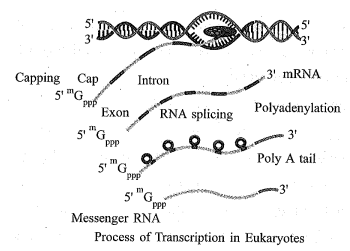
→ In eukaryotes, there are two additional complexities
(i) There are at least three RNA polymerases in the nucleus (in addition to the RNA polymerase found in the organelles). There is a clear cut division of labour. The RNA polymerase I transcribes rRNAs (28S, 18S, and 5.8S), whereas the RNA polymerase III is responsible for transcription of tRNA, 5srRNA, and snRNAs (small nuclear RNAs). The RNApolymerase II transcribes precursor of mRNA, the heterogeneous nuclear RNA (hnRNA).
(ii) The second complexity is that the primary transcripts contain both the exons and the introns and are non-functional.
→ Post-Transcriptional changes
→ Hence, it is subjected to a process called splicing where the introns are removed and exons are joined in a defined order.
hnRNA undergoes additional processing called
Image
→ It is the fully processed hnRNA, now called mRNA, that is transported out of the nucleus for translation.
→ The significance of such complexities is now beginning to be understood. The split-gene arrangements represent probably an ancient feature of the genome.
→ The presence of introns is reminiscent of antiquity, and the process of splicing represents the dominance of RNA-world.
→ In recent times, the understanding of RNA and RNA-dependent processes in the living system have assumed more importance.
Image
View full question & answer
Question 33 Marks
List the salient features of genetic code###Give important feature of genetic code###Write any six main teatares of genetic code
Answer
→ The salient features of genetic code are as follows:
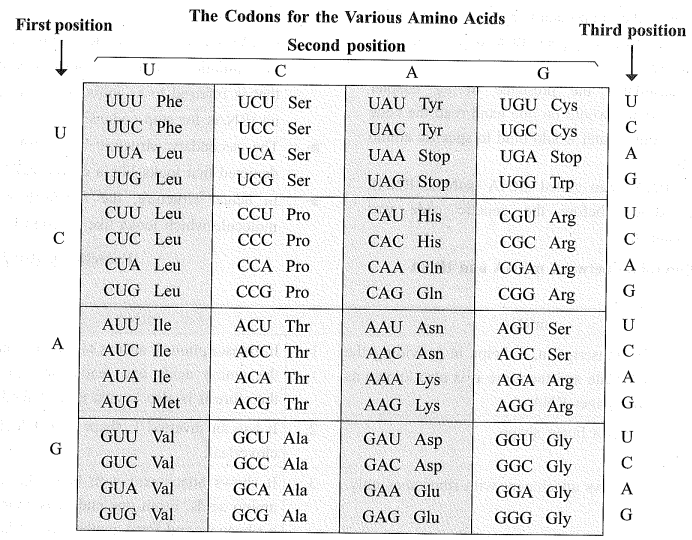
(i) The codon is a triplet. 61 codons code for amino acids and 3 codons do not code for any amino acids, hence they function as stop codons.
(ii) Some amino acids are coded by more than one codon, hence the code is degenerate.
(iii) The codon is read in mRNA in a contiguous fashion. There are no punctuations.
(iv) The code is nearly universal:for example, from bacteria to human UUU would code for Phenylalanine (phe). Some exceptions to this rule have been found in mitochondrial codons, and in some protozoans.
(v) AUG has dual functions. It codes for Methionine (met), and it also act as initiator codon.
(vi) UAA, UAG, UGA are stop terminator codons.
View full question & answer
Question 43 Marks
Explain- Biochemical Characterisation of Transforming Principle
Answer
→ Prior to the work of Oswald Avery, Colin MacLeod and Maclyn McCarty (1933-44), the genetic material was thought to be a protein.
→ They worked to determine the biochemical nature of 'transforming principle' in Griffith's experiment.
→ They purified biochemicals (proteins, DNA, RNA, etc.) from the heat-killed S cells to see which ones could transform live R cells into S cells.
→ They discovered that DNA alone from S bacteria caused R bacteria to become transformed.
→ They also discovered that protein-digesting enzymes (proteases) and RNA-digesting enzymes (RNases) did not affect transformation, so the transforming substance was not a protein or RNA.
→ Digestion with DNase did inhibit transformation, suggesting that the DNA caused the transformation.
→ They concluded that DNA is the hereditary material, but not all biologists were convinced.
View full question & answer
Question 53 Marks
With the help of a diagram, explain that the nature of $ \text{DNA}$ replication is semiconservative. $\#\#\#$ Explain the experiment of Matthew Meselson and Franklin Stahl's $[$Diagram is not necessary$]$
Answer
$\rightarrow$ It is now proved that $ \text{DNA}$ replicates semiconservatively.
$\rightarrow$ It was first shown in Escherichia coli and subsequently in higher organism, such as plant and human.
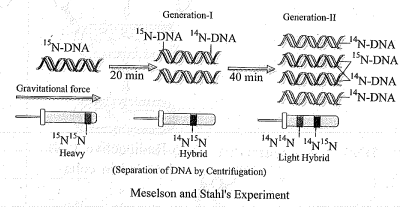
$\rightarrow$ Matthew Meselson and Franklin Stahl performed the following experiment in $1958:$
$(i)$ They grew $E$ coli in a medium containing $^{15}NH \ CI (^{15}N$ is the heavy isotope of nitrogen$)$ as the only nitrogen source for many generations.
$\rightarrow$ The result was that $^{15}N$ was incorporated into newly synthesised $ \text{DNA}$ $($as well as other nitrogen containing compounds$).$
$\rightarrow$ This heavy $ \text{DNA}$ molecule could be distinguished from the normal $ \text{DNA}$ by centrifugation in a cesium chloride $ \text{(CSCI)}$ density gradient $($Please note that $^{15}N$ is not a radioactive isotope, and it can be separated from $^{14}N$ only based on densities$).$
$(ii)$ Then they transferred the cells into a medium with normal $^{14}NH_4Cl$ and took samples at various definite time intervals as the cells multiplied, and extracted the $ \text{DNA}$ that remained as double$-$stranded helices.
$\rightarrow$ The various samples were separated independently on $CsCI$ gradients to measure the densities of $ \text{DNA}$
Image
$(iii)$ Thus, the $ \text{DNA}$ that was extracted from the culture one generation after the transfer from $^{15}N$ to $^{14}N$ medium $[$that is after $20$ minutes; $E.$ coli divides in $20$ minutes$]$ had a hybrid or intermediate density.
$\rightarrow$ $ \text{DNA}$ extracted from the culture after another generation $[$that is after $40$ minutes, $II$ generation$]$ was composed of equal amounts of this hybrid $ \text{DNA}$ and of 'light' $ \text{DNA}$.
View full question & answer
Question 63 Marks
Explain the double helix structure of $ \text{DNA}$
Answer
$\rightarrow$ $ \text{DNA}$ as an acidic substance present in nucleus was first identified by Friedrich Meischer in $1869.$ He named it as 'Nuclein'.
$\rightarrow$ However, due to technical limitation in isolating such a long polymer intact, the elucidation of structure of $ \text{DNA}$ remained elusive for a very long period of time.
$\rightarrow$ It was only in $1953$ that James Watson and Francis Crick, based on the $X-$ray diffraction data produced by Maurice Wilkins and Rosalind Franklin, proposed a very simple but famous $[$Double Helix$]$ model for the structure of $ \text{DNA}$.
$\rightarrow$ One of the hallmarks of their proposition was base pairing between the two strands of polynucleotide chains.
$\rightarrow$ However, this proposition was also based on the observation of Erwin Chargaff that for a double stranded $ \text{DNA}$, the ratios between Adenine and Thymine and Guanine and Cytosine are constant and equals one.
$\rightarrow$ The base pairing confers a very unique property to the polynucleotide chains.
$\rightarrow$ They are said to be complementary to each other, and therefore if the sequence of bases in one strand is known then the sequence in other strand can be predicted.
$\rightarrow$ Also, if each strand from a $ \text{DNA}$ $($let us call it as a parental $ \text{DNA}$$)$ acts as a template for synthesis of a new strand, the two double stranded $ \text{DNA}$ $($let us call them as daughter $ \text{DNA}$$)$ thus, produced would be identical to the parental $ \text{DNA}$ molecule.
$\rightarrow$ Because of this, the genetic implications of the structure of $ \text{DNA}$ became very clearImageImage
$\rightarrow$ The salient features of the Double$-$helix structure of $ \text{DNA}$ are as follows:
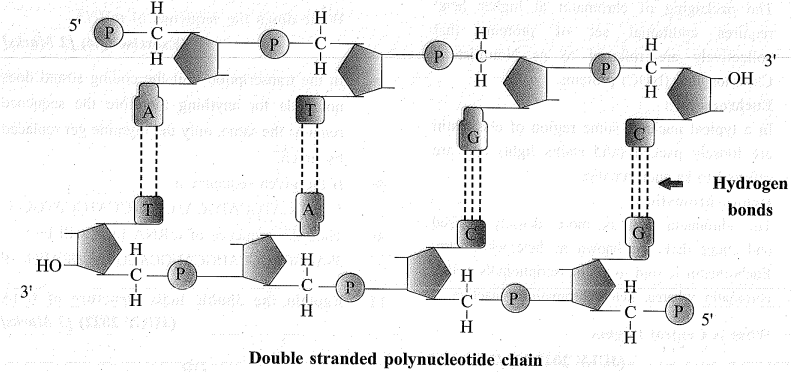
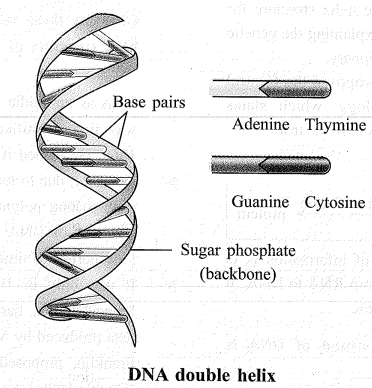
$(i)$ It is made of two polynucleotide chains, where the backbone is constituted by sugar-phosphate, and the bases project inside.
$(ii)$ The two chains have anti-parallel polarity. It means, if one chain has the polarity $5\ '$ $\rightarrow$ $3\ ',$ the other has $3\ '$ $\rightarrow$ $5\ '.$
$(iii)$ The bases in two strands are paired through hydrogen bond $(H-$bonds$)$ forming base pairs $(bp).$ Adenine forms two hydrogen bonds with Thymine from opposite strand and vice$-$versa. Similarly, Guanine is bonded with Cytosine with three $H-$bonds. As a result, a purine always comes opposite to a pyrimidine. This generates approximately uniform distance between the two strands of the helix as shown $($Figure$).$
$(iv)$ The two chains are coiled in a right$-$handed fashion. The pitch of the helix is $3.4 \ nm \ ($a nanometre is one billionth of a metre, that is $10^{-9}m)$ and there are roughly $10 \ bp$ in each turn. Consequently, the distance between a bp in a helix is approximately $0.34 \ nm.$
$(v)$ The plane of one base pair stacks over the other in double helix. This, in addition to $H-$bonds, confers stability of the helical structure $($Figure$).$
View full question & answer
Question 73 Marks
Explain DNA Polymorphism
Answer
→ As polymorphism in DNA sequence is the basis of genetic mapping of human genome as well as of DNA fingerprinting, it is essential that we understand what DNA polymorphism means in simple terms.
→ Polymorphism (variation at genetic level) arised due to mutations.
→ New mutations may arise in an individual either in somatic cells or in the germ cells (cells that generate gametes in sexually reproducing organisms).
→ If a germ cell mutation does not seriously impair individual's ability to have offspring who can transmit the mutation, it can spread to the other members of population (through sexual reproduction).
→ Allelic sequence variation has traditionally been described as a DNA polymorphism if more than one variant (allele) at a locus occurs in human population with a frequency greater than 0.01.
→ In simple terms, if an inheritable mutation is observed in a population at high frequency, it is referred to as DNA polymorphism.
→ The probability of such variation to be observed in non-coding DNA sequence would be higher as mutations in these sequences may not have any immediate effect/ impact in an individual's reproductive ability.
→ These mutations keep on accumulating generation after generation, and form one of the basis of variability / polymorphism.
→ There is a variety of different types of polymorphisms ranging from single nucleotide change to very large scale changes.
View full question & answer
Question 83 Marks
Write a note on structure of t-RNA
Answer
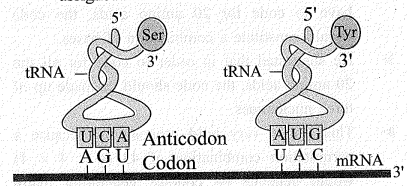
→ From the very beginning of the proposition of code, it was clear to Francis Crick that there has to be a mechanism to read the code and also to link it to the amino acids, because amino acids have no structural specialities to read the code uniquely.
→ He postulated the presence of an adapter molecule that would on one hand read the code and on other hand would bind to specific amino acids.
→ The tRNA, then called SRNA (soluble RNA), was known before the genetic code was postualated.
→ However, its role as an adapter molecule was assigned much later.
Image
→ tRNA has an anticodon loop that has bases complementary to the code, and it also has an amino acid acceptor end to which it binds to amino acids.
→ tRNAs are specific for each amino acid
→ For initiation, there is another specific tRNA that is referred to as initiator tRNA. There are no tRNAs for stop codons.
→ The secondary structure of tRNA has been depicted that looks like a clover-leaf.
→ In actual structure, the tRNA is a compact molecule which looks like inverted L.
View full question & answer
Question 93 Marks
What is genetic code? How did genetic code came into existence ?
Answer
→ The genetic code can be defined as the set of certain rules using which the living cells translate the information encoded within genetic material (DNA or mRNA sequences). The ribosomes are responsible to accomplish the process of translation.
→ During replication and transcription a nucleic acid was copied to form another nucleic acid. Hence, these processes are easy to conceptualise on the basis of complementarity.
→ The process of translation requires transfer of genetic information from a polymer of nucleotides to synthesise a polymer of amino acids.
→ Neither does any complementarity exist between nucleotides and amino acids, nor could any be drawn theoretically.
→ There existed ample evidences, though, to support the notion that change in nucleic acids (genetic material) were responsible for change in amino acids in proteins.
→ This led to the proposition of a genetic code that could direct the sequence of amino acids during synthesis of proteins.
→ If determining the biochemical nature of genetic material and the structure of DNA was very exciting, the proposition and deciphering of genetic code were most challenging.
→ In a very true sense, it required involvement of scientists from several disciplines physicists, organic chemists, biochemists and geneticists.
→ It was George Gamow, a physicist, who argued that since there are only 4 bases and if they have to code for 20 amino acids, the code should constitute a combination of bases.
→ He suggested that in order to code for all the 20 amino acids, the code should be made up of three nucleotides.
→ This was a very bold proposition, because a permutation combination of 43 (4 x 4 x 4) would generate 64 codons; generating many more codons than required.
→ Providing proof that the codon was a triplet, was a more daunting task. The chemical method developed by Har Gobind Khorana was instrumental in synthesising RNA molecules with defined combinations of bases (homopolymers and copolymers)
→ Marshall Nirenberg's cell-free system for protein synthesis finally helped the code to be deciphered.
→ Severo Ochoa enzyme (polynucleotide phosphorylase) was also helpful in polymerising RNA with defined sequences in a template independent manner (enzymatic synthesis of RNA).
Image
View full question & answer
Question 103 Marks
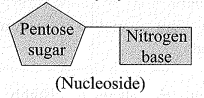
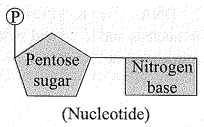
Explain - Nucleoside & Nucleotide
View full question & answer
3 Marks Question - Biology STD 12 Science Questions - Vidyadip