Questions · Page 1 of 4

M.C.Q (1 Marks)

Take a timed test

50 questions · auto-graded multiple-choice test.

MCQ 11 Mark
Electrophilic substitution reaction in phenol takes place at:
  • A
    Para position
  • B
    Meta position
  • C
    Ortho position
  • Ortho and para position
Answer
Correct option: D.
Ortho and para position
Electrophilic substitution reaction in phenol takes place at ortho and para position$. −OH$ is an ortho para directing group.
The electron density at ortho and para positions will be higher than the electron density at meta position.
View full question & answer
MCQ 21 Mark
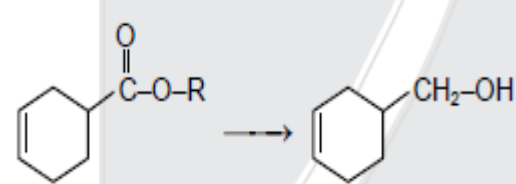
Which reagent is suitable for this conversion?
  • A
    $\text{Zn−Hg/HCl}$
  • $\mathrm{LiAlH}_4$
  • C
    $\mathrm{NH}_2-\mathrm{NH}_2 / \mathrm{OH}^{-}$
  • D
    Red $\text{P + HI}$
Answer
Correct option: B.
$\mathrm{LiAlH}_4$
Suitable Reagent for this conversion is $\mathrm{LiAlH}_4$.
View full question & answer
MCQ 31 Mark
Methanol is now prepared from:
  • A
    Water gas
  • B
    Sugar through fermentation
  • C
    Wood
  • Both $A$ and $B$
Answer
Correct option: D.
Both $A$ and $B$
On an industrial scale, methanol is predominantly produced from natural gas by reforming the gas with steam and then converting and distilling the resulting synthesized gas mixture to create pure methanol. The result is a clear, liquid, organic chemical that is water$-$soluble and readily biodegradable.
Some methanol can be produced during fermentation, but this is not derived from the ethanol or by carbohydrate oxidation. It is produced in small amounts, either by non$-$enzymatic reactions or through the reduction of formaldehyde.
View full question & answer
MCQ 41 Mark
Mark the correct statement:
  • Water gas is used in the manufacture of methyl alcohol.
  • B
    Water gas has the highest calorific value.
  • C
    Water gas burns with luminuous flame.
  • D
    The production of water gas is exothermic process.
Answer
Correct option: A.
Water gas is used in the manufacture of methyl alcohol.
View full question & answer
MCQ 51 Mark
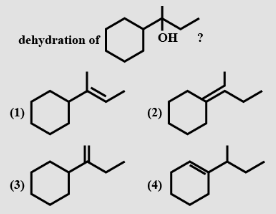
Which of the following can not be the product of this reaction?
  • A
    $1$
  • B
    $2$
  • C
    $3$
  • $4$
Answer
Correct option: D.
$4$
In the mechanism of dehydration, after the removal of water, elimination of a Hydrogen atom only occurs from an $\alpha−$Carbon atom. Thus, it is quite evident that $(4)$ can not be the product of this reaction.
View full question & answer
MCQ 61 Mark
Acid catalysed hydration of alkenes except ethene leads to the formation of.
  • A
    Primary alcohol.
  • Secondary or tertiary alcohol.
  • C
    Mixture of primary and secondary alcohols.
  • D
    Mixture of secondary and tertiary alcohols.
Answer
Correct option: B.
Secondary or tertiary alcohol.
Alkenes react with water in the presence of acid as a catalyst to form alcohol. In case of unsymmetrical alkenes$, OH$ is added to the carbon having fewer hydrogen atoms according to Markovnikov's rule.
Hence, acid catalyzed hydration of alkenes except ethene leads to the formation of secondary or tertiary alcohol. To obtain primary alcohol, hydroboration oxidation is used.
View full question & answer
MCQ 71 Mark
$\text{IUPAC}$ name of the given compound is:
$\text{H}_3\text{C}\text{−C​H}−\text{CH}_2\text{−C​H}\text{−C​H}​−\text{CH}_2−\text{CH}_3\\ \ \ \ \ \ \ \ \ \ \ \ \ \ | \ \ \ \ \ \ \ \ \ \ \ \ \ \ \ \ \ \ \ \ | \ \ \ \ \ \ \ \ | \\ \ \ \ \ \ \ \ \ \ \ \ \ \text{OH} \ \ \ \ \ \ \ \ \ \ \ \ \ \text{OH} \ \ \ \ \text{C}_2\text{O}_5$
  • $5-$ethylheptane$-2.4-$diol
  • B
    $3-$ethylheptane$-4,6-$diol
  • C
    $4-$ethyl$-1-$methylhexane$-1,3-$diol
  • D
    None of these
Answer
Correct option: A.
$5-$ethylheptane$-2.4-$diol
The compound have ethyl group at carbon no $5,$ two hydroxyl groups at carbon no $2$ and $4.$ So its name is $5−$ethylheptane$−2.4−$diol.
View full question & answer
MCQ 81 Mark
The correct order of boiling point for primary $(1),$ secondary $(2)$ and tertiary $(3)$ alcohols is:
  • $1 > 2 > 3$
  • B
    $3 > 2 > 1$
  • C
    $2 > 1 > 3$
  • D
    $2 > 3 > 1$
Answer
Correct option: A.
$1 > 2 > 3$
Alcohols with same molecular weight are expected to have almost same boiling point however two more factors other than molecular weight are important, they are namely $H-$bonding and surface area of molecule. Both these factors are least in $3$ alcohols and maximum in $1$ alcohols. Hence$, 3$ alcohols have least boiling point while $1$ alcohols have maximum boiling point.
View full question & answer
MCQ 91 Mark
Which of the following statement is not correct?
  • Phenol is neutralised by sodium carbonate.
  • B
    Phenol is used to prepare analgesic drugs.
  • C
    Solubility of phenol in water is more than that of chlorobenzene.
  • D
    Boiling point of $o-$nitrophenol is lower than that of $p-$nitrophenol.
Answer
Correct option: A.
Phenol is neutralised by sodium carbonate.
Phenol does not react with $\mathrm{Na}_2 \mathrm{CO}_3$​ because it is weaker acid than carboxylic acid and thereby do not have the strength to substitute or give away its $H^+$ ions to that of weak bases like sodium carbonate.
Phenol is used for the preparation of aspirin which is used as an analgesic as well as antipyretic drugs.
Phenol is more soluble in water than chlorobenzene due to formation of $H-$bond with water molecules.
$o-$nitrophenol form intramolecular $H−$bonding while $p-$nitrophenol form intermolecular $H−$bonding. Due to this, nature $o-$nitrophenol has a lower boiling point than $p-$nitrophenol.
View full question & answer
MCQ 101 Mark
The other name for Syngas is:
  • A
    Producer gas
  • Water gas
  • C
    Tear gas
  • D
    Fuel gas
Answer
Correct option: B.
Water gas
Syngas is also called as water gas which is a mixture of carbon monoxide and hydrogen.
View full question & answer
MCQ 111 Mark
How many alcohols with molecular formula $\mathrm{C}_4 \mathrm{H}_{10} \mathrm{O}$ are chiral in nature?
  • $1$
  • B
    $2$
  • C
    $3$
  • D
    $4$
Answer
Correct option: A.
$1$
Only one alcohol contains chiral carbon atom.
  1. $\mathrm{CH}_3 \mathrm{CH}_2 \mathrm{CH}_2 \mathrm{CH}_2 \mathrm{OH}$
  2. $\ \ \ \ \ \ \ \ \ \ \ \ \ \text{CH}_3 \\ \ \ \ \ \ \ \ \ \ \ \ \ \ \ | \\ \text{CH}_3 - \text{C} - \text{OH} \\ \ \ \ \ \ \ \ \ \ \ \ \ \ \ | \\ \ \ \ \ \ \ \ \ \ \ \ \ \ \text{CH}_3$
  3. $\text{CH}_3\text{CH}_2\text{CH} - \text{CH}_3 \\ \ \ \ \ \ \ \ \ \ \ \ \ \ \ \ \ | \\ \ \ \ \ \ \ \ \ \ \ \ \ \ \ \ \text{OH}$
Only $\text{III}$ is chiral in nature.
View full question & answer
MCQ 121 Mark
The boiling point of methanol is greater than that of methyl thiol because:
  • A
    There is intramolecular hydrogen bonding in methanol and intermolecular hydrogen bonding in methyl thiol.
  • There is intermolecular hydrogen bonding in methanol and no hydrogen bonding in methyl thiol.
  • C
    There is no hydrogen bonding in methanol and intermolecular hydrogen bonding in methyl thiol.
  • D
    There is no hydrogen bonding in methanol and intramolecular hydrogen bonding in methyl thiol.
Answer
Correct option: B.
There is intermolecular hydrogen bonding in methanol and no hydrogen bonding in methyl thiol.
Methanol has high boiling point than methyl thiol because there is intermolecular hydrogen bonding in methanol and no hydrogen bonding in methyl thiol.
View full question & answer
MCQ 131 Mark
In an aqueous solution at $25^{\circ} \mathrm{C}$ has twice as many $\mathrm{OH}^{-}$ as pure water its $\text{pOH}$ will be:
  • $6.699$
  • B
    $7.307$
  • C
    $7$
  • D
    $6.98$
Answer
Correct option: A.
$6.699$
We know that pure water at $25^{\circ} \mathrm{C}$ has $10^{-7} \mathrm{M}$ of $\mathrm{OH}^{-}.$
According to the problem, the aqueous solution at the same temperature has $2 \times 10^{-7} \mathrm{M} \mathrm{OH}^{-}$
Therefore, its $\mathrm{pOH}=-\log \left(2 \times 10^{-7}\right)$
$\mathrm{pOH}=6.6989$
or, $\mathrm{pOH}=6.699$
View full question & answer
MCQ 141 Mark
Glycol is a:
  • A
    Primary alcohol
  • Dihydric alcohol
  • C
    Secondary alcohol
  • D
    Trihydric alcohol
Answer
Correct option: B.
Dihydric alcohol
View full question & answer
MCQ 151 Mark
Which of the following is most acidic?
  • A
    Benzyl alcohol.
  • B
    Cyclohexanol.
  • C
    Phenol.
  • $m-$Chlorophenol
Answer
Correct option: D.
$m-$Chlorophenol
Alcohols are less acidic than phenol. Further electron withdrawing group $($like $- Cl)$ increases the acidity of phenol, therefore$, m-$chlorophenol is most.
View full question & answer
MCQ 161 Mark
Give $\text{IUPAC}$ name of the compound given below.$\text{CH}_3-\text{CH}-\text{CH}_2-\text{CH}_2-\text{CH}-\text{CH}_3 \\ \ \ \ \ \ \ \ \ \ \ \ \ \ \ | \ \ \ \ \ \ \ \ \ \ \ \ \ \ \ \ \ \ \ \ \ \ \ \ \ \ \ \ \ \ \ \ \ \ \ | \\ \ \ \ \ \ \ \ \ \ \ \ \ \ \text{Cl} \ \ \ \ \ \ \ \ \ \ \ \ \ \ \ \ \ \ \ \ \ \ \ \ \ \ \ \ \ \ \ \ \text{CH}$
  • A
    $2-$Chloro$-5-$hydroxyhexane.
  • B
    $2-$Hydroxy$-5-$chlorohexane.
  • $5-$Chlorohexan$-2-$ol.
  • D
    $2-$Chlorohexan$-5-$ol.
Answer
Correct option: C.
$5-$Chlorohexan$-2-$ol.
Priority will be given to $-OH$ group.
View full question & answer
MCQ 171 Mark
The $\text{IUPAC}$ name of the following compound is:
  • $3-$cyclohexylpentan$-3-$ol
  • B
    $3-$cyclohexyl$,3-$hydroxypentane
  • C
    $3-$hydroxypentyl cyclohexane
  • D
    None of the above
Answer
Correct option: A.
$3-$cyclohexylpentan$-3-$ol
The $\text{IUPAC}$ name of the given compound is $3-$Cyclohexylpentan$-3-$ol.
The parent compound contains $5 C$ atoms and is named pentane.
A hydroxyl group is present at third $C$ atom.
Hence, the last alphabet $e$ of pentane is replaced with the suffix $-3-$ol.
A cyclohexyl ring is present as substituent at third carbon atom.
View full question & answer
MCQ 181 Mark
Phenol is less acidic than $.......$
  • A
    Ethanol.
  • $o-$nitrophenol.
  • C
    $o-$methylphenol.
  • D
    $o-$methoxyphenol.
Answer
Correct option: B.
$o-$nitrophenol.
In substituted phenols, the presence of electron withdrawing group such as nitro group, enhances the acidic strength of phenol. This effect is more pronounced when such a group is present at ortho and para positions. It is due to the effective delocalisation of negative charge in phenoxide ion. On the other hand, electron releasing groups, such as alkyl groups, in general, do not favour the formation of phenoxide ion resulting in decrease in acid strength. Cresols, for example, are less acidic than phenol.
View full question & answer
MCQ 191 Mark
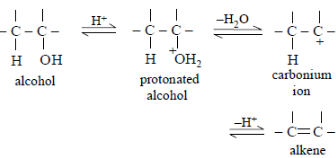
During dehydration of alcohols to alkenes by heating with conc$. \mathrm{H}_2 \mathrm{SO}_4$, the initiation step is:
  • A
    Elimination of water.
  • B
    Formation of an ester.
  • C
    Formation of carbocation.
  • Protonation of alcohol molecule.
Answer
Correct option: D.
Protonation of alcohol molecule.
Dehydration of alcohol to alkene in presence of concentrated $\mathrm{H}_2 \mathrm{SO}_4$ involves following steps:
Thus, the initiation step is protonation of alcohol.
View full question & answer
MCQ 201 Mark
Which of the following cannot be dissolved in alcohol?
  • A
    Dyes and drugs
  • B
    Soaps and varnishes
  • C
    Resins and varnishes
  • Rubber and plastics
Answer
Correct option: D.
Rubber and plastics
Rubber and plastic cannot be dissloved in alchol because of nonpolar nature of rubber and plastics.
View full question & answer
MCQ 211 Mark
Which of the following is soluble in water?
  • A
    $\mathrm{CS}_2$
  • $\mathrm{C}_2 \mathrm{H}_5 \mathrm{OH}$
  • C
    $\mathrm{CCl}_4$
  • D
    $\mathrm{CHCl}_3$
Answer
Correct option: B.
$\mathrm{C}_2 \mathrm{H}_5 \mathrm{OH}$
Ethanol $\left(\mathrm{C}_2 \mathrm{H}_5 \mathrm{OH}\right)$ forms hydrogen bonding with water.
Hence, it is soluble in water.
View full question & answer
MCQ 221 Mark
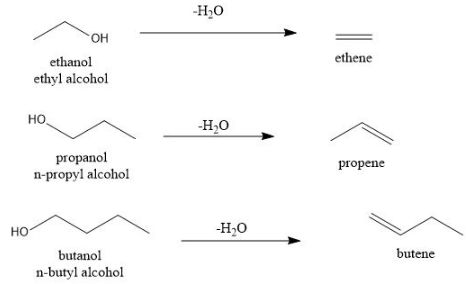
Which of the following alcohol does not give a stable compound on dehydration?
  • A
    Ethyl alcohol
  • Methyl alcohol
  • C
    $n-$propyl alcohol
  • D
    $n-$butyl alcohol
Answer
Correct option: B.
Methyl alcohol
Alcohols undergo dehydration $($removal of water$)$ to form an alkene.
To form alkene, we need at least two carbon atoms. But, methanol $(\mathrm{CH}_3 \mathrm{OH})$ has only one carbon atom. So, it does not give a stable compound on dehydration.
View full question & answer
MCQ 231 Mark
Which of the following substance will increase the acidity of phenol?
  • Dil$. \mathrm{H}_2 \mathrm{SO}_4$
  • B
    Dil$. \text{HCl}$
  • C
    Conc$. \mathrm{H}_2 \mathrm{SO}_4$
  • D
    Conc$. \mathrm{CH}_3 \mathrm{COOH}$
Answer
Correct option: A.
Dil$. \mathrm{H}_2 \mathrm{SO}_4$
Dilute $\mathrm{H}_2 \mathrm{SO}_4$ will increase the acidity of phenol. This is because now phenol will be easily able to donate $\mathrm{H}^{+}$ ion and delocalise its negative charge more efficiently. Also addition of dilute $\mathrm{H}_2 \mathrm{SO}_4$​ which is itself an acid increases the acidity of phenol.
View full question & answer
MCQ 241 Mark
Among the three isomers of the nitrophenol, the one that is least soluble in water is:
  • A
    $m-$nitrophenol
  • $o-$nitrophenol
  • C
    $p-$nitrophenol
  • D
    none of these
Answer
Correct option: B.
$o-$nitrophenol
Intramolecular hydrogen bonding in ortho$-$substituted nitrophenol reduces water solubility and increases volatility.
Thus$, o-$nitrophenol is steam distillable while the isomeric $p-$nitrophenol is soluble in water.
View full question & answer
MCQ 251 Mark
What type of spectroscopy would be the best tool to analyze a clear and colorless solution for the presence of a functional group like an alcohol group $(−OH)?$
  • A
    $UV$ spectroscopy.
  • $IR$ spectroscopy.
  • C
    Mass spectroscopy.
  • D
    Photoelectron spectroscopy.
Answer
Correct option: B.
$IR$ spectroscopy.
Functional groups are best analyzed by $IR$ spectroscopy$. IR$ is infrared spectroscopy that works in $IR$ region of electromagnetic radiations. stretching frequencies of functional groups are measured due to their vibration around bonds. Every functional groups have their particular stretching frequency range.In this way functional groups are analyzed by $IR.$
View full question & answer
MCQ 261 Mark
$3-$methyl$-2-$pentene on reaction with $\text{HOCl}$ gives:
  • A
    $3-$chloro$-3-$methyl pentanol$-2$
  • B
    $2,3-$dichloro$-3-$methyl pentane
  • $2-$chloro$-3-$methyl pentanol$-3$
  • D
    $2,3$ dimethyl butanol$-2$
Answer
Correct option: C.
$2-$chloro$-3-$methyl pentanol$-3$
The given reaction follows Markownikoff's addition mechanism and add $\mathrm{OH}^{-}$and $\mathrm{Cl}^{+}$ across carbon$-$carbon double bond.
View full question & answer
MCQ 271 Mark
Write the $\text{IUPAC}$ name of the given compound:$\text{HO}−\text{CH}_2​−\text{​CH}−\text{CH}_2​−\text{OH}​\\ \ \ \ \ \ \ \ \ \ \ \ \ \ \ \ \ \ \ \ \ \ \ ∣ \\ \ \ \ \ \ \ \ \ \ \ \ \ \ \ \ \ \ \ \ \ \text{CH}_3​​$
  • $2-$Methylpropane$-1,3-$diol
  • B
    $2-$Methylpropan-$1,3-$dial
  • C
    $1-$Hydroxy$-2-$methylpropan$-1-$ol
  • D
    None of these
Answer
Correct option: A.
$2-$Methylpropane$-1,3-$diol
The given compound can be numbered from left to right or vice versa. At the $2^{nd}$ position, there is a methyl group and is designated as $2-$Methyl.
The parent carbon chain contains $3$ carbon atoms resembling propane and at the positions $1$ and $3,$ there's the hydroxyl group designated as $1, 3-$diol.
So the $\text{IUPAC}$ name of the given compound is $2-$Methylpropane$-1, 3-$diol.
View full question & answer
MCQ 281 Mark
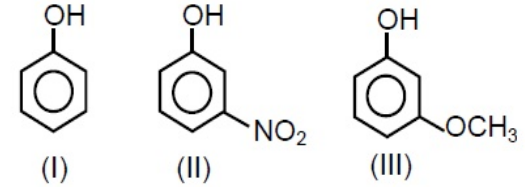
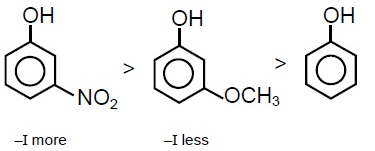
Correct order of acidic strength.
  • A
    $\text{I>II>III}$
  • $\text{II>III>I}$
  • C
    $\text{I>III>II}$
  • D
    $\text{III>II>I}$
Answer
Correct option: B.
$\text{II>III>I}$
Acidic nature $\alpha−I$
View full question & answer
MCQ 291 Mark
Ethers show dipolar nature due to the presence of $........$
  • A
    Central $C$ atom
  • Central $O$ atom
  • C
    Central $N$ atom
  • D
    None of these
Answer
Correct option: B.
Central $O$ atom
Ethers have general structural formula $R-O-R\ '.$ Hence all of them have the $C-O$ bond. We know that the $C-O$ bond is polar due to the difference between the electronegativities of carbon and oxygen. Hence, ethers show dipolar nature.
View full question & answer
MCQ 301 Mark
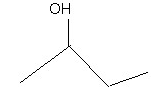
The $\text{IUPAC}$ name of sec. butyl alcohol is:
  • A
    $1-$butanol
  • $2-$butanol
  • C
    $2-$methyl$-l-$butanol
  • D
    $2-$methyl$-2-$butanol
Answer
Correct option: B.
$2-$butanol
The $\text{IUPAC}$ name of the sec. butyl acohol is $2-$butanol because the longest continue chain contain $4-$carbon as well as the $−OH$ group is attached to $2^{nd}$ carbon , hence the name is $2-$butanol.
View full question & answer
MCQ 311 Mark
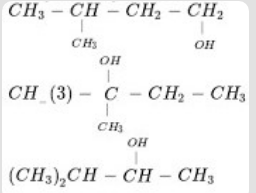
Arrange the following alkanols $1, 2$ and $3$ in order of their reactivity towards acid catalyzed dehydration.
  • A
    $1>2>3$
  • B
    $2>1>3$
  • $2>3>1$
  • D
    $3>2>1$
Answer
Correct option: C.
$2>3>1$
View full question & answer
MCQ 321 Mark
Dehydration of alcohol is an example of which type of reaction?
  • A
    Substitution
  • Elimination
  • C
    Addition
  • D
    Both $B$ and $C$
Answer
Correct option: B.
Elimination
When heated with strong acids catalysts, alcohols typically undergo a $1,2-$elimination reactions to generate an alkene and water. Also known as dehydration since it involves the removal of a molecule of water.
View full question & answer
MCQ 331 Mark
Which of the following order is true regarding the acidic nature of phenol?
  • A
    Phenol $> O -$cresol $> O-$nitrophenol
  • B
    Phenol $> O -$nitrophenol $> O-$cresol
  • $O-$cresol $<$ phenol $< O-$ nitrophenol
  • D
    Phenol $< O-$cresol $< O-$nitrophenol
Answer
Correct option: C.
$O-$cresol $<$ phenol $< O-$ nitrophenol
The following order is true regarding the acidic nature of phenol.
$O-$cresol $<$ phenol $< O-$ nitrophenol.
Phenols having electron withdrawing substituents such as nitro group are more acidic due to delocalization of negative charge.
Phenols having electron releasing substituents such as alkyl group are less acidic as negative charge is not delocalised.
View full question & answer
MCQ 341 Mark
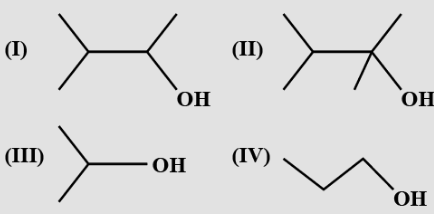
The order of reactivity of the following alcohols towards dehydration is:
  • A
    $\text{IV>I>II>III}$
  • B
    $\text{III>IV>II>I}$
  • $\text{II>I>III>IV}$
  • D
    $\text{II>III>I>IV}$
Answer
Correct option: C.
$\text{II>I>III>IV}$
Reactivity of alcohol towards dehydration is increased by the stability of the carbocation formed subsequently. Order of carbocation stability is:
tertiary$>$secondary$>$primary.
Also presence of $+I$ groups like $CH_3$​ increases the stability.
According to this the order of reactivity is$, \text{II>I>III>IV}$
View full question & answer
MCQ 351 Mark
Which of the following compounds will react with sodium hydroxide solution in water?
  • $ \mathrm{C}_6 \mathrm{H}_5 \mathrm{OH} . $
  • B
    $ \mathrm{C}_6 \mathrm{H}_5 \mathrm{CH}_2 \mathrm{OH} . $
  • C
    $ \left(\mathrm{CH}_3\right)_3 \mathrm{COH} . $
  • D
    $ \mathrm{C}_2 \mathrm{H}_5 \mathrm{OH} $
Answer
Correct option: A.
$ \mathrm{C}_6 \mathrm{H}_5 \mathrm{OH} . $
Phenol being more acidic reacts with sodium hydroxide solution in water to give sodium phenoxide which is resonance stabilized.
Alcohols are very weak acids.
$\mathrm{C}_6 \mathrm{H}_5 \mathrm{OH}+\mathrm{NaOH} \rightarrow \mathrm{C}_6 \mathrm{H}_5 \mathrm{ONa}+\mathrm{H}_2 \mathrm{O}$
View full question & answer
MCQ 361 Mark
Monochlorination of toluene in sunlight followed by hydrolysis with aq$. \text{NaOH}$ yields.
  • A
    $o-$Cresol.
  • B
    $m-$Cresol.
  • C
    $2, 4-$Dihydroxytoluene.
  • Benzyl alcohol.
Answer
Correct option: D.
Benzyl alcohol.
Monochlorination of toluene in sunlight gives benzyl chloride. On hydrolysis with aq$. \text{NaOH},$ benzyl chloride, shows nucleophilic substitution reaction to give benzyl alcohol.
View full question & answer
MCQ 371 Mark
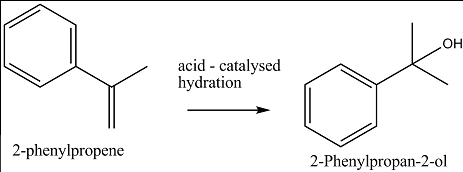
The major product obtained on acid $-$ catalysed hydration of $2-$phenylpropene is:
  • $2-$phenylpropan$-2-ol$
  • B
    $2-$phenylpropan$-1-01$
  • C
    $3-$phenylpropan$-2-ol$
  • D
    $1-$phenylpropan$-1-ol$
Answer
Correct option: A.
$2-$phenylpropan$-2-ol$
The major product obtained on acid $-$ catalysed hydration of $2-$phenylpropene is $2-$Phenylpropan$-2-ol.$ A molecule of water is added to $C=C$ double bond$. −OH$ group is added to more substituted $C$ atom.
View full question & answer
MCQ 381 Mark
Which of the following combinations can be used for the preparation of cis vic diol?
  • A
    Alkene, Baeyer reagent
  • Alkene $,\ce{OsO_4}$​
  • C
    Alkene$, \text{MMPP}$ and $\ce{H_2O/H}$
  • D
    Both of $(a)$ and $(b)$
Answer
Correct option: B.
Alkene $,\ce{OsO_4}$​
Osmium tetroxide $(\ce{OsO_4})$ is a volatile liquid that is most useful for the synthesis of $1,2$ diols from alkene.
The $\ce{OsO_4}$ is a catalyst. It reacts with the π electrons of the alkene in a syn addition to form a cyclic osmate ester.
The $OH⁻$ hydrolyzes the ester. This forms the cis-diol and $\ce{H_4OsO_4}$.
View full question & answer
MCQ 391 Mark
The common name for propan$-2-ol$ is:
  • A
    $n-$Propyl alcohol.
  • iso$-$Propyl alcohol.
  • C
    ethyl alcohol.
  • D
    methyl alcohol.
Answer
Correct option: B.
iso$-$Propyl alcohol.
Isopropyl alcohol $(\text{IUPAC}$ name $2-$propanol$),$ also called isopropanol or dimethyl carbinol.
View full question & answer
MCQ 401 Mark
What is the $\text{IUPAC}$ name of the following compound$?\ \ce{CH_3​−CH_2−CH_2−OH}$
  • Propan$-1-ol$
  • B
    Propan$-2-ol$
  • C
    Propane$-1-ol$
  • D
    Ethane$-2-ol$
Answer
Correct option: A.
Propan$-1-ol$
In this compound, the number of carbon atoms is $3.$ So, the parent alkane is propane.
The functional group present is $−OH$ i.e alcohol$. −OH$ is present at the first carbon atom.
Thus the $\text{IUPAC}$ name is Propan $- 1 - ol.$
View full question & answer
MCQ 411 Mark
Which of the following species show maximum volatility?
  • A
    $\ce{CH_3​CH_2​OH}$
  • $\ce{CH_3−O−CH_3}$​
  • C
    $\ce{H_2O}$
  • D
    $HF$
     
Answer
Correct option: B.
$\ce{CH_3−O−CH_3}$​
Due to the lack of any Hydrogen bonding in case of $\ce{CH_3−O−CH_3},$ its boiling point is comparatively low. In other words, it is the most volatile among the given compounds.
View full question & answer
MCQ 421 Mark
$\ce{CH_3CH_2OH}$ can be converted into $\ce{CH_3CHO}$ by $........$
  • A
    Catalytic hydrogenation.
  • B
    Treatment with $\ce{LiAlH_4}.$          
  • Treatment with pyridinium chlorochromate.
  • D
    Treatment with $\ce{KMnO_4}$
Answer
Correct option: C.
Treatment with pyridinium chlorochromate.
Alcohols are oxidized to aldehydes and finally to acids.
$\text{CH}_3\text{CH}_2\text{OH}\xrightarrow{[\text{O}]}\text{CH}_3\text{CHO}\xrightarrow{[\text{O}]}\text{CH}_3\text{COOH}$
Oxidations can be stopped at aldehyde stage by using puridinium chlorochromate $(\ce{CrO_3C_5H_5N.HCl})$
$\text{CH}_3\text{CH}_2\text{OH}\xrightarrow{\text{PCC}}\text{CH}_3\text{CHO}$
View full question & answer
MCQ 431 Mark
The miscibility of ether with $......$ resembles those of alcohol of the same molecular mass.
  • A
    Methanol
  • Water
  • C
    $\text{DCM}$
  • D
    Benzene
Answer
Correct option: B.
Water
The miscibility of ether with water resembles those of alcohol of the same moleculer mass. It is generally due to the hydrogen bonding with water in alcohol.
View full question & answer
MCQ 441 Mark
Ethene reacts with $Y$ to produce ethanol. ethene $+ Y \rightarrow $ ethanol What is $Y\ ?$
  • A
    Hydrogen
  • B
    Oxygen
  • Steam
  • D
    Yeast
Answer
Correct option: C.
Steam
Ethanol can be manufactured by hydration of ethene.
Ethene is heated with steam in the presence of a catalyst of phosphoric acid to produce ethanol.
$\mathrm{C}_2 \mathrm{H}_4+\mathrm{H}_2 \mathrm{O} \rightarrow \mathrm{C}_2 \mathrm{H}_5-\mathrm{OH}$
View full question & answer
MCQ 451 Mark
Formation of $2-$butene as a major product by dehydration of $2-$butanol is according to:
  • A
    Markownikoff rule
  • Saytzeff rule
  • C
    Peroxide effect
  • D
    Anti$-$markownikoff rule
Answer
Correct option: B.
Saytzeff rule
The formation of $2-$butene as major product by dehydration of $2-$butanol is according to Saytzeff rule.
The minor product is $1-$butene.
In this reaction, more substituted alkene is obtained as it is more stable.
View full question & answer
MCQ 461 Mark
Which of the following are used to convert $\text{RCHO}$ into $\ce{RCH_2OH}\ ?$
$a. H_2/Pd.$
$b. \ce{LiAlH_4}.$
$c. \ce{NaBH_4}.$
$d.$ Reaction with $\text{RMgX}$ followed by hydrolysis.
  • $a,b$ and $c$
  • B
    $a ,b,c$ and $d$
  • C
    $b, c$ and $d$
  • D
    $a,c$ and $d$
Answer
Correct option: A.
$a,b$ and $c$
Aldehydes and ketones are reduced to the corresponding alcohols by addition of hydrogen in the presence of catalysts $($catalytic hydrogenation$).$ It is also prepared by treating aldehydes and ketones with sodium borohydride $(\ce{NaBH_4})$ or lithium aluminium hydride $(\ce{LiAlH_4}).$
View full question & answer
MCQ 471 Mark
Salicylic acid, picric acid, aspirin, nylon and plastics have a common raw material, namely:
  • Phenol
  • B
    Formic acid
  • C
    Methane
  • D
    Alochol
Answer
Correct option: A.
Phenol
Phenol is used as starting material in the manufacture of nylon, plastics, aspirin, picric acid, and salicylic acid, etc.
View full question & answer
MCQ 481 Mark
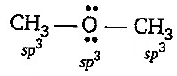
What is the hybridisation of carbon and oxygen in electronic structure of ether?
  • A
    $sp^3$ and $sp^2$
  • $sp^3$ and $sp^3$
  • C
    $sp$ and $sp$
  • D
    $sp^2$ and $sp^2$
Answer
Correct option: B.
$sp^3$ and $sp^3$
$sp^3 (4-$bond pairs$)$ and $sp^3(2-$bond pairs and $2-$lone pairs$)$ hybridisations of carbon and oxygen in the electronic structure of an ether.
View full question & answer
MCQ 491 Mark
The process of converting alkyl halides into alcohols involves $.......$
  • A
    Addition reaction.
  • Substitution reaction.
  • C
    Dehydrohalogenation reaction.
  • D
    Rearrangement reaction.
Answer
Correct option: B.
Substitution reaction.
The reaction is a type of nucleophilic substitution reaction in which $-Cl$ group is replaced by $-OH.$
View full question & answer
MCQ 501 Mark
The decreasing order of boiling points of the following alcohols is?
  • A
    $3-$methylbutan$-2-ol > 2-$methylbutan$-2-ol >$ pentan$-1-ol.$
  • pentan$-1-ol > 3-$methylbutan$-2-ol > 2-$methylbutan$-2-ol.$
  • C
    $2-$methylbutan$-2-ol > 3-$methylbutan$-2-ol >$ pentan$-1-ol.$
  • D
    $2-$methylbutan$-2-ol >$ pentan$-1-ol >3-$methylbutan$-2-ol.$
Answer
Correct option: B.
pentan$-1-ol > 3-$methylbutan$-2-ol > 2-$methylbutan$-2-ol.$
$3-$methylbutan$-2-ol$ is a secondary alcohol
$\mathrm{CH}_3 \mathrm{CH}\left(\mathrm{CH}_3\right) \mathrm{CH}(\mathrm{OH}) \mathrm{CH}_3$
$2-$methylbutan$-2-ol$ is a tertiary alcohol
$\mathrm{CH}_3 \mathrm{CH}_2 \mathrm{C}\left(\mathrm{CH}_3\right)(\mathrm{OH}) \mathrm{CH}_3$
pentan$-1-ol$ is a primary alcohol
$\mathrm{CH}_3 \mathrm{CH}_2 \mathrm{CH}_2 \mathrm{CH}_2 \mathrm{CH}_2 \mathrm{OH}$
Boiling point of alcohols is determined by the ease and extent of $H-$bonding among the alcohol molecules. Tertiary alcohols being highly hindered will have least hydrogen bonding and thus low boiling point as compared to less hindered secondary alcohol.
Therefore the order of boiling point is primary alcohol$>$secondary alcohol$>$tertiary alcohol as:
pentan$-1-ol > 3-$methylbutan$-2-ol > 2-$methylbutan$-2-ol.$
View full question & answer