Questions

2 Marks Questions

Take a timed test

18 questions · self-marked practice — reveal the answer and mark yourself.

Question 12 Marks
What are hormones ?
Answer
"Hormones are molecules that act as intracellular messengers. These are produced by endocrine glands in the body and are poured directly in the blood stream which transports them to the site of action."
" In terms of chemical nature, some of these are steroids. e.g. estrogens and androgens, some are polypeptides for example insulin and endorphins and some others are amino acid derivatives such as epinephrine and norepinephrine.
View full question & answer
Question 22 Marks
Describe the biological functions of nucleic acid compounds.
Answer
DNA is the chemical basis of heredity and may be regarded as the reserve of genatic information.
DNA is exclusively responsible for maintaining the identity of different species of organisms over millions of years.
DNA molecule is capable of self duplication during cell division and identical DNA strands are transferred to daughter cells.
Actually, the proteins are synthesized by various RNA molecules in the cell but the message for the synthesis of a particular protein is present in DNA.
View full question & answer
Question 32 Marks
Write a note on Double Helical structure of DNA.
Answer
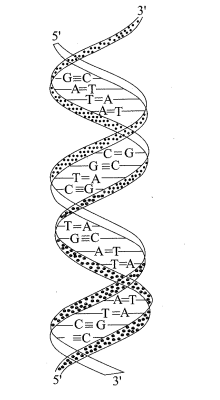
Information regarding the sequence of nucleotides in the chain of a nucleic acid is called its primary structure. Nucleic acids have a secondary structure too.
James Watson and Francis Crick gave a double strand helix structure for DNA. Two nucleic acid chains are wound about each other and held together by hydrogen bonds are formed between specific pairs of bases. Adenine forms hydrogen bonds with thymine where as cytosine forms hydrogen bonds with guanine.
Image
View full question & answer
Question 42 Marks
Give primary information about nucleic acid compounds.
Answer
Every generation of each and every species resembles its ancestors in many ways.
These characteristics transmitted from one generation to the next generation.
It has been observed that nucleus of a living cell is responsible for this transmission of inherent characters also called heredity.
The particles in nucleus of the cell, responsible for heredity are called chromosomes which are made up of proteins and another type of biomolecules called nucleic acids.
These are mainly of two types, the deoxyribonucleic acid (DNA) and ribonucleic acid (RNA).
Nucleic acids are long chain polymers of nucleotides, so they are also called Polynucleotides.
View full question & answer
Question 52 Marks
Why $B$ complex vitamine compounds are essential for us? Describe their important sources.
Answer
$\rightarrow$ Deficiency of vitamin $B_1($thiamine$)$ leads to the disease like Beriberi (loss of appetite, retarded growth). So, it is essential for us. Important sources are yeast, milk, green vegetables and cereals. etc....
$\rightarrow$ Deficiency of vitamin $B_2 ($Riboflavin$)$ leads to the cheilosis $($fissuring at corners of mouth and lips$),$ digestive disorders and burning sensation of the skin, so it is essential for us. Important sources are milk, egg white, liver and kidney.
$\rightarrow$ Deficiency of vitamin $B_6($Pyridoxine$)$ leads to convulsions so it is essential for us. Important sources are yeast, milk, egg yolk, cereals and grams
$\rightarrow$ Deficiency of vitamin $B_{12}$ leads to pernicious anaemia $(\text{RBC}$ deficient in haemoglobin$),$ so it is essential for us. Important sources are meat, fish, egg and curd.
View full question & answer
Question 72 Marks
Explain the nomenclature of Enzymes.
View full question & answer
Question 82 Marks
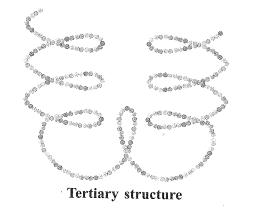
Write a note on tertiary structure of protein compound.
Answer
→"The tertiary structure of proteins represents overall folding of the polypeptide chains ie., further folding of the secondary structure."
It gives rise to two major molecular shapes viz. Fibrous and globular.
The main forces which stabilise the 2º and 3º structures of proteins are hydrogen bonds, disulphide linkages, van der Waals and electrostatic forces of attraction.
Image
View full question & answer
Question 92 Marks
Write a note on primary structure of protein compounds.
Answer
Proteins may have one or more polypeptide chains.
→"Each polypeptide in a protein has amino acids linked with each other in a specific sequence and this sequence of amino acids is said to be the primary structure of that protein."
Any change in the primary structure i.e., the sequence of amino acids creates a different protein.
View full question & answer
Question 102 Marks
Explain the property of optical activity of an amino acids.
Answer
Except glycine, all other naturally occurring a-amino acids are optically active since the a-carbon atom is asymmetric.
These exist both in "D" and "L" forms.
Most naturally occurring amino acids have L- configuration.
L - amino acids are represented by writting the $- NH _2$group on left hand side.
View full question & answer
Question 112 Marks
What are amino acid compounds? Explain the nomenclature of amino acid compounds.
Answer
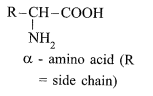
$\rightarrow$ "Amino acids contain amino $(-NH_2)$ and carboxyl $(-COOH)$ functional groups."
$\rightarrow$ Depending upon the relative position of amino group with respect to carboxyl group, the amino acids can be classified as $\alpha , \beta, γ, δ,$ and so on.
Only $\alpha -$ amino acids are obtained on hydrolysis of proteins.
$\rightarrow$ They may contain other functional groups also.
Image
$\rightarrow$ All $\alpha -$ amino acids have trivial names, which usually reflect the property of that compound or it's source.
$\rightarrow$ Glycine is so named since it has sweet taste $($in greek glykos means sweet$)$ and tyrosine was first obtained from cheese $($in Greek, tyros means cheese$).$
$\rightarrow$ Amino acids are generally represented by a three letter symbol, sometimes one letter symbol is also used.
$\rightarrow$ e.g. glycine $3-$letter symbol is $'Gly \ '$ and one letter symbol is $"G".$
View full question & answer
Question 122 Marks
Give primary information about the protein compounds.
Answer
Protein are the most abundant biomolecules of the living system.
Chief sources of proteins are milk, cheese, pulses, peanuts, fish meat etc. They occur in every part of the body and form the fundamental basis of structure and functions of life.
They are also required for growth and maintenance of the body.
The word protein is derived from greek word "Proteios" which means primary or of prime importance.
All proteins are polymers of $\alpha$ - amino acids.
View full question & answer
Question 132 Marks
Short note on: Glycogen
Answer
"The carbohydrates are stored in animal body as glycogen."
It is also known as animal starch because its structure is similar to amylopectin and is rather more highly branched.
It is present in liver, muscles and brain.
When the body needs glucose, enzymes break down glycogen into glucose.
View full question & answer
Question 142 Marks
Short note on : Cellulose.
Answer
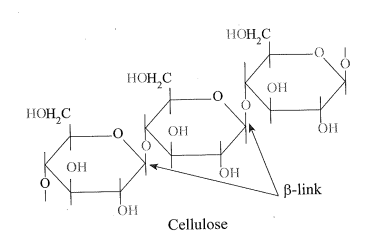
$\rightarrow$ Cellulose occurs exclusively in plants and it is the most abundant organic substance in plant kingdom.
$\rightarrow$ It is a predominant constituent of cell wall of plant cells.
Cellulose is a straight chain polysaccharide composed only of $ẞ-D-$glucose units which $\rightarrow$ are joined by glycosidic linkage between $C_1$ of one glucose unit and $C_4$ of the next glucose unit.
Image
View full question & answer
Question 152 Marks
Short note on :Lactose
Answer
$\rightarrow$ It is more commonly known as milk sugar since this disaccharide is found in milk.
$\rightarrow$ It is composed of $ẞ-D-$galactose and $ẞ-D-$Glucose
$\rightarrow$ Image
$\rightarrow$ The linkage is between $C_1$ of galactose and $C_4$ of glucose.
$\rightarrow$ Free aldehyde group may be produced at $C-1$ of glucose unit, hence it is also a reducing sugar.
Image
View full question & answer
Question 162 Marks
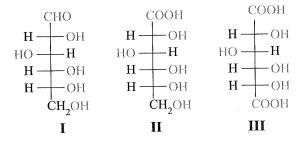
Draw the stereo structure of glucose, gluconic acid and saccharic acid given by Fischer.
Answer
The exact spatial arrangement of different -OH groups was given by Fischer after studying many other properties.
It's configuration is correctly represented as I. So gluconic acid is represented as II and saccharic acid III.Image
View full question & answer
Question 172 Marks
Explain the classification of monosaccharide compounds.
Answer
Monosaccharides are further classified on the basis of number of carbon atoms and the functional group present in them.
If a monosaccharide contains an aldehyde group it is known as an aldose and if it contains a keto group it is known as ketose.
Number of carbon atoms constituting the monosaccharide is also introduced in the name. e.g. 3 carbon containing monosaccharide is known as triose and 4 carbon containing monosaccharide is known as tetrose.
Different types of monosaccharide compounds are given below in table:
Carbon atomsGeneral termAldehydeKetone
3TrioseAldotrioseKetotriose
4TetroseAldotetroseKetotetrose
5PentoseAldopentoseKetopentose
6HexoseAldohexoseKetohexose
7HeptoseAldoheptoseKetoheptose
View full question & answer
Question 182 Marks
Note on preparation of glucose $\#\#\#$ Explain the preparation of glucose with it's equations.
Answer
$\rightarrow$ Glucose occurs freely in nature as well as in the combined form. It is present in sweet fruits and honey. Ripe grapes also contain glucose in large amounts. It is prepared as follows:
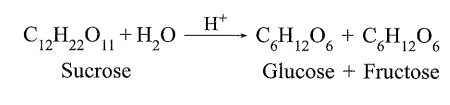
$\rightarrow$ $1.$ From sucrose $($cane sugar$):$
If sucrose is boiled with dilute $ \text{HCl}$ or $H _2 SO _4$ in alcoholic solution, glucose and fructose are obtained in equal amounts.
Image
$\rightarrow$ $2.$ From starch:
Commercial glucose is obtained by hydrolysis of starch by boiling it with dilute $H_2SO_4$ at $393 K$ under pressure.
Image
 
View full question & answer