Questions · Page 2 of 2

1 Marks Question

Question 521 Mark
Write IUPAC names of following and classify them into primary, secondary, tertiary amines:
$CH_3NHCH(CH_3)_2$
Answer
$CH_3NHCH(CH_3)_2$
Methyl isopropyl amine (secondary)
View full question & answer
Question 531 Mark
Why is cellulose not digested in human body?
Answer
It is due to the fact that human beings do not have enzyme to digest cellulose.
View full question & answer
Question 571 Mark
Answer the following questions.
Name two fat storing tissues in human body.
Answer
Liver and adipose tissue.
View full question & answer
Question 601 Mark
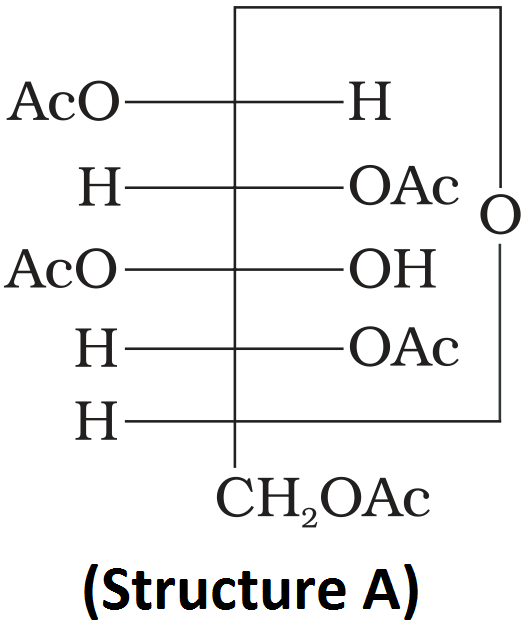
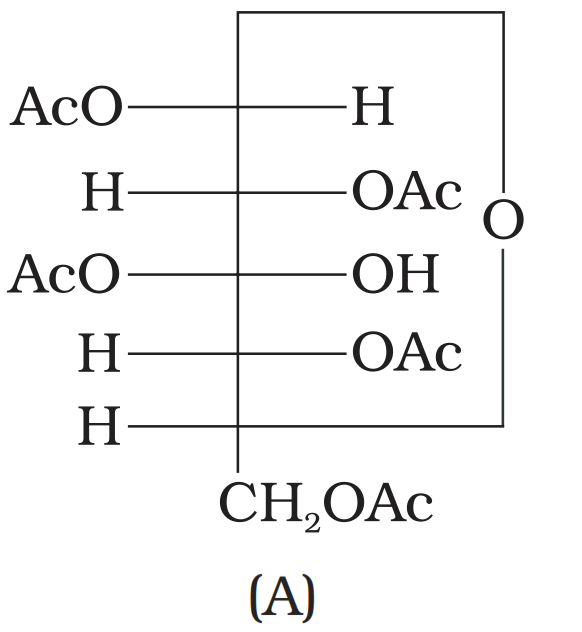
Why does compound (A) given below not form an oxime?
Answer
Glucose pentaacetate (structure A) doesn’t have a free —OH group at C1 and so can’t be converted to the open chain form to give —CHO group and hence doesn’t form the oxime.
View full question & answer
Question 611 Mark
Why are carbohydrates generally optically active?
Answer
Carbohydrates have chiral or asymmetric carbon atom.
View full question & answer
Question 631 Mark
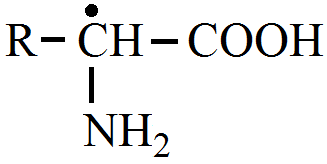
Amino acids can be classified as $\alpha-, \beta-, \delta-,$and so on depending upon the relative position of amino group with respect to carboxyl group. Which type of amino acids form polypetide chain in proteins?
Answer

$\alpha-$Amino acid,forms polypeptide chain in proteins.
View full question & answer
Question 651 Mark
Give an example each of essential and non-essential amino acids.
Answer
Valine is an essential amino acid whereas glycine is a non-essential amino acid.
View full question & answer
Question 681 Mark
How do enzymes help a substrate to be attacked by the reagent effectively?
Answer
Enzymes arehighly specific. They react with substrate molecule and form intermediate complex. They reduce the magnitude of activation energy.
View full question & answer
Question 691 Mark
Which moieties of nucleosides are involved in the formation of phosphodiester linkages present in dinucleotides? What does the word diester in the name of linkage indicate? Which acid is involved in the formation of this linkage?
Answer

Nucleosides are linked to phosphoric acid at 5′-position of sugar moiety to form a nucleotide. Further, nucleotides (two molecules) are joined together by phosphodiester linkage between 5′ and 3′ carbon atoms of pentose sugar to form dinucleotide. Phosphoric acid is involved in the formation of this linkage.
View full question & answer
Question 711 Mark
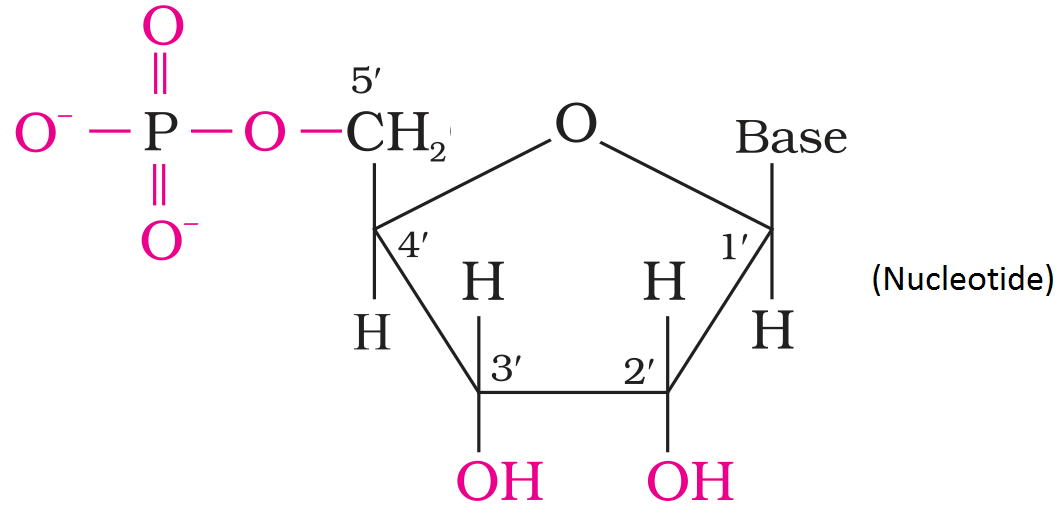
In nucleoside a base is attached at 1′ position of sugar moiety. Nucleotide is formed by linking of phosphoric acid unit to the sugar unit of nucleoside. At which position of sugar unit is the phosphoric acid linked in a nucleoside to give a nucleotide?
Answer
Phosphoric acid unit is linked preferably at 5′-position of sugar moiety of a nucleoside to give a nucleotide.
View full question & answer
Question 721 Mark
Aldopentoses named as ribose and 2-deoxyribose are found in nucleic acids. What is their relative configuration?
Answer
Configuration assigned is O. Thus, ribose is $\beta-$D-ribose Deoxyribose is $\beta-$D-2-deoxyribose.
View full question & answer
Question 731 Mark
$\alpha-$Helix is a secondary structure of proteins formed by twisting of polypeptide chain into right handed screw like structures. Which type of interactions are responsible for making the $\alpha-$helix structure stable?
Answer
In $\alpha-$helix, apolypeptide chain is stabilized by the formation of hydrogen bonds between NH— group of amino acids in one turn with the >C —O groups of amino acids belonging to adjacent turn.
View full question & answer
Question 741 Mark
Answer the following questions.
Name the protein and its shape present in oxygen carrier in human body.
Answer
Globular protein and its shape is spherical.
View full question & answer
Question 751 Mark
Answer the following questions.
Which of the following biomolecules is insoluble in water? Justify. Insulin, Haemoglobin, Keratin.
Answer
Keratin being a fibrous protein insoluble in water.
View full question & answer
Question 771 Mark
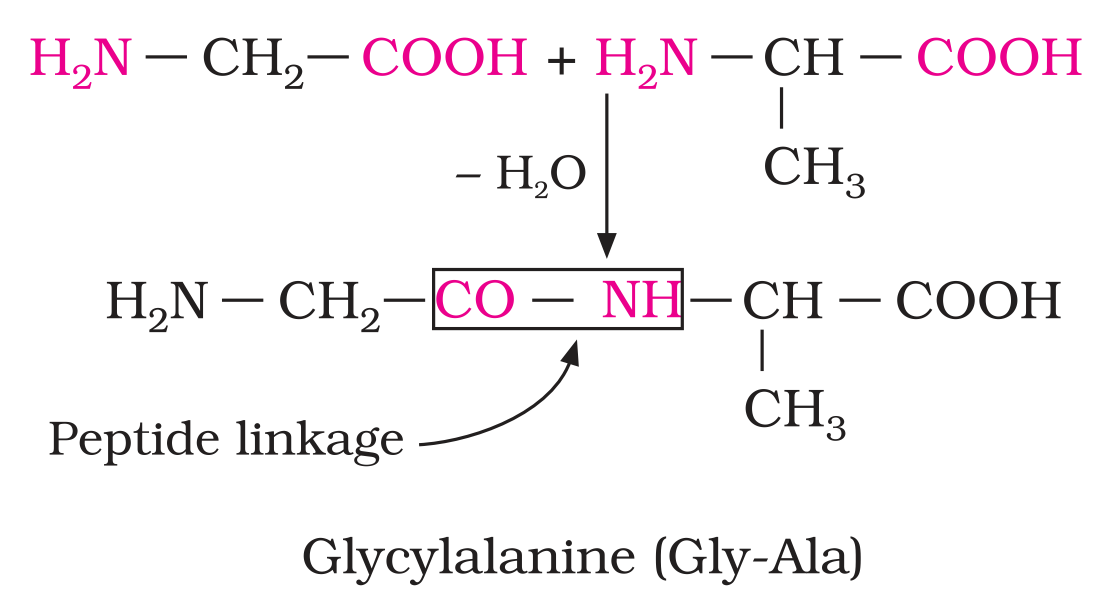
Structures of glycine and alanine are given below. Show the peptide linkage in glycylalanine. $\text{H}_{2}\text{N}-\text{CH}_{2}-\text{COOH} :\text{H}_2\text{N}-\text{CH}_2-\text{COOH}\\\\ \ \ \ \ \ \ \ \ \ \ \ \ \ \ \ \ \ \ \ \ \ \ \ \ \ \ \ \ \ \ \ \ \ \ \ \ \ \ \ \ \ \ \ \ \ \ \ \ \ \ \ \ \ \ |\\\ \ \ \ \ \ \ \ \ \ \ \ \ \ \ \ \ \ \ \ \ \ \ \ \ \ \ \ \ \ \ \ \ \ \ \ \ \ \ \ \ \ \ \ \ \ \ \ \ \ \ \ \ \text{CH}_3$
Answer

The carboxyl group of glycine and amino group of alanine when combines together, they form glycylalanine through a peptide (-CO – NH) linkage.
View full question & answer
Question 781 Mark
Among B group vitamins $B_1, B_2, B_6$ and $B_{12} $ which vitamin can be stored in our body?
Answer
Vitamin $B_{12}.$
View full question & answer
Question 791 Mark
How do you explain the presence of all the six carbon atoms in glucose in a straight chain?
Answer
On prolonged heating with HI, glucose gives n-hexane.
$\text{Glucose}\ \xrightarrow{\ \ \ \ \ \ \ \ \ \ \text{HI} }\text{CH}_{3}-\text{CH}_{2}-\text{CH}_{2}-\text{CH}_{2}-\text{CH}_{3}$
View full question & answer
Question 801 Mark
Write IUPAC names of the following compounds and classify them into primary, secondary and tertiary amines.
$(CH3)_3CNH_2$
Answer
$(CH_3)_3CNH_2$
Tert-butylamine (primary amine)
View full question & answer
Question 811 Mark
How do you explain the presence of an aldehydic group in a glucose molecule?
Answer
Glucose gets oxidised to six carbon carboxylic acid (gluconic acid) on reaction with a mild oxidising agent like bromine water. This indicates that the carbonyl group is present as an aldehydic group.
$\ \text{CHO} \ \ \ \ \ \ \ \ \ \ \ \ \ \ \ \ \ \ \ \ \ \ \ \ \ \ \ \ \ \ \ \ \text{COOH} \\ \ \ {|} \ \ \ \ \ \ \ \ \ \ \ \ \ \ \ \ \ \ \ \ \ \ \ \ \ \ \ \ \ \ \ \ \ \ \ \ \ \ \ \ {|} \\ \text{(CHOH)}_4 \xrightarrow{\text{Br}_2/\text{H}_2\text{O}}(\text{CHOH})_4\\ \ \ {|} \ \ \ \ \ \ \ \ \ \ \ \ \ \ \ \ \ \ \ \ \ \ \ \ \ \ \ \ \ \ \ \ \ \ \ \ \ \ \ \ \ \ {|} \\ \ \text{CH}_2\text{OH} \ \ \ \ \ \ \ \ \ \ \ \ \ \ \ \ \ \ \ \ \ \ \ \ \ \ \ \ \ \text{CH}_2\text{OH} \\ \text{Glucose} \ \ \ \ \ \ \ \ \ \ \ \ \ \ \ \ \ \ \ \ \ \ \ \ \ \ \ \text{Glucose acid}$
View full question & answer
Question 821 Mark
Activation energy for the acid catalysed hydrolysis of sucrose is $6.22kJ\ mol^{–1},$ while the activation energy is only $2.15kJ\ mol^{–1}$ when hydrolysis is catalysed by the enzyme sucrase. Explain.
Answer
Enzymes are biocatalysts. They reduce the magnitude of activation energy by providing alternative path. In the hydrolysis of sucrose, the enzyme sucrase reduces the activation energy from $6.22kJ\ mol^{-1}$ to $2.15kJ\ mol^{-1}$. As a result, enzyme catalysed reactions occur at a much faster rate than the ordinary chemical reactions using conventional catalysts.
View full question & answer
Question 831 Mark
Write IUPAC name of the following compounds and classify them into primary, secondary and tertiary amines.
$(CH_3CH_2)_2NCH_3$
Answer
$(CH_3CH_2)_2 NCH_3$
N - Ethyl - N - methylethanamine $(3^\circ$ amine$)$
View full question & answer
Question 851 Mark
Under what conditions glucose is converted to gluconic and saccharic acid?
Answer
Glucose is converted to gluconic acid by $Br_2$ water and to saccharic acid by cone $HNO_3.$
$\ \text{CHO} \ \ \ \ \ \ \ \ \ \ \ \ \ \ \ \ \ \ \ \ \ \ \ \ \ \ \ \ \ \ \ \ \text{COOH} \\ \ \ {|} \ \ \ \ \ \ \ \ \ \ \ \ \ \ \ \ \ \ \ \ \ \ \ \ \ \ \ \ \ \ \ \ \ \ \ \ \ \ \ \ {|} \\ \text{(CHOH)}_4 + \text{O} \xrightarrow{\text{Br}_2/\text{H}_2\text{O}}(\text{CHOH})_4\\ \ \ {|} \ \ \ \ \ \ \ \ \ \ \ \ \ \ \ \ \ \ \ \ \ \ \ \ \ \ \ \ \ \ \ \ \ \ \ \ \ \ \ \ \ \ {|} \\ \ \text{CH}_2\text{OH} \ \ \ \ \ \ \ \ \ \ \ \ \ \ \ \ \ \ \ \ \ \ \ \ \ \ \ \ \ \text{CH}_2\text{OH} \\ \text{Glucose} \ \ \ \ \ \ \ \ \ \ \ \ \ \ \ \ \ \ \ \ \ \ \ \ \ \ \ \text{Gluconoc acid}$
$\ \text{CHO} \ \ \ \ \ \ \ \ \ \ \ \ \ \ \ \ \ \ \ \ \ \ \ \ \ \ \ \ \ \ \ \ \text{COOH} \\ \ \ {|} \ \ \ \ \ \ \ \ \ \ \ \ \ \ \ \ \ \ \ \ \ \ \ \ \ \ \ \ \ \ \ \ \ \ \ \ \ \ \ \ {|} \\ \text{(CHOH)}_4 +3[ \text{O}] \xrightarrow{\text{Br}_2/\text{H}_2\text{O}}(\text{CHOH})_4\\ \ \ {|} \ \ \ \ \ \ \ \ \ \ \ \ \ \ \ \ \ \ \ \ \ \ \ \ \ \ \ \ \ \ \ \ \ \ \ \ \ \ \ \ \ \ {|} \\ \ \text{CH}_2\text{OH} \ \ \ \ \ \ \ \ \ \ \ \ \ \ \ \ \ \ \ \ \ \ \ \ \ \ \ \ \ \text{CH}_2\text{OH} \\ \text{Glucose} \ \ \ \ \ \ \ \ \ \ \ \ \ \ \ \ \ \ \ \ \ \ \ \ \ \ \ \text{Saccharic acid}$
View full question & answer
Question 861 Mark
During curdling of milk, what happens to sugar present in it?
Answer
When milk is curdeled, its sugar get oxidize to form lactic acid.
View full question & answer
Question 891 Mark
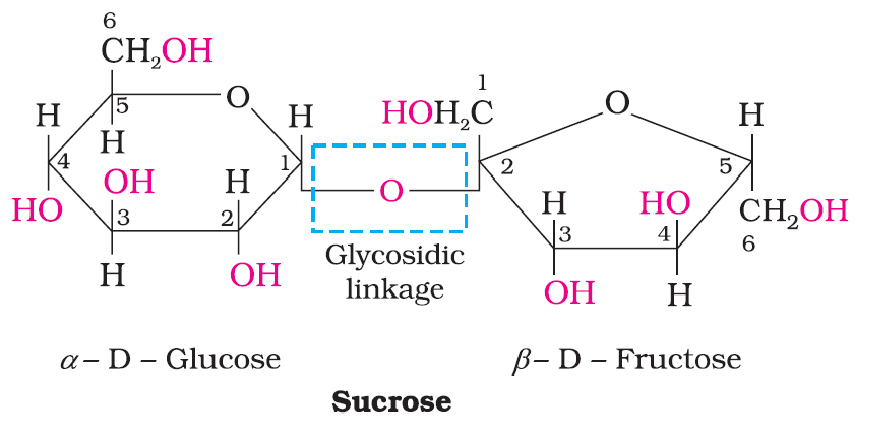
What are glycosidic linkages? In which type of biomolecules are they present?
Answer
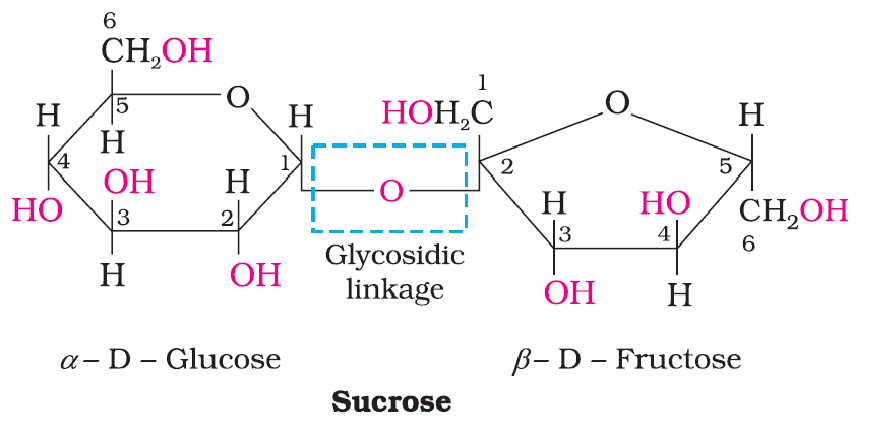
The two monosaccharides are joined together by an oxide linkage formed by the loss of a water molecule. Such a linkage between two monosaccharides is held together by a glycosidic linkage between $C_1$ of and $C_2$. Since the reducing groups of glucose and fructose are involved in glycosidic bond formation, between two monosaccharide units through oxygen atom is called glycosidic linkage.
View full question & answer
Question 901 Mark
Why must vitamin C be supplied regularly in diet?
Answer
Vitamin C are soluble in water. Water soluble vitamins must be supplied regularly in diet because they are readily excreted in urine and cannot be stored in our body.
View full question & answer
Question 931 Mark
What is the structural feature characterising reducing sugars?
Answer
The main structural feature of reducing sugars is the presence of an aldehyde group (-CHO) such as in glucose, mannose, galactose, etc. or a-ketol group (-CO- CH2OH) as present in fructose.
View full question & answer
Question 941 Mark
Name two of the different types of RNA molecules found in the cells of organisms.
Answer
Messenger RNA (mRNA) and transfer RNA (tRNA).
View full question & answer
Question 951 Mark
Among the amino acids phenylalanine, glutamine and alanine which one is an essential amino acid?
Answer
Phenylalanine is an essential amino acid.
View full question & answer
1 Marks Question - Page 2 - Chemistry STD 12 Science Questions - Vidyadip