Questions · Page 1 of 2

1 Marks Question

🎯

Test yourself on this topic

50 questions · timed · auto-graded

Question 11 Mark
What are the common types of secondary structure of proteins?
Answer
Secondary structure of protein: The secondary structure of protein refers to the shape in which a long polypeptide chain exist. They are found exist in two different types of structures viz. $\alpha$ - helix and β - pleated sheet structure. It arises due to the regular folding of the backbone of the polypeptide chain due to intermolecular hydrogen bonding between the carboxyl and amino group. In an $\alpha$ - helix, the peptide chain coils and the turns of the coil are held together by hydrogen bonds. In contrast to this, another type of secondary structure is possible in which the protein chains are stretched out and is known as β - structures.
View full question & answer
Question 21 Mark
What type of bonding helps in stabilising the $\alpha$ - helix structure of protins.
Answer
In the $\alpha$ - helix configuration, a polypeptide chain forms all possible hydrogen bonds by twisting into a right handed screw (helix) with -NH group of each amino acid residue hydrogen to the bonded $ \ \ \ \ \ \text{O}\\ \ \ \ \ \ ||\\ -\text{C}-$of an adjacent turn of the helix.
View full question & answer
Question 31 Mark
With reference to which classification has the statement, “ranitidine is an antacid” been given?
Answer
The statement refers to the classification according to pharmacological effect of the drug because any drug which will be used to counteract the effect of excess acid in the stomach will be called antacid. Antacids are the medicinal agents which decreases the excess level of hydrochloric acid in stomach.
View full question & answer
Question 41 Mark
Write IUPAC name of following and classify them into primary, secondary, tertiary amines:
$CH_3(CH_2)_2NH_2$
Answer
$CH_3(CH_2)_2NH_2$
1 - amino propane(primary)
View full question & answer
Question 51 Mark
What are the different types of RNA found in the cell?
Answer
  1. Messenger RNA (m-RNA)
  2. Ribosomal RNA (r-RNA)
  3. Transfer RNA (t-RNA)
View full question & answer
Question 61 Mark
How do you explain the amphoteric behaviour of amino acids?
Answer
In aqueous solution, the carboxyl group of an amino acid can lose a proton and the amino group can accept a proton to give a dipolar ion known as zwitter ion.
$ \ \ \ \ \ \ \ \ \ \ \ \ \ \ \ \ \ \ \ \ \text{O} \ \ \ \ \ \ \ \ \ \ \ \ \ \ \ \ \ \ \ \ \ \ \ \ \ \ \ \ \ \ \ \ \ \ \ \ \ \ \ \ \ \text{O}\\ \ \ \ \ \ \ \ \ \ \ \ \ \ \ \ \ \ \ \ \ || \ \ \ \ \ \ \ \ \ \ \ \ \ \ \ \ \ \ \ \ \ \ \ \ \ \ \ \ \ \ \ \ \ \ \ \ \ \ \ \ \ \ ||\\\text{R}-\text{CH}-\text{C}-\text{O}-\text{H}\leftrightarrows\text{R}-\text{CH}-\text{C}-\text{O}^-\\ \ \ \ \ \ \ \ \ \ | \ \ \ \ \ \ \ \ \ \ \ \ \ \ \ \ \ \ \ \ \ \ \ \ \ \ \ \ \ \ \ \ \ \ \ \ \ \ \ \ \ \ \ |\\ \ \ \ \ \ :\text{NH}_2 \ \ \ \ \ \ \ \ \ \ \ \ \ \ \ \ \ \ \ \ \ \ \ \ \ \ \ \ \ \ \ \ \ ^+\text{NH}_3\\ \ \ \ \ \ \ \ \ \ \ \ \ \ \ \ \ \ \ \ \ \ \ \ \ \ \ \ \ \ \ \ \ \ \ \ \ \ \ \ \ \ \ \ \ \ \ \ (\text{Zwitter ion})$
Therefore, in zwitter ionic form, the amino acid can act both as an acid and as a base. Thus, amino acids show amphoteric behaviour.
View full question & answer
Question 71 Mark
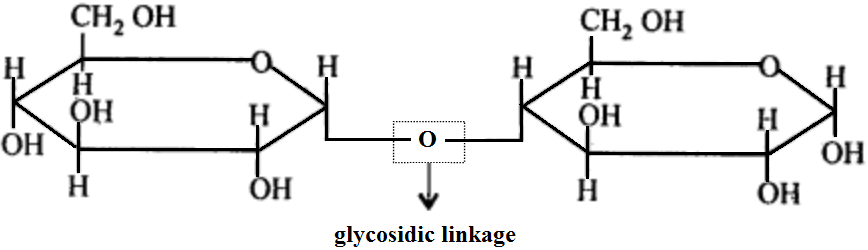
What do you understand by the term glycosidic linkage?
Answer

The ethereal or oxide linkage through which two monosaccharide units are joined together by the loss of a water molecule to form a molecule of disaccharide is called the glycosidic linkage. The glycosidic linkage in maltpse molecule is shown below:
View full question & answer
Question 81 Mark
The two strands in DNA are not identical but are complementary. Explain.
Answer
In the helical structure of DNA, the two strands are held together by hydrogen bonds between specific pairs of bases. Cytosine forms hydrogen bond with guanine, while adenine forms hydrogen bond with thymine. As a result, the two strands are complementary to each other.
View full question & answer
Question 91 Mark
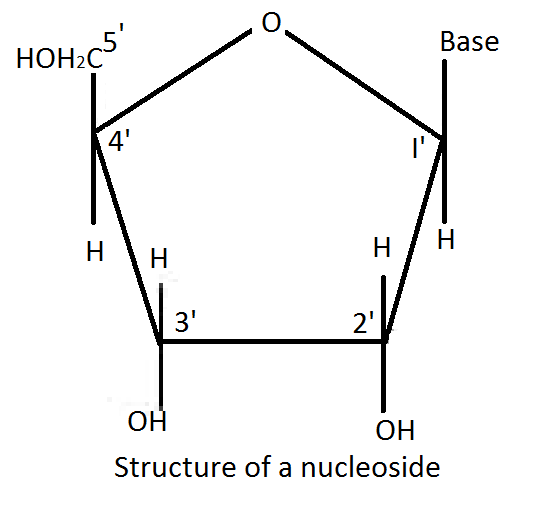
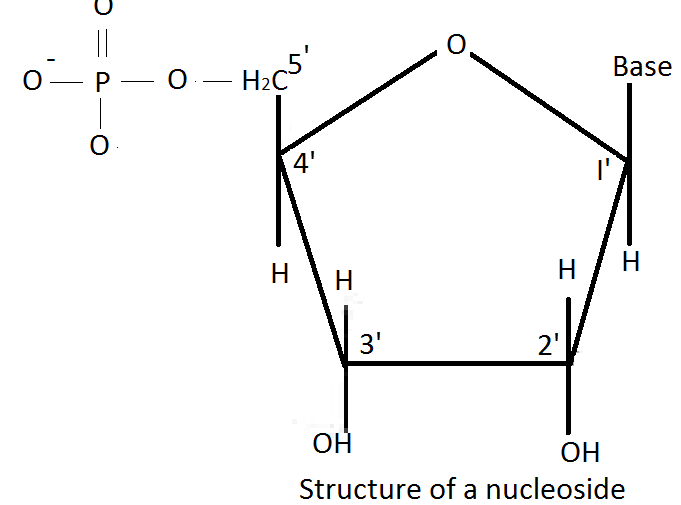
What is the difference between a nucleoside and a nucleotide?
Answer

A nucleoside is formed by the attachment of a base $to^{I'}$ position of sugar.
Nucleoside = Sugar + Base

On the other hand, all the three basic components of nucleic acids (i.e., pentose sugar, phosphoric acid, and base) are present in a nucleotide. Nucleotide = Sugar + Base + Phosphoric acid
View full question & answer
Question 101 Mark
What are the expected products of hydrolysis of lactose?
Answer
Upon hydrolysis, lactose gives equivalent amounts of D (+) glucose and D (+) galactose.
$\text{C}_{12}\text{H}_{22}\text{O}_{11}+\text{H}_2\text{O}\xrightarrow[]{\text{Hydrolysis}}\text{C}_6\text{H}_{12}\text{O}_6\$+)-\text{Lactose} \ \ \ \ \ \ \ \ \ \ \ \ \ \ \ \ \ \ \ \ \ \ \ \ \ \ \text{D}-(+)-\text{Glucose}\\\ \ \ \ \ \ \ \ \ \ \ \ \ \ \ \ \ \ \ \ \ \ \ \ \ \ \ \ \ \ \ \ \ \ \ \ \ \ \ \ \ \ \ \ \ \ \ \ \ +\text{C}_6\text{H}_{12}\text{O}_6\\ \ \ \ \ \ \ \ \ \ \ \ \ \ \ \ \ \ \ \ \ \ \ \ \ \ \ \ \ \ \ \ \ \ \ \ \ \ \ \ \ \ \ \ \ \ \ \ \ \ \ \text{D}-(+)-\text{galactose}$
View full question & answer
Question 111 Mark
Define the following as related to proteins:
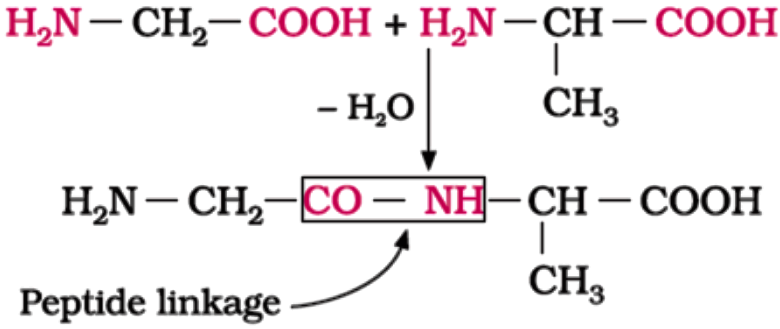
Peptide linkage.
Answer
Peptide linkage: In peptide linkage amide formed between -COOH groups of one molecule of an amino acid and $-NH_2$ group of another molecule of the amino acid by the elimination of a water molecules.
View full question & answer
Question 121 Mark
Glucose or sucrose are soluble in water but cyclohexane or benzene (simple six membered ring compounds) are insoluble in water. Explain.
Answer
The solubility of a solute in a given solvent follows the rule ‘Li ke dissolves like’.Glucose contains five and sucrose contains eight -OH groups. These -OH groups form H-bonds with water. As a result of this extensive intermoleeular H-bonding, glucose and sucrose are soluble in water.On the other hand, benzene and cyclohexane do not contain -OH bonds and hence do not form H-bonds with water. Moreover, they are non-polar molecules and hence do not dissolve in polar water molecules.
View full question & answer
Question 131 Mark
The melting points and solubility in water of amino acids are generally higher than that of the corresponding halo acids Explain.
Answer
The amino acids exist as zwitter ions, $H_3N^+ — CHR-COO-$. Due to this dipolar salt like character, they have strong dipole-dipole attractions. Therefore, their melting points are higher than corresponding haloacids which do not have salt like character.
Due to salt like character, amino acids intereact strongly with water. As a result, their solubility in water is higher than corresponding haloacids which do not have salt like character.
View full question & answer
Question 141 Mark
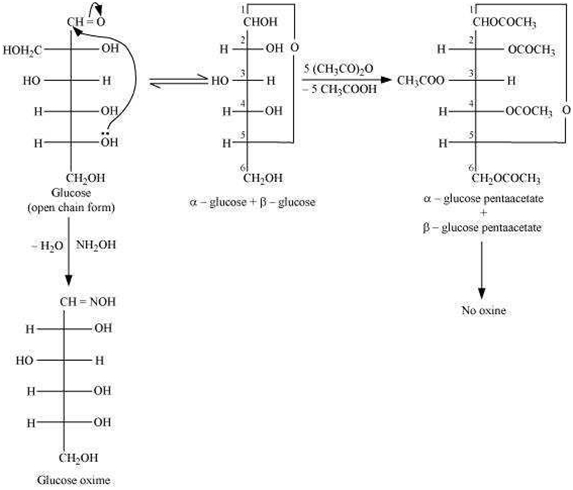
How do you explain the absence of aldehyde group in the pentaacetate of D-glucose?
Answer
D-glucose reacts with hydroxylamine $(NH_2OH)$ to form an oxime because of the presence of aldehydic (CHO) group or carbonyl carbon. This happens as the cyclic structure of glucose forms an open chain structure in an aqueous medium, which then reacts with $NH_2OH$ to give an oxime.
$\text{CHO} \ \ \ \ \ \ \ \ \ \ \ \ \ \ \ \ \ \ \ \ \ \ \ \ \text{CH}=\text{N}-\text{OH}\\ \ \ \ | \ \ \ \ \ \ \ \ \ \ \ \ \ \ \ \ \ \ \ \ \ \ \ \ \ \ \ \ \ \ \ | \$\text{CHOH})_4\xrightarrow[]{\text{NH}_4\text{OH}} \ \ (\text{CHOH})_4\\ \ \ \ \ | \ \ \ \ \ \ \ \ \ \ \ \ \ \ \ \ \ \ \ \ \ \ \ \ \ \ \ \ \ \ \ |\\\text{CH}_2\text{OH} \ \ \ \ \ \ \ \ \ \ \ \ \ \ \ \ \ \ \ \ \text{CH}_2\text{OH}\\\text{Glucose} \ \ \ \ \ \ \ \ \ \ \ \ \ \ \ \ \ \ \ \ \ \ \text{Oxime}$
But pentaacetate of D-glucose does not react with $NH_2OH$. This is because pentaacetate does not form an open chain structure.
View full question & answer
Question 151 Mark
What products would be formed when a nucleotide from DNA containing thymine is hydrolysed?
Answer
The products obtained are 2-deoxy-D-ribose, Phosphoric acid and thymine.
View full question & answer
Question 161 Mark
Define the following as related to protein
Denaturation
Answer
In a biological system, a protein is found to have a unique 3-dimensional structure and a unique biological activity. In such a situation, the protein is called native protein. However, when the native protein is subjected to physical changes such as change in temperature or chemical changes such as change in pH, its H-bonds are disturbed. This disturbance unfolds the globules and uncoils the helix. As a result, the protein loses its biological activity. This loss of biological activity by the protein is called denaturation.
During denaturation, the secondary and the tertiary structures of the protein get destroyed, but the primary structure remains unaltered. One of the examples of denaturation of proteins is the coagulation of egg white when an egg is boiled.
View full question & answer
Question 171 Mark
What is the effect of denaturation on the structure of proteins?
Answer
Denaturation of proteins: Proteins are very sensitive to the action of heat, change of pH, presence of electrolytes and radiations (particularly of short wavelength). Whenever proteins are subjected to such changes in the surroundings, they undergo some structural changes leading to disruption of three dimensional structure. This causes permanent loss of activity to proteins. Disruption of the native conformation of protein, by changing its environment, resulting in loss of its biological activity, is known as denaturation of proteins.
View full question & answer
Question 181 Mark
What are monosaccharides?
Answer
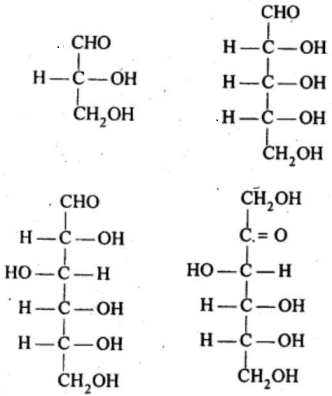
Monosaccharides are carbohydrates Which cannot be hydrolysed to smaller molecules.Their general formula is $(CH_20)n$ Where n = 3 - 7 These are of two types: Those which contain an aldehyde group (-CHO) are called aldoses and those which contain a keto (C = O) group are called ketoses.
They are further classified as trioses, tetroses ,pentoses, hexoses and heptoses according as they contain 3, 4, 5, 6, and 7 carbon atoms respectively For example.
View full question & answer
Question 191 Mark
What are reducing sugars?
Answer
Carbohydrates which reduces Fehling's solution to red precipitate of $Cu_20$ or Tollen's reagent to metallic Ag are called reducing sugars.
All monosaccharides (both aldoses and ketoses) and disaccharides except sucrose are reducing sugars.
Thus, D - (+) - glucose, D-(-)-fructose, D - (+) - maltose and D - (+) - lactose are reducing sugars.
View full question & answer
Question 201 Mark
Why cannot vitamin C be stored in our body?
Answer
Vitamin C cannot be stored in our body because it is water soluble. As a result, it is readily excreted in the urine.
View full question & answer
Question 211 Mark
Write IUPAC name of the following compounds and classify them into primary, secondary and tertiary amines.
$C_6H_5NHCH_3$
Answer
N - Methylbenzamine or N - methylaniline(2° amine)
View full question & answer
Question 221 Mark
What are enzymes?
Answer
Enzymes are proteins that catalyze biological reaction. They are very specific in nature and catalyze only a particular reaction for a particular substrate. Enzymes are usually named after a particular. For example, the enzyme used to catalyses the hydrolysis of maltose in glucose is named as maltase.
$\text{C}_{12}\text{H}_{22}\text{O}_{11}\xrightarrow[]{\text{Maltase}}2\text{C}_6\text{H}_{12}\text{O}_6\\\text{maltose} \ \ \ \ \ \ \ \ \ \ \ \ \ \ \ \ \ \ \ \text{glucose}$
View full question & answer
Question 231 Mark
Where does the water present in the egg go after boiling the egg?
Answer
Denaturation of proteins is a process in which physical and biological properties of protein without changing the chemical composition of protein. In an egg denaturation of protein is the coagulation of albumin present in the white of an egg. When egg is boiled in water, the globular proteins present in it changes to a rubber like insoluble mass which absorbs all water present in the egg.
View full question & answer
Question 241 Mark
Define the following as related to protein:
Primary structure.
Answer
Primary structure: The primary structure of protein refers to the specific sequence in which various amino acids are present in it, i.e., the sequence of linkages between amino acids in a polypeptide chain. The sequence in which amino acids are arranged is different in each protein. A change in the sequence creates a different protein.
View full question & answer
Question 281 Mark
What is meant by ‘reducing sugars’?
Answer
Carbohydrates which reduce Tollen’s reagent or Fehling solution are called reducing sugars which have free aldehydic group.
View full question & answer
Question 291 Mark
Write two main functions of carbohydrates in plants.
Answer
  1. Structural support.
  2. Storage molecules.
  3. Constituent of cell wall.
View full question & answer
Question 341 Mark
Arrange the following compounds in an increasing order of their solubility in water:
$C_6H_5NH_2, (C_2H_5)_2NH, C_2H_5NH_{2}.$
Answer
$C_6H_5NH_2 < (C_2H_5)_2NH < C_2H_5NH_{2}.$
View full question & answer
Question 351 Mark
Write the products obtained after hydrolysis of lactose.
Answer
Lactose is composed of $\beta-\text{D}$ galactose and $\beta-\text{D}$ glucose. Thus, on hydrolysis, it gives $\beta-\text{D}$ galactose and $\beta-\text{D}$ glucose.
$\text{C}_{12}\text{H}_{22}\text{O}_{11}\ \ \ +\ \ \ \text{H}_2\text{O}\ \ \ \xrightarrow{\ \ \ \ \ \ \ \ \ }\ \ \ \text{C}_6\text{H}_{12}\text{O}_6\ \ \ \ \ +\ \ \ \ \text{C}_6\text{H}_{12}\text{O}_6\\ \ \ \text{Lactose}\ \ \ \ \ \ \ \ \ \ \ \ \text{Water}\ \ \ \ \ \ \ \ \ \ \ \ \ \text{D}-\text{Glucose}\ \ \ \ \ \ \ \ \text{D}-\text{Galactose}$
View full question & answer
Question 371 Mark
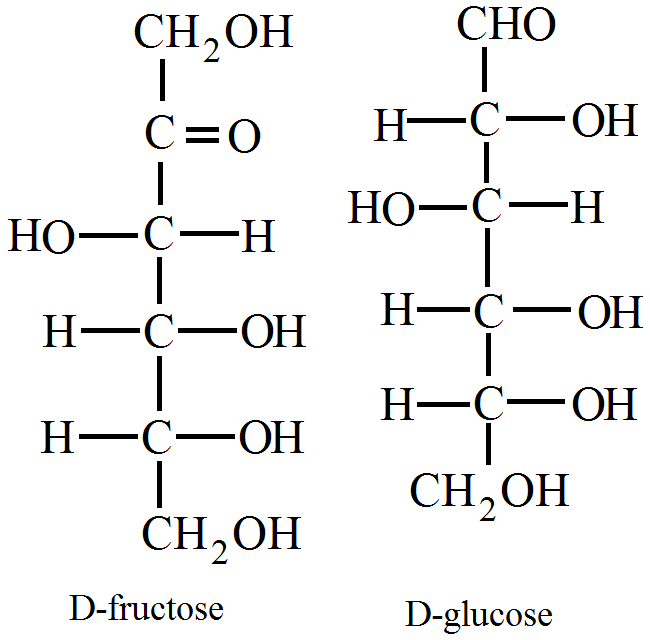
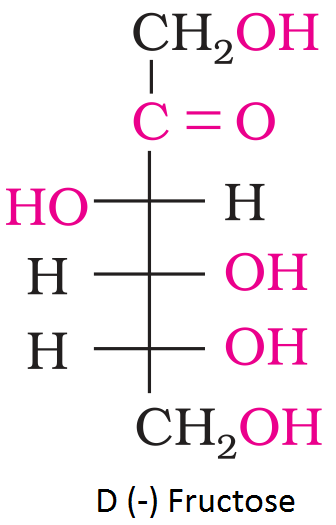
What is the basic structural difference between glucose and fructose?
Answer
Both Glucose and Fructose are hexose sugars with six carbon atoms but, Glucose is an aldohexose and Fructose is ketohexose which means the functional group present in glucose is aldehyde and the functional group in fructose is ketone.
View full question & answer
Question 391 Mark
Write biological importance of nucleic acid.
Answer
  1. To transmit genetic material to their offsprings.
  2. Protein synthesis.
View full question & answer
Question 401 Mark
Some enzymes are named after the reaction, where they are used. What name is given to the class of enzymes which catalyse the oxidation of one substrate with simultaneous reduction of another substrate?
Answer
Oxidoreductase is class of enzymes which catalyse the oxidation of one substrate with simultaneous reduction of another substrate.
View full question & answer
Question 411 Mark
Name the molecule which provides energy for all the activities of a cell.
Answer
Adenosine triphosphate (ATP).
View full question & answer
Question 431 Mark
What are oligosaccharides?
Answer
Carbohydrates which on hydrolysis give 2-10 molecules of monosaccharides are called oligosaccharides. For example, sucrose, raffinose, stachyose, etc.
View full question & answer
Question 461 Mark
How do you explain the presence of five —OH groups in glucose molecule?
Answer
Glucose gives penta-acetyl derivative on acetylation with acetic anhydride.
$\text{CHO}| (\text{CHOH})_4|\text{CH}_2\text{OH}|\text{CH}_2\text{OH}\xrightarrow{\ \ \ \ \ \ \ \ \ }\text{CHO}|(\text{CHOCOCH}_3)_4|\text{CH}_2\text{OH}_2\text{OCOCH}_3$
This confirms the presence of five -OH groups.
View full question & answer
Question 471 Mark
Name the sugar present in milk. How many monosaccharide units are present in it? What are such oligosaccharides called?
Answer
Lactose is present in milk. Two monosaccharide units (i.e., glucose and galactose) are present in it. Such oligosaccharides are called disaccharides.
View full question & answer
Question 481 Mark
Monosaccharides contain carbonyl group hence are classified, as aldose or ketose. The number of carbon atoms present in the monosaccharide molecule are also considered for classification. In which class of monosaccharide will you place fructose?
Answer
Monosaccharides contain carbonyl group. Hence, are classified as aldose or ketose.
When aldehyde group is present, the monosaccharides are known as aldose. When ketone group is present, the monosaccharides are known as ketose. Fructose has molecular formula $C_6H_{12}O_6$ containing six carbon and keto group and is classified as ketohexose.
View full question & answer
Question 491 Mark
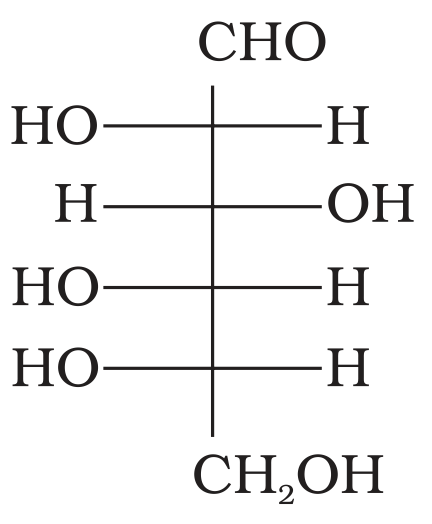
The letters ‘D’ or ‘L’ before the name of a stereoisomer of a compound indicate the correlation of configuration of that particular stereoisomer. This refers to their relation with one of the isomers of glyceraldehyde. Predict whether the following compound has ‘D’ or ‘L’ configuration.
Answer
The letters ‘D’ or ‘L’ before the name of any compound indicate the relative configuration of a particular stereoisomer. This refers to their relation with a particular isomer of glyceraldehydes.
D’ before the name of glucose represents the configuration whereas ‘(+)’ represents dextrorotatory nature of the molecule. It may be remembered that ‘D’ and ‘L’ have no relation with the optical activity of the compound. For assigning the configuration of monosaccharides, it is the lowest asymmetric carbon atom which is compared. The given compound has L-configuration.
View full question & answer
1 Marks Question - Chemistry STD 12 Science Questions - Vidyadip