Question 14 Marks
Derive nernst equation for Daniel cell
Answer
View full question & answer→$\rightarrow$ Concentration of Electrolyte in Electrochemic cell is Unity $(1M).$ It is not true always.
$\rightarrow$ Nernst derive equation for calculating $E$ when concentration of electrolyte is not unin this equation is known as nernst equation.
$M ^{ n +}( aq )+ ne ^{-} \rightarrow M ( s )$
$\rightarrow$ Electrode potential of above reaction is
$E _{\left( M ^{ n +} \mid M \right)}= E _{\left( M ^{ n +} \mid M \right)}^{\ominus}-\frac{ RT }{ nF } \ln \frac{1}{\left[ M ^{ n +}\right]}$
but concentration of solid $M$ is taken as unity and we have
$E _{\left( M ^{ n +} \mid M \right)}= E _{\left( M ^{ n +} \mid M \right)}^{\ominus}-\frac{ RT }{ nF } \ln \frac{1}{\left[ M ^{ n +}\right]}$
Where, $E ^{\ominus}{ }_{ M ^{ n +} \mid M }=$ Standard Electrode potential
$R =$ gas constant
$T =$ Temperature
$F =$ Faraday $\left(96427 C \cdot mol ^{-1}\right. )$
$\left[M^{n+}\right]=$ concentration of $M^{n+}$
$n =$ No. of Electron
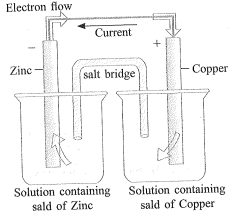
$\rightarrow$ For Daniell Cell $Zn$ act as anode and $Cu$ act as cathode so,
For cathode :
$E _{\left( Cu ^{2+} \mid Cu \right)}= E _{\left( Cu ^{2+} \mid Cu \right)}^{\ominus}-\frac{ RT }{2 F} \ln \frac{1}{\left[ Cu ^{2+}( aq )\right]}$
For Anode :
$E _{\left( Zn ^{2+} \mid Zn \right)}= E _{\left( Zn ^{2+} \mid Zn \right)}^{\ominus}-\frac{ RT }{2 F} \ln \frac{1}{\left[ Zn ^{2+}( aq )\right]}$
The cell potential,
$E _{\text {cell }}= E _{\left( Cu ^{2+} \mid Cu \right)}- E _{\left( Zn ^{2+} \mid Zn \right)}$
$= E _{\left( Cu ^{2+} \mid Cu \right)}-\frac{ RT }{2 F} \ln \frac{1}{\left[ Cu ^{2+}( aq )\right]}$
$ \quad- E _{\left( Zn ^{2+} \mid Zn \right)}^{\ominus}+\frac{ RT }{2 F} \ln \frac{1}{\left[ Zn ^{2+}( aq )\right]}$
$= E _{\left( Cu ^{2+} \mid Cu \right)}^{\ominus}- E _{\left( Zn ^{2+} \mid Zn \right)}$
$ -\frac{ RT }{2 F} \ln \left(\ln \frac{1}{\left[ Cu ^{2+}( aq )\right]}-\ln \frac{1}{\left[ Zn ^{2+}( aq )\right]}\right)$
$E _{\text {cell }}= E _{\text {cell }}^{\ominus}-\frac{ RT }{2 F} \ln \frac{\left[ Zn ^{2+}\right]}{\left[ Cu ^{2+}\right]}
$$\rightarrow$ It can be seen that $E _{\text {(cell) }}$ depends on the concentration of both $Cu ^{2+}$ and $Zn ^{2+}$ ions.
It increase with increase in the concentration of $Cu^{2+}$ ions and decrease in the concentration of $Zn^{2+}$ ions.
$\rightarrow R =8.314 J mol ^{-1} k ^{-1}$
$T=298 K$
$F =96487 C$
$ln =2.303 \log$
Substituting this value in above equation.
$E _{\text {(cell) }}= E _{\text {(cell) }}^{\ominus}-\frac{0.059}{2} \log \frac{\left[ Zn ^{2+}\right]}{\left[ Cu ^{2+}\right]}$
$\rightarrow$ Nernst derive equation for calculating $E$ when concentration of electrolyte is not unin this equation is known as nernst equation.
$M ^{ n +}( aq )+ ne ^{-} \rightarrow M ( s )$
$\rightarrow$ Electrode potential of above reaction is
$E _{\left( M ^{ n +} \mid M \right)}= E _{\left( M ^{ n +} \mid M \right)}^{\ominus}-\frac{ RT }{ nF } \ln \frac{1}{\left[ M ^{ n +}\right]}$
but concentration of solid $M$ is taken as unity and we have
$E _{\left( M ^{ n +} \mid M \right)}= E _{\left( M ^{ n +} \mid M \right)}^{\ominus}-\frac{ RT }{ nF } \ln \frac{1}{\left[ M ^{ n +}\right]}$
Where, $E ^{\ominus}{ }_{ M ^{ n +} \mid M }=$ Standard Electrode potential
$R =$ gas constant
$T =$ Temperature
$F =$ Faraday $\left(96427 C \cdot mol ^{-1}\right. )$
$\left[M^{n+}\right]=$ concentration of $M^{n+}$
$n =$ No. of Electron
$\rightarrow$ For Daniell Cell $Zn$ act as anode and $Cu$ act as cathode so,
For cathode :
$E _{\left( Cu ^{2+} \mid Cu \right)}= E _{\left( Cu ^{2+} \mid Cu \right)}^{\ominus}-\frac{ RT }{2 F} \ln \frac{1}{\left[ Cu ^{2+}( aq )\right]}$
For Anode :
$E _{\left( Zn ^{2+} \mid Zn \right)}= E _{\left( Zn ^{2+} \mid Zn \right)}^{\ominus}-\frac{ RT }{2 F} \ln \frac{1}{\left[ Zn ^{2+}( aq )\right]}$
The cell potential,
$E _{\text {cell }}= E _{\left( Cu ^{2+} \mid Cu \right)}- E _{\left( Zn ^{2+} \mid Zn \right)}$
$= E _{\left( Cu ^{2+} \mid Cu \right)}-\frac{ RT }{2 F} \ln \frac{1}{\left[ Cu ^{2+}( aq )\right]}$
$ \quad- E _{\left( Zn ^{2+} \mid Zn \right)}^{\ominus}+\frac{ RT }{2 F} \ln \frac{1}{\left[ Zn ^{2+}( aq )\right]}$
$= E _{\left( Cu ^{2+} \mid Cu \right)}^{\ominus}- E _{\left( Zn ^{2+} \mid Zn \right)}$
$ -\frac{ RT }{2 F} \ln \left(\ln \frac{1}{\left[ Cu ^{2+}( aq )\right]}-\ln \frac{1}{\left[ Zn ^{2+}( aq )\right]}\right)$
$E _{\text {cell }}= E _{\text {cell }}^{\ominus}-\frac{ RT }{2 F} \ln \frac{\left[ Zn ^{2+}\right]}{\left[ Cu ^{2+}\right]}
$$\rightarrow$ It can be seen that $E _{\text {(cell) }}$ depends on the concentration of both $Cu ^{2+}$ and $Zn ^{2+}$ ions.
It increase with increase in the concentration of $Cu^{2+}$ ions and decrease in the concentration of $Zn^{2+}$ ions.
$\rightarrow R =8.314 J mol ^{-1} k ^{-1}$
$T=298 K$
$F =96487 C$
$ln =2.303 \log$
Substituting this value in above equation.
$E _{\text {(cell) }}= E _{\text {(cell) }}^{\ominus}-\frac{0.059}{2} \log \frac{\left[ Zn ^{2+}\right]}{\left[ Cu ^{2+}\right]}$