Questions · Page 1 of 2

1 Marks Question

Take a timed test

50 questions · 1 auto-graded MCQ + 49 self-marked written.

Question 11 Mark
How much electricity in terms of Faraday is required to produce,
40.0g of Al from molten $Al_2O_3$.
Answer
According to the question,
$\text{Al}^{3+}+3\text{e}^{-1}\ \rightarrow\ \text{Al}\\ \ \ \ \ \ \ \ \ \ \ \ \ \ \ \ \ \ \ \ \ \ \ \ \ \ \ \ \ \ 27\text{g}$
Electricity required to produce 27g of Al = 3 F
Therefore, electricity required to produce 40 g of Al $=\frac{3\times40}{27}\text{F}=4.44\ \text{F}$
View full question & answer
Question 21 Mark
How much electricity is required in coulomb for the oxidation of
1 mol of $\mathrm{H}_2 \mathrm{O}$ to $\mathrm{O}_2$.
Answer
According to the question,
$\text{H}_2\text{O}\ \rightarrow\ \text{H}_2\ +\ \frac{1}{2}\text{O}_2$
Now, we can write:
$\text{O}_2\rightarrow\frac{1}{2}\text{O}_2+2\text{e}^-$
Electricity required for the oxidation of 1 mol of $\mathrm{H}_2 \mathrm{O}$ to $\mathrm{O}_2=2 \mathrm{~F}$
$= 2 × 96487\ C$
$= 192974\ C$
View full question & answer
Question 31 Mark
Can you store copper sulphate solutions in a zinc pot?
Answer
Zn being more reactive than Cu , displaces Cu from $\mathrm{CuSO}_4$ solution as follows: $\mathrm{Zn}(\mathrm{s})+\mathrm{CuSO}_4(\mathrm{aq}) \rightarrow \mathrm{ZnSO}_4(\mathrm{ag})+\mathrm{Cu}(\mathrm{s})$
In terms of EMF, we have
$Zn|Zn^{2+}||Cu^{2+}|Cu$
$\text{E}^\circ_\text{cell}=\text{E}^\circ_{\text{Cu}^{2+}\text{Cu}}-\text{E}^\circ_{\text{Zn}^{2+}/\text{Zn}}$
$= 0.34\ V - (-0.76\ V)$
$= 1.10\ V$
As $\text{E}^\circ_\text{cell}$ is positive, reaction takes place, i.e., Zn reacts with copper and hence, we cannot store $CuSo_4$ solution in zinc pot.
View full question & answer
Question 41 Mark
Consider the reaction:
$\mathrm{Cr}_2 \mathrm{O}_7^{2-}+14 \mathrm{H}^{+}+6 \mathrm{e}^{-} \rightarrow 2 \mathrm{Cr}^{3+}+8 \mathrm{H}_2 \mathrm{O}$
$\text { What is the quantity of electricity in coulombs needed to reduce } 1 \mathrm{~mol} \text { of } \mathrm{Cr}_2 \mathrm{O}_7 2^{-} \text {? }$
Answer
$ \mathrm{Cr}_2 \mathrm{O}_7^{2-} \rightarrow 2 \mathrm{Cr}^{3+} $
$ 2 \mathrm{Cr}^{6+}+6 \mathrm{e}^{-} \rightarrow 2 \mathrm{Cr}^{3+}$
In given equation there are 6 electrons are required so that $n = 6$
Use the formula
Required charge $= nF$
Plug the values in this formula we get
Required charge $= 6 × 96487$ Coulombs
$= 578922 $ Coulombs
$= 5.79 × 10^5$ Coulombs
View full question & answer
Question 51 Mark
How much electricity is required in coulomb for the oxidation of
1 mol of FeO to $\mathrm{Fe}_2 \mathrm{O}_3$.
Answer
According to the question,
$\mathrm{Fe}^{2+} \rightarrow \mathrm{Fe}^{3+}+\mathrm{e}^{-1}$
Electricity required for the oxidation of 1 mol of FeO to $\mathrm{Fe}_2 \mathrm{O}_3=1 \mathrm{~F}$
$=96487 \mathrm{~C}$
View full question & answer
Question 61 Mark
How much charge is required for the following reduction:
1 mol of $\mathrm{Cu}^{2+}$ to Cu .
Answer
$\mathrm{Cu}^{2+}+2 \mathrm{e}^{-} \rightarrow \mathrm{Cu}$
Therefore, Required charge $= 2\ F$
$= 3 × 96487\ C$
$= 192974\ C$
View full question & answer
Question 71 Mark
Suggest two materials other than hydrogen that can be used as fuels in fuel cells.
Answer
Methane and Methanol.
View full question & answer
Question 81 Mark
How much charge is required for the following reduction:
1 mol of $ \mathrm{MnO}_4^{-} $ to $ \mathrm{Mn}^{2+} $
Answer
$ \mathrm{MnO}_4^{-} \rightarrow \mathrm{Mn}^{2+} $
$ \text { i.e., } \mathrm{Mn}^{7+}+5 \mathrm{e}^{-} \rightarrow \mathrm{Mn}^{2+}$
$\text { Therefore, Required charge }=5 \mathrm{~F}$
$ =5 \times 96487 \mathrm{C} $
$ =482435 \mathrm{C}$
View full question & answer
Question 91 Mark
Given the standard electrode potentials,
$ \mathrm{K}^{+} / \mathrm{K}=-2.93 \mathrm{~V}, \mathrm{Ag}^{+} / \mathrm{Ag}=0.80 \mathrm{~V}, $
$ \mathrm{Hg}^{2+} / \mathrm{Hg}=0.79 \mathrm{~V} $
$ \mathrm{Mg}^{2+} / \mathrm{Mg}=-2.37 \mathrm{~V}, \mathrm{Cr}^{3+} / \mathrm{Cr}=-0.74 \mathrm{~V}$
Arrange these metals in their increasing order of reducing power.
Answer
$\mathrm{Ag} < \mathrm{Hg} < \mathrm{Cr} < \mathrm{Mg} < \mathrm{K}$.
View full question & answer
Question 111 Mark
Why does the conductivity of a solution decrease with dilution?
Answer
The conductivity of a solution is the conductance of ions present in a unit volume of the solution. The number of ions (responsible for carrying current) decreases when the solution is diluted. As a result, the conductivity of a solution decreases with dilution.
View full question & answer
Question 121 Mark
How much electricity in terms of Faraday is required to produce,
20.0 g of Ca from molten $CaCl_2$.
Answer
According to the question, $\text{Ca}^{2+}+2\text{e}^{-1}\ \rightarrow\ \text{Ca}\\ \ \ \ \ \ \ \ \ \ \ \ \ \ \ \ \ \ \ \ \ \ \ \ \ \ \ \ \ \ 40\text{g}$ Electricity required to produce 40 g of calcium = 2 F Therefore, electricity required to produce 20 g of calcium $\frac{2\times20}{40}\text{F}=1\text{F}$
View full question & answer
Question 131 Mark
Arrange the following metals in the order in which they displace each other from the solution of their salts.
Al, Cu, Fe, Mg and Zn.
Answer
Mg > Al > Zn > Fe > Cu is decreasing order of their reactivity.
View full question & answer
Question 141 Mark
How much charge is required for the following reduction:
1 mol of $Al^{3+}$ to Al.
Answer
$\mathrm{Al}^{3+}+3 \mathrm{e}^{-} \rightarrow \mathrm{Al}$
Therefore, Required charge = 3 F
= 3 × 96487 C
= 289461 C
View full question & answer
Question 151 Mark
What is meant by ‘limiting molar conductivity’?
Answer
It is molar conductivity at infinite dilution or approaching zero concentration.
View full question & answer
Question 161 Mark
Express the relation between the conductivity and the molar conductivity of a solution.
Answer
$\Lambda_{m}=\frac{k}{\text{c}}$ where $Λ_m$ is molar conductivity, κ is conductivity, c is concentration in mol $L^{-1}$.
View full question & answer
Question 171 Mark
From the given cells:
Lead storage cell, Mercury cell, Fuel cell and Dry cell
Answer the following:
  1. Which cell is used in hearing aids?
  2. Which cell was used in Apollo Space Programme?
  3. Which cell is used in automobiles and inverters?
  4. Which cell does not have long life?
Answer
  1. Mercury cell.
  2. Fuel cell.
  3. Lead storage battery.
  4. Dry cell.
View full question & answer
Question 181 Mark
Express the relation between conductivity and molar conductivity of a solution held in a cell.
Answer
$\Lambda_m= k/c.$
where $\Lambda_m$ is molar conductivity, k is conductivity, c is concentration in mol $L^{-1}$.
View full question & answer
Question 191 Mark
Out of zinc and tin, whose coating is better to protect iron objects?
Answer
Zink is better than tin in protecting iron from corrosion because zink has more affinity to oxygen than tin. When is coated on iron layer then it reacts with oxygen if air to form a protective layer of zink oxide on iron which prevent the further reaction of iron with oxygen, and thus preventing the process of rusting. But in the case of tin, it(tin) does not react with oxygen thus it is less effective in preventing rusting.
View full question & answer
Question 201 Mark
What is electrode potential?
Answer
The electrical potential difference set up between the metal and its solution is called electrode potential.
View full question & answer
Question 211 Mark
Write the mathematical expression for Kohlrausch’s law.
Answer
$\Lambda^{\circ}_{\text{m}}=\text{v}_{\text{c}}\Lambda^{\circ}_{\text{c}}+\text{v}_{\text{a}}\Lambda^{\circ}_{\text{a}}$ where $ν_c$ and $ν_a$ are the number of cations and anions respectively in one formula unit of the compound.
View full question & answer
Question 221 Mark
What is the reference electrode in determining the standard electrode potential?
Answer
Normal hydrogen electrode (NHE).
View full question & answer
Question 231 Mark
What is cathodic protection?
Answer
A process in which a metal is connected with a more reactive metal which acts as anode and the metal to be protected acts as a cathode is known as cathodic protection.
View full question & answer
Question 241 Mark
Why does a dry cell become dead after a long time even if it has not been used?
Answer
Even though not in use, a dry cell becomes dead after some time because the acidic $NH_4Cl$ corrodes the zinc container.
View full question & answer
Question 251 Mark
In an aqueous solution how does specific conductivity of electrolytes change with addition of water?
Answer
On the addition of water, number of ions per unit volume decreases and therefore conductivity decreases.
View full question & answer
Question 261 Mark
Write Nernst equation for the general cell reaction,
$\text{aA}+\text{bB}\xrightarrow{ \ \ \ \ \ \ }\text{xX + yY}.$
Answer
If n moles of electrons are transferred, Nernst equation is:
$\text{E}_{\text{cell}}=\text{E}^{\circ}_{\text{cell}}-\frac{\text{RT}}{\text{nF}}\text{In}\frac{[\text{X}]^{\text{z}}[\text{Y}]^{\text{y}}}{[\text{A}]^{\text{a}}[\text{B}]^{\text{b}}}$
View full question & answer
Question 271 Mark
State the factors that influence the value of cell potential of the following cell:
$\mathrm{Mg}(\mathrm{s})\left|\mathrm{Mg}^{2+}(\mathrm{aq}) \| \mathrm{Ag}^{+}(\mathrm{aq})\right| \mathrm{Ag}(\mathrm{s})$
Answer
Concentration of Mg 2+ and Ag+ ions in the solution and temperature.
View full question & answer
Question 281 Mark
What is the role of $ZnCl_2$ in a dry cell?
Answer
$\mathrm{ZnCl}_2$ combines with the $\mathrm{NH}_3$ produced to form the complex salt $\left[\mathrm{Zn}\left(\mathrm{NH}_3\right)_2 \mathrm{Cl}_2\right]$ otherwise the pressure developed due to $\mathrm{NH}_3$ would crack the seal of the cell.
View full question & answer
Question 291 Mark
Why is it not possible to measure the single electrode potential?
Answer
Oxidation or reduction cannot take place alone. Moreover, electrode potential is a relative tendency and can be measured with respect to a reference electrode only.
View full question & answer
Question 301 Mark
Write the name of the electrolyte used in (i) fuel cell (ii) mercury cell.
Answer
  1. Concentrated aqueous KOH solution.
  2. Moist mercuric oxide (HgO) mixed with KOH.
View full question & answer
Question 331 Mark
Why is alternating current used for measuring resistance of an electrolytic solution?
Answer
Alternating current is used to prevent electrolysis so that concentration of ions in the solution remains constant.
View full question & answer
Question 341 Mark
What are the products of electrolysis of molten and aqueous sodium chloride?
Answer
 Na and $\mathrm{Cl}_2$.
 $\mathrm{H}_2$ and $\mathrm{Cl}_2$.
View full question & answer
Question 351 Mark
When acidulated water (dil. $\mathrm{H}_2 \mathrm{SO}_4$ solution) is electrolysed, will the pH of the solution be affected? Justify your answer.
Answer
$\text{At anode}:\ \ 2\text{H}_2\text{O}\xrightarrow{\ \ \ \ \ \ \ \ \ \ \ \ }\text{O}_2+4\text{H}^++4\text{e}^-$
$\text{At cathode}:\ \ 4\text{H}^++4\text{e}^{-}\xrightarrow{\ \ \ \ \ \ \ \ \ \ \ \ \ }2\text{H}_2$
View full question & answer
Question 361 Mark
What is the overall electrochemical reaction taking place in rusting?
Answer
$2\text{Fe(s) + O}_2(\text{g})+4\text{H}^+(\text{aq})\xrightarrow{ \ \ \ \ \ \ }2\text{Fe}^{2+}(\text{aq})+2\text{H}_2\text{O}(\text{I})$
View full question & answer
Question 371 Mark
Value of standard electrode potential for the oxidation of $Cl^-$ ions is more positive than that of water, even then in the electrolysis of aqueous sodium chloride, why is $Cl^-$ oxidised at anode instead of water?
Answer
Under the conditions of electrolysis of aqueous sodium chloride, oxidation of water at anode requires overpotential hence $Cl^-$ is oxidised instead of water.
View full question & answer
Question 381 Mark
Define electrochemical series.
Answer
The arrangement of elements in the increasing or decreasing order of their standard reduction potentials is called electrochemical series.
View full question & answer
Question 391 Mark
Can absolute electrode potential of an electrode be measured?
Answer
No, absolute electrode potential of an electrode cannot be measured.
View full question & answer
Question 401 Mark

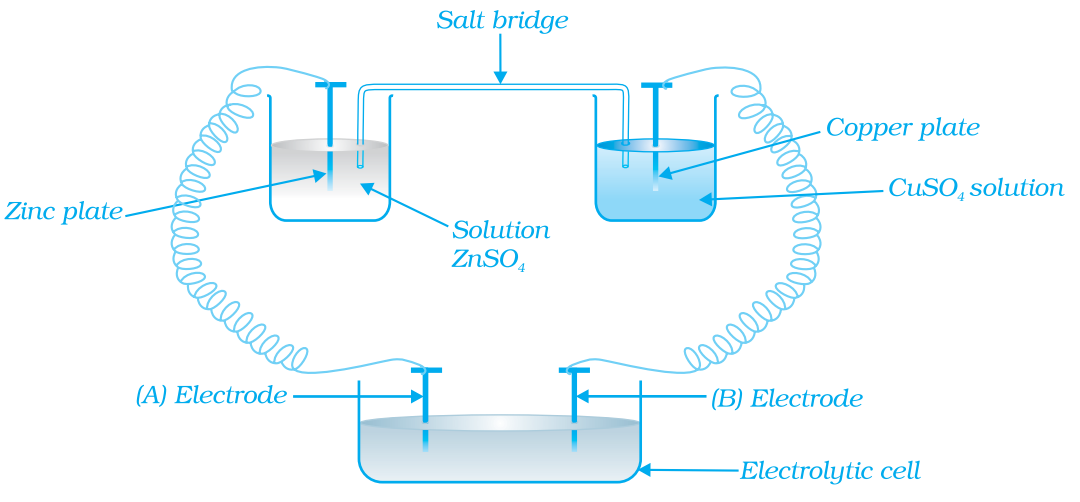
Consider the following diagram in which an electrochemical cell is coupled to an electrolytic cell. What will be the polarity of electrodes ‘A’ and ‘B’ in the electrolytic cell?
Answer
‘A’ will have negative polarity. ‘B’ will have positive polarity.
View full question & answer
Question 411 Mark
Why electrolysis of NaBr and Nal gives $\mathrm{Br}_2$ and $\mathrm{I}_2$ respectively while that of NaF gives $\mathrm{O}_2$ instead of $\mathrm{F}_2$ ?
Answer
$\mathrm{Br}^{-}$and $\mathrm{I}^{-}$ions have higher oxidation potentials than water. Hence, they are more easily oxidised. But $\mathrm{F}^{-}$ions have lower oxidation potential than $\mathrm{H}_2 \mathrm{O}$. So, $\mathrm{H}_2 \mathrm{O}$ is easily oxidised to give $\mathrm{O}_2$ gas.
View full question & answer
Question 421 Mark
What is the necessity to use a salt bridge in a Galvanic cell?
Answer
To complete the inner circuit and to maintain the electrical neutrality of the electrolytic solutions of the half-cells we use a salt bridge in a Galvanic cell.
View full question & answer
Question 431 Mark
Why does a galvanic cell become dead after some time?
Answer
As the reaction proceeds, concentration of ions in anodic half keeps on increasing while in the cathodic half it keeps on decreasing. Hence, their electrode potentials also keep on changing till ultimately they become equal and then e.m.f. of the cell becomes zero.
View full question & answer
Question 441 Mark
Depict the galvanic cell in which the cell reaction is $\text{Cu}+2\text{Ag}^{+}\xrightarrow{\ \ \ \ \ \ \ \ \ \ \ \ }2\text{Ag}+\text{Cu}^{2+}$
Answer
$\text{Cu}|\text{Cu}^{2+}||\text{Ag}^{+}|\text{Ag}$
View full question & answer
Question 451 Mark
What does the negative sign in the expression $\text{E}^\ominus_{\text{zn}^{2+}/\text{zn}}=-0.76\text{V}$ mean?
Answer
It means that Zn is more reactive than hydrogen. When zinc electrode will be connected to SHE, Zn will get oxidised and $H^+$ will get reduced.
View full question & answer
MCQ 461 Mark
Which of the statements about solutions of electrolytes is not correct?
  • A
    Conductivity of solution depends upon size of ions.
  • B
    Conductivity depends upon viscosiy of solution.
  • Conductivity does not depend upon solvation of ions present in solution.
  • D
    Conductivity of solution increases with temperature.
Answer
Correct option: C.
Conductivity does not depend upon solvation of ions present in solution.
Conductivity depends upon salvation of ions present in the solution. The greater the salvation of ions, the lesser is the conductivity.
View full question & answer
Question 471 Mark
How is the unit of molar conductivity arrived at?
Answer
$\Lambda_{\text{m}}=\text{k}\times\text{V}=\text{ohm}^{-1}\text{cm}^{-1}\times\text{cm}^3\text{mol}^{-1}$
$=\text{ohm}^{-1}\text{cm}^{2}\text{mol}^{-1}=\text{S cm}^2\text{mol}^{-1}$
View full question & answer
Question 481 Mark
In operation of a galvanic cell, at one of the electrodes oxidation takes place. What is the name of this electrode and what is its polarity?
Answer
Anode is the electrode at which oxidation, i.e., loss of electron takes place. It is -ve terminal.
View full question & answer
Question 491 Mark
Can $\text{E}^\ominus_{\text{Cell}}$ or $\Delta_{\text{r}}\text{G}^\ominus$ for cell reaction ever be equal to zero?
Answer
No, $\text{E}^\ominus$ and $\Delta\text{G}^\ominus$ for cell reaction can never be zero.
$\Delta\text{G}^\ominus=-\text{n}\text{FE}^\ominus$
$\text{E}^\ominus$ is never zero hence, $\Delta\text{G}^\ominus$ will also be not equal to zero.
View full question & answer
Question 501 Mark
What would happen if no salt bridge were used in an electrochemical cell (like Zn-Cu cell)?
Answer
The metal ions $(\text{Zn}^{2+})$ formed by the loss of electrons will accumulate in one electrode and the negative ions $(\text{SO}^{2-}_4)$ will accumulate in the other. Thus, the solutions will develop charges and the current will stop flowing. Moreover, the inner circuit will not be completed.
View full question & answer
1 Marks Question - Chemistry STD 12 Science Questions - Vidyadip