Questions · Page 2 of 2

1 Marks Question

Question 511 Mark
Write Nernst equation for single electrode potential.
Answer
For the electrode reaction $\text{M}^{\text{n}+}+\text{ne}^-\xrightarrow{ \ \ \ \ \ }\text{M}$
$\frac{\text{E}_{\text{M}^{\text{n}+}}}{\text{M}}=\frac{\text{E}^{\circ}_{\text{M}^{\text{n}+}}}{\text{M}}-\frac{2.303\text{RT}}{\text{nF}}\log\frac{|\text{M}|}{|\text{M}^{\text{n}+}|}$
$=\frac{\text{E}^{\circ}_{\text{M}^{\text{n}+}}}{\text{M}}-\frac{2.303\text{RT}}{\text{nF}}\log\frac{1}{|\text{M}^{\text{n}+}|}$
View full question & answer
Question 521 Mark

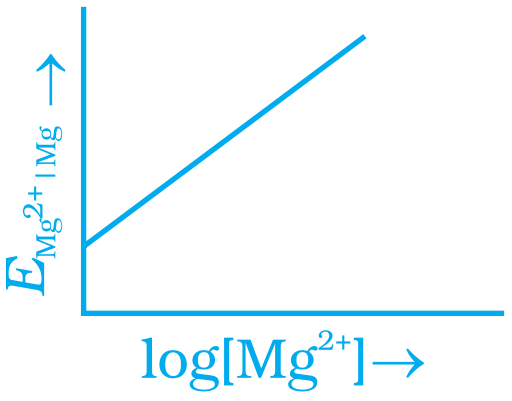
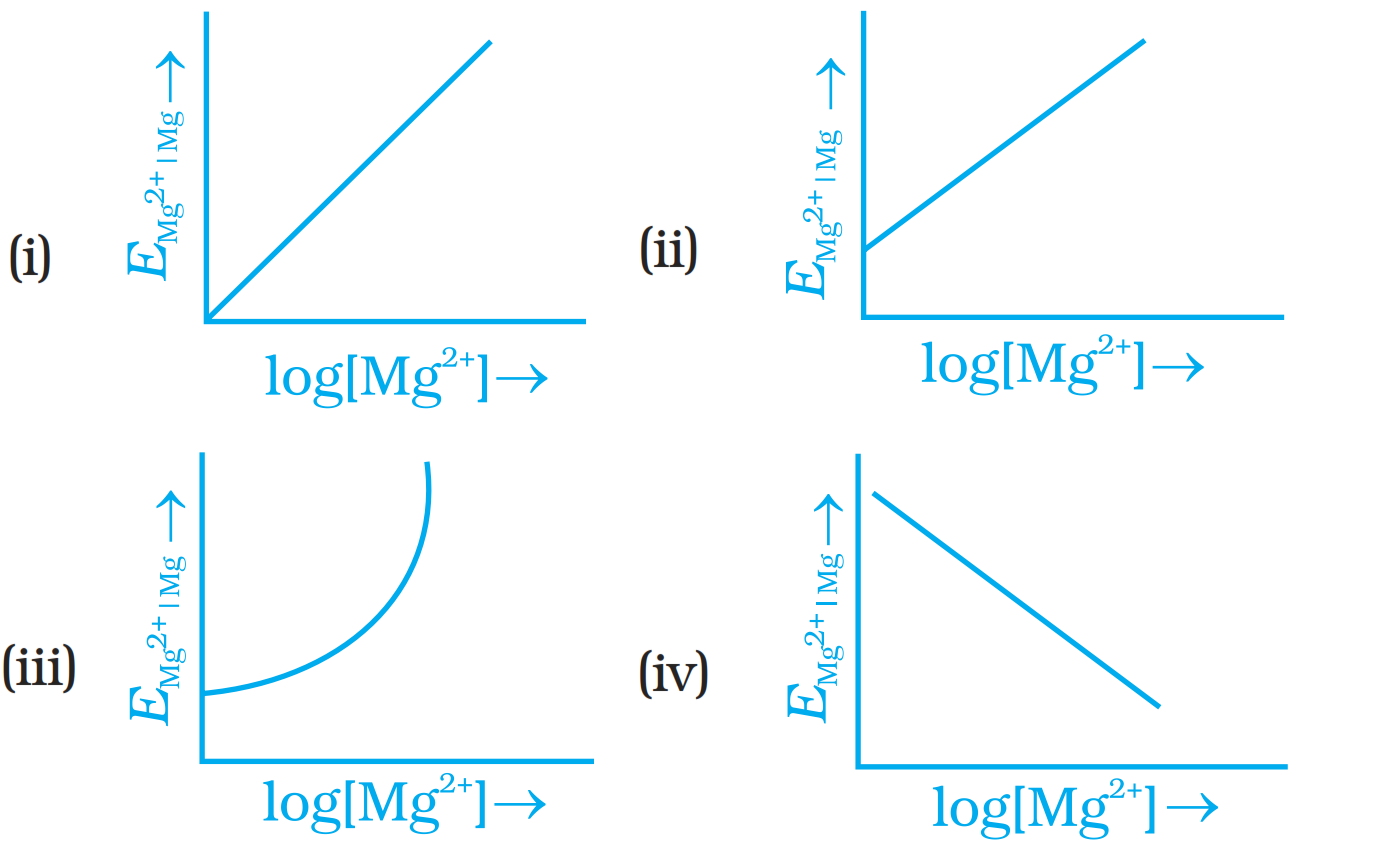
Electrode potential for Mg electrode varies according to the equation
$\text{E}_{\text{Mg}^{2+}|\text{Mg}}=\text{E}^\ominus_{\text{Mg}^{2+}|\text{Mg}}-\frac{0.059}{2}\log\frac{1}{\big[\text{Mg}^{2+}\big]}$ The graph of $\text{E}_{\text{Mg}^{2+}|\text{Mg}}\text{ vs }\log\big[\text{Mg}^{2+}\big]\text{ is}:$
Answer

Explanation:
$\text{E}_{\text{Mg}^{2+}/\text{Mg}}=\text{E}^\ominus_{\text{Mg}^{2+}/\text{Mg}}-\frac{0.059}{2}\log\frac{1}{\big[\text{Mg}^{2+}\big]}$
Compare this equation with the equation of straight line y = mx + c
The graph of $\text{E}_{\text{Mg}^{2+}/\text{Mg}}$ versus $\log\big[\text{Mg}^{2+}\big]$ is a straight line with a positive alope and intercept $\text{E}_{\text{Mg}^{2+}/\text{Mg}}$
View full question & answer
Question 531 Mark
What is meant by cell constant?
Answer
Cell constant is the ratio of distance (l) between electrodes and area of cross-section (A). It is denoted by $\frac{\text{l}}{\text{A}}.$ Its unit is $cm^{-1}$.
View full question & answer
Question 541 Mark
How can the reduction potential of an electrode be increased?
Answer
$\text{M}^{\text{n}+}+\text{ne}^-\xrightarrow{ \ \ \ \ \ \ \ }\text{M},$
$\frac{\text{E}_{\text{M}^{\text{n}+}}}{\text{M}}=\frac{\text{E}^{\circ}_{\text{M}^{\text{n}+}}}{\text{M}}-\frac{\text{RT}}{\text{nF}}\text{In}\frac{1}{[\text{M}^{\text{n}+}]}$
$=\frac{\text{E}^{\circ}_{\text{M}^{\text{n}+}}}{\text{M}}+\frac{\text{RT}}{\text{nF}}\text{In}[\text{M}^{\text{n}+}]$
Thus, electrode potential can be increased by increasing the metal ion concentration.
View full question & answer
Question 551 Mark
Write the equation showing the relationship between equivalent or molar conductance and concentration of a strong electrolyte.
Answer
Debye-Huckel-Onsager equation, $\Lambda=\Lambda^{\circ}-\text{b}\sqrt{\text{c}}$ is the molar conductance at concentration cand b is the constant, $\\\Lambda^{\circ}$ is the conductance at infinite dilution.
View full question & answer
Question 561 Mark
Why does an aqueous solution of NaCl on electrolysis give $H_2$ gas at the cathode and not sodium metal?
Answer
This is because of the fact that standard reduction potential of water is greater than that of sodium.
View full question & answer
Question 581 Mark
Three iron sheets have been coated separately with three metals A, B and C whose standard electrode potentials are given below.
Metal A B C Iron
-0.46V -0.66V -0.20V -0.44V
Identify in which case rusting will take place faster when coating is damaged.
Answer
As iron (-0.44V) has lower standard reduction potential than C (-0.20V) only therefore when coating is broken, rusting will take place faster.
View full question & answer
Question 591 Mark
Which type of a metal can be used in cathodic protection of iron against rusting?
Answer
A metal which is more electropositive than iron such as Al, Zn, Mg can be used in cathodic protection of iron against rusting.
View full question & answer
Question 601 Mark
What are secondary cells?
Answer
Secondary cells are those cells which are rechargeable, i.e., the products can be changed back to reactants.
View full question & answer
Question 611 Mark
What does the negative value of $\text{E}^{\circ}_{\text{cell}}$ indicate?
Answer
Negative $\text{E}^{\circ}_{\text{cell}}$ value means $\Delta\text{r}\text{G}^{\circ}$ will be +ve, and the cell will not work.
View full question & answer
Question 621 Mark
Using the E° values of A and B, predict which is better for coating the surface of iron $\Big[\text{E}^{\circ}_{\text{Fe}^{2+}/\text{Fe}}=-0.44\text{V}\Big]$ to prevent corrosion and why?
Given: $\Big[\text{E}^{\circ}_{\text{A}^{2+}/\text{A}}=-2.37\text{V, E}^{\circ}_{\text{B}^{2+}/\text{B}}=-0.14\text{V}\Big]$
Answer
A, as its standard reduction potential is less than B, therefore, it will undergo oxidation more easily than B.
View full question & answer
Question 631 Mark
Write Nernst equation for the reaction
$2\text{Cr}+3\text{Fe}^{2+}\xrightarrow{ \ \ \ \ \ }2\text{Cr}^{3+}+3\text{Fe}$
Answer
$\text{E}_{\text{cell}}=\text{E}^{\circ}_{\text{cell}}-\frac{\text{RT}}{6\text{F}}\text{In}\frac{[\text{Cr}^{3+}]^2}{[\text{Fe}^{2+}]^3}$ $(\because\text{n}=6)$
View full question & answer
Question 641 Mark
Consider a cell given below $\text{Cu}|\text{Cu}^{2+}||\text{Cl}^{-}|\text{Cl}_2,\text{pt}$ Write the reactions that occur at anode and cathode.
Answer
$\text{Anode}:\ \ \text{Cu}^{-}\xrightarrow{\ \ \ \ \ \ \ \ \ }\text{Cu}^{2+}+2\text{e}^{-}$
$\text{Cathode}:\ \ \text{Cl}_2+2\text{e}^{-}\xrightarrow{\ \ \ \ \ \ \ \ \ \ \ }2\text{Cl}^{-}\text{Cu}$ is anode as it is getting oxidised.
$Cl_2$ is cathode as it is getting reduced.
View full question & answer
Question 651 Mark
Define specific conductance or conductivity.
Answer
Specific conductance is defined as conductance of electrolyte when distance between electrodes is 1cm and area of cross section is $1cm^2$.
View full question & answer
1 Marks Question - Page 2 - Chemistry STD 12 Science Questions - Vidyadip