Questions

3 Marks Question

🎯

Test yourself on this topic

8 questions · timed · auto-graded

Question 13 Marks
What is an electrochemical series? How does it help in calculating the e.m.f of a standard cell?
Answer
The series of elements which have been arranged on the basis of their electrode potential is called electrochemical series or activity series.
Standard EMF of the cell = [standard reduction potential of the right hand side electrode] - [Standard reduction potential of the left hand side electrode]
emf $=E_{\text {cathode }}^0-E_{\text {anode }}^0$
View full question & answer
Question 23 Marks
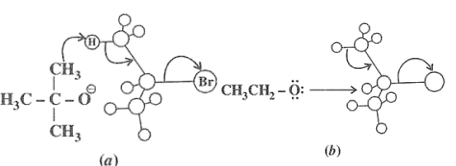
One of the two figures given below represents substitution and the other represents elimination. Indicate which is substitution and which is elimination.
Image
Answer
a. represents elimination because in this the anion attacks the H and simultaneously Br leaves leading to formation of a double bond.
b. represents substitution as the nucleophile attacks the compound and simultaneously the leaving group leaves.
View full question & answer
Question 33 Marks
One half$-$cell in a voltaic cell is constructed from a silver wire dipped in silver nitrate solution of unknown concentration. The other half$-$cell consists of a zinc electrode in $1.0 \ M$ solution of $Zn(NO_3)_2.$ A voltage of $1.48 \ V$ is measured for this cell. Use this information to calculate the concentration of silver nitrate solution.
[ Given, $E_{\mathrm{Zn}^{2+} / \mathrm{Zn}}^{\circ}=-0.763 \mathrm{~V}$ and $E_{\mathrm{Ag}^{+} / \mathrm{Ag}}^{\circ}=+0.80 \mathrm{~V}$ ].
View full question & answer
Question 43 Marks
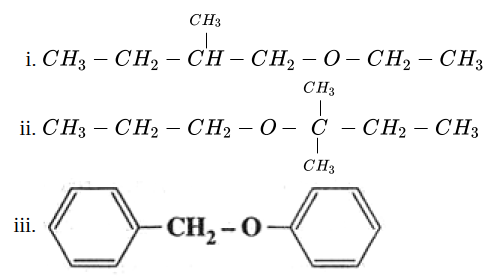
Arrange the following compounds in the increasing order of their property indicated:
$i.$ Acetaldehyde, Benzaldehyde, Acetophenone, Acetone $($Reactivity towards $HCN)$
$ii. (CH_3)_2CHCOOH, CH_3CH_2CH(Br)COOH, CH_3CH(Br)CH_2COOH ($Acidic strength$)$
$iii. CH_3CH_2OH, CH_3CHO, CH_3COOH ($Boiling point$)$
Answer
$(1)$ Acetophenone $<$ Benzaldehyde $<$ Acetone $<$ Acetaldehyde
$(2)$
Image
$(3) \ CH_3CHO < CH_3CH_2OH < CH_3COOH$
View full question & answer
Question 53 Marks
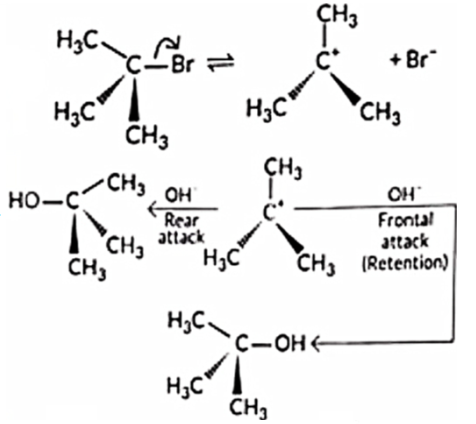
i. Write the mechanism of the following SN1 reaction:
$\left(\mathrm{CH}_3\right)_3 \mathrm{C}-\mathrm{Br} \xrightarrow{A q . \mathrm{NaOH}}\left(\mathrm{CH}_3\right)_3 \mathrm{C}-\mathrm{OH}+\mathrm{NaBr}$
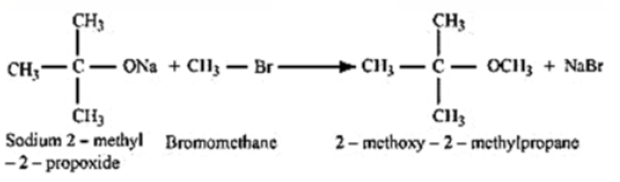
ii. Write the equation for the preparation of 2-methyl-2-methoxypropane by Williamson synthesis.
Answer
(1)
Image
(2)
Image
View full question & answer
Question 73 Marks
Consider a certain reaction $A \rightarrow$ Products with $k = 2.0 \times 10^{-2} s^{-1}.$ Calculate the concentration of $A$ remaining after $100 \ s$ if the initial concentration of $A$ is $1.0 \ mol \ L^{-1}.$
Answer
$k=2.0 \times 10^{-2} s^{-1}$
$T=100 \ s$
${[A]_0=1.0 \ mol \ L^{-1}}$
Since the unit of $k $ is $s^{-1}$, the given reaction is a first order reaction.
Therefore, $k=\frac{2.303}{t} \log \frac{[A]_0}{[A]}$
$2.0 \times 10^{-2} s^{-1}=\frac{2.303}{100} \log \frac{1.0}{[A]}$
$2.0 \times 10^{-2} s^{-1}=\frac{2.303}{100}(-\log [A])$
$-\log [A]=\frac{2.0 \times 10^{-2} \times 100}{2.303}$
$[ A ]=\operatorname{antilog}\left(-\frac{2.0 \times 10^{-2} \times 100}{2.303}\right)$
$= 0.135 \ mol \ L^{-1} ($approximately$)$
Hence, the remaining concentration of $A$ is $0.135 \ mol \ L^{-1}.$
View full question & answer
Question 83 Marks
Calculate the equilibrium constant for the reaction.
$ Z n(s)+C u^{2+}(a q) \rightleftharpoons Z n^2(a q)+C u(s)$
$ \text { Given: } E_{Z n^{2+} / Z n}^0=-0.763 V$
$ \text { and } E_{c u^{2+} / c u}^0=+0.34 V$
Answer
$Z n(s) \rightarrow Z n^{2+}(a q)+2 e^{-}$
$C u^{2+}(a q)+2 e^{-} \rightarrow C u(s)$
$Z n(s)+C u^{2+}(a q) \rightarrow Z n^{2+}(a q)+C u(s)$
$E _{\text {cell }}= E ^0 C u ^{+2} / C u - E ^0 Z n ^{+2} / Z n$
$=+0.34 V-(-0.763 V)$
$=1.103 V$
$\log K=\frac{n E^0}{0.0591}$
$=\frac{2 \times 1.103}{0.0591}$
$\log K=\frac{2.206}{0.0591}=37.326$
$k=\text { Antilog } 37.326$
$=2.118 \times 10^{37}$
View full question & answer
3 Marks Question - Chemistry STD 12 Science Questions - Vidyadip