Sample QuestionsMODEL PAPER 1 questions
One sample from each question group in this chapter. Select any group above to see the full set with answer keys.
Which of the following methods of preparation of amines will give same number of carbon atoms in the chain of amines as in the reactant?
The conversion of an alkyl halide into alcohol by aqueous $\ce{NaOH}$ is classified as
- A
a dehydrohalogenation reaction
- ✓
- C
- D
Answer: B.
View full solution →Which of the following does not give Cannizaro reaction?
Answer: B.
View full solution →The half life of a substance in a first order reaction is $15 \ \min$. The rate constant is
Answer: A.
View full solution →The incorrect statement about interstitial compounds is:
- A
They retain metallic conductivity.
- B
- ✓
They are chemically reactive.
- D
They have high melting point.
Answer: C.
View full solution →Assertion $(A):$ Last traces of moisture in ethanol can be removed by keeping it over sodium wire
Reason $(R):$ Sodium reacts with water but not with ethanol to produce $H_2$ gas.
- A
Both $A$ and $R$ are true and $R$ is the correct explanation of $A.$
- B
Both $A$ and $R$ are true but $R$ is not the correct explanation of $A.$
- ✓
$A$ is true but $R$ is false.
- D
both $A$ and $R$ are false.
Answer: C.
View full solution →Assertion (A): Aryl halide gives a mixture of o- and p-products.
Reason (R): Aryl halides undergo electrophilic substitutions more readily than benzene.
- A
Both A and R are true and R is the correct explanation of A.
- B
Both A and R are true but R is not the correct explanation of A.
- ✓
A is true but R is false.
- D
A is false but R is true.
Answer: C.
View full solution →Assertion $(A): \ce{RCHO, RCOCH_3}$ and cyclic ketones react with sodium bisulphite.
Reason $(R):$ Crystalline solid derivatives are formed when aldehydes or ketones are shaken with saturated aqueous solution of sodium bisulphite.
- ✓
Both $A$ and $R$ are true and $R$ is the correct explanation of $A.$
- B
Both $A$ and $R$ are true but $R$ is not the correct explanation of $A.$
- C
$A$ is true but $R$ is false.
- D
$A$ is false but $R$ is true.
Answer: A.
View full solution →Assertion (A): Primary structure of proteins gives an idea about the conformation of the molecule.
Reason (R): The differences in chemical and biological properties of various proteins arise due to the difference in primary structure.
- A
Both A and R are true and R is the correct explanation of A.
- B
Both A and R are true but R is not the correct explanation of A.
- C
- ✓
A is false but R is true.
Answer: D.
View full solution →Describe how the following conversions can be brought about (any two)?
i. Cyclohexanol to cyclohexan-1-one.
ii. Ethyl benzene to benzoic acid.
iii. Bromobenzene to benzoic acid.
Calculate the osmotic pressure in pascals exerted by a solution prepared by dissolving 1.0 g of polymer of molar mass 185,000 in 450 mL of water at 37°C.
The vapour pressure of pure benzene at a certain temperature is $0.850 \ bar.$ A non$-$volatile, non$-$electrolyte solid weighing $0.5 \ g$ when added to $39.0 \ g$ of benzene $($molar mass $78\ g \ mol^{-1}). $Vapour pressure of the solution, then, is $0.845 \ bar.$ What is the molar mass of the solid substance?
View full solution →Answer the following:
(a) For a certain reaction large fraction of molecules has energy more than the threshold energy, yet the rate of reaction is very slow. Why?
(b) State a condition under which a bimolecular reaction is kinetically first-order reaction.
What is lanthanoid contraction? What is its effect on the chemistry of the elements which follow the lanthanoids?
What is an electrochemical series? How does it help in calculating the e.m.f of a standard cell?
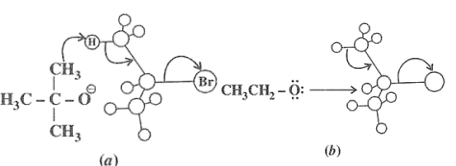
One of the two figures given below represents substitution and the other represents elimination. Indicate which is substitution and which is elimination.
One half$-$cell in a voltaic cell is constructed from a silver wire dipped in silver nitrate solution of unknown concentration. The other half$-$cell consists of a zinc electrode in $1.0 \ M$ solution of $Zn(NO_3)_2.$ A voltage of $1.48 \ V$ is measured for this cell. Use this information to calculate the concentration of silver nitrate solution.
[ Given, $E_{\mathrm{Zn}^{2+} / \mathrm{Zn}}^{\circ}=-0.763 \mathrm{~V}$ and $E_{\mathrm{Ag}^{+} / \mathrm{Ag}}^{\circ}=+0.80 \mathrm{~V}$ ].
View full solution →Arrange the following compounds in the increasing order of their property indicated:
$i.$ Acetaldehyde, Benzaldehyde, Acetophenone, Acetone $($Reactivity towards $HCN)$
$ii. (CH_3)_2CHCOOH, CH_3CH_2CH(Br)COOH, CH_3CH(Br)CH_2COOH ($Acidic strength$)$
$iii. CH_3CH_2OH, CH_3CHO, CH_3COOH ($Boiling point$)$
View full solution →i. Write the mechanism of the following SN1 reaction:
$\left(\mathrm{CH}_3\right)_3 \mathrm{C}-\mathrm{Br} \xrightarrow{A q . \mathrm{NaOH}}\left(\mathrm{CH}_3\right)_3 \mathrm{C}-\mathrm{OH}+\mathrm{NaBr}$
ii. Write the equation for the preparation of 2-methyl-2-methoxypropane by Williamson synthesis.
View full solution →$(i).$ Illustrate the following reactions giving suitable example in each case:
$a.$ Ammonolysis
$b.$ Coupling reaction
$c.$ Acetylation of amines
$(ii).$ Describe Hinsberg method for the identification of primary, secondary and tertiary amines. Also, write the chemical equations of the reactions involved.
View full solution →(i). Write the structures of main products when benzene diazonium chloride $\left( C _6 H _5 N_2^{+} Cl ^{-}\right)$ reacts with the following reagents.
a. $HBF _4 / \Delta$
b. $Cu / HBr$
(ii). Write the structures of A, B and C in the following reactions:
a. $C _6 H _5 NO _2 \xrightarrow{ Sn / HCl } A \xrightarrow[\Delta]{ NaNO _2+ HCl } B \xrightarrow{273 K} H$
b. $CH _3 Cl \xrightarrow{ KCN } A \xrightarrow{ LiAlH _4} B \xrightarrow[273 K]{\stackrel{273 K}{ HNO }{ }_2} C$
View full solution →Using Valence bond theory, explain the following in relation to the paramagnetic complex $[Mn(CN)_6]^{3-}$
$a.$ type of hybridisation
$b.$ magnetic moment value
$c.$ type of complex $-$ inner, outer orbital complex
View full solution →Write the $" \text{IUPAC}"$ names of the following coordination compounds:
$a. \left[ Pt \left( NH _3\right)_2 Cl \left( NO _2\right]\right.$
$b. K _3\left[ Cr \left( C _2 O _4\right)_3\right]$
$c. \left[ CoCl _2( en )_2\right] Cl$
$d. \left[ Co \left( NH _3\right)_5\left( CO _3\right)\right] Cl$
$e. Hg \left[ Co ( SCN )_4\right]$
View full solution →Attempt any five of the following:
(a) What is the structural feature characterising reducing sugars?
(b) What type of linkage is present in polysaccharides?
(c) Give examples of fat soluble vitamins.
(d) The two strands in DNA are not identical but are complementary. Explain.
(e) Write uses of B-Complex.
(f) Name the disaccharide which on hydrolysis gives two molecules of glucose.
(g) Name purines present in DNA?
The mole fraction of helium in a saturated solution at $20^\circ C$ is $1.2 g 10-6.$ Find the pressure of helium above the solution. Given Henry's constant at $20^\circ C$ is $144.97\ k\ bar. (2)$
View full solution →Read the following text carefully and answer the questions that follow:
Aariv Sharma is very fond of a special drink made by his grandmother using different fruits available in their hometown. It has an outstanding taste and also provide great health benefits of natural fruits. He thought of utilizing his grandmother recipe to create a new product in the beverage market that provide health benefits and also contain fizziness of various soft drinks available in the market.
$i.$ How he can add fizz to the special drink made by his grandmother?
$ii.$ What is the law stated in the chapter that can help Aariv to make his drink fizzy?
$iii.$ What precautions he should take while bottling so that his product does not lose fizz during storage and handling across long distances?
View full solution →Crystal structure of oxides of transition metals often show defects. Given reason. (2)
Read the following text carefully and answer the questions that follow:
The transition metals when exposed to oxygen at low and intermediate temperatures form thin, protective oxide films of up to some thousands of Angstroms in thickness. Transition metal oxides lie between the extremes of ionic and covalent binary compounds formed by elements from the left or right side of the periodic table. They range from metallic to semiconducting and deviate by both large and small degrees from stoichiometry. Since delectron bonding levels are involved, the cations-exist in various valence states and hence give rise to a large number of oxides. The crystal structures are often classified by considering a cubic or hexagonal close-packed lattice of one set of ions with the other set of ions filling the octahedral or tetrahedral interstices. The actual oxide structures, however, generally show departures from such regular arrays due in part to distortions caused by packing of ions of different size and to ligand field effects. These distortions depend not only on the number of d-electrons but also on the valence and the position of the transition metal in a period or group.
i. Why does copper, which is in first series of transition metal exhibits +1 oxidation state most frequently? (1)
ii. The lowest oxide of transition metal is basic. Why? (1)
iii. The variability in oxidation states of d-block different from that of the p-block elements. Explain. (2)