Questions

M.C.Q (1 Marks)

🎯

Test yourself on this topic

12 questions · timed · auto-graded

MCQ 11 Mark
Which of the following methods of preparation of amines will give same number of carbon atoms in the chain of amines as in the reactant?
  • A
    Treatment of amide with bromine in an aqueous solution of sodium hydroxide
  • B
    Heating alkylhalide with potassium salt of phthalimide followed by hydrolysis
  • C
    Reaction of nitrite with $LiAlH_4$
  • D
    Reaction of amide with $LiAlH_4$ followed by treatment with water
Answer
Aliphatic and aryl/alkyl primary amines can be prepared by the reduction of the corresponding nitriles with lithium aluminium hydride $LiAIH_4.$

Image
Heating alkyl halide with primary, secondary, and tertiary amine can be prepared by reduction of $LiAlH_4$ ether followed by treatment with water.

Image
Heating alkyl halide with potassium salt of phthalimide followed by hydrolysis produces primary amine. This process is known as Gabriel's phthalimide reaction. The number of carbon atoms in the chain of amines of the product is the same as a reactant.
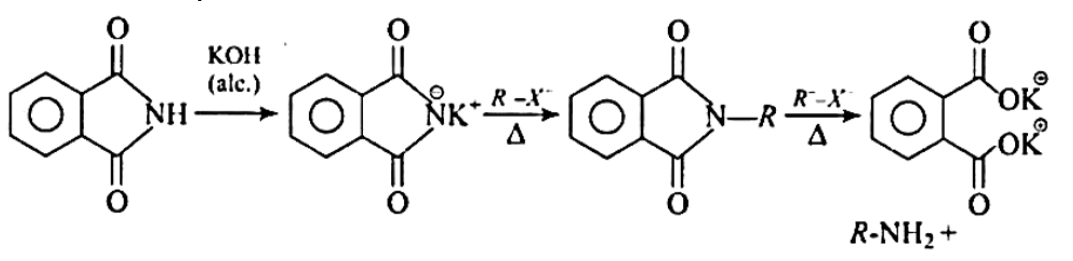
Image
View full question & answer
MCQ 21 Mark
The conversion of an alkyl halide into alcohol by aqueous $\ce{NaOH}$ is classified as
  • A
    a dehydrohalogenation reaction
  • a substitution reaction
  • C
    an addition reaction
  • D
    a dehydration reaction
Answer
Correct option: B.
a substitution reaction
Alkyl halides on alkaline hydrolysis $($aqueous $\ce{NaOH)}$ get converted into alcohol. This takes place by a nucleophilic substitution reaction where the $-X$ atom is substituted by a nucleophile i.e $-OH$ group. The primary alkyl halides undergo nucleophilic substitution reaction by $SN_2$ substitution mechanism, while tertiary alkyl halides follow $SN_1$ substitution mechanism.
View full question & answer
MCQ 31 Mark
Which of the following does not give Cannizaro reaction?
  • A
    $\ce{(CH_3)_3 }\text{C-CHO}$
  • $\ce{(CH_3)_2 }\text{C-CHO}$
  • C
    $\text{HCHO}$
  • D
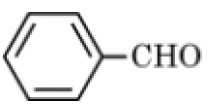
    Image
Answer
Correct option: B.
$\ce{(CH_3)_2 }\text{C-CHO}$
$\ce{(CH_3)_2 }\text{C-CHO}$ doesn't give cannizaro reaction.
View full question & answer
MCQ 41 Mark
The half life of a substance in a first order reaction is $15 \ \min$. The rate constant is
  • $4.62 x 10^{-2} \min^{-1}$
  • B
    $6.74 x 10^{-2} \min^{-1}$
  • C
    $2.46 x 10^2 \min^{-1}$
  • D
    $7.18 x 10^2 \min^{-1}$
Answer
Correct option: A.
$4.62 x 10^{-2} \min^{-1}$
for first order reaction $t_{1 / 2}=\frac{0.693}{k}$
Given:
$t_{1/2}=15 \ t_{1/2​}=15 \min$
So,
$k=0.693\ t_{1/2} = 0.69315 = 0.0462 \min−1_k$
$=t_{1/2}​ \ 0.693​=150.693​=0.0462 \min−1$
Or, in scientific notation:
$k=4.62\times 10−2 \min−1k=4.62\times 10−2 \min−1$
$4.62 x 10^{-2} \min^{-1}$
View full question & answer
MCQ 51 Mark
The incorrect statement about interstitial compounds is:
  • A
    They retain metallic conductivity.
  • B
    They are very hard.
  • They are chemically reactive.
  • D
    They have high melting point.
Answer
Correct option: C.
They are chemically reactive.
(c) They are chemically reactive.
Explanation: Interstitial compounds are obtained when small atoms like H, B, C, resemble N, etc. fit into the lattice of other elements. They are chemically inert
View full question & answer
MCQ 61 Mark
Chlorine reacts with cold and dilute $\ce{NaOH}$ to give
  • A
    $\ce{NaCIO}$ and $\ce{NaCIO_3}$
  • B
    $\ce{NaCl}$ and $\ce{NaCIO_3}$
  • $\ce{NaCl}$ and $\ce{NaCIO}$
  • D
    $\ce{NaCl}$ and $\ce{NaCIO_4}$
Answer
Correct option: C.
$\ce{NaCl}$ and $\ce{NaCIO}$
Chlorine reacts with cold and dilute $\ce{NaOH}$ to produce a mixture of sodium chloride $\ce{(NaCl)}$ and sodium hypochloride $\ce{(NaOCl). 2NaOH + Cl_2 \rightarrow NaCl + NaOCl + H_2O}$
View full question & answer
MCQ 71 Mark
  • (a) (2), (b) - (3), (c) - (4), (d) - (1)
  • B
    (a) (4), (b) - (3), (c) - (2), (d) - (1)
  • C
    (a)-(3), (b) - (2), (c) - (1), (d) - (4)
  • D
    (a)-(1), (b) - (2), (c) - (3), (d) - (4)
Answer
Correct option: A.
(a) (2), (b) - (3), (c) - (4), (d) - (1)
(a) (a)-(2), (b) - (3), (c) - (4), (d) - (1)
Explanation: (a) - (2), (b) - (3), (c) - (4), (d) - (1)
View full question & answer
MCQ 81 Mark
The ionic reactions are generally very fast because
  • It does not involve bond breaking
  • B
    The number of collisions between ions are very large
  • C
    Reactions are highly exothermic
  • D
    The energy of interaction between charged ion is greater than between neutral molecules
Answer
Correct option: A.
It does not involve bond breaking
(a) It does not involve bond breaking
Explanation: Ionic reactions do not involve bond breaking, energy is directly used in completing the reaction, therefore they are fast.
View full question & answer
MCQ 91 Mark
A compound $(A)$ with molecular formula $\ce{C_5H_{10}O},$ forms a phenyl hydrazone and gives negative Tollens' and iodoform tests. The compound on reduction gives $n-$pentane. The compound $(A)$ is:
  • Pentan$-3-$one
  • B
    Pentan$-2-$one
  • C
    Pentanal
  • D
    Pentanol
Answer
Correct option: A.
Pentan$-3-$one
 Pentan$-3-$one
View full question & answer
MCQ 101 Mark
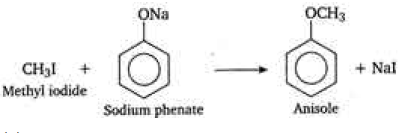
Anisole can be prepared by the action of methyl iodide on sodium phenate. The reaction is called
  • A
    Fittigs reaction
  • B
    Wurtzs reaction
  • Williamsons reaction
  • D
    Etards reaction
Answer
Correct option: C.
Williamsons reaction
(c) Williamsons reaction
Explanation: The reaction of an alkyl halide with sodium alkoxide to give ether (alkoxy alkane), is known as Williamson's synthesis. In this reaction, an ether (anisole) is prepared by the action of alkyl halide (methyl iodide) on sodium alkoxide (sodium phenate), so it is an example of Williamson's synthesis.
Image
View full question & answer
MCQ 111 Mark
β-pleated sheet structure in proteins refers to
  • A
    tertiary structure
  • B
    primary structure
  • C
    quaternary structure
  • secondary structure
Answer
Correct option: D.
secondary structure
(d) secondary structure
Explanation: Alpha helices and beta sheets are the two most known secondary structures of protein, As the protein folds into a three-dimensional structure, the secondary structure forms an intermediate.
View full question & answer
MCQ 121 Mark
Which one of the following compounds is more reactive towards $S_N1$ reaction?
  • A
    $C_6H_5CH(C_6H_5)Br$
  • B
    $CH_2=CHCH_2Br$
  • C
    $C_6H_5CH(CH_3)Br$
  • D
    $C_6H_5CH_2Br$
Answer
$C_6H_5CH(C_6H_5)^+$ carbocation formed is more stable.
View full question & answer
M.C.Q (1 Marks) - Chemistry STD 12 Science Questions - Vidyadip