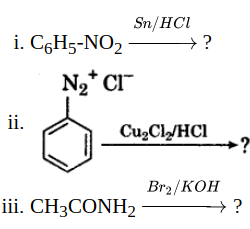
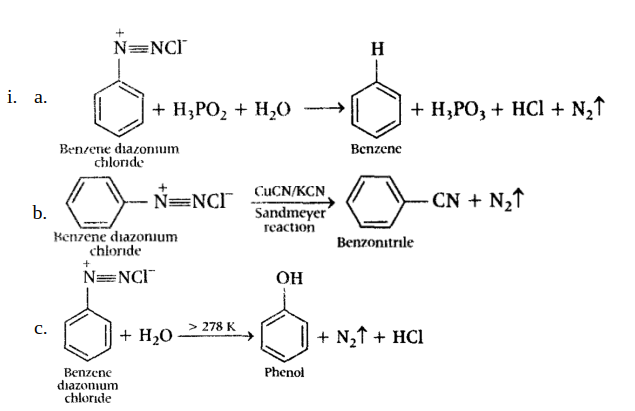
$i.$ Write the structures of main products when benzene diazonium chloride reacts with the following reagents:
$a. H_3PO_2 + Hp$
$b. CuCN/KCN$
$c. H_2O$
$ii.$ Arrange the following in the increasing order of their basic character in an aqueous solution: $C_2H_5NH_2, (C_2H5)_2NH, (C_2H_5)_3N. $ Give justification.
Answer
The relative basic strength of $C_2H_5NH_2, (C_2H_5)_2NH$ and $(C_2H_5)_3N$ depends upon the stabilisation of their corresponding conjugate acids $($formed as a result of accepting a proton from water by a number of factors such a; $B-$bonding, steric hindrance of the alkyl groups and $+I-$effect of the alkyl groups. All these factors are favourable for $2^\circ$ amines, therefore, $((C_2H_5)_2NH)$ is a stronger base than $C_2H_5NH_2$ and $((C_2H_5)_3N.)$ Since. $C_2H_5$ group is large, it exerts some steric hindrance to $H-$bond.
Therefore, stabilisation of the conjugate acid derived from $(C_2H_5)_3N$ is due to mainly by $+I-$effect which is greater than the stabilisation of the conjugate acid derived from $C_2H_5NH_2$ by $H-$bonding.
Thus, $(C_2H_5)_3N$ is more basic than $C_2H_5NH_2.$ Hence, the overall basic strength of the three amines increases in the order: $C_2H_5NH_2 < (C_2H_5)_3N < (C_2H_5)_2NH.$
Using IUPAC norms write the formulas for the following: a. Tetrahydroxozincate(II) b. Potassium tetrachloridopalladate(II) c. Diamminedichloridoplatinum(II) d. Potassium tetracyanonickelate(II) e. Pentaamminenitrito-O-cobalt(III) f. Hexaamminecobalt (III) sulphate g. Potassium tri(oxalato) chromate(III) h. Hexaammineplatinum(IV) i. Tetrabromidocuprate(II) j. Pentaamminenitrito-N-cobalt(III)
Answer
a. The IUPAC name of Tetrahydroxozincate(II) is $\left[ Zn ( OH )_4\right]^{2-}$ b. The IUPAC name of Potassium tetrachloridopalladate(II) is $K _2\left[ PdCl _4\right]$ c. The IUPAC name of Diamminedichloridoplatinum(II) is $\left[ Pt \left( NH _3\right)_2 Cl _2\right]$ d. The IUPAC name of Potassium tetracyanonickelate(II) is $K_2\left[ Ni ( CN )_4\right]$ e. The IUPAC name of Pentaamminenitrito-O-cobalt(III) is $\left[ Co ( ONO )\left( NH _3\right)_5\right]^{2+}$ f. The IUPAC name of Hexaamminecobalt(III) sulphate is $\left[ Co \left( NH _3\right)_6\right]\left( SO _4\right)_3$ g. The IUPAC name of Potassium tri(oxalato)chromate(III) is $K _3\left[ Cr \left( C _2 O _4\right)_3\right]$ h. The IUPAC name of Hexaammineplatinum(IV) is $\left[ Pt \left( NH _3\right)_6\right]^{4+}$ i. The IUPAC name ofTetrabromidocuprate(II) is $\left[ Cu ( Br )_4\right]^{2-}$ j. The IUPAC name of Pentaamminenitrito-N-cobalt(III) is $\left[ Co \left( NO _2\right)\left( NH _3\right)_5\right]^{2+}$
Write the IUPAC names of the following coordination compounds: i. $\left[ Co \left( NH _3\right) 6\right] Cl _3$ ii. $\left[ Co \left( NH _3\right)_5 Cl \right] Cl _2$ iii. $K_3\left[ Fe ( CN )_6\right]$ iv. $K_3\left[ Fe \left( C _2 O _4\right)_3\right]$ v. $K_2\left[P_{d C l}^4\right]$ vi. $\left[ Pt \left( NH _3\right)_2 Cl \left( NH _2 CH _3\right)\right] Cl$
Answer
i. Hexaamminecobalt(III) chloride ii. Pentaamminechloridocobalt (III) chloride iii. Potassium hexacyanoferrate(III) iv. Potassium trioxalatoferrate(III) v. Potassium tetrachloridopalladate(II) vi. Diamminechlorido(methylamine)platinum(II) chloride
Attempt any five of the following:
$(a)$ What are Purines and Pyrimidines? Name the purines and Pyrimidines present in $ \text{DNA}$ and $ \text{RNA}$ nucleic Acids.
$(b)$ Write the full forms of $ \text{DNA}$ and $ \text{RNA}$
$(c)$ Name the vitamin whose deficiency causes convulsions.
$(d)$ Which vitamin $B$ group can be stored in our body?
$(e) (i).$ What is the difference between a nucleoside and nucleotide?
$(ii).$ Write one difference between $a-$helix and $\beta-$pleated sheet structures of protein.
$(f)$ What are nucleic acids? Why two strands in $ \text{DNA}$ are not identical but are complementary?
$(g)$ Some enzymes are named after the reaction, where they are used. What name is given to the class of enzymes which catalyse the oxidation of one substrate with simultaneous reduction of another substrate?
Answer
Attempt any five of the following:
$(i)$ Pyrimidines: These are three bases derived from pyrimidines. These are cytosine $(C)$, thymine $(T)$ and uracil $(U)$.In $ \text{DNA}$, $T$ is present but in $ \text{RNA}$, $U$ is present.
Purines: There are two bases derived from purine. These are adenine $(A)$ and guanine $(G)$.
In $ \text{DNA}$, Purines present are Adenine $(A)$ and Guanine $(G)$ and Pyrimidines present are Cytosine $(C)$ and Thymine $(T)$ while in $ \text{RNA}$, Purines are the same while Pyrimidines present in $ \text{RNA}$ includes Cytosine $(C)$ and Uracil $(U)$.
$(ii)$ $ \text{DNA}$ $\rightarrow$ Deoxyribonucleic acid
$ \text{RNA}$ $\rightarrow$ Ribonucleic acid
$(iii)$ $B_6 $ Pyridoxine
$(iv)$ Vitamin $B^{12}$ can be stored in our body.
$(v) \ i.$ Nucleoside: It is formed when pentose sugar combines with nitrogen base.
Nucleotide: When nucleoside bonds with phosphate group.
$ii. \alpha -$helix has intramolecular hydrogen bonding while $\beta-$pleated has intermolecular hydrogen bonding $\alpha -$helix results due to regular coiling of polypeptide chains while in $\alpha -$pleated all polypeptide chains are stretched and arranged side by side.
$(vi)$Nucleic acids are polymers of Nucleotides.
Because the $H-$bonds are formed between specific pairs of bases/pairing between $A \ T$ and between $C \ G.$
$(vii)$ Enzyme oxidoreductase, the ending of name of an enzyme is $-$ase.