Questions

5 Marks Questions

🎯

Test yourself on this topic

5 questions · timed · auto-graded

Question 15 Marks
Arrange the following compounds in a decreasing order of basic strength in their aqueous solutions.
$NH_3, CH_3NH_2, (CH_3)_2NH, (CH_3)_3N$
Answer
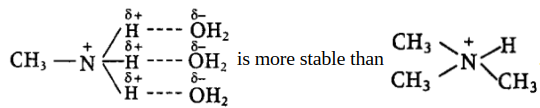
The relative strength of $CH _3 NH _2$, $\left( CH _3\right)_2 NH$ and $\left( CH _3\right)_3 N$ depends upon the stabilisation of their conjugate acids which depend on the number of factors like $H -$bonding, steric hindrance and $+ I -$effect of the alkyl groups. All these factors are favourable for $2^0$ amines, therefore $\left( CH _3\right)_2 NH$ is a stronger base than $CH _3 NH _2$ and $\left( CH _3\right)_3 N$. Since, $\left( CH _3\right)_3 N$ does not have $H -$atom linked to N atom, therefore, the stabilisation of the conjugate acid$-$derived from $CH _3 NH _2$ due to $H -$bonding is greater than that of the conjugate acid derived from $\left( CH _3\right)_3 N$.
Image
Further, in $NH _3$ $no + I - $group is linked to $N -$atom thus, it is least basic among all the given amines. Hence, the order would be:$ \left(CH_3\right)_2 NH>CH_3 NH_2>\left(CH_3\right)_3 N>NH_3.$
View full question & answer
Question 25 Marks
$i. \text{IUPAC} $ Write structures of different isomeric amines corresponding to the molecular formula, $C_4H_{11}N.$
$ii.$ Write $ \text{IUPAC} $ names of all the isomers.
$iii.$ What type of isomerism is exhibited by different pairs of amines?
Answer
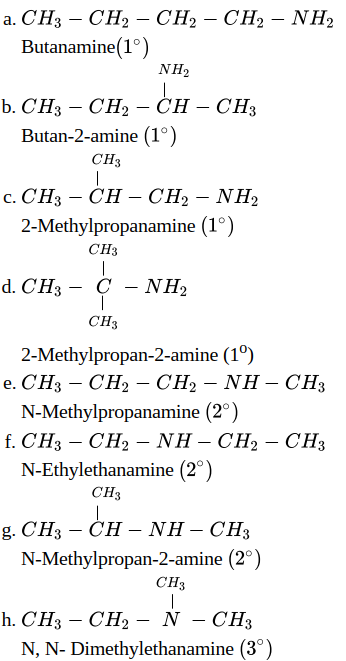
$(i), (ii)$ The structures and $ \text{IUPAC} $ names of different isomeric amines corresponding to the molecular formula, $C_4H_{11}N$ are given below:
 Image
$(iii)$ The pairs $(a)$ and $(b)$ and $(e)$ and $(g)$ exhibit position isomerism.
The pairs $(a)$ and $(c); (a)$ and $(d); (b)$ and $(c); (b)$ and $(d)$ exhibit chain isomerism.
The pairs $(e)$ and $(f) $ and $(f)$ and $(g)$ exhibit metamerism.
All primary amines exhibit functional isomerism with secondary and tertiary amines and vice$-$versa.
View full question & answer
Question 35 Marks
Write the formulas for the following coordination compounds:
a. Tetraammineaquachloridocobalt(III) chloride
b. Potassium tetrahydroxidozincate(II)
c. Potassium trioxalatoaluminate(III)
d. Dichloridobis(ethane-1, 2-diamine)cobalt(III)
e. Tetracarbonylnickel(0)
Answer
a. The formula of Tetraammineaquachloridocobalt(III) chloride is $\left[ Co \left( NH _3\right)_4\left( H _2 O \right) Cl ^2\right) Cl _2$.
b. The formula of Potassium tetrahydroxidozincate(II) is $K _2\left[ Zn ( OH )_4\right]$.
c. The formula of potassium trioxalatoaluminate(III) is $K _3\left[ Al \left( C _2 O _4\right)_3\right]$.
d. The formula of Dichloridobis(ethane-1, 2-diamine)cobalt(III) is $\left[ CoCl _2( en )^2\right]^{+}$.
e. The formula of Tetracarbonylnickel $(0)$ is $\left[ Ni ( CO )_4\right]$.
View full question & answer
Question 45 Marks
Give the oxidation state, d-orbital occupation and coordination number of the central metal ion in the following complexes:
$i. K_3\left[ Co \left( C _2 O _4\right)_3\right]$
$ii.$ cis- $\left[ Cr (e n)_2 Cl _2\right] Cl$
$iii. \left( NH _4\right)_2\left[ CoF _4\right]$
$iv. \left[ Mn \left( H _2 O \right)_6\right] SO _4$
Answer
$i. K _3\left[ Co \left( C _2 O _4\right)_3\right]$ The central metal ion is $Co.$
Its coordination number is $6 .$
The oxidation state can be given as:
$x-6=-3$
$x=+3$
The d orbital occupation for $Co ^{3+} i s, t_{2 g}{ }^6 e_g{ }^0$
$ii.$ cis- $\left[ Cr (e n)_2 Cl _2\right] Cl$ The central metal ion is $Cr .$
The coordination number is $6$ .
The oxidation state can be given as:
$x+2(0)+2(-1)=+1$
$x-2=+1$
$x=+3$
The $d$ orbital occupation for $Cr ^{3+}$ is $t_{2 g}{ }^3$.
$iii. \left( NH _4\right)_2\left[ CoF _4\right]$ The central metal ion is $Co.$
The coordination number is $4$.
The oxidation state can be given as:
$x-4=-2$
$x=+2$
The $d$ orbital occupation for
$C o^{2+} i s, e_g{ }^4 t_{2 g}{ }^3 \text {. }$
$iv. \left[ Mn \left( H _2 O \right)_6\right] SO _4$ The central metal ion is Mn.
The coordination number is $6$ .
The oxidation state can be given as:
$x+0=+2$
$x=+2$
The $d$ orbital occupation for Mn is $t_{2 g}{ }^3 e_g{ }^2$.
View full question & answer
Question 55 Marks
Attempt any five of the following:
(a) Name the enzyme which convert surcrose into glucose and fructose.
(b) i. Name any two bases which are common to both DNA and RNA.
     ii. Which vitamin deficiency causes:
1. Bone deformities in children?
2. Pernicious anaemia?
(c) What are heterocyclic bases?
(d) Write the name of linkage joining two monosaccharides.
(e) Name the purines present in DNA.
(f) Give an example of fibrous protein.
(g) Of the two bases named below, which one is present in RNA and which one is present in DNA?
i. Thymine
ii. Uracil
Answer
Attempt any five of the following:
(i) Invertase
(ii) i. Adenine, Guanine
     ii. 1. Vitamin D 2. Vitamin B12
(iii) Cyclic compound containing element other than carbon i.e., N, S, O at ring position are called heterocyclic bases.
(iv) Glycosidic linkage
(v) Adenine and Guanine.
(vi) Keratin and Myosin
(vii) i. Thymine is present in DNA.
      ii. Uracil is present in RNA.
View full question & answer
5 Marks Questions - Chemistry STD 12 Science Questions - Vidyadip