Question
$i. \text{IUPAC} $ Write structures of different isomeric amines corresponding to the molecular formula, $C_4H_{11}N.$
$ii.$ Write $ \text{IUPAC} $ names of all the isomers.
$iii.$ What type of isomerism is exhibited by different pairs of amines?
Answer

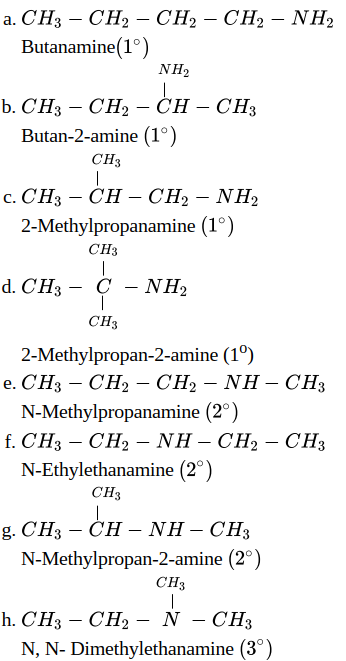
$(i), (ii)$ The structures and $ \text{IUPAC} $ names of different isomeric amines corresponding to the molecular formula, $C_4H_{11}N$ are given below:
 Image
$(iii)$ The pairs $(a)$ and $(b)$ and $(e)$ and $(g)$ exhibit position isomerism.
The pairs $(a)$ and $(c); (a)$ and $(d); (b)$ and $(c); (b)$ and $(d)$ exhibit chain isomerism.
The pairs $(e)$ and $(f) $ and $(f)$ and $(g)$ exhibit metamerism.
All primary amines exhibit functional isomerism with secondary and tertiary amines and vice$-$versa.

Need a full question paper?

Generate a complete, print-ready paper with questions like this in minutes — across 16+ boards, with answer keys.

Start Generating Free

Similar questions

Write the formulas for the following coordination compounds:
a. Tetraammineaquachloridocobalt(III) chloride
b. Potassium tetrahydroxidozincate(II)
c. Potassium trioxalatoaluminate(III)
d. Dichloridobis(ethane-1, 2-diamine)cobalt(III)
e. Tetracarbonylnickel(0)
Describe the structure of a fuel cell. Draw labelled diagram of a structure of fuel cell?
  1. Account for the following:
  1. Bond angle in $NH_4^+$is greater than that in $NH_3$.
  2. Reducing character decreases from $SO_2​​​​​​​$​​​​​​​ to $TeO_2$​​​​​​​.
  3. $HClO_4​​​​​​​$​​​​​​​ is a stronger acid than $HClO$.
  1. Draw the structures of the following :
  1. $H_2S_2O_8$
  2. $XeOF_4$
Explain the method of preparing haloalkanes by free radical substitution of alkanes.
  1. Account for the following:
  1. The acidic strength decreases in the order $HCl > H_2S > PH_3$.
  2. Tendency to form pentahalides decreases down the group in group $15$ of the periodic table.
  1. Complete the following chemical equations:
  1. $P_4+ SO_2Cl_2 \rightarrow $
  2. $XeF_2 + H_2O\rightarrow $
  3. $I_2 + HNO_3 \rightarrow $
(conc.)
$[A], [B], [C], [D], [E], [F]$ and $[G]$ are amines each of which forms a hydrochloride containing $32.42\%$ chlorine. $[A], [B], [C]$ and $[D]$ evolve $N_2$ on reaction with $HNO_2,$ but $[E], [F], [G]$ and $[H]$ do not. Give structures of $[A]$ to $[H]$ with reasons.
Match the compounds/elements given in Column I with uses given in Column II.
 
Column I (Compound/element)
 
Column II (Use)
(i)
Lanthanoid oxide
(a)
Production of iron alloy
(ii)
Lanthanoid
(b)
Television screen
(iii)
Misch metal
(c)
Petroleum cracking
(iv)
Magnesium based alloy is constituent of
(d)
Lanthanoid metal + iron
(v)
Mixed oxides of lanthanoids are employed
(e)
Bullets
 
 
(f)
In X-ray screen
Explain the oxidation of primary, secondary and tertiary alcohols.
  1. ‘Hormones are chemical messengers.’ Explain.
  2. Name the main disease caused due to lack of the vitamin and its source in each of the following: A, $B_6$ and E.
An element ‘A’ exists as a yellow solid in standard state. It forms a volatile hydride ‘B’ which is a foul smelling gas and is extensively used in qualitative analysis of salts. When treated with oxygen, ‘B’ forms an oxide ‘C’ which is a colourless, pungent smelling gas. This gas when passed through acidified $KMnO_4$ solution, decolourises it. ‘C’ gets oxidised to another oxide ‘D’ in the presence of a heterogeneous catalyst. Identify ‘A’, ‘B’, ‘C’, ‘D’ and also give the chemical equation of reaction of ‘C’ with acidified $KMnO_4​​​​​​​$​​​​​​​ solution and for conversion of ‘C’ to ‘D’.