Questions

2 Marks Questions

Take a timed test

6 questions · self-marked practice — reveal the answer and mark yourself.

Question 12 Marks
Compound $A$ was prepared by oxidation of compound $B$ with alkaline $KMnO_{4-}.$ Compound $A$ on reduction with lithium aluminium hydride gets converted back to compound $B.$ When compound $A$ is heated with compound $B$ in the presence of $H_2SO_4$ it produces fruity smell of compound $C$ to which family the compounds $A, B$ and $C$ belong to?
Answer
Compound $(A)$ is carboxylic acid $(R-COOH), (B)$ is an alcohol $(R - CH_2OH)$ and $(C)$ is an ester $(RCH_2 - COOR)$
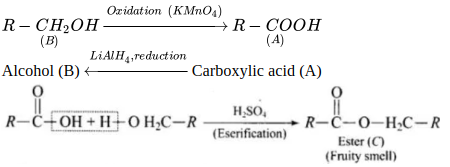
Image ​​​​​​​
View full question & answer
Question 22 Marks
a. Find the value of van't Hoff factor for acetic acid in benzene as per the given equation:
$2 CH _3 COOH \leftrightharpoons\left( CH _3 COOH \right)_2$, assuming its complete association.
b. Osmotic pressure of a solution containing 3.5 g of dissolved protein in 0.05 L of a solution is 0.035 atm at 310 K . Calculate the molar mass of the protein.$\left( R =0.0821 L atm K ^{-1} mol^{-1}\right)$
Answer
a. 0.5 ( in case of dimer)
$\begin{aligned} &b. M=\frac{w R T}{\Pi V} \\ \quad= & \frac{3.5 \times 0.0821 \times 310}{0.035 \times 0.05} \\ = & 50902 g mol ^{-1}\end{aligned}$
View full question & answer
Question 32 Marks
$i.$ What is the relationship between Molarity and Normality?
$ii.$ One litre of water at $\text{N.T.P.}$ dissolves $0.08 g$ of nitrogen. Calculate the amount of nitrogen that can be dissolved in four litres of water at $0^\circ C$ and at a pressure of $1520 \ mm.$
Answer
$i.$ Molarity $( M ) \times$ Molecular mass of solute $=$ Normality $( N ) \times$ Equivalent mass of solut
$ii.$ Solubility of gas $\left(C_1\right)=0.08 g$ /litre
$P_1=760 \ mm$
$P_2=1520 \ mm$
Solubility of gas $\left( C _2\right)$ at pressure $P _2= ?$
By Henry's law,
$\frac{C_1}{C_2}=\frac{P_1}{P_2}$
$C_2=\frac{C_1 \times P_2}{P_1}=\frac{0.08 \times 1520}{760}=0.16 g / \text { litre }$
$\therefore$ Solubility of nitrogen in $4$ litres of water
$=0.16 \times 4=0.64 g$
View full question & answer
Question 42 Marks
$(a)$ Why in the redox titration of $KMnO_4$ versus oxalic acid do we heat oxalic acid solution before starting the titration?
$(b)$ What are the units of rate of a reaction?
Answer
Answer the following$:$
$(i)$ The reaction in redox titration between $KMnO4$ and oxalic acid is very slow. By raising the temperature we can increase
the rate of reaction.
$(ii)$ The units of rate of a reaction are mol $L^{-1} s^{-1}.$ In gaseous reaction the unit of rate of reaction is atm $s^{-1}.$
View full question & answer
Question 52 Marks
Explain why do transition elements shows discrepancy in the variation of atomic radii.
Answer
As we move from left to right in a series from Sc to Mn atomic radii decreases. This decrease occurs because of increase in nuclear charge that occurs. After Mn, electron pairing occurs so shielding effect of d orbitals increases which try to increase the size. From Fe to Ni size almost remains constant because of two factors playing role simultaneously i.e nuclear charge effect as well as shielding effect. After Ni, size increases from Cu to Zn, because Cu and Zn have completely filled d orbital so shielding effect plays dominant role.
View full question & answer
Question 62 Marks
a. On the basis of crystal field theory, write the electronic configuration for $d ^4$ with a strong field ligand for which $\Delta_0>P$.
b. A solution of $\left[ Ni \left( H _2 O \right)_6\right]^{2+}$ is green but a solution of $\left[ Ni ( CO )_4\right]$ is colourless. Explain.
[Atomic number : $Ni =28$ ]
Answer
a. If $\Delta_0> P$, then on the basis of crystal field theory the electronic configuration of the $d ^4$ ion will be $t _{2 g}^4 e _g^0$ as it is associated with strong field and low spin situation.
b. $H _2 O$ is a weak field ligand in $\left[ Ni \left( H _2 O \right)_6\right]^{2+}$. As a result, $Ni ^{2+}$ has unpaired electrons. In this compound, $d$-electrons from the lower energy level can be stimulated to the higher energy level, implying that a d-d transition is possible. As a result, $\left[ Ni \left( H _2 O \right)_6\right]^{2+}$ appears green, whereas $\left[ Ni ( CO )_4\right]$ is colourless due to the absence of an unpaired electron in the complex. CO is a strong field ligand that produces electron pairing.
View full question & answer
2 Marks Questions - Chemistry STD 12 Science Questions - Vidyadip