Sample QuestionsMODEL PAPER 6 questions
One sample from each question group in this chapter. Select any group above to see the full set with answer keys.
When Benzene diazonium chloride reacts with phenol, it forms a dye. This reaction is called
Answer: A.
View full solution →Which of the following alcohols will not undergo oxidation?
Answer: B.
View full solution →Which of the following compounds will give butanone on oxidation with alkaline $KMnO_4$ solution?
View full solution →When $10 g$ of radioactive isotope is reduced to $1.25 g$ in $12$ years, the half life period of the isotope is
- ✓
$4$ years
- B
$24$ years
- C
$16$ years
- D
$8$ years
Answer: A.
View full solution →The product of oxidation of $I^-$ with $\ce{MnO}_4^{-}$ in acidic medium is:
- ✓
$I_2$
- B
$lo_3^-$
- C
$lo^-$
- D
$lo_4^-$
Answer: A.
View full solution →Assertion $(A):$ With $\ce{Br_2H_2O},$ phenol gives $2,4,6-$tribromophenol but with $\ce{Br_2 - CS_2}$ it gives $4-$bromophenol as the major product.
Reason $(R):$ In water ionization of phenol is enhanced but in $\ce{CS_2},$ it is greatly suppressed
- ✓
Both $A$ and $R$ are true and $R$ is the correct explanation of $A.$
- B
Both $A$ and $R$ are true but $R$ is not the correct explanation of $A.$
- C
$A$ is true but $R$ is false.
- D
$A$ is false but $R$ is true.
Answer: A.
View full solution →Assertion (A): Boiling point of alkyl halides increases with an increase in molecular weight.
Reason (R): Boiling point of alkyl halides is in the order RI > RB > RCI > RF.
- ✓
Both A and R are true and R is the correct explanation of A.
- B
Both A and R are true but R is not the correct explanation of A.
- C
A is true but R is false.
- D
A is false but R is true.
Answer: A.
View full solution →Assertion (A): Formaldehyde cannot be prepared by Rosenmund's reduction.
Reason (R): Acid chlorides can be reduced into aldehydes with hydrogen in boiling xylene using palladium or platinum as a catalyst supported on barium sulphate. This is known as Rosenmund's reduction.
- A
Both A and R are true and R is the correct explanation of A.
- ✓
Both A and R are true but R is not the correct explanation of A.
- C
A is true but R is false.
- D
A is false but R is true.
Answer: B.
View full solution →Assertion (A): Mg is not present in the enamel of human teeth.
Reason (R): Mg is an essential element for the biological functions of humans.
- A
Both A and R are true and R is the correct explanation of A.
- ✓
Both A and R are true but R is not the correct explanation of A.
- C
A is true but R is false.
- D
A is false but R is true.
Answer: B.
View full solution →Compound $A$ was prepared by oxidation of compound $B$ with alkaline $KMnO_{4-}.$ Compound $A$ on reduction with lithium aluminium hydride gets converted back to compound $B.$ When compound $A$ is heated with compound $B$ in the presence of $H_2SO_4$ it produces fruity smell of compound $C$ to which family the compounds $A, B$ and $C$ belong to?
View full solution →a. Find the value of van't Hoff factor for acetic acid in benzene as per the given equation:
$2 CH _3 COOH \leftrightharpoons\left( CH _3 COOH \right)_2$, assuming its complete association.
b. Osmotic pressure of a solution containing 3.5 g of dissolved protein in 0.05 L of a solution is 0.035 atm at 310 K . Calculate the molar mass of the protein.$\left( R =0.0821 L atm K ^{-1} mol^{-1}\right)$
View full solution →$i.$ What is the relationship between Molarity and Normality?
$ii.$ One litre of water at $\text{N.T.P.}$ dissolves $0.08 g$ of nitrogen. Calculate the amount of nitrogen that can be dissolved in four litres of water at $0^\circ C$ and at a pressure of $1520 \ mm.$
View full solution →$(a)$ Why in the redox titration of $KMnO_4$ versus oxalic acid do we heat oxalic acid solution before starting the titration?
$(b)$ What are the units of rate of a reaction?
View full solution →Explain why do transition elements shows discrepancy in the variation of atomic radii.
On the basis of the following data, explain why $Co -(III)$ is not stable in aqueous solution?
$Co^{3+}+e^{-} \rightarrow Co^2+, E^o=+1.82 V$
$2 H_2 O \rightarrow O_2+4 H^{+}+4 e^{-}, E^o=1.23 V$
View full solution →How the following conversions can be carried out?
i. 2-Bromopropane to 1-bromopropane
ii. Chloroethane to butane
iii. Benzene to diphenyl
How long will it take an electric current of $0.15 A$ to deposit all the copper from $500\ ml$ of $0.15 M$ copper sulphate solution?
View full solution →An organic compound $(A)$ $($molecular formula $C_8H_{16}0_2)$ was hydrolysed with dilute sulphuric acid to give a carboxylic acid $(B)$ and an alcohol $(C).$ Oxidation of $(C)$ with chromic acid produced $(B). (C)$ on dehydration gives but$-1-$ene. Write equations for the reactions involved.
View full solution →Name the reagents used in the following reactions$:$
$i.$ Oxidation of a primary alcohol to carboxylic acid.
$ii.$ Oxidation of a primary alcohol to aldehyde.
$iii.$ Bromination of phenol to $2,4,6-$tribromophenol.
$iv.$ Benzyl alcohol to benzoic acid.
$v.$ Dehydration of propan$-2-$ol to propene.
$vi.$ Butan$-2-$one to butan$-2-$ol.
View full solution →A colorless substance ' $A$ ' $\left( C _6 H _7 N\right)$ is sparingly soluble in water and gives a water-soluble compound ' B ' on treating with a mineral acid. On reacting with CHCl 3 and alcoholic potash ' A ' produces an obnoxious smell due to the formation of compound ' C '. The reaction of ' A ' with benzene sulphonyl chloride gives compound ' D ' which is soluble in alkali. With $NaNO _2$ and HCl , ' A ' forms compound ' E ' which reacts with phenol in alkaline medium to give an orange dye ' $F$ '. Identify compounds ' $A$ ' to ' $F$ '.
View full solution →Write IUPAC names of the following compounds and classify them into primary, secondary and tertiary amines.
1. $\left( CH _3\right)_2 CHNH _2$
2. $CH _3\left( CH _2\right)_2 NH _2$
3. $CH _3 NHCH \left( CH _3\right)_2$
4. $\left( CH _3\right)_3 CNH _2$
5. $C _6 H _5 NHCH _3$
View full solution →What is crystal field splitting energy? How does the magnitude of $\Delta_0$ decide the actual configuration of d-orbitals in a coordination entity?
View full solution →Specify the oxidation numbers of the metals in the following coordination entities:
i. $\left[ Co \left( H _2 O \right)( CN )( en )_2\right]^{2+}$
ii. $\left[ Pt ( Cl )_4\right]^{2-}$
iii. $K _3\left[ Fe ( CN )_6\right]$
iv. $\left[ Cr \left( NH _3\right)_3 Cl _3\right]$
View full solution →(a) Differentiate between
a. Nucleotide and Nucleoside
b. Amylose and Amylopectin
(b) Write a reaction which shows that all the carbon atoms in glucose are linked in a straight chain.
(c) Write two differences between DNA and RNA.
(d) Amino acids can be classified as $\alpha-, \beta-, \gamma-, \delta-$ and so on depending upon the relative position of the amino group with respect to the carboxyl group. Which type of amino acids forms a polypeptide chain in proteins?
(e) What are any two good sources of vitamin A?
(f) What is anomeric carbon?
(g) What is the difference between a glycosidic linkage and a peptide linkage?
View full solution →In order to overcome the scarcity of drinking water in a remote village in Gujarat, Arnav and Aariv two young entrepreneurs still in their high school, have developed a unique water purifier that is capable of converting sea water into drinking water. It works on the principle of concentration difference between two solutions.
i. Name the phenomenon/process based on which this product is made? (1)
ii. How difference in concentration of solutions help in converting sea water into drinking water?
iii. What arrangement they must have created in their product to covert sea water into drinking water?
OR
iii. Equimolar solutions of NaCl and glucose are not isotonic. Why?
The unique behaviour of $Cu ,$ having a positive $E ^{\circ}$ accounts for its inability to liberate $H _2$ from acids. Only oxidising acids (nitric and hot concentrated sulphuric) react with $Cu ,$ the acids being reduced. The stability of the half$-$filled sub$-$shell in $Mn ^{2+}$ and the completely filled $d ^{10}$ configuration in $Zn ^{2+}$ are related to their $E ^{\circ}$ values, whereas $E ^{\circ}$ for $Ni$ is related to the highest negative $\Delta_{h y d} H ^{\circ}$. An examination of the $E_{\left(M^{3+} / M^{2+}\right)}^o$ values the low value for $Sc$ reflects the stability of $Sc ^{3+}$ which has a noble gas configuration. The comparatively high value for $Mn$ shows that $Mn ^{2+}\left( d ^5\right)$ is particularly stable, whereas a comparatively low value for $Fe$ shows the extra stability of $Fe ^{3+}\left( d ^5\right)$. The comparatively low value for $V$ is related to the stability of $V ^{2+} ($half$-$filled $t _{2 g}$ level$).$
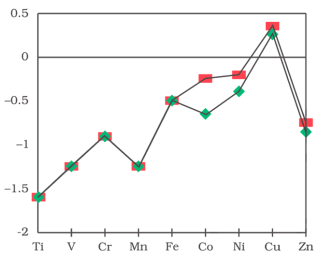
$i.$ Why $Zn$ has high value for $M^{3+}/M^{2+}$ Standard Electrode Potentials?
$ii.$ Transition metals, despite high $E^\circ$ oxidation, are poor reducing agents. Justify.
$iii.$ Why is $Cr^{2+}$ reducing and $Mn^{3+}$ oxidising when both $Cr$ and $Mn$ have $d^4$ configuration?
$OR$
$iii.$ Why $Cu^{2+}$ is more stable than $Cu^+$ ? View full solution →