Questions · Page 2 of 32

M.C.Q (1 Marks)

MCQ 511 Mark
$Xe$ has max. $EN$ in
  • A
    $XeF_2$
  • B
    $XeF_4$
  • $XeO_3$
  • D
    $XeOF_2$
Answer
Correct option: C.
$XeO_3$
c
$Xe{O_3} = s{p^3}\frac{{\% \,{\text{Character  =  25}}\,\% }}{{{\text{More EN}}}}$
View full question & answer
MCQ 521 Mark
Which of the following noble gas does not form clathrate compound?
  • A
    $Kr$
  • $Ne$
  • C
    $Xe$
  • D
    $Ar$
Answer
Correct option: B.
$Ne$
b
Both $He$ and $Ne$ do not form clathrate compound due to their small size.
View full question & answer
MCQ 531 Mark
The compound that cannot be formed by xenon is
  • A
    $XeO_3$
  • B
    $XeF_4$
  • $XeCl_4$
  • D
    $XeO_2F_2$
Answer
Correct option: C.
$XeCl_4$
c
View full question & answer
MCQ 541 Mark
Which factor is most responsible for the increase in boiling points of noble gases from $He$ to $Xe$?
  • A
    Decrease in $I.E.$
  • B
    monoatomic nature
  • C
    Decrease in polarisability
  • Increase in polarisability
Answer
Correct option: D.
Increase in polarisability
d
Polarisability increases with increase in size. So, from $He$ to $Xe$ as size increases, polarisability increases.
View full question & answer
MCQ 551 Mark
The noble gas compound prepared by bartlett was
  • A
    $XeO_3$
  • $XePtF_6$
  • C
    $KrF_2$
  • D
    $XeF_2$
Answer
Correct option: B.
$XePtF_6$
b
$XeP tF _6$ was the first noble gas prepared by Bartlett.
View full question & answer
MCQ 561 Mark
Deep sea divers used a mixture of ....... to respirate
  • A
    Oxygen and argon
  • Oxygen and helium
  • C
    Oxygen and nitrogen
  • D
    Oxygen and hydrogen
Answer
Correct option: B.
Oxygen and helium
b
The mixture of helium-oxygen is used by deep-sea divers.

The main reason for adding helium with oxygen to the breathing mix is to reduce the proportions of nitrogen and oxygen to allow the gas mix to be breathed safely on deep dives.

View full question & answer
MCQ 591 Mark
$p\pi \,-\,d\pi $ bond is present in
  • A
    $SO_2$
  • B
    $XeO_4$
  • C
     $CO_2$
  • Both  $(A)\,\,$  and  $\,\,(B)$
Answer
Correct option: D.
Both  $(A)\,\,$  and  $\,\,(B)$
d
View full question & answer
MCQ 601 Mark
$\begin{gathered}
  \mathop {Xe + {F_2}}\limits_{(1:20)} \xrightarrow{{573\,K,\,60.70\,bar}}A \hfill \\
  \,\,\,\,\,\,\,\, \hfill \\ 
\end{gathered} $

 What is $A$

  • $XeF_6$
  • B
    $XeF_5$
  • C
    $XeF_2$
  • D
    $XeF_4$
Answer
Correct option: A.
$XeF_6$
a
View full question & answer
MCQ 611 Mark
$1$.  $KClO_3 \xrightarrow{\Delta } $

$2$.  $XeF_2 \xrightarrow{H_2O} $

$3$.  $XeF_4 \xrightarrow{H_2O} $

$4$. $PbO_2 \xrightarrow{\Delta } $

$5$. $XeF_6 \xrightarrow{H_2O} $

In how many of the above processes, $O_2$ will be one of the products

  • A
    $2$
  • B
    $3$
  • $4$
  • D
    $5$
Answer
Correct option: C.
$4$
c
$\mathrm{KClO}_{3} \stackrel{\Delta}{\longrightarrow} \mathrm{KCl}+\frac{3}{2} \mathrm{O}_{2}$

$\mathrm{XeF}_{2}+\mathrm{H}_{2} \mathrm{O} \longrightarrow \mathrm{Xe}+2 \mathrm{HF}+\frac{1}{2} \mathrm{O}_{2}$

$\mathrm{XeF}_{4}+\mathrm{H}_{2} \mathrm{O} \longrightarrow \mathrm{Xe}+\mathrm{XeO}_{3}+\mathrm{HF}+\mathrm{O}_{2}$

$\mathrm{PbO}_{2} \stackrel{\Delta}{\longrightarrow} \mathrm{Pb}+\mathrm{O}_{2}$

View full question & answer
MCQ 621 Mark
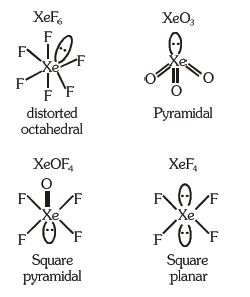
Match the compounds given in column $I$ with the hybridisation and shape given in column $II$ and mark the correct option.
Column $-I$ Column $-II$
$(a) \,Xe{F_6}$ $(i)$ Distorted Octahedral
$(b)\, XeO_3$ $(ii)$ Square planar
$(c)\, XeOF_4$ $(iii)$ pyramidal
$(d)\, XeF_4$ $(iv)$ Square pyramidal
  • $(a)-(i),\,(b)-(iii),\,(c)-(iv),\,(d)-(ii)$
  • B
    $(a)-(i),\,(b)-(ii),\,(c)-(iv),\,(d)-(iii)$
  • C
    $(a)-(iv),\,(b)-(iii),\,(c)-(i),\,(d)-(ii)$
  • D
    $(a)-(iv),\,(b)-(i),\,(c)-(ii),\,(d)-(iii)$
Answer
Correct option: A.
$(a)-(i),\,(b)-(iii),\,(c)-(iv),\,(d)-(ii)$
a

View full question & answer
MCQ 631 Mark
Hydrolysis of which of the following is not the example of redox reaction?
  • A
    $Cl_2$
  • B
    $XeF_4$
  • $XeF_6$
  • D
    $XeF_2$
Answer
Correct option: C.
$XeF_6$
c
$\mathop {Xe}\limits^{ + 6} {F_6}\, + \,{H_2}O\, \to \,\mathop {Xe}\limits^{ + 6} {O_3}$
View full question & answer
MCQ 641 Mark
$XeF_2 + H_2O \to$ Products (The possible product would be) 
  • A
    $Xe$ 
  • B
    $HF$
  • C
    $O_2$
  • All of these
Answer
Correct option: D.
All of these
d
$Xe{F_2}\, + \,{H_2}O\, \to \,Xe + \frac{1}{2}{O_2} + 2HF$
View full question & answer
MCQ 651 Mark
$\mathop {Xe + {F_2}}\limits_{\left( {1:20} \right)} \xrightarrow{{573\,K,60 - 70\,bar}}A$ 

What is $A$

  • $XeF_6$
  • B
    $XeF_5$
  • C
    $XeF_2$
  • D
    $XeF_4$
Answer
Correct option: A.
$XeF_6$
a
View full question & answer
MCQ 661 Mark
In the prepration of compounds of $Xe$, Bartlett had taken $O_2^+PtF_6^-$ as a base Compound. This is beacuse :-
  • A
    Both $O_2$ and $Xe$ have same size
  • B
    Both $O_2$ and $Xe$ have same electron gain enthalpy
  • Both $O_2$ and $Xe$ have almost same ionisation enthalpy
  • D
    Both $Xe$ and $O_2$ are gases
Answer
Correct option: C.
Both $O_2$ and $Xe$ have almost same ionisation enthalpy
c
bartlett observed that the first ionization potential of Xenon is almost equals to that of the Oxygen molecule and made Born-Haber calculation to predict that there would be a stable compound: $\mathrm{Xe}^{+} \mathrm{P} \mathrm{tF}_{6}^{-}$

Hence option $\mathrm{C}$ is correct.

View full question & answer
MCQ 671 Mark
$XeF_2$ reacts with $SbF_5$ to form
  • $[XeF]^+ [SbF_6]^-$
  • B
    $[XeF_3]^-[SbF_4]^-$
  • C
    $Xe^-[PtF_6]^+$
  • D
    $XeF_4$
Answer
Correct option: A.
$[XeF]^+ [SbF_6]^-$
a
View full question & answer
MCQ 681 Mark
Incorrect statement regarding following reactions is

$Xe{F_6}\,\xrightarrow{{ + \,\,Excess\,\,{H_2}O}}\,'X'\, + \,HF$

$Xe{F_6}\,\xrightarrow{{ + 2\,\,\,{H_2}O}}\,'Y'\, + \,HF$

  • A
    $'X'$ is explosive
  • $'Y'$ is an oxyacid of xenon
  • C
    Both are example of non-redox reaction
  • D
    $XeF_6$ can undergo partial hydrolysis
Answer
Correct option: B.
$'Y'$ is an oxyacid of xenon
b
$Xe{F_6}\,\xrightarrow{{excess\,\,{H_2}O}}\,6HF\, + \,Xe{O_3}$

$Xe{F_6}\,\xrightarrow{{2\,\,{H_2}O}}\,4HF\, + \,Xe{O_2}{F_2}$

View full question & answer
MCQ 691 Mark
Which of the following statement is $INCORRECT$
  • A
    In Haber's process iron oxide, potassiumoxide and aluminium oxide are used as catalyst.
  • B
    $ClO_2$ is used as bleaching agent
  • Decomposion of ozone is an endothermic process
  • D
    Hydrolysis of $XeF_6$ is a non redox process
Answer
Correct option: C.
Decomposion of ozone is an endothermic process
c
$XeF_6 + 3H_2O \to XeO_3 + 6HF$
View full question & answer
MCQ 701 Mark
Select the gas-phase reaction$(s)$ which can proceed spontaneously ?
  • A
    $C{l^ - } + I \to {I^ - } + Cl$
  • B
    $S{i^ + } + Cl \to Si + C{l^ + }$
  • C
    Both $(A)$ and $(B)$
  • $Kr + H{e^ + } \to K{r^ + } + He$
Answer
Correct option: D.
$Kr + H{e^ + } \to K{r^ + } + He$
d
View full question & answer
MCQ 711 Mark
First compound of inert gases was prepared by scientist Neil Barthlete in $1962.$ This compound is
  • $XePtF_6$
  • B
    $XeO_3$
  • C
    $XeF_6$
  • D
    $XeOF_4$
Answer
Correct option: A.
$XePtF_6$
a
Neil Bartlett in $1962$ prepared a compound $O _2 Pt F _6$ by reacting $O _2$ with a powerful oxidising agent platinum hexafluoride. Then he found through $X$-ray oxygen with xenon since ionisation potential of xenon is quite close to ionisation potential of oxygen. $XePt F _6$ was the first real compound of any of the noble gases.
View full question & answer
MCQ 721 Mark
The density of Neon will be highest at
  • A
    $STP $
  • ${0\,^o}C,\,2$ atmosphere
  • C
    ${273\,^o}C,\,1$ atmosphere
  • D
    ${273\,^o}C,\,2$ atmosphere
Answer
Correct option: B.
${0\,^o}C,\,2$ atmosphere
b
(b) Density of Neon will be highest as ${0\,^o}C$, $2$ atmosphere.
View full question & answer
MCQ 731 Mark
The ratio of $\frac{{{C_p}}}{{{C_v}}}$ for inert gases is
  • A
    $1.99$
  • B
    $2.13$
  • $1.66$
  • D
    $1.33$
Answer
Correct option: C.
$1.66$
c
(c) $1.66$ Since inert gases are monoatomic.
View full question & answer
MCQ 741 Mark
Which of the following element does not belong to the family of elements indicated
  • A
    Rubidium ($Rb$, $Z = 37$) : Alkali metals
  • B
    Barium ($Ba$, $Z = 56$) : Alkaline earth metals
  • Iridium ($I$, $Z = 77$) : Nobel gases
  • D
    Argon ($Ar$, $Z = 18$) : Nobel gases
Answer
Correct option: C.
Iridium ($I$, $Z = 77$) : Nobel gases
c
(c) Iridium $[I,Z = 77]$ is not belong to noble gas.
View full question & answer
MCQ 751 Mark
Which of the following is planar
  • A
    $Xe{F_2}$
  • B
    $Xe{O_3}F$
  • C
    $Xe{O_2}{F_2}$
  • $Xe{F_4}$
Answer
Correct option: D.
$Xe{F_4}$
d
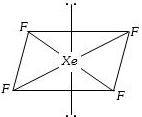
(d) In the formation of $Xe{F_4}, s{p^3}{d^2}$ hybridisation occurs which gives the molecule an octahedral structure. The xenon and four fluorine atoms are coplanar while the two equatorial positions are occupied by the two lone pairs of electrons.
 
View full question & answer
MCQ 761 Mark
Which of the following is most polarised
  • A
    $Kr$
  • B
    $He$
  • C
    $Ar$
  • $Xe$
Answer
Correct option: D.
$Xe$
d
(d) $Xe$ is highly polar since the ionisation potential of xenon is quite close to the ionisation potential of oxygen.
View full question & answer
MCQ 771 Mark
Which inert gas having highest boiling point
  • $Xe$
  • B
    $Ar$
  • C
    $Kr$
  • D
    $He$
Answer
Correct option: A.
$Xe$
a
(a)
  $He$ $Ne$ $Ar$ $Kr$ $Xe$ $Rn$
Boiling point of $-269$ $-246$ $-186$ $-153.6$ $-108.1$ $-62$
View full question & answer
MCQ 781 Mark
The oxidation number of xenon in $XeO{F_2}$ is
  • A
    Zero
  • B
    $2$
  • $4$
  • D
    $3$
Answer
Correct option: C.
$4$
c
(c) Suppose the oxidation state of $Xe$ is $x$ in $XeO{F_2}$

$x + ( - 2) + 2( - 1) = 0$ $⇒$ $x - 2 - 2 = 0$ $⇒$ $x = 4$

View full question & answer
MCQ 791 Mark
Which of the following inert gas liquifies easily
  • $Kr$
  • B
    $He$
  • C
    $Ne$
  • D
    $Ar$
Answer
Correct option: A.
$Kr$
a
(a) The maximum temperature at which gas can be liquified is called its critical temperature. The gas which have high boiling point will change into liquid first and so critical temperature of the gas will be more.

${T_C} \propto {\rm{B}}{\rm{.P}}{\rm{.}}$ and $B.P.$ $ \propto $ Molecular weight

So $Kr$ liquifies first.

View full question & answer
MCQ 801 Mark
Which of the following gas is/are called rare gas
  • A
    $Ne$
  • B
    $He$
  • C
    $Kr$
  • All of these
Answer
Correct option: D.
All of these
d
(d) $He, Ne$ and $Kr$ all are found in very little amount in atmosphere, so all are called rare gas.
View full question & answer
MCQ 811 Mark
Who among the following first prepared a stable compound of noble gas
  • A
    Rutherford
  • B
    Rayleigh
  • C
    Ramsay
  • Neil Bartlett
Answer
Correct option: D.
Neil Bartlett
d
(d) Neil Bartlett prepared first noble gas compound. Xenon hexafluoroplatinate $(IV)$.
View full question & answer
MCQ 821 Mark
Which of the following are formed by Xenon
  • A
    $Xe{F_3}$
  • $Xe{F_4}$
  • C
    $Xe{F_5}$
  • D
    $Xe{F}$
Answer
Correct option: B.
$Xe{F_4}$
b
(b) $Xe{F_2},$ $Xe{F_4},$ $Xe{F_6}$.
 
View full question & answer
MCQ 831 Mark
Which of the following exhibits the weakest intermolecular forces
  • $He$
  • B
    $HCl$
  • C
    $N{H_3}$
  • D
    ${H_2}O$
Answer
Correct option: A.
$He$
a
(a) Zero group element are attached with weak intermolecular force.
View full question & answer
MCQ 841 Mark
Which element out of $He,$ $Ar,$ $Kr,$ and $Xe$ forms least number of compounds
  • $He$
  • B
    $Ar$
  • C
    $Kr$
  • D
    $Xe$
Answer
Correct option: A.
$He$
a
(a) It is because

$(1)$ Small atomic size

$(2)$ High Ionization energy

$(3)$ Absence of $d$ - orbitals

View full question & answer
MCQ 851 Mark
Which of the following is not obtained by direct reaction of constituent elements
  • A
    $Xe{F_2}$
  • B
    $Xe{F_4}$
  • $Xe{O_3}$
  • D
    $Xe{F_6}$
Answer
Correct option: C.
$Xe{O_3}$
c
(c) $Xe{{F}_{2}},\,Xe{{F}_{4}}$ And  $Xe{{F}_{6}}$ can be directly prepared

$Xe+{{F}_{2}}\,\underset{673\,K}{\mathop{\xrightarrow{Ni\text{ }\,\text{tube}}}}\,\,Xe{{F}_{2}}$ ;

$Xe+2{{F}_{2}}\,\underset{6\,\text{ atm}}{\mathop{\xrightarrow{673\,K}}}\,\,Xe{{F}_{4}}$

$Xe+3{{F}_{2}}\,\underset{50-60\,\text{atm}}{\mathop{\xrightarrow{523-573\,K}}}\,\,Xe{{F}_{6}}$

$Xe{{O}_{3}}$ is obtained by the hydrolysis of  $Xe{{F}_{6}}$

$Xe{{F}_{6}}+3{{H}_{2}}O\,\to \,Xe{{O}_{3}}+6HF$

View full question & answer
MCQ 861 Mark
The low chemical reactivity of the rare gases can be attributed to their
  • A
    Being non-metals
  • Having high ionization energies
  • C
    Being gases
  • D
    Found in nature in small quantities
Answer
Correct option: B.
Having high ionization energies
b
The low chemical reactivity of the noble gases can be attributed to their high ionisation energies.
View full question & answer
MCQ 871 Mark
Which of the following noble gas does not have an octet of electrons in its outermost shell
  • A
    Neon
  • B
    Radon
  • C
    Argon
  • Helium
Answer
Correct option: D.
Helium
d
Noble gases have eight electrons in their outermost shell, except in the case of helium, which has two.
View full question & answer
MCQ 881 Mark
$Xe{F_6}$ on hydrolysis gives
  • $Xe{O_3}$
  • B
    $XeO$
  • C
    $Xe{O_2}$
  • D
    $Xe$
Answer
Correct option: A.
$Xe{O_3}$
a
(a)$Xe{F_6} + 3{H_2}O \to Xe{O_3} + 6HF$
View full question & answer
MCQ 891 Mark
Which of the following statements is not correct for a noble gas
  • A
    $Ar$ is used in electric bulbs
  • $Kr$ is obtained during radioactive disintegration
  • C
    Half life of $Rn$ is only $3.8$ days
  • D
    $He$ is used in producing very low temperature
Answer
Correct option: B.
$Kr$ is obtained during radioactive disintegration
b
Traces of krypton are found in various minerals, the most important source of Krypton is Earth's atmosphere. Air is also the source for the other noble gases, with the exception of helium which obtained from natural gas and radon which is obtained as a byproduct of the decay of radioactive elements So Krypton is not obtained during radioactive disintegration. It is radon formed during radioactive disintegration.
View full question & answer
MCQ 901 Mark
Which one of the following noble gases is not found in the atmosphere
  • $Rn$
  • B
    $Kr$
  • C
    $Ne$
  • D
    $Ar$
Answer
Correct option: A.
$Rn$
a
(a) $Rn$ because it is radioactive element obtained by the disintegration of radium

$_{88}R{a^{206}}\, \to {\,_{86}}R{n^{202}}{ + _2}H{e^4}$

View full question & answer
MCQ 911 Mark
$Xe{F_4}$ on partial hydrolysis produces
  • A
    $Xe{F_2}$
  • $XeO{F_2}$
  • C
    $XeO{F_4}$
  • D
    $Xe{O_3}$
Answer
Correct option: B.
$XeO{F_2}$
b
(b) Partial hydrolysis; $Xe{F_4} + {H_2}O \to $$XeO{F_2} + 2HF$

Complete hydrolysis;

$2Xe{F_4} + 3{H_2}O\, \to $$Xe + Xe{O_3} + {F_2} + 6HF$

View full question & answer
MCQ 921 Mark
Noble gases do not react with other elements because
  • They have completely paired up and stable electron shells
  • B
    The sizes of their atoms are very small
  • C
    Are not found in abundance
  • D
    Are monoatomic
Answer
Correct option: A.
They have completely paired up and stable electron shells
a
It’s Obvious.
View full question & answer
MCQ 931 Mark
Least chemical activity is shown by
  • A
    Nitrogen
  • Argon
  • C
    Methane
  • D
    Ammonia
Answer
Correct option: B.
Argon
b
Among the given options, argon is a noble gas. Noble gases are the least reactive because they are the most stable. Their outer orbitals are fully filled and so they have a stable electronic configuration.
View full question & answer
MCQ 941 Mark
The colour discharge tubes for advertisement mainly contain
  • A
    Argon
  • Neon
  • C
    Helium
  • D
    Xenon
Answer
Correct option: B.
Neon
b
Coloured lighting in discharge tubes are usually filled with neon. Mixing with other gases results in different coloured lights.
View full question & answer
MCQ 951 Mark
The electronic configuration of neon is
  • A
    $1{s^2},$ $2{s^2}2{p^2}$
  •  $2{s^2}2{p^6}$
  • C
    $1{s^2},$ $2{s^2}$
  • D
    $1{s^2}$
Answer
Correct option: B.
 $2{s^2}2{p^6}$
b
(b) $N{e_{10}}$ $\to$ $1{s^2}\,2{s^2}2{p^6}$
View full question & answer
MCQ 961 Mark
The last orbit of argon would have electrons
  • A
    $6$
  • B
    $2$
  • C
    $18$
  • $8$
Answer
Correct option: D.
$8$
d
(d) $A{r_{18}}$ $\to$ $ 2, 8, 8$
View full question & answer
MCQ 971 Mark
Among the fluorides below, the one which does not exist is
  • A
    $Xe{F_4}$
  • $He{F_4}$
  • C
    $S{F_4}$
  • D
    $C{F_4}$
Answer
Correct option: B.
$He{F_4}$
b
(b) $He{F_4}$ does not exist.
View full question & answer
MCQ 981 Mark
Nuclear fusion produces
  • A
    Argon
  • B
    Deuterium
  • Helium
  • D
    Krypton
Answer
Correct option: C.
Helium
c
(c) $_1{H^2}{ +\, _1}{H^2}\, \to {\,_2}H{e^4}$
View full question & answer
MCQ 991 Mark
Which of the following is monoatomic
  • A
    Nitrogen
  • B
    Fluorine
  • Neon
  • D
    Oxygen
Answer
Correct option: C.
Neon
c
(c) Neon $ → Ne$  is monoatomic and others are diatomic ${N_2},\,{F_2}$ and ${O_2}$.
View full question & answer
MCQ 1001 Mark
Which of the following gases exist more abundantly in nature than the others
  • A
    Helium
  • B
    Neon
  • Argon
  • D
    Krypton
Answer
Correct option: C.
Argon
c
(c) 
Gas  (Abundance in air by volume ($ppm$))
Helium $5.2$
Neon     $18.2$
 Argon $93.4$
 Krypton $1.1$
Xenon $ 0.09$
View full question & answer