- A$Ar$
- B$He$
- ✓$Xe$
- D$Ne$
(c) $Xe{F_2}$, $XeO{F_2}$, $Xe{F_4}$, $XeO{F_4}$, $Xe{F_6}$, $Xe{O_3}$.
$ICl$ is more reactive due to polar bonds.
$X-X'$ bond is weaker than $X - X$ bond except $F _{2}$
$Cl_2 + 2Y^-\to 2Cl^-+ Y_2$
The incorrect match regarding above reaction is

Due to inter electronic repulsions $F - F$ bond becomes weak and easily broken.
$(b)$ $1 s ^{2} 2 s ^{2} 2 p ^{4} \rightarrow O$
$(c)$ $1 s ^{2} 2 s ^{2} 2 p ^{3} \rightarrow N$
$(d)$ $1 s ^{2} 2 s ^{2} 2 p ^{1} \rightarrow B$
The ionization enthalpy order is $B < Be < O < N$
Be has more IE compared to $B$ due to extra stability and $N$ has more $IE$ compared to oxygen due to extra stability
Hence, $N \rightarrow 1402 kJ / mol$
$O \rightarrow 1314 kJ / mol$
$B \rightarrow 801 kJ / mol$
$Be \rightarrow 899 kJ / mol$
Due to strong reducing nature of $I^{-}$
$2 Fe ^{3+}+2 I ^{-} \longrightarrow 2 Fe ^{2+}+ I _{2}$
$Cl _{2}+ H _{2} O \rightarrow HCl + HClO$
$HClO \rightarrow HCl +[ O ]$
$Cl _{2}> Br _{2}> F _{2}> I _{2}$
Fluorine has very small size due to which inter-electronic repulsion is there between two fluorine atoms this results in the weaken bond.
(Excess)
$NH _{3}+3 Cl _{2} \rightarrow NCl _{3}+3 HCl$
(Excess)
Hence. $X=6 N H_{4} C l+N_{2}$
$Y=N C l_{3}+3 H C l$
$(H F $ to $HI $ $ ( HF > HCl > HBr > HI )$
Due to successive decrease in the strength of $H X$ bonds, bonds dissociation enthalpy decreases from $H F$ to $H I$ $H X$ Bond dissociation $\underset{574.0}{H F}>\underset{428.1}{H C l}>\underset{362.5}{H B r}>\underset{294}{H I}$ enthalpy ( $k J / m o l)$
Anions $-$ Separated by reagent
$(hot \;and \;conc.)\quad \quad (A)\quad \quad \quad side \;product$
$2 \mathrm{Ca}(\mathrm{OH})_{2}+2 \mathrm{Cl}_{2} \rightarrow \mathrm{Ca}(\mathrm{OCl})_{2}+\mathrm{CaCl}_{2}+2 \mathrm{H}_{2} \mathrm{O}$
$(dry)\quad \quad \quad \quad \quad \quad \quad \quad (B)\quad \quad \quad side \;product$
$E.A.$ order : $F < Cl$
(ii) Down the group electron affinity decreases due to size increases.
$EA.$ order : $S > Se$ $Li > Na$
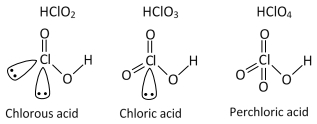
The correct structure is
$2NaI + Br_2 \to 2NaBr + I_2$
$C{l_2} + {H_2}O \to HCl + HOCl$
$B{r_2} + {H_2}O \to HBr + HOBr$
${I_2} + {H_2}O + No\,reaction\,[\Delta G > 0\,at\,R.T.]$
Chlorine reacts with water to form hydrochloric and hypochlorous acids.
$Cl_2+ H_2 O \longrightarrow HCl + HClO$
Hypochlorous acid is unstable, and it easily dissociates to form nascent oxygen.
$HClO \longrightarrow HCl +[ O ]$
Nascent oxygen is a more powerful oxidising agent. Its formation is responsible for the bleaching nature of chlorine in the presence of moisture.
$C{l_2} + 2{Y^ - } \to \,2C{l^ - }\, + \,{Y_2}$
The incorrect match regarding above reaction is
When bromine gas is passed through solutions of $NaF , NaCl , NaI$, bromine cannot displace fluorine and chlorine compound but it can displace iodine compound
$2 NaI + Br _2 \rightarrow 2 NaBr + I _2$
Iodine gas is released.
so the reaction $SF_6$ and $BF_3$ is not complete
$3Br_2 + 6CO_3^{2-} + 3H_2O \longrightarrow 5Br^-+ BrO_3^-+ 6HCO_3^-$
Which of the following statements is true regarding this reaction

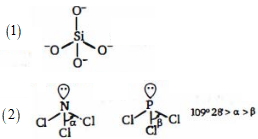
Hybridization of $\mathrm{Si}-\mathrm{s} p^{3},$ bond angle $=109\,^o28'$
$\angle Cl-\text{N}-\text{Cl}$ in $NCl_3$ is greater than $\angle \text{Cl}-\text{P}-\text{Cl}$ in $\mathrm{PCl}_{3}$ because partidpation of $s-$ orbital in the hybridization decreases from $NCl_3$ to $PCl_3$
Figure $(2)$
$\angle \text{Cl}-\text{P}-\text{Cl}$ in $\text{PC}{{\text{l}}_{3}}>\angle \text{H}-\text{Sb}-\text{H}$ in $\mathrm{SbH}_{3},$ as in $\mathrm{SbH}_{3}$, bond pairs are formed by overlapping of almost pure $p-$ orbitals.
$\angle \text{H}-\text{Sb}-\text{H}$ in $\text{Sb}{{\text{H}}_{3}}<\angle \text{H}-\text{Te}-\text{H}$ in $\mathrm{H}_{2}Te$ because two lone pairs are present on $Te$ while at $\mathrm{Sb}$ there is one lone pair.
$\underbrace{HF\,}_{H\,-\,Bonding}\,>\,\,\underbrace{HI\,\,>\,\,HBr\,\,>\,\,HCl}_{\begin{smallmatrix}
Dipole\,\,dipole \\
attraction\,\,(V.W.forces)
\end{smallmatrix}}$
In case of same type of van der waal's forces of attraction b.pt. $\propto $ molecular mass.
${I_2} + 2N{a_2}{S_2}{O_3} \to 2NaI + N{a_2}{S_4}{O_6}$
$Cl_2 + 2Y^-\to 2Cl^-+ Y_2$
The incorrect match regarding above reaction is
Chlorine reacts with water and produces a single oxygen atom also called nascent oxygen. This nascent oxygen when combines with any colour make it colourless.
$Cl _2+ H _2 O \rightarrow 2 HCl +( O )$ ( $O$ is oxidizing)
Sulphur dioxide when reacts with coloured substances it releases oxygen from the substance resulting in loss of colour.
$SO _2+2 H _2 O \rightarrow H _2 SO _4+2( H )$ ( $H$ is reducing)
$I _2\,<\, Br _2\,<\, Cl _2\,<\, F _2$
$F _2$ is better oxidizing agent in water than chlorine due to greater hydration energy.

$X_2Cl_3\Rightarrow X^{3+}Cl^{2-}$
$X_2(SO_4)_3\Rightarrow X^{3+}SO_4^{2-}$
$XPO_4\Rightarrow X^{3+}PO_4^{3-}$
Because $Cl^{2-}$ does not exist. So, $X_2Cl_3$ is incorrect. The correct formula should be $XCl_3$.
$C{l_2}\,\xrightarrow[{NaOH}]{{Cold\, + \,dil}}\,A\, + \,NaCl\, + \,{H_2}O$
$C{l_2}\,\xrightarrow[{NaOH}]{{Hot\,\,\& \,\,conc.}}\,B\, + \,NaCl\, + \,{H_2}O$
Therefore, the product of the reaction of $I _2 I _2$ with $H _2 O _2. H _2 O _2$ in the basic medium is Iodine.
Acidic nature $ \propto EN \propto + O.S.$
For compounds of an element