MCQ 511 Mark
The Vant Hoff factor for a dilute solution $\mathrm{K}_3\left[\mathrm{Fe}(\mathrm{CN})_6\right].$
View full question & answer→MCQ 521 Mark
In an endothermic process, solubility increases with $......$ in temperature:
AnswerThe effect of temperature on solubility depends on the type of reaction that occurs during the process of dissolving the solute in the solvent. In endothermic reactions, increasing the temperature increases the solubility of the solute in a solution. In exothermic reactions, increasing the temperature decreases the solubility of the solute.
View full question & answer→MCQ 531 Mark
$.......$ obeys Raoult’s law in all stages of concentration.
- ✓
- B
Non $-$ Ideal solution
- C
- D
AnswerAt all concentration levels, Ideal Solution follows Raoult’s law.
View full question & answer→MCQ 541 Mark
A zinc metal sample containing zinc chloride as impurity was made to react with an excess of dilute hydrochloric acid at $27^\circ C.$ Liberated hydrogen gas is collected at $760\ mm\ Hg$ pressure that occupies $780.0\ cm^3$ volume. If the vapour pressure of water at $27^\circ C$ is $14\ mm\ Hg,$ what is the volume of $H_2$ at $\text{STP}?$ The Standard pressure is $760\ mm\ Hg\ ($molar volume of gas at standard temperature and pressure, $\text{STP} = 22.4\ dm^3)$
- A
$746\ cm^3$
- ✓
$697\ cm^3$
- C
$750\ cm^3$
- D
$300\ cm^3$
AnswerCorrect option: B. $697\ cm^3$
View full question & answer→MCQ 551 Mark
Vapour pressure of a pure liquid $X$ is $\text{2 atm}$ at $300K.$ It is lowered to $\text{atm}$ on dissolving $1 g$ of $Y$ in $20g$ of liquid $X.$ If molar mass of $X$ is $200,$ what is the molar mass of $Y?$
View full question & answer→MCQ 561 Mark
The pressure that a single component in a gaseous mixture would exert if it existed alone in the same volume as the mixture and at the same temperature as the mixture is referred to as.
- A
- ✓
- C
Total pressure of a gas mixture
- D
AnswerPartial pressure is the pressure exerted by a single component in a gaseous mixture if it exists alone in the same volume.
View full question & answer→MCQ 571 Mark
Which substance would dissolve fastest in water?
AnswerCorrect option: A. $1g$ granulated sugar
Each Granulated sugar is touched with water so exposed surface is highest from others so its solubility is highest.
View full question & answer→MCQ 581 Mark
The vapour pressure of water at $300K$ in a closed container is $\text{0.4 atm.}$ If the volume of the container is doubled, its vapour pressure at $300K$ will be:
- A
$\text{0.8 atm}$
- B
$\text{0.2 atm}$
- ✓
$\text{0.4 atm}$
- D
$\text{0.6 atm}$
AnswerCorrect option: C. $\text{0.4 atm}$
Vapour pressure will be the same because it doesn't depend on the volume it depends only on Temperature.
View full question & answer→MCQ 591 Mark
Consider the and mark the correct option.
- A
Water will move from side $(A)$ to side $(B)$ if a pressure lower than osmotic pressure is applied on piston $(B).$
- ✓
Water will move from side $(B)$ to side $(A)$ if a pressure greater than osmotic pressure is applied on piston $(B).$
- C
Water will move from side $(B)$ to side $(A)$ if a pressure equal to osmotic pressure is applied on piston $(B).$
- D
Water will move from side $(A)$ to side $(B)$ if pressure equal to osmotic pressure is applied on piston $(A).$
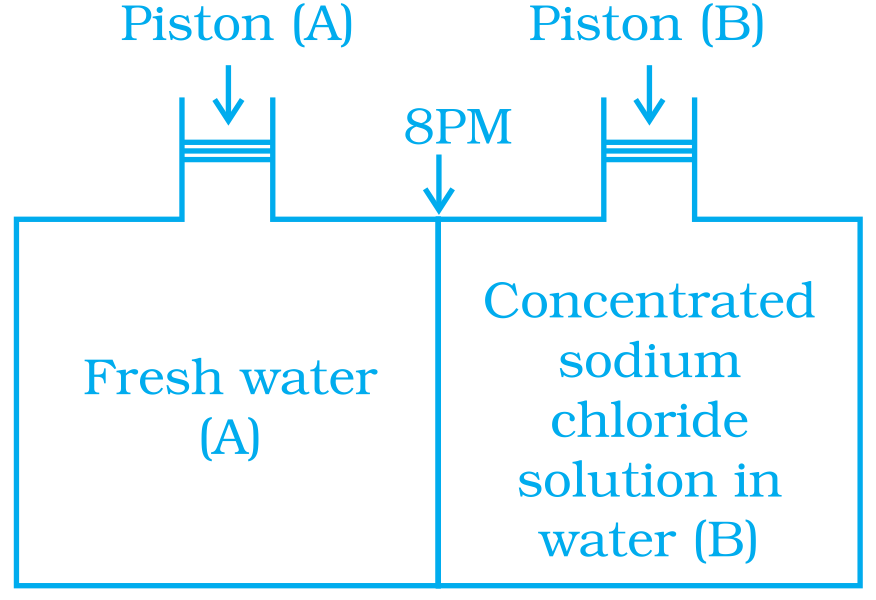
AnswerCorrect option: B. Water will move from side $(B)$ to side $(A)$ if a pressure greater than osmotic pressure is applied on piston $(B).$
Water will move from side $(B)$ to side $(A)$ if pressure greater than osmotic pressure is applied on piston $(B)$ due to reverse osmosis.
View full question & answer→MCQ 601 Mark
What will be the degree of dissociation of $\ce{0.1M Mg(NO_3)_2}$ solution if van’t Hoff factor is $2.74?$
- A
$75\%$
- ✓
$87\%$
- C
$100\%$
- D
$92\%$
AnswerCorrect option: B. $87\%$
View full question & answer→MCQ 611 Mark
Which of the following units is useful in relating concentration of solution with its vapour pressure?
AnswerIt is mole fraction $(x)$ which is useful in relating concentration of solution with its vapour pressure. For example according to Rault's law in a binary solution of two volatile liquids, $p_1 = x_1 {p^0}_1$ where $p_1$ is vapour pressure of component $1,$ and $x_1$ is its mole fraction in solution, ${p^0}_1$ denotes the vapour pressure of pure solvent.
View full question & answer→MCQ 621 Mark
At equilibrium, the rate of dissolution of a solid solute in a volatile liquid solvent is:
- A
Less than the rate of crystallisation
- B
Greater than the rate of crystallisation
- ✓
Equal to the rate of crytallisation
- D
AnswerCorrect option: C. Equal to the rate of crytallisation
Crystallization is the process of the formation of solid crystals precipitating from a solution.
In an unsaturated solution, the rate of dissolution of a solute in a volatile liquid solvent is greater than the rate of crystallization.
In a supersaturated solution, the rate of dissolution of a solute in a volatile liquid solvent is less than the rate of crystallization.
At equilibrium, the rate of dissolution of a solute in a volatile liquid solvent is equal to the rate of crystallization.
View full question & answer→MCQ 631 Mark
AnswerThe solution is made up of two components that is solute and solvent.
View full question & answer→MCQ 641 Mark
Which salt may show the same value of van't Hoff factor $(i)$ as that of $\mathrm{K}_4 \mathrm{Fe}(\mathrm{CN})_6$ in very dilute solution state?
- ✓
$\mathrm{Al}_2\left(\mathrm{SO}_4\right)_3$
- B
$\text{NaCl}$
- C
$\mathrm{Al}\left(\mathrm{NO}_3\right)_3$
- D
$\mathrm{Na}_2 \mathrm{SO}_4$
AnswerCorrect option: A. $\mathrm{Al}_2\left(\mathrm{SO}_4\right)_3$
View full question & answer→MCQ 651 Mark
$1$ mole of liquid $A$ and $9$ moles of liquid $B$ are mixed to form a solution. If $\text{P}^\circ_\text{B}=400_\text{mm}$ of $Hg$ and $\text{P}^\circ_\text{B}=200_\text{mm}$ of $Hg$ at a temperature $'T\ '$ and normal boiling point of liquid $B$ is $300K$ then answer the questions that follow. Given data$:\ K_b = 2.7K \ kg\ mol^{-1}$, Molar mass of $B = 100$ If $'A\ '$ is perfectly non$-$volatile and it dimerises to an extent of $60\%$ then what will be the vapour pressure of the solution.
- A
$\text{360}\text{mm}$ of $\text{Hg}$
- ✓
$\frac{3600}{9.7}\text{mm}$ of $\text{Hg}$
- C
$\frac{4000}{9.7}\text{mm}$ of $\text{Hg}$
- D
$36\text{mm}$ of $\text{Hg}$
AnswerCorrect option: B. $\frac{3600}{9.7}\text{mm}$ of $\text{Hg}$
View full question & answer→MCQ 661 Mark
An unripe mango placed in a concentrated salt solution to prepare pickle, shrivels because $.......$
- A
It gains water due to osmosis.
- B
It loses water due to reverse osmosis.
- C
It gains water due to reverse osmosis.
- ✓
It loses water due to osmosis.
AnswerCorrect option: D. It loses water due to osmosis.
Water starts moving out of mango $($lower concentration$)$ to the salt solution $($higher concentration$)$ due to osmosis.
View full question & answer→MCQ 671 Mark
$4L$ of $0.02M$ aqueous solution of $\text{NaCl}$ was diluted by adding one litre of water. The molality of the resultant solution is $.......$
- A
$0.004$
- B
$0.008$
- C
$0.012$
- ✓
$0.016$
AnswerCorrect option: D. $0.016$
Apply the relation, $\mathrm{M}_1\mathrm{V}_1=\mathrm{M}_2\mathrm{V}_2$
Given, $\mathrm{M}_1=0.02 \mathrm{M}, \mathrm{V}_1=4 \mathrm{L}, \mathrm{M}_2= ?,$
$\mathrm{V}_2=5 \mathrm{L}$
Therefore, $0.02 \times 4 \mathrm{L}=\mathrm{M}_2 \times 5 \mathrm{L}$
$\mathrm{M}_2=0.08 / 5$
$=0.016M$
View full question & answer→MCQ 681 Mark
Colligative properties depend on $......$
- A
The nature of the solute particles dissolved in solution.
- ✓
The number of solute particles in solution.
- C
The physical properties of the solute particles dissolved in solution.
- D
The nature of solvent particles.
AnswerCorrect option: B. The number of solute particles in solution.
Colligative properties depend upon the number of solute particles in the solution and independent of its nature.
View full question & answer→MCQ 691 Mark
How much oxygen is dissolved in $100\ rnL$ water at $298K$ if partial pressure of oxygen is $\text{0.5 atm}$ and $K = 1.4 \times 10^{-3} mol / L / \text{atm}?$
- A
$22.4\ mg$
- B
$22.4g$
- C
$2.24g$
- ✓
$2.24\ mg$
AnswerCorrect option: D. $2.24\ mg$
View full question & answer→MCQ 701 Mark
Low concentration of oxygen in the blood and tissues of people living at high altitude is due to $......$
- A
- ✓
Low atmospheric pressure.
- C
High atmospheric pressure.
- D
Both low temperature and high atmospheric pressure.
AnswerCorrect option: B. Low atmospheric pressure.
At high altitude the atmospheric pressure is decreased $\ \&\ ,$ due to low atmospheric pressure the solubility of oxygen in blood and tissues is reduced.
View full question & answer→MCQ 711 Mark
What happens when a solute crystal is added to a supersaturated solution?
- A
It becomes a colloidal solution.
- B
The solute dissolves in the solution.
- C
The solution desaturates.
- ✓
The solute precipitates out of the solution.
AnswerCorrect option: D. The solute precipitates out of the solution.
Solute particles leave the solution and form a crystalline precipitate when a solute crystal is added to a supersaturated solution. Seeding refers to the addition of the solute crystal.
View full question & answer→MCQ 721 Mark
Which has the lowest boiling point at $\text{1 atm}$ pressure?
- A
$\text{0.1 M KCl}$
- ✓
$0.1 M$ Urea
- C
$\ce{0.1 M CaCl_2}$
- D
$\ce{0.1 M A1Cl_3}$
AnswerCorrect option: B. $0.1 M$ Urea
View full question & answer→MCQ 731 Mark
If $2\ gm$ of $\text{NaOH}$ is present is $200\ ml$ of its solution, its molarity will be:
AnswerCorrect option: A. $0.25$
View full question & answer→MCQ 741 Mark
A liquid is kept in a closed vessel. If a glass plate $($negligible mass$)$ with a small hole is kept on top of the liquid surface, then the vapour pressure of the liquid in the vessel is :
- A
More than what would be if the glass plate were removed
- ✓
Same as what would be if the glass plate were removed
- C
Less than what would be if the glass plate were removed
- D
AnswerCorrect option: B. Same as what would be if the glass plate were removed
The vapour pressure of the liquid in the vessel is same as what would be if the glass plate were removed. Vapour pressure is characteristic property of a solvent at a temperature.
View full question & answer→MCQ 751 Mark
At equilibrium the rate of dissociation of a solid solute in a volatile liquid solvent is:
- A
Less than the rate of crystallisation
- B
Greater than the rate of crystallisation
- ✓
Equal to the rate of crystallisation
- D
AnswerCorrect option: C. Equal to the rate of crystallisation
View full question & answer→MCQ 761 Mark
The volume occupied by a single gas in a mixture at the same temperature and pressure is referred to as the single $-$ gas volume.
- A
- ✓
- C
Total volume of a gas mixture
- D
AnswerAt the same temperature and pressure, the volume occupied by a single gas alone in a combination is a portion of a volume.
View full question & answer→MCQ 771 Mark
The system that forms maximum boilingazetrope is:
AnswerCorrect option: A. Acetone $-$ chloroform
View full question & answer→MCQ 781 Mark
$1M, 2.5$ litre $\text{NaOH}$ solution is mixed with another $0.5M, 3$ litre $\text{NaOH}$ solution. Then find out the molarity of resultant solution:
- A
$0.80M$
- B
$1.0M$
- ✓
$0.73M$
- D
$0.50M$
AnswerCorrect option: C. $0.73M$
View full question & answer→MCQ 791 Mark
When two perfect solutions with volume $V$ each are combined, What is the volume of the solution as a result?
- A
$V$
- ✓
$2V$
- C
Greater than $2V$
- D
Less than $2V$
AnswerWhen two perfect solutions are mixed, there is no change in volume.
View full question & answer→MCQ 801 Mark
$234.2\ gm$ of sugar syrup contains $34.2\ gm$ of sugar. What is the molal concentration of the solution.
View full question & answer→MCQ 811 Mark
Mole fraction of glycerine $\mathrm{C}_3 \mathrm{H}_5(\mathrm{OH})_3$ in solution containing $36g$ of water and $46g$ of glycerine is:
- A
$0.46$
- B
$0.40$
- ✓
$0.20$
- D
$0.36$
AnswerCorrect option: C. $0.20$
View full question & answer→MCQ 821 Mark
When a solution is diluted at constant temperature, its vapour pressure:
AnswerWhen a solution is diluted at a constant temperature, its vapour pressure increases.
When the solution is diluted, the mole fraction of solute decreases and the mole fraction of solvent increases.
Hence, the relative lowering in vapour pressure decreases and the vapor pressure increases.
View full question & answer→MCQ 831 Mark
Maximum amount of a solid solute that can be dissolved in a specified amount of a given liquid solvent does not depend upon $........$
AnswerSolubility of a solid in liquid does not depend upon pressure since solid and liquids are almost incompressible.
View full question & answer→MCQ 841 Mark
- A
Number of electrons of an atom.
- ✓
Sum of the numbers of electrons and protons of an atom.
- C
Sum of the numbers of neutrons and protons of an atom.
- D
AnswerCorrect option: B. Sum of the numbers of electrons and protons of an atom.
View full question & answer→MCQ 851 Mark
A beaker contains a solution of substance $'A\ ’.$ Precipitation of substance $'A\ ’$ takes place when small amount of $'A\ ’$ is added to the solution. The solution is $......$
AnswerWhen small amount of solute is added to its solution and it does not dissolve and get precipitated then this solution is supersaturated solution.
View full question & answer→MCQ 861 Mark
$H_2S$ is a toxic gas used in qualitative analysis. If solubility of $H_2S$ in water at $\text{STP}$ is $0.195m.$ what is the value of $K_H?$
- A
$0.0263$ bar
- B
$69.16$ bar
- C
$192$ bar
- ✓
$282$ bar
AnswerCorrect option: D. $282$ bar
View full question & answer→MCQ 871 Mark
In comparison to a $0.01M$ solution of glucose, the depression in freezing point of a $\ce{0.01M MgCl_2}$ solution is $.......$
AnswerDepression in freezing point is a colligative property. In case of $\ce{MgCl_2}$ value of van’t. Hoff factor will be more. No. of ions yielded when a molecule of $\ce{MgCl_2}$ gets dissociated in its aqueous solution is $= 3.$ Thus one molecule of $\ce{0.01M MgCl_2}$ gives out three particles/ ions in solution, thereby increasing the number of particles present in its solution to three times. It is because of this that depression in freezing point of $\ce{0.01M MgCl_2}$ will be three times as compared to that of $0.01M -$ glucose solution, where no dissociation of the molecule takes place.
View full question & answer→MCQ 881 Mark
$100\ mL$ of liquid $A$ and $25\ mL$ of liquid $B$ are mixed to formal solution of volume $125\ mL.$ Then the solution is $......$
AnswerAs change in volume $(\triangle\text{V})$ is zero so the solution is ideal.
View full question & answer→MCQ 891 Mark
The Van't Hoff factors i for an electrolyte which undergoes dissociation and association in solvents are respectively:
- ✓
Greater than one and less than one
- B
Less than one and greater than one
- C
Less than one and less than one
- D
Greater than one and greater than one
AnswerCorrect option: A. Greater than one and less than one
In case of association of solute particles in solution, the observed molecular weight of solute being more than the normal, the value of factor $'i\ '$ is less than unity $($i.e. $i < 1),$ while for dissociation the value of $i$ is greater than unity $($i.e. $i > 1),$ because the observed molecular weight has lesser value than normal molecular weight.
View full question & answer→MCQ 901 Mark
The relative lowering in vapour pressure is proportional to the ratio of number of :
- A
Solute molecules to solvent molecules.
- B
Solvent molecules to solute molecules.
- ✓
Solute molecules to the total number of molecules to the total number of molecules in solution.
- D
Solvent molecules to the total number of molecules in solution.
AnswerCorrect option: C. Solute molecules to the total number of molecules to the total number of molecules in solution.
Relative lowering of vapour pressure. The vapour pressure of a liquid is the pressure of the vapor which is in equilibrium with that liquid. The vapour pressure of a solvent is lowered when a non-volatile solute is dissolved in it to form a solution.
View full question & answer→MCQ 911 Mark
A closed vessel is maintained at a constant temperature. It is first evacuated and then vapour is injected into it continuously. The pressure of the vapour in the vessel is:
- A
- ✓
First increases and then remains constant
- C
First increases and then decreases
- D
AnswerCorrect option: B. First increases and then remains constant
The molecules of a gas are in a state of random motion. They continuously collide against the walls of the container. Even at ordinary temperature and pressure, the number of molecular collisions with walls is very large. During each collision, certain momentum is transferred to the walls of the container. The pressure exerted by the gas is due to continuous bombardment of gas molecules against the walls of the container. Due to this continuous bombardment, the walls of the container experience a continuous force which is equal to the total momentum imparted to the walls per second. The average force experienced per unit area of the walls of the container determines the pressure exerted by the gas. This should be clear from the fact that although the molecule collisions are random, the pressure remains constant.
View full question & answer→MCQ 921 Mark
A drop each of two non$-$corrosive and nonirritating liquids $A$ and $B$ at a temperature of $22^\circ$C are placed on the skin. Liquid $A$ gives a more cooling sensation than liquid $B.$ Which of the following can be said about the liquids $A$ and $B?$
- A
Liquid $A$ has higher boiling point than that of liquid $B$
- B
Liquid $A$ has higher latent heat of vaporisation than that of liquid $B$
- ✓
Liquid $A$ has lower latent heat of vaporisation than that of liquid $B$
- D
The boiling points of liquid $A$ and $B$ are equal
AnswerCorrect option: C. Liquid $A$ has lower latent heat of vaporisation than that of liquid $B$
Liquid $A$ gives cooling sensation means liquid $A$ is absorbing more heat from the skin, so, liquid $A$ and $B$ can be differentiated as liquid $A$ has lower latent heat of vaporisation than that of liquid $B.$
View full question & answer→MCQ 931 Mark
The van't Hoff factor for a solute which does not dissociate or associate in solution is:
AnswerThe Van't Hoff factor for a solute which does not dissociate or associate in solution is $1$ as it is non$-$electrolyte.
View full question & answer→MCQ 941 Mark
The Van't Hoff factor of $0.1M \mathrm{Ba}\left(\mathrm{NO}_3\right)_2$ solutions is $2.74.$ The degree of dissociation will be:
- A
$91.3\%$
- ✓
$87\%$
- C
$100\%$
- D
$74\%$
AnswerCorrect option: B. $87\%$
View full question & answer→MCQ 951 Mark
On the basis of information given below mark the correct option.Information:
- In bromoethane and chloroethane mixture intermolecular interactions of $A–A$ and $B–B$ type are nearly same as $A–B$ type interactions.
- In ethanol and acetone mixture $A–A$ or $B–B$ type intermolecular interactions are stronger than $A–B$ type interactions.
- In chloroform and acetone mixture $A–A$ or $B–B$ type intermolecular interactions are weaker than $A–B$ type interactions.
- A
Solution $(B)$ and $(C)$ will follow Raoult’s law.
- ✓
Solution $(A)$ will follow Raoult’s law.
- C
Solution $(B)$ will show negative deviation from Raoult’s law.
- D
Solution $(C)$ will show positive deviation from Raoult’s law.
AnswerCorrect option: B. Solution $(A)$ will follow Raoult’s law.
For an ideal solution $A-A$ and $B-B$ intermolecular interactions should be nearly same as $A-B$ type interactions.
View full question & answer→MCQ 961 Mark
For which solution the value of Van't hoff factor is not equal to $1?$
AnswerGlucose, sugar and fructose are non$-$ electrolytes, acetic acid is weak elecrolyte and hence dissociates in hydrogen and acetate ions.
Colligative property depends on number of particles present in the solution.
van't Hoff factor is ratio of observed colligative property to theoretical colligative property.
Therefore, van't Hoff factor of acetic acid is greater than $1.$
View full question & answer→MCQ 971 Mark
$50L$ of a certain liquid is confined in a piston system at the external pressure $\text{100 atm.}$ This pressure is suddenly released and liquid is expanded against the constant one atmosphere pressure, volume of the liquid increases by $1L$ and the final pressure on the liquid is $\text{10 atm.}$ Find the magnitude of work done.
- ✓
$\text{1L atm}$
- B
$\text{5L atm}$
- C
$\text{50L atm}$
- D
$\text{500L atm}$
AnswerCorrect option: A. $\text{1L atm}$
View full question & answer→MCQ 981 Mark
Identify which of the following statements is $\text{FALSE.}$
- A
The vapor pressure of a liquid decreases with increasing atmospheric pressure.
- B
The value of an equilibrium constant is dependent on temperature.
- C
The rate of a spontaneous reaction cannot be determined solely by its Gibbs free energy.
- ✓
During a phase transition, the temperature of a substance must be constant.
AnswerCorrect option: D. During a phase transition, the temperature of a substance must be constant.
During phase transition, temperature is taken on the $x-$axis of the phase transition curve, hence, during phase transition the temperature of substance changes.
View full question & answer→MCQ 991 Mark
At a certain temperature, the vapour pressure of water is $50\ mm.$ The relative lowering of vapour pressure of a solution containing $36g$ of glucose in $900g$ of water is:
- A
$0.1$
- B
$0.5$
- C
$0.004$
- ✓
$3.75$
AnswerCorrect option: D. $3.75$
View full question & answer→MCQ 1001 Mark
If two liquids $A$ and $B$ form minimum boiling azeotrope at some specific composition then $......$
- A
$A–B$ interactions are stronger than those between $A–A$ or $B–B.$
- B
vapour pressure of solution increases because more number of molecules of liquids $A$ and $B$ can escape from the solution.
- C
vapour pressure of solution decreases because less number of molecules of only one of the liquids escape from the solution.
- ✓
$A–B$ interactions are weaker than those between $A–A$ or $B–B.$
AnswerCorrect option: D. $A–B$ interactions are weaker than those between $A–A$ or $B–B.$
- The solutions which show large positive deviation from Rault's law form minimum boiling azeotrope at some specific composition.
- In case of positive deviation from Rault's law $A-B$ interactions are weaker than those between $A–A$ or $B–B.$
View full question & answer→