MCQ 1011 Mark
An ideal binary solution is prepared by two liquids $A$ and $B,$ with $\text{P}^\circ_\text{A}>\text{P}^\circ_\text{B}.$Then:
- A
$A - B$ interactions are stronger than $A - A$ and $B - B.$
- B
$A$ and $B$ have same molecular masses.
- ✓
$A - B$ interactions are similar to $A - A$ and $B - B$ interactions.
- D
Both $A$ and $B$ are non $-$ polar substances.
AnswerCorrect option: C. $A - B$ interactions are similar to $A - A$ and $B - B$ interactions.
For an ideal binary solution containing two liquids $A$ and $B, A - B$ interactions are similar to $A - A$ and $B - B$ interactions.
View full question & answer→MCQ 1021 Mark
Considering the formation, breaking and strength of hydrogen bond, predict which of the following mixtures will show a positive deviation from Raoult’s law?
AnswerMixture of Methanol and acetone shows positive deviation because methanol$-$methanol and acetone$-$acetone interactions are more than methanol-acetone. The more number of hydrogen bonds are broken the less number of new $H-$bonds are formed.
View full question & answer→MCQ 1031 Mark
We have three aqueous solutions of $\text{NaCl}$ labelled as $'A\ ’, 'B\ ’$ and $'C\ ’$ with concentrations $0.1M, 0.01M$ and $0.001M,$ respectively. The value of van’t Hoff factor for these solutions will be in the order $......$
- A
$ i_A < i_B < i_C $
- B
$ i_A > i_B > i_C $
- ✓
$ i_A = i_B = i_C $
- D
$ i_A < i_B > i_C $
AnswerCorrect option: C. $ i_A = i_B = i_C $
The value of van’t Hoff’s factor will be $ i_A = i_B = i_C $ due to complete dissociation of strong electrolyte $(\text{NaCl})$ in dilute solutions. On complete dissociation value of $i$ for $\text{NaCl}$ is $2.$
View full question & answer→MCQ 1041 Mark
Equipment needed for measuring the vapour pressure of a liquid:
AnswerA Manometer is a device to measure pressures. A common simple manometer consists of a $U$ shaped tube of glass filled with some liquid. Typically the liquid is mercury because of its high density.
View full question & answer→MCQ 1051 Mark
For carrying reverse osmosis for desalination of water the material used for making semipermeable membrane is:
MCQ 1061 Mark
$\mathrm{K_H}$ value for $\operatorname{Ar}(\mathrm{g}), \mathrm{CO}_2(\mathrm{g}), \mathrm{HCHO}(\mathrm{g})$ and $\mathrm{CH}_4(\mathrm{\sim g})$ are $40.39,1.67,1.83 \times 10^{-5}$ and $0.413$ respectively. Arrange these gases in the order of their increasing solubility.
- A
$ \mathrm{HCHO} < \mathrm{CH}_4 < \mathrm{CO}_2 < \mathrm{Ar} $
- B
$ \mathrm{HCHO} < \mathrm{CO}_2 < \mathrm{CH}_4 < \mathrm{Ar} $
- ✓
$ \mathrm{Ar} < \mathrm{CO}_2 < \mathrm{CH}_4 < \mathrm{HCHO} $
- D
$ \mathrm{Ar} < \mathrm{CH}_4 < \mathrm{CO}_2 < \mathrm{HCHO} $
AnswerCorrect option: C. $ \mathrm{Ar} < \mathrm{CO}_2 < \mathrm{CH}_4 < \mathrm{HCHO} $
$ \mathrm{Ar} < \mathrm{CO}_2 < \mathrm{CH}_4 < \mathrm{HCHO} $ Explanation: Higher the value of $\mathrm{K_H}$ lower will be the solubility of the gas at a given pressure, hence the solubility of given gases would increase with increase in $\mathrm{K_H}$ values.
View full question & answer→MCQ 1071 Mark
The vapour pressures of two liquids $A$ and $B$ in their pure states are in the ratio of $1 : 2.$ A binary solution of $A$ and $B$ contains $A$ and $B$ in the mole proportion of $1 : 2.$ The mole fraction of $A$ in the vapour phase of the solution will be:
- A
$0.33$
- ✓
$0.2$
- C
$0.25$
- D
$0.52$
Answer$\frac{\text{P}^\circ_\text{A}}{\text{P}^\circ_\text{B}}=\frac{1}{2}$
$\frac{\text{X}_{\text{A}}}{\text{X}_{\text{B}}}=\frac{1}{2}$
$\text{P}_{\text{T}}\gamma_\text{A}=\text{P}^\circ_\text{A}\text{x}_\text{A}$
$\therefore\frac{\gamma_\text{A}}{\gamma_\text{B}}=\frac{\text{P}^\circ_\text{A}}{\text{P}^\circ_\text{B}}\frac{\text{X}_\text{A}}{\text{X}_\text{B}}$
We know $\gamma_\text{A}+\gamma_{\text{B}}=1$
$\therefore\gamma_\text{A}=0.2$
View full question & answer→MCQ 1081 Mark
At same temperature which pair of the following solutions are isotonic?
- A
$0.2 \mathrm{M} \mathrm{\sim BaCl}_2$ and $0.2 M$ urea
- B
$0.1M$ urea and $\text{0.1M NaCl}$
- C
$\text{0.1 M NaCl}$ and $0.1 \mathrm{M} \mathrm{\sim K}_2 \mathrm{SO}_4$
- ✓
$0.1 \mathrm{M} \mathrm{\sim Ba}\left(\mathrm{NO}_3\right)_2$ and $0.1 \mathrm{M} \mathrm{\sim Na}_2 \mathrm{SO}_4$
AnswerCorrect option: D. $0.1 \mathrm{M} \mathrm{\sim Ba}\left(\mathrm{NO}_3\right)_2$ and $0.1 \mathrm{M} \mathrm{\sim Na}_2 \mathrm{SO}_4$
Isotonic solutions have the same osmotic pressure and same molar concentration.
The solution of $0.1 \mathrm{M} \mathrm{\sim Ba}\left(\mathrm{NO}_3\right)_2$ and $0.1 \mathrm{M} \mathrm{\sim Na}_2 \mathrm{SO}_4$ are isotonic.
The osmotic pressure of $0.1 \mathrm{M} \mathrm{\sim Ba}\left(\mathrm{NO}_3\right)_2$
$= \text{iMRT} = 3 \times 0.1RT = 0.3RT$
Osmotic pressure of $0.1M \mathrm{\sim Na}_2 \mathrm{SO}_4$
$= \text{iMRT} = 3 \times 0.1RT = 0.3RT$
The correct answer is "The solution of $0.1 \mathrm{M} \mathrm{\sim Ba}\left(\mathrm{NO}_3\right)_2$ and $0.1M \mathrm{\sim Na}_2 \mathrm{SO}_4$ are isotonic".
View full question & answer→MCQ 1091 Mark
Which of the following conditions is not correct for ideal solution:
- A
No change in volume on mixing
- B
No change in enthalpy on mixing
- C
- ✓
Lonisation of solute should occurs to a small extent
AnswerCorrect option: D. Lonisation of solute should occurs to a small extent
In an ideal solution, no change in volume on mixing, no change in enthalpy on mixing and it obeys Raoults law but ionisation of solute should not occur to a small extent.
View full question & answer→MCQ 1101 Mark
What is the molality of an aqueous solution,whose relative lowering of vapour pressure is $0.1$
- A
$2m$
- B
$2.75m$
- C
$3.25m$
- ✓
$5.56m$
AnswerCorrect option: D. $5.56m$
View full question & answer→MCQ 1111 Mark
Which one of the following electrolytes has the same value of van't Hoff's factor $(i)$ as that of $\mathrm{Al}_2\left(\mathrm{SO}_4\right)_3 ($if all are $100\%$ ionised$)?$
- A
$ \mathrm{Al}\left(\mathrm{NO}_3\right)_3 $
- ✓
$ \mathrm{\sim K}_4\left[\mathrm{Fe}(\mathrm{CN})_6\right] $
- C
$ \mathrm{K}_2 \mathrm{SO}_4 $
- D
$ \mathrm{\sim K}_3\left[\mathrm{Fe}(\mathrm{CN})_6\right] $
AnswerCorrect option: B. $ \mathrm{\sim K}_4\left[\mathrm{Fe}(\mathrm{CN})_6\right] $
Van't Hoff factor $i = \frac{\text{number of solute particles present in solution}}{\text{theoretical number of solute particles due to solution of non electrolyte }}$
$=\frac{\text{n(observed)}}{\text{n(theoretical)}}.$
$1$ molecule of $\mathrm{Al}_2\left(\mathrm{SO}_4\right)_3$ ionizes in solution to produce $5$ ions.
$\text{Al}_2(\text{SO}_4)_3\rightarrow2\text{Al}^{3+}+3\text{SO}^2_4$
Hence$, i =\frac{\text{n(observed)}}{\text{n(theoretical)}}=\frac{5}{1}=5.$
$1$ molecule of $\mathrm{K}_4\left[\mathrm{Fe}(\mathrm{CN})_6\right]$ ionize in solution to produce $5$ ions.
$\mathrm{K}_4\left[\mathrm{Fe}(\mathrm{CN})_6\right]$
$\rightarrow 4 \mathrm{\sim K}^{+}+\left[\mathrm{Fe}(\mathrm{CN})_6\right]^{4-}$
Hence, i $=\frac{\text{n(observed)}}{\text{n(theoretical)}}=\frac{5}{1}=5.$
Thus, $\mathrm{K}_4\left[\mathrm{Fe}(\mathrm{CN})_6\right]$ has the same value of van't Hoff's factor $(i)$ as that of $\mathrm{Al}_2\left(\mathrm{SO}_4\right)_3 ($assuming $100\%$ ionization$).$
Note$:\ 1$ molecule each of $\mathrm{Al}\left(\mathrm{NO}_3\right)_3, \mathrm{\sim K}_2 \mathrm{SO}_4$ and $\mathrm{K}_4\left[\mathrm{Fe}(\mathrm{CN})_6\right]$ ionizes in solution to produce $4, 3$ and $4$ ions respectively.
View full question & answer→MCQ 1121 Mark
Which of the following are true solutions?
AnswerCorrect option: A. $\text{ENO}$ salt in water
The definition of true solution is a homogeneous mixture of two or more substances in which substance dissolved $($solute$)$ in solvent has the size of the particle less than $10^{-9}m$ or $1\ nm.$ So the perfect example of true solution is $\text{ENO}$ salt in water. $\text{ENO}$ is perfectly soluble in water and has minimum size.
View full question & answer→MCQ 1131 Mark
Which of the following property indicates weak intermolecular forces of attraction in liquid?
- A
High heat of vaporization
- ✓
- C
High critical temperature
- D
AnswerThe molecules that are having weak intermolecular forces of attraction, they can easily dissociate and convert into vapour state, so, molecules with weak intractions have high vapour pressure.
View full question & answer→MCQ 1141 Mark
Molarity of liquid $\text{HCl}$ will be, if density of solution is $1.17 gm/cc.$
- A
$36.5$
- ✓
$32.05$
- C
$18.25$
- D
$42.10$
AnswerCorrect option: B. $32.05$
View full question & answer→MCQ 1151 Mark
A mixture of benzene and toluene forms:
AnswerMixing of benzene and toluene does not involve any kind of decrease or increase in interaction forces in between molecules so they form ideal solution.
View full question & answer→MCQ 1161 Mark
Partial pressure of a solution component is directly proportional to its mole fraction. This is known as:
MCQ 1171 Mark
To an aqueous solution of $\text{NaI},$ increasing amounts of solid $\text{HgI}_2$ is added, the vapour pressure of the solution:
AnswerCorrect option: B. Increases to a constant value.
View full question & answer→MCQ 1181 Mark
Which of the following plot does not represent the behaviour of an ideal binary liquid solution of $A$ and $B?$
- A
Plot of $p_A$ vs $x_A$ is linear
- B
Plot of $p_B$ vs $x_B$ is linear
- C
Plot of $p_{total}$ vs $x_A$ is linear
- ✓
Plot of $p_{total}$ vs $x_B$ is parabola
AnswerCorrect option: D. Plot of $p_{total}$ vs $x_B$ is parabola
View full question & answer→MCQ 1191 Mark
Which one of the following is the ratio of the lowering of vapour pressure of $0.1M$ aqueous solutions of $\text{BaCl}_2, \text{NaCl}$ and $\mathrm{Al}_2\left(\mathrm{SO}_4\right)_3$ respectively?
- ✓
$3 : 2 : 5$
- B
$5 : 2 : 3$
- C
$5 : 3 : 2$
- D
$2 : 3 : 5$
AnswerCorrect option: A. $3 : 2 : 5$
Lowering of vapour pressure is a colligative property. It depends on the number of particles of the solute.
$\text{BaCl}_2\rightleftharpoons\text{Ba}^{2+}+2\text{Cl}^−; 3$ ions
$\text{NaCl}\rightleftharpoons\text{Na}^++\text{Cl}^−; 2$ ions
$\text{Al}_2(\text{SO}_4)_3\rightleftharpoons2\text{Al}^{3+}+3\text{SO}^{3-}_4; 5$ ions
Hence, the ratio of lowering of vapour pressure is $3 : 2 : 5$ since the concentration of the solutions are same.
View full question & answer→MCQ 1201 Mark
When a solute is present in trace quantities the following expression is used:
MCQ 1211 Mark
The heat of solution or mixing has a negative side.
AnswerThe heat of solution or mixing has a negative side. Dissolution’s heat.
View full question & answer→MCQ 1221 Mark
Which characteristics the weak inter molecular forces of attraction in a liquid?
- A
- ✓
- C
High critical temperature
- D
High heat of vapourisation
AnswerThe stronger the intermolecular forces between the molecules, the harder it is for vaporization to occur since more energy is required to break the bonds holding the molecules together. So, weak intermolecular forces means high vapour pressure.
View full question & answer→MCQ 1231 Mark
The law which indicates the relation’-hip between solubility of a gas in liquid and pressure rs:
- A
- ✓
- C
Lowering of vapour pressure
- D
View full question & answer→MCQ 1241 Mark
The mass of a non $-$ volatile non $-$ electrolyte solute $($molar mass $= 50g\ mol−1)$ needed to be dissolved in $114g$ octane to reduce its vapour pressure to $75\%$ is:
- A
$37.5g$
- B
$75g$
- ✓
$150g$
- D
$50g$
AnswerCorrect option: C. $150g$
View full question & answer→MCQ 1251 Mark
A student slowly mixes salt into $25\ ml$ of water until no more salt dissolves in it. The student could make more salt dissolve in the solution by:
AnswerAs no more salt is dissolving in the solution, the solution has became saturated solution. The student can dissolve more solution by heating the solution as on heating the saturated solution become supersaturated. After, the solution become supersaturated, no more salt can be dissolved, it will precipitate out.
View full question & answer→MCQ 1261 Mark
Vant Hoff factor for a dilute solution of glucose is:
AnswerSolution of glucose is a non$-$electrolytic solution.
For a non $-$ electrolytic solution, vant hoff factor is $1.$
View full question & answer→MCQ 1271 Mark
When heating of a miscible solution begins, vapours formed will be:
- A
Of liquid lower in boiling point
- B
Of liquid higher in boiling point
- ✓
Of both liquids with a higher concentration of liquid having low boiling point
- D
AnswerCorrect option: C. Of both liquids with a higher concentration of liquid having low boiling point
When heating begins in miscible solutions, vapours will be of both liquids with a higher concentration of liquid having a low boiling point $($since that component will be more volatile in nature$).$
View full question & answer→MCQ 1281 Mark
Which of the following solutions will have the highest boiling point:
- A
$\ce{1M BaCl_2}$.
- B
$1M$ Urea.
- ✓
$\ce{1M FeCl_3}$.
- D
$\ce{1M NaCl}.$
AnswerCorrect option: C. $\ce{1M FeCl_3}$.
$\ce{FeCl_3}$ solution $(\text{T}_\text{b}=\text{T}_\text{b}^0+\Delta\text{T}_\text{b})$ As number of ions produced is maximum in $\ce{FeCl_3}$ solution. The colligative property $\Delta\text{T}_\text{b}$ will be maximum in case of $\ce{FeCl_3}$.
View full question & answer→MCQ 1291 Mark
Relative lowering of vapour pressure of a solution is equal to:
- A
The mole fraction of solvent
- B
The ratio of moles of solute to moles of solvent
- ✓
The mole fraction of solute
- D
The ratio of moles of solvent to moles of solute
AnswerCorrect option: C. The mole fraction of solute
Relative lowering of vapour pressure of a solution is equal to the mole fraction of solute. After adding the solute, the vapour pressure of the solution is found to be lower than that of the pure liquid at a given temperature.
View full question & answer→MCQ 1301 Mark
At equilibrium the rate of dissolution of a solid solute in a volatile liquid solvent is $......$
- A
Less than the rate of crystallisation.
- B
Greater than the rate of crystallisation.
- ✓
Equal to the rate of crystallisation.
- D
AnswerCorrect option: C. Equal to the rate of crystallisation.
This happens as per conditions attained at equilibrium state; i.e. rate of forward reaction $($dissolution$) =$ rate of backward reaction $($crystallisation$)$
View full question & answer→MCQ 1311 Mark
Which of the following would have the lowest vapor pressure in the pure state?
- ✓
Sodium hydroxide because of the strong interparticle forces of ionic solids
- B
Methanol because of the hydrogen bonding in the functional group along with the non-polar nature of the carbon hydrogen bonds
- C
Water because of the very strong hydrogen bonding in the substances
- D
Ammonia because of the unbonded pair of electrons on the central atom coupled with hydrogen bonding in the substance.
AnswerCorrect option: A. Sodium hydroxide because of the strong interparticle forces of ionic solids
Sodium hydroxide have lowest vapour pressure in the pure state because of the strong interparticle forces of ionic solids and also non-volatile in nature.
View full question & answer→MCQ 1321 Mark
At a given temperature, osmotic pressure of a concentrated solution of a substance $........$
- ✓
Is higher than that at a dilute solution.
- B
Is lower than that of a dilute solution.
- C
Is same as that of a dilute solution.
- D
Cannot be compared with osmotic pressure of dilute solution.
AnswerCorrect option: A. Is higher than that at a dilute solution.
$\pi=\text{CRT}$
Where $C$ is concentration of the solution. So, the higher the concentration of solution at given temperature the higher will be the osmotic pressure.
View full question & answer→MCQ 1331 Mark
The unit of ebulioscopic constant is $.......$
- ✓
$\ce{K \ kg\ mol^{-1}}$ or $\ce{K(molality)^{-1}}$
- B
$\ce{mol kg K^{-1}}$ or $\ce{K^{-1}(molality)}$
- C
$\ce{kg mol^{-1} K^{-1}}$ or $\ce{K^{-1}(molality)^{-1}}$
- D
$\ce{K mol kg^{-1}}$ or $\ce{K(molality)}$
AnswerCorrect option: A. $\ce{K \ kg\ mol^{-1}}$ or $\ce{K(molality)^{-1}}$
$\text{K}_{\text{b}}=\frac{\Delta\text{T}_{\text{b}}}{\text{m}}=\frac{\text{K}}{\text{mol kg}^{-1}}$ or $\text{K}\text{(molality)}^{-1}$
The unit of ebullioscopic constant is $\ce{K kg mol^{-1}}$ or $\ce{K molality^{-1}}$
View full question & answer→MCQ 1341 Mark
What weight of glycerol should be added to $600g$ of water in order to lower its freezing point by $10^\circ C?$
- A
$496g$
- ✓
$297g$
- C
$310g$
- D
$426g$
AnswerCorrect option: B. $297g$
View full question & answer→MCQ 1351 Mark
For an ideal liquid solution, which of the following is unity?
AnswerAn activity coefficient is a factor used in thermodynamics to account for deviations from ideal behavior in a mixture of chemical substances.
Hence, for an ideal liquid solution, that deviation is $0,$ as the mole fraction of other substance is $0.$
View full question & answer→MCQ 1361 Mark
Which characteristic the weak intermolecular forces of attraction in a liquid?
- A
- ✓
- C
High critical temperature
- D
High heat of vaporization
AnswerHigh vapour pressure leads to the weak intermolecular forces of attraction in a liquid.Weaker are the intermolecular forces of attractions, more is the tendency for evaporation, more is vapour pressure, lower is boiling point.
View full question & answer→MCQ 1371 Mark
For a very dilute solution of $\ce{H_3PO_3}$ van't Hoff factor is:
- A
$i = 7$
- ✓
$i = 3$
- C
$i = 4$
- D
$i = 5$
AnswerCorrect option: B. $i = 3$
View full question & answer→MCQ 1381 Mark
For a binary ideal liquid solution, the variation in total vapour pressure versus composition of solution is given by which of the curves?
$i.$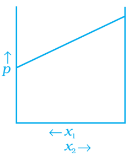
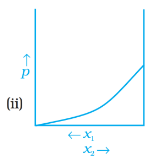 $iii.$
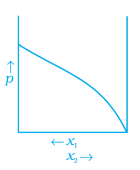 $iv.$
$iv.$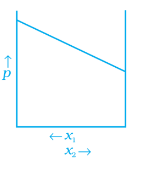
- A
$i$ and $ii$
- B
$i$ and $iii$
- C
$ii$ and $iii$
- ✓
$i$ and $iv$
AnswerCorrect option: D. $i$ and $iv$
The slopes at $(i)$ and $(iv)$ are straight lines, therefore they represent ideal behaviour of the solution.
View full question & answer→MCQ 1391 Mark
When $20g$ of napthoic acid $(\mathrm{C}_{11} \mathrm{H}_8 \mathrm{O}_2)$ is dissolved in $50g$ of benzene $(K_f = 1.72K kg/ mol),$ a freezing point depression of $2K$ is observed. The van't Hoff factor $(i)$ is:
View full question & answer→MCQ 1401 Mark
Henry’s law constant for molality of methane is benzene at $298K$ is $4.27 \times 10^5mm\ Hg.$ The mole fraction of methane is nenzene at $298K$ under $760\ mm\ Hg$ is:
- ✓
$1.78 \times 10^{-3}$
- B
$17.43$
- C
$0.114$
- D
$2.814$
AnswerCorrect option: A. $1.78 \times 10^{-3}$
View full question & answer→MCQ 1411 Mark
The pressure at which liquid and vapour can coexist at equilibrium is called the :
- ✓
- B
- C
- D
Saturated vapour pressure
AnswerOrdinary evaporation is a surface phenomenon $-$ some molecules have enough kinetic energy to escape. If the container is closed, then an equilibrium is reached where an equal number of molecules return to the surface.
The pressure at which this equilibrium where the coexistence of liquid and vapour is achieved is called the saturated vapor pressure.
View full question & answer→MCQ 1421 Mark
A plant cell shrinks when it is kept in a:
MCQ 1431 Mark
Which of the following have least vapour pressure?
- A
$\ce{0.1M NaCl sol}$
- ✓
$\ce{0.1M urea sol}$
- C
$\ce{0.1M AlCl_3 sol}$
- D
$\ce{0.1M KCl sol}$
AnswerCorrect option: B. $\ce{0.1M urea sol}$
View full question & answer→