Questions · Page 1 of 4

M.C.Q (1 Marks)

Take a timed test

50 questions · auto-graded multiple-choice test.

MCQ 11 Mark
Hardening of leather in tanning industry is based on:
  • A
    Electrophoresis.
  • B
    Electro$-$osmosis.
  • Mutual coagulation.
  • D
    Tyndall effect.
Answer
Correct option: C.
Mutual coagulation.
  1. The chemical used in process of tanning is known as Tannin.
  2. It contains negatively charged colloidal particles whereas leather contains positively charged colloidal particles.
  3. When the leather is soaked in tannin, due to the difference in charges, mutual coagulation occurs.
  4. This coagulation results in the hardening of the leather after tanning process.
View full question & answer
MCQ 21 Mark
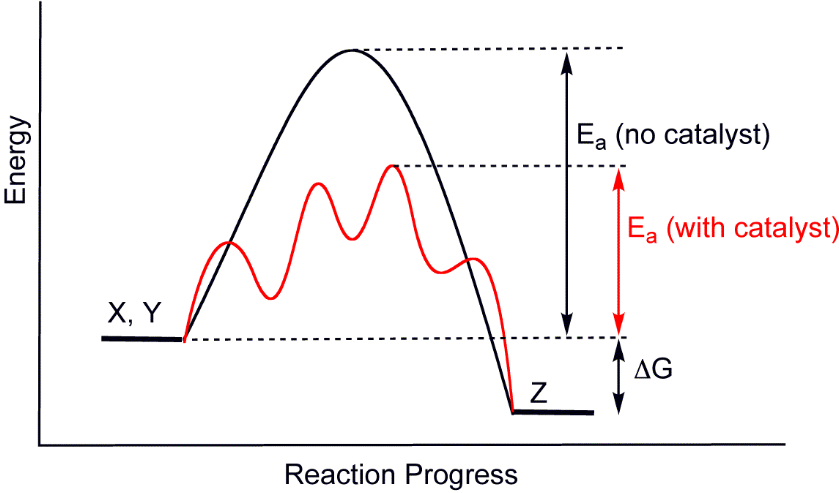
Which of the following statements regarding catalyst is not true?
  • A
    A catalyst remains uncharged in composition and quantity at the end of the reaction.
  • A catalyst can initiate a reaction.
  • C
    A catalyst does not alter the equilibrium in a reversible reaction.
  • D
    Catalysts are sometimes very specific in respect of reaction.
Answer
Correct option: B.
A catalyst can initiate a reaction.
A catalyst is a substance, which increases the rate of reaction without itself being consumed at the end of the reaction, and the phenomenon is called catalysis. There are some catalysts which decrease the rate of reaction and such catalysts are called negative catalyst. Obviously, the catalyst accelerating the rate will be positive catalyst. However, the term positive is seldom used and catalyst itself implies positive catalyst. Catalysts are generally foreign substances but sometimes one of the product formed may act as a catalyst and such a catalyst is called "auto catalyst" and the phenomenon is called auto catalysis.
View full question & answer
MCQ 31 Mark
Cow milk, an example of natural emulsion is stabilised by:
  • A
    Fat.
  • B
    Water.
  • Casein.
  • D
    $Mg^{2+}$ ions.
Answer
Correct option: C.
Casein.
View full question & answer
MCQ 41 Mark
The stabilizer used in the preparation of colloidal sol of mercury and sulphur is:
  • A
    An ammonium salt.
  • B
    A citrate.
  • C
    $\text{KOH}.$
  • Both $A$ and $B.$
Answer
Correct option: D.
Both $A$ and $B.$
A colloidal solution of certain elements such as mercury and sulphur are obtained by passing their vapours through cold water containing a stabilizer $($an ammonium salt or a citrate$).$
View full question & answer
MCQ 51 Mark
An example of autocatalytic reaction is:
  • Decomposition of nitroglycerine.
  • B
    Thermal decomposition of $\mathrm{KClO}_3$ and $\mathrm{MnO}_2$ mixture.
  • C
    Breakdown of ${ }^{14} \mathrm{C}_6$
  • D
    Hydrogenation of vegetable oil using nickel catalysts.
Answer
Correct option: A.
Decomposition of nitroglycerine.
A chemical reaction is called autocatalytic if at least one of the reaction products acts as a catalyst in the same or in one of the coupled reactions. $\mathrm{N}_2$ is one of the products of decomposition of nitroglycerine plays the role of an autocatalyst.
View full question & answer
MCQ 61 Mark
Cleansing action of soap occurs because:
  • Oil and grease can be absorbed into the hydrophobic centres of soap micelles and washed away.
  • B
    Oil and grease can be absorbed into hydrophilic centres of soap micelles and washed away.
  • C
    Oil and grease can be absorbed into both hydrophilic and hydrophobic centres but cannot be washed away.
  • D
    Cleansing action is not related to micelles.
Answer
Correct option: A.
Oil and grease can be absorbed into the hydrophobic centres of soap micelles and washed away.
View full question & answer
MCQ 71 Mark
Soft soaps are:
  • A
    Sodium salts of fatty acids.
  • B
    Potassium salts of fatty acids, containing excess of free alkali.
  • Potassium salts of fatty acids, containing no free alkali.
  • D
    Calcium salts of fatty acids.
Answer
Correct option: C.
Potassium salts of fatty acids, containing no free alkali.
Potassium salts of fatty acids, containing no free alkali, are called soft soaps.
View full question & answer
MCQ 81 Mark
What is a sol?
  • A solid dispersed in a liquid.
  • B
    A liquid dispersed in a gas.
  • C
    A gas dispersed in a liquid.
  • D
    A gas dispersed in a solid.
Answer
Correct option: A.
A solid dispersed in a liquid.
Sol is a colloidal suspension when a solid is dispersed in a liquid.
An example of sol is a gel, blood, paint, etc.
A liquid is dispersed in a gas called aerosols.
A gas dispersed in liquid or solid called foam.
View full question & answer
MCQ 91 Mark
The moles of $\text{HCl}$ required to neutralise left $NH_3$​ solution after adsorption is:
  • A
    $0.123$
  • $0.175$
  • C
    $0.145$
  • D
    $0.153$
Answer
Correct option: B.
$0.175$
Total moles of $NH_3$​ adsorbed on surface$=\frac{1.415\times10^{22}}{6.023\times10^{23}}=0.0235$
Moles of $NH_3$ before adsorption$=\frac{100\times2}{1000}=0.2.$
So, moles of $NH_3$ left after adosrption $=$ moles of $\text{HCl}$ required $= 0.2 − 0.0235 = 0.175.$
View full question & answer
MCQ 101 Mark
Burning of coal is represented as $\mathrm{C}(\mathrm{s})+\mathrm{O}_2(\mathrm{\sim g}) \rightarrow \mathrm{CO}_2(\mathrm{\sim g})$ The rate of this reaction is increased by:
  • A
    Decreasing in the concentration of oxygen.
  • Powdering the lumps of coal.
  • C
    Decreasing the temperature of coal.
  • D
    Providing inert atmosphere.
Answer
Correct option: B.
Powdering the lumps of coal.
$\text{FACTORS AFFECTING THE RATE OF REACTION}:$
$(i)$ Concentration: Law of mass action enunciates that greater is the conc. of the reactants, the more rapidly the reaction proceeds.
$(ii)$ Pressure $($Gaseous reaction$):$ On increasing the pressure, volume decreases and conc. increases and hence the rate increases.
$(iii)$ Temperature: It is generally observed that rise in temperature increases the reaction rate.
$(iv)$ Nature of the reactants: The rate depends upon specific bonds involved and hence on the nature of reactants.
$(v)$ Surface area of the reactants: In heterogeneous reactions, more powdered is the form of reactants, more is the velocity$. [$as more active centres are provided$]$
View full question & answer
MCQ 111 Mark
Which of the following is incorrect for physisorption?
  • A
    Reversible.
  • Increases with increase in temperature.
  • C
    Low heat of adsorption.
  • D
    Increases with increase in surface area.
Answer
Correct option: B.
Increases with increase in temperature.
Since the adsorption process is exothermic, the physical adsorption occurs readily at low temperature and decreases with increase in temperature $($Le$-$Chatelier's principle$).$
View full question & answer
MCQ 121 Mark
Which of the following is not a favourable condition for physical adsorption?
  • A
    High pressure.
  • B
    Negative $\triangle\text{H}$
  • C
    Higher critical temperature of adsorbate.
  • High temperature.
Answer
Correct option: D.
High temperature.
High temperature is not favourable for physical adsorption since it is an exothermic process.
View full question & answer
MCQ 131 Mark
Which metal is used as a catalyst in the hydrogenation of oils?
  • A
    Iron
  • B
    Sodium
  • Nickel
  • D
    Gold
Answer
Correct option: C.
Nickel
Raney Nickel is used as a catalyst in the hydrogenation of oils.Hydrogenation $–$ to treat with hydrogen $–$ is a chemical reaction between molecular hydrogen $(H_2)$ and another compound or element, usually in the presence of a catalyst such as nickel, palladium or platinum. The process is commonly employed to reduce or saturate organic compounds.
View full question & answer
MCQ 141 Mark
Freshly prepared precipitate sometimes gets converted to colloidal solution by $........$
  • A
    Coagulation.
  • B
    Electrolysis.
  • C
    Diffusion.
  • Peptisation.
Answer
Correct option: D.
Peptisation.
Peptisation is the process of converting freshly prepared precipitate into colloid.
View full question & answer
MCQ 151 Mark
The emulsifying agent used in $o/ w$ emulsion is:
  • Protein.
  • B
    Long chain alcohol.
  • C
    Lampblack.
  • D
    Heavy metal salts of fatty acids.
Answer
Correct option: A.
Protein.
The emulsifying agent used in oil in water emulsion is protein. Milk is an example of oil in water emulsion. It consists of liquid fat dispersed in water. Milk proteins act as an emulsifying agent.
View full question & answer
MCQ 161 Mark
To which of the following category does ice-cream belong?
  • A
    Solution.
  • Emulsion.
  • C
    Element.
  • D
    Suspension.
Answer
Correct option: B.
Emulsion.
An emulsion is a colloid of two or more immiscible liquids where one liquid contains a dispersion of the other liquids. In other words, an emulsion is a special type of mixture made by combining two liquids that normally don't mix.
Oil and water mixtures are emulsions when shaken together. The oil will form drops and disperse throughout the water.
View full question & answer
MCQ 171 Mark
The catalyst used in making $\mathrm{H}_2 \mathrm{SO}_4$​ in contact process is:
  • $ \mathrm{V}_2 \mathrm{O}_5 $
  • B
    $ \mathrm{Fe}_2 \mathrm{O}_3 $
  • C
    $ \mathrm{Cr}_2 \mathrm{O}_3 $
  • D
    $ \mathrm{CrO}_3 $​
Answer
Correct option: A.
$ \mathrm{V}_2 \mathrm{O}_5 $
The contact process is the current method of producing sulfuric acid in the high concentrations needed for industrial processes. Platinum used to be the catalyst for this reaction. However, as it is susceptible to reacting.
View full question & answer
MCQ 181 Mark
The catalyst used in preparation of oxygen from hydrogen peroxide is:
  • Manganese dioxide.
  • B
    Agnesium oxide.
  • C
    Manganese oxide.
  • D
    Manganese sulphate.
Answer
Correct option: A.
Manganese dioxide.
Manganese dioxide lowers the activation energy which makes the reaction of decomposition of hydrogen peroxide to oxygen fast. It allows more molecules of $H_2​O_2$ to undergo decomposition in a shorter period of time.
Balanced chemical equation of reaction is:
$2\text{H}_2​\text{O}_2​(\text{aq})\rightarrow{\text{MnO}_2​(\text{s})}​2\text{H}_2\text{​O(l)+O}_2​(\text{g})$
View full question & answer
MCQ 191 Mark
An emulsifier is a substance:
  • which stabilises an emulsion.
  • B
    which breaks the emulsion into its constituent liquids.
  • C
    which can convert liquid into an emulsion.
  • D
    which bring about coagulation of an emulsion.
Answer
Correct option: A.
which stabilises an emulsion.
An emulsifier is a substance that acts as a stabilizer in an emulsion and prevents the mixing of two solutions.
An emulsifier has a water$-$loving hydrophilic head and an oil$-$loving hydrophobic tail.
The hydrophilic head is for the aqueous phase and the hydrophobic tail is for the oil phase.
e.g. lecithin.
View full question & answer
MCQ 201 Mark
The efficiency of an enzyme in catalyzing a reaction is due to its capacity $.......$
  • A
    To form a strong enzyme$-$substrate complex.
  • B
    To decrease the bond energy of all substrate molecules.
  • C
    To change the shape of the substrate molecule.
  • To lower the activation energy of the reaction.
Answer
Correct option: D.
To lower the activation energy of the reaction.
A catalyst is a substance, which increases the rate of reaction without itself being consumed at the end of the reaction, and the phenomenon is called catalysis. There are some catalysts which decrease the rate of reaction and such catalysts are called negative catalyst. Obviously, the catalyst accelerating the rate will be positive catalyst. However, the term positive is seldom used and catalyst itself implies positive catalyst. Enzymes acts as catalyst for biological process and lower activation energy and it increases efficiency.
View full question & answer
MCQ 211 Mark
The process of passing of a precipitate into colloidal solution, on adding an electrolyte is called:
  • A
    Dialysis.
  • Peptization.
  • C
    Electrophoresis.
  • D
    Electrosmosis.
Answer
Correct option: B.
Peptization.
The process of formation or conversion of a precipitate into a colloidal solution is called peptisation.
View full question & answer
MCQ 221 Mark
The values of colligative properties of colloidal solution are of small order in comparison to those shown by true solutions of same concentration because of colloidal particles $.......$
  • A
    Exhibit enormous surface area.
  • B
    Remain suspended in the dispersion medium.
  • C
    Form lyophilic colloids.
  • Are comparatively less in number
Answer
Correct option: D.
Are comparatively less in number
Colloidal particles being bigger aggregates, the number of particles in a colloidal solution is comparatively small as compared to a true solution. Hence, the values of colligative properties $($osmotic pressure, lowering in vapour pressure, depression in freezing point and elevation in boiling point$)$ are of small order as compared to values shown by true solutions at same concentration.
View full question & answer
MCQ 231 Mark
Hydrophobic is another name for a substance which:
  • A
    Bonds weakly to oil.
  • Bonds weakly to water.
  • C
    Repels oil.
  • D
    Attracts water.
Answer
Correct option: B.
Bonds weakly to water.
Hydrophobic is another name for a substance which bonds weakly to water. Hydrophobic means " water fearing". These compounds do not dissolve easily in water, and are usually non$-$polar. Oils and other long hydrocarbons are hydrophobic.
View full question & answer
MCQ 241 Mark
The substance added to increase the stability of a lyophobic sol are called:
  • A
    Promoters.
  • Stabilizers.
  • C
    Inhibitors.
  • D
    Poison.
Answer
Correct option: B.
Stabilizers.
Stabilizers are the substance that are added in lyophobic sols to increase their stability.
Examples of stabilizers are an ammonium salt and a citrate.
View full question & answer
MCQ 251 Mark
The physical adsorption of gases on the solid surface is due to:
  • A
    Covalent bond.
  • B
    Hydrogen bond.
  • C
    Ionic bond.
  • Van der wal's force.
Answer
Correct option: D.
Van der wal's force.
When the force of attraction existing between adsorbate and adsorbent are weak Vanderwaal forces of attraction, the process is called Physical Adsorption or Physisorption. When the force of attraction existing between adsorbate and adsorbent are chemical forces of attraction or chemical bond, the process is called Chemical Adsorption.
View full question & answer
MCQ 261 Mark
Which of the following process is not responsible for the presence of electric charge on the sol particles?
  • A
    Electron capture by sol particles.
  • B
    Adsorption of ionic species from solution.
  • C
    Formation of Helmholtz electrical double layer.
  • Absorption of ionic species from solution.
Answer
Correct option: D.
Absorption of ionic species from solution.
The charge on the sol particles is due to one or more reasons, Viz.,
  1. Due to electron capture by sol particles during electro dispersion of metals.
  2. Due to preferential adsorption of ions from solution and/or.
  3. Due to formulation of electrical double layer.
View full question & answer
MCQ 271 Mark
On the basis of data given below predict which of the following gases shows least adsorption on a definite amount of charcoal?
Gas $\text{CO}_2$ $\text{SO}_2$ $\text{CH}_4$ $\text{H}_2$
Critical temp$./K$ $304$ $630$ $190$ $33$
  • A
    $\text{CO}_2$
  • B
    $\text{SO}_2$
  • C
    $\text{CH}_4$
  • $\text{H}_2$
Answer
Correct option: D.
$\text{H}_2$
The lesser the value of critical temperature of gases the lesser will be the extent of adsorption. Here $H_2$ has lowest value of critical temperature, i.e.$, 33.$
Hence, hydrogen gas shows least adsorption on a definite amount of charcoal.
View full question & answer
MCQ 281 Mark
Tanning of leather is the:
  • A
    Colouring of leather by chemicals.
  • B
    Drying process to make the leather hard.
  • C
    Polishing of leather to make it look attractive.
  • Coagulative hardening of the leather by chemicals.
Answer
Correct option: D.
Coagulative hardening of the leather by chemicals.
Tanning is the process that converts the protein of the raw hide or skin into a stable material which will not putrefy and is suitable for a wide variety of end applications. The principal difference between raw hides and tanned hides is that raw hides dry out to form a hard inflexible material that can putrefy when re$-$wetted $($wetted back$),$ while tanned material dries out to a flexible form that does not become putrid when wetted back. A large number of different tanning methods and materials can be used. The choice is ultimately dependent on the end application of the leather. The most commonly used tanning material is chromium, which leaves the leather, once tanned, a pale blue colour $($due to the chromium$),$ this product is commonly called wet blue.
View full question & answer
MCQ 291 Mark
Which of the following rules states that with the increase of every $10^\circ$C temperature the rate of metabolic activity gets doubled?
  • Van't Hoff's rule.
  • B
    Bergman's rule.
  • C
    Allen's rule.
  • D
    Jordon's rule.
Answer
Correct option: A.
Van't Hoff's rule.
Van't Hoff's rule states that the velocity or the metabolic activity is doubled for every rise of $10^\circ$C in temperature.
Bergmann's rule states that species of larger size are found in colder environments and species of smaller size are found in warmer environments.
Allen's rule states that body form is linear in warm climates and more rounded and compact in cold climates. Round body shapes give a smaller surface area to volume ratio.
Jordon's rule states that fin ray, vertebrae or scale numbers increase with the decrease in temperature.
View full question & answer
MCQ 301 Mark
Peptization is a process of:
  • A
    Recipitating colloidal particles.
  • B
    Purifying colloidal particles.
  • Dispersing the precipitate into colloidal state.
  • D
    None of the above.
Answer
Correct option: C.
Dispersing the precipitate into colloidal state.
Peptization is a process of passing of a precipitate into colloidal particles on adding suitable electrolyte. The electrolyte added is known as peptizing agent.
For example: A reddish brown colored colloidal solution is obtained by adding small quantity of ferric chloride solution to the freshly precipitated ferric hydroxide.
View full question & answer
MCQ 311 Mark
Gelatin is often used as an ingredient in the manufacture of ice$-$cream. The reason for this is:
  • A
    To prevent the formation of a colloid.
  • To stabilize the colloid and prevent crystal growth.
  • C
    To cause the mixture to solidify.
  • D
    To improve the flavour.
Answer
Correct option: B.
To stabilize the colloid and prevent crystal growth.
Gelatin is a translucent, colourless, brittle $($when dry$),$ flavourless foodstuff derived from collagen obtained from various animal by$-$products. It is commonly used as a gelling agent in food, pharmaceuticals. Substances containing gelatin or functioning in a similar way are called gelatinous. Gelatin is an irreversibly hydrolyzed form of collagen. It is often used as an ingredient in the manufacture of ice$-$cream to stabilize the colloid and prevent crystal growth and works as protective colloid.
View full question & answer
MCQ 321 Mark
Extent of physisorption of a gas increases with $........$
  • A
    Increase in temperature.
  • Decrease in temperature.
  • C
    Decrease in surface area of adsorbent.
  • D
    Decrease in strength of van der Waals forces.
Answer
Correct option: B.
Decrease in temperature.
Since the adsorption $($Solid $+$ Gas $=$ Gas/ Solid $+$ Heat$)$ process is exothermic, the physical adsorption occurs readily at low temperature and decreases with increasing temperature as the equilibrium will shift in backward direction$. ($Le$-$Chatelier’s principle$)$
View full question & answer
MCQ 331 Mark
Freundlich adsorption isotherm is given by the expression $\frac{\text{x}}{\text{m}}=\text{k}\ \text{p}^\frac{1}{\text{n}}$ which of the following conclusions can be drawn from this expression.
$a.$ When $\frac{1}{\text{n}}=0,$ the adsorption is independent of pressure.
$b.$ When $\frac{1}{\text{n}}=0,$ the adsorption is directly proportional to pressure.
$c.$ When $\text{n}=0,\ \frac{\text{x}}{\text{m}}\ vs\ p$ graph is a line parallel to $x-$axis.
$d.$ When $\text{n}=0,$ plot of $\frac{\text{x}}{\text{m}}\ vs\ p$ is a curve.
  • $a$ and $c$
  • B
    $a$ and $b$
  • C
    $b$ and $d$
  • D
    $a$ and $d$
Answer
Correct option: A.
$a$ and $c$
$(\text{a},\text{c})\frac{\text{x}}{\text{m}}=\text{k}\ \text{p}^\frac{1}{\text{n}}$
Whan $\frac{1}{\text{n}}=0,\ \frac{\text{x}}{\text{m}}=$ constant, the adsorption is indendent of the pressure.
When $\text{n}=0,\frac{\text{x}}{\text{m}}$ versus $p$ graph is a line parallel to $x-$axis
View full question & answer
MCQ 341 Mark
Rate of physisorption increases with:
  • Decrease in temperature.
  • B
    Increase in temperature.
  • C
    Decrease in pressure.
  • D
    Decrease in surface area.
Answer
Correct option: A.
Decrease in temperature.
The rate of physisorption is inversely proportional to temperature. The rate of physisorption increases with the decrease in temperature as it is an exothermic process.
View full question & answer
MCQ 351 Mark
In physisorption adsorbent does not show specificity for any particular gas because $......$
  • Involved van der Waals forces are universal.
  • B
    Gases involved behave like ideal gases.
  • C
    Enthalpy of adsorption is low.
  • D
    It is a reversible process.
Answer
Correct option: A.
Involved van der Waals forces are universal.
Physisorption is not specific to any gas since it involves van der Waals forces and no specific bonds are formed.
View full question & answer
MCQ 361 Mark
Cod liver is an example of:
  • A
    Oil emulsion.
  • B
    Oil in water emulsion.
  • Water in oil emulsion.
  • D
    Water in water emulsion.
Answer
Correct option: C.
Water in oil emulsion.
The emulsion in which water forms the dispersed phase, and the oil acts as the dispersion medium is called a water$-$in$-$oil emulsion. These emulsions are also termed oil emulsions. Butter and cold cream are typical examples of these types of emulsions. Other examples are cod liver oil etc.
Cod liver oil is a dietary supplement derived from liver of cod fish. As with most fish oils, it contains the omega$-3$ fatty acids eicosapentaenoic acid and docosahexaenoic acid.
View full question & answer
MCQ 371 Mark
The peptizing agent used in Peptization is a/ an:
  • A
    Stabilizer.
  • Electrolyte.
  • C
    Proton donor.
  • D
    Promoter.
Answer
Correct option: B.
Electrolyte.
Peptization is the process responsible for the formation of stable dispersion of colloidal particles in dispersion medium. In other words it may be defined as a process of converting a precipitate into colloidal sol by shaking it with dispersion medium in the presence of small amount of electrolyte. The electrolyte used in this process is called as peptizing agent.
View full question & answer
MCQ 381 Mark
Carbocation having more stability is:
  • A
    $1^\circ$ carbocation.
  • B
    $2^\circ$ carbocation.
  • $3^\circ$ carbocation.
  • D
    None.
Answer
Correct option: C.
$3^\circ$ carbocation.
View full question & answer
MCQ 391 Mark
Rate of physical adsorption increases with:
  • A
    Decrease in surface area.
  • Decrease in temperature.
  • C
    Decrease in pressure.
  • D
    All of the above.
Answer
Correct option: B.
Decrease in temperature.
View full question & answer
MCQ 401 Mark
Argyrol is a:
  • A
    Ferric oxide sol.
  • Silver sol.
  • C
    Gold sol.
  • D
    Arsenic sol.
Answer
Correct option: B.
Silver sol.
Argyrol is a silver sol and is used as an eye lotion.It is manufactured in the chemical industry to pharmaceutical grade only, using denatured pharmaceutical$-$grade protein for ophthalmic application and elemental silver, to produce the silver protein molecule.
View full question & answer
MCQ 411 Mark
On adding few drops of dilute $\text{HCl}$ or $\text{FeCl}_3$ to freshly precipitated ferric hydroxide, a red coloured colloidal solution is obtained. This phenomenon is known as:
  • Peptization.
  • B
    Dialysis.
  • C
    Protection.
  • D
    Dissolution.
Answer
Correct option: A.
Peptization.
The phenomenon of converting a freshly precipitated mass into colloidal state by the action of solute or solvent is known as peptization.
In biochemistry, dialysis is the process of separating molecules in solution by the difference in their rates of diffusion through a semi$-$permeable membrane, such as dialysis tubing.
Dissolution is the process by which a solute forms a solution in a solvent. The solute, in the case of solids, has its crystalline structure disintegrated as separate ions, atoms and molecules form.
View full question & answer
MCQ 421 Mark
Which of the following metals adsorb hydrogen?
  • A
    $Zn$
  • B
    $Pd$
  • $Pt$
  • D
    $K$
Answer
Correct option: C.
$Pt$
Platinum and Palladium adsorb hydrogen on its surface.Platinum and Palladium are nobel/ inert metals they do not react with hydrogen.
View full question & answer
MCQ 431 Mark
$H_2$ gas is adsorbed on activated charcoal to a very little extent in comparison to easily liquefiable gases due to $.......$
$a.$ Very strong van der Waal’s interaction.
$b.$ Very weak van der Waals forces.
$c.$ Very low critical temperature.
$d.$ Very high critical temperature.
  • A
    $a$ and $b$
  • B
    $a$ and $c$
  • $b$ and $c$
  • D
    $a$ and $d$
Answer
Correct option: C.
$b$ and $c$
$H_2$ molecule on an activated charcoal is adsorbed to a very little extent in comparison to easily liquefiable gases because it has
$(a)$ Very weak van der Waals force of attraction
$(b)$ Very low critical temperature
View full question & answer
MCQ 441 Mark
The cleansing action of soaps happens with the formation of micelles above the Critical Micelle Concentration. This occurs at:
  • Above Critical Micelle Temperature.
  • B
    Below Critical Micelle Temperature.
  • C
    Equal Critical Micelle Temperature.
  • D
    None of the above.
Answer
Correct option: A.
Above Critical Micelle Temperature.
A molecule of soap has two dissimilar ends. At one end is the hydrocarbon chain, which is water repellent and the other end is carboxylate anion which is polar end.
When soap is dissolved in water, many molecules come together and from a group called micelle. These micelles are formed because their hydrocarbon chains come together and the polar ends are projected outward.
When a Cloth with a spot of oil is soaked into a soap solution, soap dissolves tiny oil droplets by the hydrophobic end in the middle of the micelle. Due to the outer polar ends, these micelles dissolve in water and are washed away. In this way cloth gets cleaned.
View full question & answer
MCQ 451 Mark
Substances, which are added to soaps change their properties in order to make them more useful for a particular application, are called $.......$
  • Fillers.
  • B
    Absorbant.
  • C
    Reagent.
  • D
    None.
Answer
Correct option: A.
Fillers.
Substances, which are added to soaps change their properties in order to make them more useful for a particular application, are called fillers. Fillers make the soap harder, harsher on the skin and lower the cost.
View full question & answer
MCQ 461 Mark
The colour of the colloidal solution formed by combination of ferric chloride and freshly prepared ferric hydroxide is:
  • A
    Red.
  • Reddish$-$brown.
  • C
    Green.
  • D
    Grey.
Answer
Correct option: B.
Reddish$-$brown.
View full question & answer
MCQ 471 Mark
In the presence of a catalyst, the heat evolved or absorbed during the reaction:
  • A
    Increases.
  • B
    Decreases.
  • Remains unchanged.
  • D
    May increase or decrease.
Answer
Correct option: C.
Remains unchanged.
The enthalpy change value of the reaction will not be affected by a catalyst. A catalyst will only lower the required activation energy for the reactions. Since it will lower the activation energy for both the forward and reverse reactions to the same extent, the net change in enthalpy is zero.
View full question & answer
MCQ 481 Mark
Which on adding to freshly precipitated aluminium hydroxide and shaking produces sol of aluminium hydroxide?
  • A
    Insufficient quantity of conc $\text{HCl}.$
  • B
    Sufficient quantity of conc $\text{HCl}.$
  • Insufficient quantity of very dil $\text{HCl}.$
  • D
    Sufficient quantity of very dil $\text{HCl}.$
Answer
Correct option: C.
Insufficient quantity of very dil $\text{HCl}.$
On adding insufficient quantity of very dilute $\text{HCl}$ solution to the freshly precipitated aluminium hydroxide, a sol of aluminium hydroxide is obtained. When small amount of very dilute solution of $\text{HClHCl}$ is added to freshly precipitated aluminium hydroxid $\left(\mathrm{Al}(\mathrm{OH})_3,\left(\mathrm{Al}(\mathrm{OH})_3\right.\right.$, a colloidal solution of $\mathrm{Al}(\mathrm{OH})_3 \ \mathrm{Al}(\mathrm{OH})_3$ is obtained.
View full question & answer
MCQ 491 Mark
The heat of physisorption lie in the range of:
  • A
    $1$ to $10kJ\ mol^{-1}$
  • $20$ to $40kJ\ mol^{-1}$
  • C
    $40$ to $200kJ\ mol^{-1}$
  • D
    $200$ to $400kJ\ mol^{-1}$
Answer
Correct option: B.
$20$ to $40kJ\ mol^{-1}$
The heat of physisorption lie in the range of $20$ to $40kJ/ mol.$ The value is small as weak van der waals forces are involved. It has negative sign as the adsorption is an exothermic reaction.
View full question & answer
MCQ 501 Mark
True statement is:
  • A
    Positive catalyst increases the rate of reaction
  • B
    During the course of the reaction, specific reaction rate remains constant.
  • C
    Rate constant always increases with rise in temperature whether the reaction is endothermic or exothermic.
  • All are correct.
Answer
Correct option: D.
All are correct.
$(A)$ Positive catalyst increases the rate of reaction. It increases the rate of forward as well as reverse reaction. Hence, equilibrium is quickly attained.
$(B)$ During the course of the reaction, specific reaction rate remains constant. It is independent of the reactant concentration and varies only with temperature.
$(C)$ Rate constant always increases with rise in temperature whether the reaction is endothermic or exothermic. This is in accordance with Arrhenius equation which gives the temperature dependence of reaction rates.
View full question & answer
M.C.Q (1 Marks) - Chemistry STD 12 Science Questions - Vidyadip