Questions

2 Marks Questions

🎯

Test yourself on this topic

20 questions · timed · auto-graded

Question 12 Marks
Discuss comparison between Lathanoids and Actinoids.
Answer
→ The actinoid metals are all silvery in appearance but display a variety of structures. The structural variability is obtained due to irregularities in metallic radii which are far greater than in lanthanoids.
→ The magnetic properties of the actinoids are more complex than those of the lanthanoids.
→ It is evident from the behaviour of the actinoids that the ionization enthalpies of the early actinoids, though not accurately known, but are lower than for the early lanthanoids.
→ The stable oxidation state of all the lanthanoids is (+3). In actinoids, oxidation states (+2) to (+6) are seen.
→ In lanthanoids only promethium is radioactive but all the actinoids are radioactive.
View full question & answer
Question 22 Marks
Write down uses of lanthanoids and its compounds.
Answer
→ Use of the lanthanoids is for the production of alloy steels for plates and pipes.
→ A well known alloy is mischmetal which consists of a lanthanoid metal (~95%) and iron (~5%) and traces of S, C, Ca and Al.
→ A good deal of mischmetal is used in Mg-based alloy to produce bullets, shell and lighter flint.
→ Mixed oxides of lanthanoids are employed as catalysts in petroleum cracking.
→ Some individual Ln oxides are used as phosphors in television screens and similar fluorescing surfaces.
View full question & answer
Question 32 Marks
Write note on physical properties of Ianthanoids.
Answer
→ All the lanthanoids are silvery white soft metals and tarnish rapidly in air.
→ The hardness increases with increasing atomic number, samarium being steel hard.
→ Their melting points range between 1000 to 1200 K but samarium melts at 1623 K.
→ They have typical metallic structure and are good conductors of heat and electricity.
→ Density and other properties change smoothl except for Eu and Yb and occasionally for Str and Tm.
View full question & answer
Question 42 Marks
Write note on inner transition elements ### Write note on  f-Block element
Answer
→ The f-block consists of the two series, lanthanoids (the fourteen elements following lanthanum) and actinoids (the fourteen elements following actinium).
→ Because lanthanum closely resembles the lanthanoids, it is usually included in any discussion of the lanthanoids for which the general symbol Ln is often used.
→Similarly, a discussion of the actinides includes actinium besides the fourteen elements constituting the series.
→ The lanthanoids resemble one another more closely than do the members of ordinary transition elements in any series.
→ They have only one stable oxidation state and their chemistry provides an excellent opportunity to examine the effect of small changes in size and nuclear charge along a series of otherwise similar elements.
→ The chemistry of the actinoids is, on the other hand, much more complicated. The complication arises partly owing to the occurrence of a wide range of oxidation states in these elements and partly because their radioactivity creates special problems in their study.
View full question & answer
Question 52 Marks
Give the structure of chromate and dichromate ions, and explain interconvertible property of these ions.
Answer
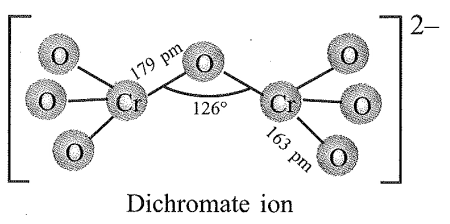
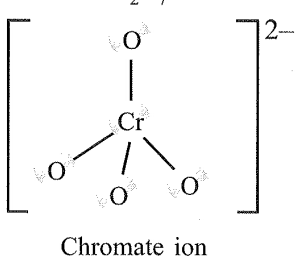
→ The structures of chromate ion, $CrO _4^{2-}$ and the dichromate ion, $Cr _2 O _7{ }^{2-}$ are shown below.
Image
Image
→ The chromate ion is tetrahedral whereas the dichromate ion consists of two tetrahedra sharing one corner with Cr - O - Cr bond angle of $126^{\circ}$.
→ The chromates and dichromates are interconvertible in aqueous solution depending upon pH of the solution. The oxidation state of chromium in chromate and dichromate is the same.
View full question & answer
Question 62 Marks
Discuss structures and magnetic properties of manganate and permanganate ions
Answer
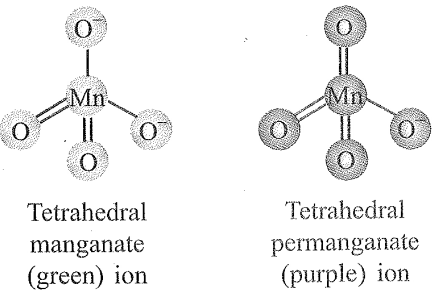
→ The manganate and permanganate ions are tetrahedral
Image
→ The green manganate is paramagnetic with one unpaired electron but the permanganate is diamagnetic.
→ The π-bonding takes place by overlap of p orbitals of oxygen with d orbitals of manganese.
View full question & answer
Question 72 Marks
Write down use of $KMnO_4$
Answer
$\rightarrow $ Potassium permanganate is used as a favourite oxidant in preparative organic chemistry.
$\rightarrow $ Its uses are for the bleaching of wool, cotton, silk and other textile fibres and for the decolourisation of oils are also dependent on its strong oxidising power.
$\rightarrow $ An aqueous solution of potassium permanganate is used for gargling to keep mouth germfree as it is antiseptic.
$\rightarrow $ It is useful as titrant in redox titrations to know the proportion of metal ions like iron $(II)$ and organic compounds like oxalic acid.
View full question & answer
Question 82 Marks
Write note on oxides and oxoanions of $3d$ transition metals.
Answer
$\rightarrow $ The ability of oxygen to stabilize the high oxidation states of metal than fluorine is higher because it forms a multiple bonds with a metal.
$\rightarrow $ The metal oxide in lower oxidation state is basic while in higher oxidation state are acidic.
$\rightarrow $ The metal oxides having metals in intermediate oxidation states are amphoteric.
e.g.
Acidic
oxide
Basic
oxide
Amphoteric
oxide
$\ce{Mn _2 O _7}$ $\ce{MnO}$ $\ce{Mn _3 O _4, Mn _2 O _3, MnO _2}$
  $\ce{CrO}$ $\ce{Cr _2 O _3}$
Oxides of $3d$ Metals
Oxidati on NUmber $3$ $4$ $5$ $6$ $7$ $8$ $9$ $10$ $11$ $12$
$+7$         $\ce{Mn _2 O _7}$          
$+6$       $\ce{CrO _3}$            
$+5$     $\ce{V _2 O _5}$              
$+4$   $\ce{TiO _2}$ $\ce{V _2 O _4}$ $\ce{CrO _2}$ $\ce{MnO _2}$          
$+3$ $\ce{Sc _2 O _3}$ $\ce{Ti _2 O _3}$ $\ce{V _2 O _3}$ $\ce{Cr _2 O _3}$ $ \ce{Mn _2 O _3}$
$\ce{Mn _3 O _4}^*$
$\ce{ Fe _2 O _3}$
$\ce{Fe _3 O _4}^*$
$Co _3 O _4{ }^*$      
$+2$   $\ce{TiO}$ $\ce{VO}$ $\ce{(CrO)}$ $\ce{MnO}$ $\ce{FeO}$ $\ce{CoO}$ $\ce{NiO}$ $\ce{CuO}$ $\ce{ZnO}$
$+1$           $\ce{Cu _2 O}$        
$*$ mixed oxides
$\rightarrow $ In the covalent oxide $\ce{Mn _2 O _7}$, each Mn is tetrahedrally surrounded by $O\ '$ s including a $\ce{Mn - O - Mn}$ bridge.
The tetrahedral $\left[\ce{ MO _4}\right]^{ n -}$ ions are known for $V ^{ V }, Cr ^{ VI }, Mn ^{ V }, Mn ^{ VI }$ and $Mn ^{ VII }$.
View full question & answer
Question 92 Marks
Explain Catalytic property of transition element.
Answer
$\rightarrow$ The transition metals and their compounds are known for their catalytic activity.
$\rightarrow$ This activity is ascribed to their ability to adopt multiple oxidation states and to form complexes.
$\rightarrow$ Vanadium $(V)$ oxide $($in Contact Process$),$ finely divided iron $($in Haber's Process$),$ and nickel $($in Catalytic Hydrogenation$)$ are some of the examples.
$\rightarrow$ Catalysts at a solid surface involve the formation of bonds between reactant molecules and atoms of the surface of the catalyst $($first row transition metals utilise $3d$ and $4s$ electrons for bonding$)$.
$\rightarrow$ This has the effect of increasing the concentration of the reactants at the catalyst surface and also weakening of the bonds in the reacting molecules $($the activation energy is lowering$)$.
$\rightarrow$ The Transition metal ions can change their oxidation states, they become more effective as catalysts.
$\rightarrow$ For example, iron $(III)$ catalyses the reaction between iodide and persulphate ions.
$2 I ^{-}+ S _2 O _8^{2-} \rightarrow I _2+2 SO _4^{2-}$
$\rightarrow$ An explanation of this catalytic action can be given as :
$2 Fe ^{3+}+2 I ^{-} \rightarrow 2 Fe ^{2+}+ I _2$
$2 Fe ^{2+}+ S _2 O _8^{2-} \rightarrow 2 Fe ^{3+}+2 SO _4^{2-}$
View full question & answer
Question 102 Marks
Why the tansition element form a large number of complex compounds ?
Answer
→ Complex compounds are those in which the metal ions bind a number of anions of neutral molecules giving complex species with characteristic properties.
→ A few examples are : $\left[ Fe ( CN )_6\right]^{3-},\left[ Fe ( CN )_6{ }]^{4-}\right.$, $\left[ Cu \left( NH _3\right)_4\right]^{2+}$ and $\left[ PtCl _4\right]^{2-}$.
→ The transition metals form a large number of complex compounds.
→ This is due to the comparatively smaller sizes of the metal ions. Their high ionic charges and the availability of d orbitals for bond formation.
View full question & answer
Question 112 Marks
Explain chemical reactivity of transition metals.
Answer
$\rightarrow$ Transition metals vary widely in their chemical reactivity.
$\rightarrow$ Many of them are sufficiently electropositive to dissolve in mineral acids, although a few are 'noble' $-$ that is, they are unaffected by simple acids.
$\rightarrow$ The metals of the first series with the exception of copper are relatively more reactive and are oxidised by $1M H+,$ though the actual rate at which these metals react with oxidising agents like hydrogen ion $(H+)$ is sometimes slow
$\rightarrow$ The $E^\circ$ values for $M^{2+}/M$ indicate a decreasing tendency to form divalent cations across the series
$\rightarrow$ This general trend towards less negative $E^\circ$ values is related to the increase in the sum of the first and second ionization enthalpies.
$\rightarrow$ It is interesting to note that the $E ^{\ominus}$ values for $Mn , Ni$ and $Zn$ are more negative than expected from the general trend.
$\rightarrow$ An examination of the $E ^{\ominus}$ values for the redox couple $M ^{3+} / M ^{2+}$ shows that $Mn ^{3+}$ and $Co ^{3+}$ ions are the strongest oxidising agents in aqueous solutions. The ions $Ti ^{2+}, V ^{2+}$ and $Cr ^{2+}$ are strong reducing agents and will liberate hydrogen from a dilute acid, e.g.,
$2 Cr ^{2+}( aq )+2 H ^{+}( aq )  \rightarrow  2 Cr ^{3+}( aq )+ H _2(g)$
View full question & answer
Question 122 Marks
Explain trends in $M^{2+}/M$ standard electrode potentials.
Answer
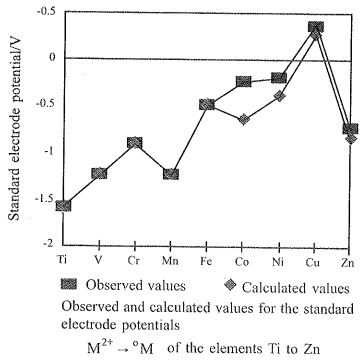
$\rightarrow$ An element in $M^{2+}$ state in aqueous medium is more stable if the electrode potential $(M^{2+}/M)$ value is more negative.
$\rightarrow$ The general trend towards less negative $ E^Θ$ values across the series is related to the general increase in the sum of the first and second ionization enthalpies.
$\rightarrow$ The unique behaviour of $Cu,$ having a positive $EV,$ accounts for its inability to liberate $H_2$ from acids. Only oxidising acids $($nitric and hot concentrated sulphuric$)$ react with $Cu,$ the acids being reduced.
Image
$\rightarrow$ It is interesting to note that the value of $EV$ for $Mn, Ni$ and $Zn$ are more negative than expected from the trend.
View full question & answer
Question 132 Marks
Write note on enthalpy of atomization of trasition metals.
Answer
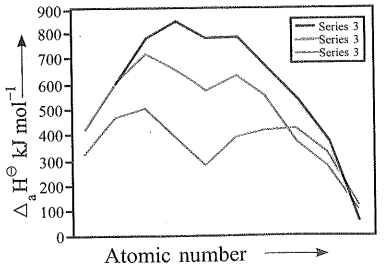
→ The transition elements have high enthalpy of atomization because of presence of strong bonds between the atoms.
→ The enthalpy of atomisation increases with the increase in number of unpaired electrons which results in formation of strong bonds due to strong interatomic interactions.
→ The metals of the second and third series have greater enthalpies of atomisation than the corresponding elements of the first series; this is an important factor in accounting for the occurrence of much more frequent metal - metal bonding in compounds of the heavy transition metals.
Image
View full question & answer
Question 142 Marks
Why the tansition elements are hard and have high melting and boiling points?
Answer
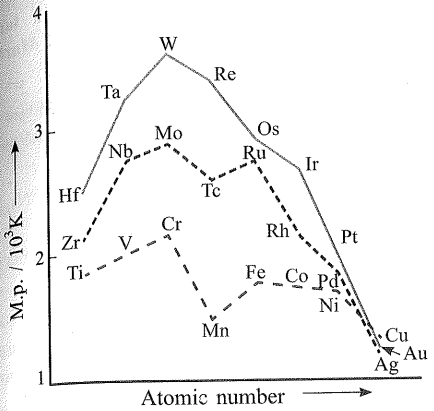
$\rightarrow$ The high melting points of these metals are attributed to the involvement of greater number of electrons from $(n-1)d$ in addition to the ns electrons in the interatomic metallic bonding.
$\rightarrow$ In any row the melting points of these metals rise to a maximum at $d^5$ except for anomalous values of $Mn$ and $Te$ and fall regularly as the atomic number increases.
Image
Trends in melting points of transition elements
$\rightarrow$ $Zn, Cd,$ and $Hg$ are soft and volatile and they have low melting point because all these elements have no unpaired electrons.
View full question & answer
Question 152 Marks
Explain physical properties of transition elements.
Answer
ty → All the transition elements are metallic element.
→ All the transition metals have high tensile strength, ductility, malleability, high thermal and electrical conductivity and metallic lustre.
→ With the exceptions of Zn. Cd. Hg and Mn, they have one or more typical metallic structures at normal temperatures.
ScTiVCrMnFeCoNiCuZn
hcp (bcc)hcp
(bcc)
bccbcc (bcc,ccp)X
(hcp)
bcc (hcp)ccpccpccpX
(hcp)
YZrNbMoTeRuRhPdAgCd
hcp
(bcc)
hcp (bcc)bccbcchcphcpccpccpccpX
(hcp)
LaHfTaWReOsIrPtAuHg
hcp (ccp,bcc)hcp (bcc)bccbcchcphcpccpccpccpX
(bcc body centred cubic; hcp = hexagonal close packed;
ccp = cubic close packed; X = a typical metal structure).
→ The transition metals (with the exception of Zn, Cd and Hg) are very much hard and have low volatility.
→ Their melting and boiling points are high.
View full question & answer
Question 162 Marks
Why the chromium and copper have exceptional electronic configuration?
Answer
→ There is little energy difference between (n-1)d and ns orbitals.
Furthermore, half and completely filled sets of orbitals are relatively more stable.
→ A consequence of this factor is reflected in the electronic configurations of Cr and Cu in the 3d series.
→In case of Cr
${ }_{24} Cr :[ Ar ] 3 d^5 4 s^1$ instead of $[ Ar ] 3 d^4 4 s^2$
→ The energy gap between the two sets (3d and 4s) of orbitals is small enough to prevent electron entering the 3d orbitals.
→ Similarly in case of Cu,
${ }_{29} Cu :[ Ar ] 3 d^{10} 4 s^1$ instead of $[ Ar ] 3 d^9 4 s^2$
View full question & answer
Question 172 Marks
Explain position of d-Block in periodic table.
Answer
→ The d-block occupies the large middle section flanked by s- and p-blocks in the periodic table.
→ The name 'transition' given to the elements of d-block is only because of their position between s- and p-block elements, and their properties is transition between s and p block elements.
→ The d-orbitals of the penultimate energy in their atoms receive electrons giving rise the three rows of the transition metals, ie., 3d, 4d and 5d.
→ The fourth row of 6d is still incomplete.
View full question & answer
Question 182 Marks
What is f-block element?
Answer
→ The element in which last electron fill in f-orbital is known as f-block element.
→ f-block element is known as inner transition element.
→ The elements constituting the f-block are those in which the 4f and 5f orbitals progressively filled.
→ The two series of the inner transition metals, (4f and 5f) are known as lanthanoids and actinoids respectively.
View full question & answer
Question 192 Marks
What is transition element? Explain with example.
Answer
$\rightarrow$ Transition element is defined as the one which has incompletely filled d orbitals in its ground state or in any one of its oxidation states.
$\rightarrow$ Zinc, cadmium and mercury of group $12$ have full $d^{10}$ configuration in their ground state as well as in their common oxidation states and hence, are not regarded as transition metals
${ }_{30} Zn :[ Ar ] 3 d^{10} 4 s^2 \ \ \ \ \ \ Zn ^{+2}:[ Ar ] 3 d^{10}$
${ }_{48} Cd :[ Kr ] 4 d^{10} 5 s^2 \ \ \ \ \ \ Cd ^{+2}:[ Ar ] 4 d^{10}$
${ }_{80} Hg :[ Xe ] 4 f^{14} \ 5 d^{10}\ 6 s^2 \ Hg ^{+2}:[ Xe ] 4 f^{14} 5 d^{10}$
View full question & answer
Question 202 Marks
What is d-block element? Explain classification of d-block element?
Answer
→ The d-block of the periodic table contains the elements of the groups 3-12 in which the d orbitals are progressively filled in each of the four long periods.
→ The name transition metals is often used to refer to the elements of d-block
→ There are mainly three series of the transition metals, 3d series (Sc to Zn), 4d series (Y to Cd) and 5d series (La and Hf to Hg).
→ The fourth 6d series which begins with Ac is still incomplete.
View full question & answer