Question 11 Mark
Write the formula of the compound of iodine which is obtained when conc. $\mathrm{HNO}_3$ oxidises $\mathrm{I}_2$.
View full question & answer→Question 21 Mark
Why does $NH_3$ act as a Lewis base?
Answer$NH_3$ can donate its lone pair of electrons.
View full question & answer→Question 31 Mark
Write the formula of the compound of sulphur which is obtained when conc. $\mathrm{HNO}_3$ oxidises $\mathrm{S}_8$.
Answer$\mathrm{H}_2 \mathrm{SO}_4$
View full question & answer→Question 41 Mark
$Pb(NO_3)_2$ on heating gives a brown gas which undergoes dimerization on cooling? Identify the gas.
View full question & answer→Question 51 Mark
Write the formulae of any two oxoacids of phosphorus.
Answer$ \mathrm{H}_3 \mathrm{PO}_2, \mathrm{H}_3 \mathrm{PO}_3, \mathrm{H}_4 \mathrm{P}_2 \mathrm{O}_5, \mathrm{H}_4 \mathrm{P}_2 \mathrm{O}_6, \mathrm{H}_3 \mathrm{PO}_4, \mathrm{H}_4 \mathrm{P}_2 \mathrm{O}_7, \mathrm{H}_3 \mathrm{PO}_5, \mathrm{H}_4 \mathrm{P}_2 \mathrm{O}_8,\left(\mathrm{HPO}_3\right)_3 $
$ \left(\mathrm{HPO}_3\right) \mathrm{n}$
View full question & answer→Question 61 Mark
Write the formula of the compound of phosphorus which is obtained when conc. $\mathrm{HNO}_3$ oxidises $\mathrm{P}_4$.
Answer$\mathrm{H}_3 \mathrm{PO}_4$.
View full question & answer→Question 71 Mark
What is the basicity of $\mathrm{H}_3 \mathrm{PO}_3$ ?
View full question & answer→Question 81 Mark
Name two poisonous gases which can be prepared form chlorine gas.
AnswerPhosgene gas $\left(\mathrm{COCl}_2\right)$, Cholorpicrin (or tear gas) $\left(\mathrm{CCl}_2 \mathrm{NO}_2\right)$, Mustard gas $\left(\mathrm{ClCH}_2 \mathrm{CH}_2 \mathrm{SCH}_2 \mathrm{CH}_2 \mathrm{Cl}\right)$.
View full question & answer→Question 91 Mark
Which is a stronger reducing agent, $\mathrm{SbH}_3$ or $\mathrm{BiH}_3$, and why?
Answer$\mathrm{BiH}_3$, because the stability of hydrides decreases on moving from $\mathrm{SbH}_3$ to $\mathrm{BiH}_3$.
View full question & answer→Question 101 Mark
Fluorine does not exhibit any positive oxidation state. Why?
AnswerBecause Fluorine is the most electronegative element.
View full question & answer→Question 111 Mark
Why is red phosphorus less reactive than white phosphorus?
AnswerDue to its polymeric structure, red phosphorus is much less reactive than white phosphorus or white phosphorus is under strain.
View full question & answer→Question 121 Mark
Why is the bond angle in $\mathrm{PH}_3$ molecule lesser than that in $\mathrm{NH}_3$ molecule?
AnswerBecause of decrease in $\mathrm{sp}^3$ hybridization character from $\mathrm{NH}_3$ to $\mathrm{PH}_3$.
View full question & answer→Question 131 Mark
Arrange the following hydrides of Group-16 elements in the decreasing order of their reducing character :
$\mathrm{H}_2 \mathrm{O}, \mathrm{H}_2 \mathrm{~S}, \mathrm{H}_2 \mathrm{Se}, \mathrm{H}_2 \mathrm{Te}$
Answer$\mathrm{H}_2 \mathrm{Te}>\mathrm{H}_2 \mathrm{Se}>\mathrm{H}_2 \mathrm{~S}>\mathrm{H}_2 \mathrm{O}$
View full question & answer→Question 141 Mark
On heating Cu turnings with conc. $\mathrm{HNO}_3$, a brown coloured gas is evolved which on cooling dimerises. Identify the gas.
Answer$\mathrm{NO}_2$ gas
View full question & answer→Question 151 Mark
Arrange the following hydrides of Group-16 elements in the decreasing order of their acidic strength:
$\mathrm{H}_2 \mathrm{O}, \mathrm{H}_2 \mathrm{~S}, \mathrm{H}_2 \mathrm{Se}, \mathrm{H}_2 \mathrm{Te}$
Answer$\mathrm{H}_2 \mathrm{Te}>\mathrm{H}_2 \mathrm{Se}>\mathrm{H}_2 \mathrm{~S}>\mathrm{H}_2 \mathrm{O}$
View full question & answer→Question 161 Mark
On adding NaOH to ammonium sulphate, a colourless gas with pungent odour is evolved which forms a blue coloured complex with $\mathrm{Cu}^{2+}$ ion. Identify the gas.
View full question & answer→Question 171 Mark
Arrange the following in increasing order of basic strength:
$\mathrm{C}_6 \mathrm{H}_5 \mathrm{NH}_2, \mathrm{C}_6 \mathrm{H}_5 \mathrm{NHCH}_3, \mathrm{C}_6 \mathrm{H}_5 \mathrm{~N}\left(\mathrm{CH}_3\right)_2$
Answer$\mathrm{C}_6 \mathrm{H}_5 \mathrm{NH}_2<\mathrm{C}_6 \mathrm{H}_5 \mathrm{NHCH}_3<\mathrm{C}_6 \mathrm{H}_5 \mathrm{~N}\left(\mathrm{CH}_3\right)_2$.
View full question & answer→Question 181 Mark
Arrange the following in increasing order of basic strength:
$C_6H_5NH_2, C_6H_5NHCH_{3,} C_6H_5CH_2NH_2$
Answer$C_6H_5NH_2< C_6H_5NH – CH_3< C_6 H_5 – CH_2 – NH_{2}.$
View full question & answer→Question 191 Mark
What is the basicity of $H_3PO_4?$
View full question & answer→Question 201 Mark
What is the covalency of nitrogen in $N_2O_5?$
View full question & answer→Question 211 Mark
Which one of ${PCl^+}_4$ and ${PCl^–}_4$ is not likely to exist and why?
Answer${PCl^–}_4$, because P has 10 electrons which cannot be accommodated in $sp^3$ hybrid orbitals.
View full question & answer→Question 221 Mark
Draw the structure of $XeF_2$ molecule.
View full question & answer→Question 231 Mark
Why does $NO_2$ dimerise?
AnswerBecause $NO_2$ contains odd number of valence electrons and on dimerisation it is converted to stable $N_2O_4$ molecule with even number of electrons.
View full question & answer→Question 241 Mark
Why is Bi(v) a stronger oxidant than Sb(v)?
AnswerDue to “inert pair effect” or because lower oxidation state becomes more stable for Bi than Sb.
View full question & answer→Question 251 Mark
Give reason for the following:
$CN^-$ ion is known but $CP^-$ ion is not known.
AnswerNitrogen being smaller in size forms $\text{p}\pi-\text{p}\pi$ multiple bonding with carbon, so $CN^-$ ion is known, but phosphorus does not form $\text{p}\pi-\text{p}\pi$ bond as it is larger in size.
View full question & answer→Question 261 Mark
Explain why fluorine forms only one oxoacid, HOF.
AnswerCl, Br and I form four series of oxo acids of general formula HOX, HOXO, HOXO2 and $HOXO_3$. In these oxo-adds, the oxidation states of halogens are +1, +3, +5, and +7 respectively. However, due to high electronegativity, small size and absence of dorbitals, F does not form oxo-acids with +3, + 5 and +7, oxidation states. It just forms one oxo-acid (HOF).
View full question & answer→Question 271 Mark
Can $PCl_5$ act as an oxidising as well as a reducing agent? Justify.
Answer$PCl_5$ can only act as an oxidizing agent. The highest oxidation state that P can show is +5. In $PCl_5$, phosphorus is in its highest oxidation state (+5). However, it can decrease its oxidation state and act as an oxidizing agent.
View full question & answer→Question 281 Mark
Give reason for the following:
$NO_2$ dimerises to form $N_2O_4.$
AnswerThis is because $NO_2$ is an odd electron molecule and therefore gets dimerised to stable $N_2O_4.$
View full question & answer→Question 291 Mark
Give the disproportionation reaction of $H_3PO_3.$
AnswerOn heating, orthophosphorus acid $( H_3PO_3)$ disproportionates to give orthophosphoric acid $(H_3PO_3)$ and phosphine $( PH_3)$. The oxidation states of P in various species involved in the reaction are mentioned below. $4\text{H}_3\stackrel{{+3}}{{\text{P}}}\text{O}_3\rightarrow3\text{H}_3\stackrel{{\text{+5}}}{{\text{P}}}\text{O}_4+\stackrel{{-3}}{{\text{P}}}\text{H}_3$
View full question & answer→Question 301 Mark
Name two poisonous gases which can be prepared from chlorine gas.
AnswerPhosgene $(COCl_2)$ & tear gas $(CCl_3NO_2).$
View full question & answer→Question 311 Mark
What is the difference between the nature of $\pi-$bonds present in $H_3PO_3$ and $HNO_3$ molecules?
AnswerIn $H_3PO_3$, there is $\text{p}\pi-\text{d}\pi$ bond whereas in $HNO_3,$ there is $\text{p}\pi-\text{p}\pi$ bond.
View full question & answer→Question 321 Mark
The maximum number of covalent bonds formed by nitrogen is 4. Why?
AnswerNitrogen has three unpaired electrons and one lone pair of electrons, therefore, it can form three covalent bonds and one coordinate bond.
View full question & answer→Question 331 Mark
Why does the reactivity of nitrogen differ from phosphorus?
AnswerNitrogen molecule is a diatomic and the two nitrogen atoms are linked by triple bond (N ≡ N). Forming a $\text{P}\pi-\text{P}\pi$ bonding and thus the bond dissociation energy is very high $(946$ kj mol$^{–1})$, it is not possible to cleave the triple bond so easily. Therefore, the reactivity of nitrogen differ from phosphorus.
View full question & answer→Question 341 Mark
Why is ICl more reactive than $I_2?$
AnswerICl is more reactive than $I_2$ because I-Cl bond in ICl is weaker than I-I bond in $I_2$.
View full question & answer→Question 351 Mark
Why is $H_2O$ a liquid and $H_2S$ a gas?
Answer$H_2O$ has oxygen as the central atom. Oxygen has smaller size and higher electronegativity as compared to sulphur. Therefore, there is extensive hydrogen bonding in $H_2O$, which is absent in $H_2S$. Molecules of $H_2S$ are held together only by weak van der Waal’s forces of attraction.
Hence, $H_2O$ exists as a liquid while $H_2S$ as a gas.
View full question & answer→Question 361 Mark
Why are pentahalides more covalent than trihalides?
AnswerIn pentahalides, the oxidation state is +5 and in trihalides, the oxidation state is +3. Since the metal ion with a high charge has more polarizing power, pentahalides are more covalent than trihalides.
View full question & answer→Question 371 Mark
Account for the following:
Ozone acts as a powerful oxidising agent.
AnswerDue to the ease with which it liberates atoms of nascent oxygen, it acts as a powerful oxidising agent.
$O_3 → O_2 + O$ (nascent oxygen).
View full question & answer→Question 381 Mark
What inspired N. Bartlett for carrying out reaction between Xe and $PtF_6?$
AnswerN. Bartlett observed that PtF6 reacts with 02to give an compound $\text{PtF}_6(\text{g})+\text{O}_2$
$\rightarrow\text{O}_2+[\text{PtF}_6]^-$
Since the first ionization enthalpy of Xe (1170 kJ rnol' )is fairly close to that of $O_2$ molecule $(1175\ kJ\ mol^{-1} ),$
he thought that $PtF_6$ should also oxidise Xe to $xe^+$.
This inspired Bartlett to carryout the reaction between Xe and PtF6.
When PtF6 and Xe were made to react, a rapid reaction took place and a red solid,
$Xe + [PtF_6]^-$ was obtained.
$\text{Xe}+\text{PtF}_6\xrightarrow[]{278 \ \text{K}}\text{Xe}^+[\text{PtF}_6]^-$
View full question & answer→Question 391 Mark
How does ammonia react with a solution of $Cu^{2+}?$
Answer$\text{Cu}^{2+}(\text{aq})+4\text{NH}_4\text{OH}(\text{aq})\rightarrow\ [\text{Cu(NH}_3)_4]^{2+}\\ \ \ \ \ \ \ \ \ \ \ \ \ \ \ \ \ \ \ \ \ \ \ \ \ \ \ \ \ \ \ \ \ \ \ \ \ \ \ \ \ \ \ \ \ \ \ \ \ \ \ \ \text{tetrammine copper}\\ \ \ \ \ \ \ \ \ \ \ \ \ \ \ \ \ \ \ \ \ \ \ \ \ \ \ \ \ \ \ \ \ \ \ \ \ \ \ \ \ \ \ \ \ \ \ \ \ \ \ \ \text{(II) ion (deep blue)}\\ \ \ \ \ \ \ \ \ \ \ \ \ \ \ \ \ \ \ \ \ \ \ \ \ \ \ \ \ \ \ \ \ \ \ \ \ \ \ \ \ \ \ \ \ \ \ \ \ \ \ \ \ \ \ \ \ \ \ \ \ \ \ \ \ \ \ \ \ \ \ \ \ \ \ \ +4\text{H}_2\text{O}$
View full question & answer→Question 401 Mark
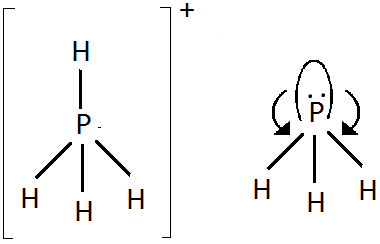
Bond angle in $PH_4^+$ is higher than that in $PH_3.$ Why?
AnswerIn $PH_3,$ P is sp hybridized. Three orbitals are involved in bonding with three hydrogen atoms and the fourth one contains a lone pair. As lone pair-bond pair repulsion is stronger than bond pair-bond pair repulsion, the tetrahedral shape associated with $Sp_{3}$ changed to pyramidal. $PH_3$ combines with a proton to form in which the lone pair is absent. Due to the absence of lone pair in, there is no lone pair-bond pair repulsion. Hence, the bond angle in is higher than the bond angle in $PH_3.$
View full question & answer→Question 411 Mark
Which of the three is the strongest oxidising agent:
$\text{ClO}^-_4,\ \text{BrO}^-_4,\ \text{IO}^-_4\ ?$
Answer$\text{BrO}^-_4$ is the strongest oxidising agent.
View full question & answer→Question 421 Mark
Why sulphurous acid acts as a reducing agent?
AnswerDue to the presence of a lone pair of electrons on the sulphur atom, sulphurous acid can be easily oxidised to sulphuric acid. Therefore, it acts as a reducing agent.
View full question & answer→Question 431 Mark
Why is $NH_3$ a good complexing agent?
Answer$NH_3$ is a good complexing agent because nitrogen has a lone pair of electrons which it can donate to form coordinate bond.
View full question & answer→Question 441 Mark
In interhalogen compounds of the type $AB_5$ and $AB_7,$ B is invariably fluorine. Why?
AnswerFluorine being the strongest oxidising agent, can form interhalogen compounds in $^+5$ and $^+7$ oxidation state.
View full question & answer→Question 451 Mark
In the preparation of $H_2SO_4$ by Contact Process, why is $SO_3$ not absorbed directly in water to form $H_2SO_4?$
AnswerAcid fog is formed, which is difficult to condense.
View full question & answer→Question 461 Mark
Concentrated $H_2SO_4$ is used as a dehydrating agent. Explain.
AnswerSulphuric acid has a strong affinity for water. It, therefore, removes water not only from materials which contain it but frequently removes oxygen and hydrogen from other compounds in the proportion required to form water $(H_2O).$
View full question & answer→Question 471 Mark
Fluorine exhibits only -1 oxidation state whereas other halogens exhibit +1, +3, +5 and +7 oxidation states also. Explain.
AnswerFluorine is the most electronegative element and cannot exhibit any positive oxidation state. Other halogens have d-orbitals and therefore, can expand their octets and show +1, +3, +5 and +7 oxidation states also.
View full question & answer→Question 481 Mark
Arrange the following in the order of property indicated for each set:
$F_2, Cl_2, Br_2, I_2 -$ increasing bond dissociation enthalpy.
AnswerThe order of increasing bond enthalpy
$I_2 < Br_2 < F_2 < Cl_2.$
View full question & answer→Question 491 Mark
What happens when $PCl_5$ is heated?
AnswerWhen $PCl_5$ is heated, it sublimes but decomposes on stronger heating.
$PCl_5$ heat $→ PCl_3 + Cl_2PCl_5 →$ heat $PCl_3 + Cl_2$
View full question & answer→Question 501 Mark
Why does $O_3$ act as a powerful oxidising agent?
Answer$O_3$ being endothermic compound readily decomposes on heating to give dioxygen or nascent oxygen.
$O_3 → O_2 + O$ (nascent oxygen)
since nascent oxygen is very reactive therefore O act as powerful oxidising agent.
View full question & answer→