Questions · Page 1 of 3

2 Marks Questions

🎯

Test yourself on this topic

50 questions · timed · auto-graded

Question 12 Marks
Write the chemical equations involved in the preparation of the following:
  1. $XeF_4.$
  2. $H_3PO_3.$
Answer
  1. $\text{Xe}+\text{2F}_{2}\xrightarrow{873K 7bar}\text{XeF}_{4}.$
  2. $\text{PCl}_{3}+\text{3H}_{2}\text{O}\rightarrow\text{H}_{3}\text{PO}_{3}+\text{3HCl}.$
Alternate answer
$\text{P}_{4}\text{O}_{6}+\text{6H}_{2}\text{O}\rightarrow\text{4H}_{3}\text{PO}_{3}.$
View full question & answer
Question 22 Marks
Account for the following:
  1. $N_2$ has higher bond dissociation energy than NO.
  2. $N_2$ and CO both have same bond order but CO is more reactive than $N_2.$
Answer
  1. $N_2$ have 6 more electrons in a bonding atomic orbital so it’s bond order is 3, whereas $N_{2+}$ has only 5 in bonding so it's bond order is 2.5.
  1. Bond dissociation energy is directly proportional to Bond order of a molecule so $N_2$ has more bond dissociation energy.
  2. Because of higher electronegativity difference, CO is polar and therefore more reactive or any other suitable reason (polarity or heteronuclear nature).
View full question & answer
Question 32 Marks
Name the reagents used in the following reactions:
  1. $ \ \ \ \ \ \ \ \ \ \ \ \ \ \ \ \ \ \ \ \ \ \ \ \ \ \ \ \ \ \ \ \ \ \ \ \ \ \ \ \ \ \ \ \ \ \ \ \ \ \ \ \ \ \ \text{CH}_3\\ \ \ \ \ \ \ \ \ \ \ \ \ \ \ \ \ \ \ \ \ \ \ \ \ \ \ \ \ \ \ \ \ \ \ \ \ \ \ \ \ \ \ \ \ \ \ \ \ \ \ \ \ \ \ \ \ \ |\\\text{CH}_3-\text{CO}-\text{CH}_3\xrightarrow{{ \ \ \ \ ? \ \ \ \ }}\text{CH}_3-\text{C}-\text{CH}_3\\ \ \ \ \ \ \ \ \ \ \ \ \ \ \ \ \ \ \ \ \ \ \ \ \ \ \ \ \ \ \ \ \ \ \ \ \ \ \ \ \ \ \ \ \ \ \ \ \ \ \ \ \ \ \ \ \ \ |\\ \ \ \ \ \ \ \ \ \ \ \ \ \ \ \ \ \ \ \ \ \ \ \ \ \ \ \ \ \ \ \ \ \ \ \ \ \ \ \ \ \ \ \ \ \ \ \ \ \ \ \ \ \ \ \text{OH}$
  2. $\text{CH}_3-\text{COOH}\xrightarrow{\ \ \ \ \ ? \ \ \ \ \ }\text{ClCH}_2-\text{COOH}$
Answer
  1. $CH_3MgBr, H_3O^+$
  2. $Cl_2, P$
View full question & answer
Question 72 Marks
Complete the following equations:
  1. $C +$ conc.$ H_2SO_4 →$
  2. $XeF_2 + H_2O →$
Answer
  1. $C + 2H_2SO_4($conc.$) → CO_2 + 2 SO_2 + 2 H_2O$
  2. $2XeF_2+ 2H_2O → 2Xe + 4HF + O_2$
View full question & answer
Question 82 Marks
What happens when:
  1. $SO_2$ gas is passed through an aqueous solution $Fe^{3+}$ salt?
  2. $XeF_4$ reacts with $SbF_5?$
Answer
  1. $2\text{F}\text{e}^{3+} + \text{SO}_{2} + 2\text{H}_{2}\text{O}\rightarrow 2\text{Fe}^{2+} + \text{SO}_{4}^{ 2-} + 4\text{H}^{+}$
  2. $\text{XeF}_{4} + \text{SbF}_{5}\rightarrow [\text{ XeF}_{3}]^{+} [\text{SbF}_{6}]^{-}.$
View full question & answer
Question 112 Marks
Complete the following equations:
  1. $\mathrm{Ag}+\mathrm{PCl}_5 \rightarrow$
  2. $\mathrm{CaF}_2+\mathrm{H}_2 \mathrm{SO}_4 \rightarrow$
Answer
  1. $2 \mathrm{Ag}+\mathrm{PCl}_5 \rightarrow 2 \mathrm{AgCl}+\mathrm{PCl}_3$.
  2. $\mathrm{CaF}_2+\mathrm{H}_2 \mathrm{SO}_4 \rightarrow \mathrm{CaSO}_4+2 \mathrm{HF}$.
View full question & answer
Question 132 Marks
Complete the following equations:
  1. $\mathrm{P}_4+\mathrm{H}_2 \mathrm{O} \rightarrow$
  2. $\mathrm{XeF}_4+\mathrm{O}_2 \mathrm{~F}_2 \rightarrow$
Answer
  1. $\mathrm{P}_4+\mathrm{H}_2 \mathrm{O} \rightarrow$ no reaction.
  2. $\mathrm{XeF}_4+\mathrm{O}_2 \mathrm{~F}_2 \rightarrow \mathrm{XeF}_6+\mathrm{O}_2$.
View full question & answer
Question 162 Marks
Complete the following reaction equations:
  1. $C_6H_5N_2Cl + H_3PO_2 + H_2O\rightarrow$
  2. $C_6H_5NH_2 + Br_2 (aq.) \rightarrow$
View full question & answer
Question 172 Marks
Explain the following facts giving appropriate reason in each case:
  1. $NF_3$ is an exothermic compound where as $NCl_3$ is not.
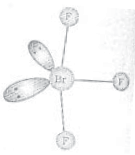
  2. All the bonds in $SF_4$ are not equivalent.
Answer
  1. Because bond energy of $F_2$ is lower than that of $Cl_2$ and therefore F forms stronger bond with $N$ with the release of energy.
  2. $SF_4$ has trigonal bipyramidal structure with one $l.p.$ Due to $l.p-b.p$ repulsion two axial $S-F$ bonds are longer than two $S-F$ equatorial bonds.
View full question & answer
Question 182 Marks
Describe the principle controlling each of the following processes:
  1. Vapour phase refining of titanium metal.
  2. Froth flotation method of concentration of a sulphide ore.
Answer
  1. In this method the titanium metal is heated with $I_2$ to form a volatile compound $TiI_4$ which on further heating at higher temperature decomposes to give pure titanium metal.
  2. This method is based upon the fact that the surface of the sulphide ores is preferentially wetted by oil while that of gangue is wetted by water.
View full question & answer
Question 202 Marks
Complete the following, chemical reaction equations:
  1. $I_2 + HNO_3→$
(conc.)
  1. $HgCl_2 + PH_3→$
Answer
  1. $I_2 + 10HNO_3 \rightarrow 2HIO_3 + 10NO_2 + 4H_2O.$
  2. $3HgCl_2 + PH_3 \rightarrow Hg_3P_2 + 6HCl.$
View full question & answer
Question 212 Marks
Complete the following chemical reaction equations:
  1. $XeF_2 + H_2O →$
  2. $PH_3 + HgCl_2 →$
Answer
  1. $2XeF_2 + 2H_2O → 2Xe + 4HF + O_2.$
  2. $2PH_3 + 3HgCl_2 → Hg_3P_2 + 6HCl.$
View full question & answer
Question 222 Marks
Answer the following:
  1. Which neutral molecule would be isoelectronic with $CIO^–?$
  2. Of $Bi(V)$ and $Sb(V)$ which may be a stronger oxidising agent and why?
Answer
  1. $ClF.$
  2. $Bi\ (V)$, due to greater stability of its lower oxidation state effect.
View full question & answer
Question 232 Marks
How would you account for the following:
  1. Sulphur hexafluoride is less reactive than sulphur tetrafluoride.
  2. Of the noble gases only xenon forms known chemical compounds.
Answer
  1. Due to sterically protected sulphur atom.
  2. Because Xe is with the lowest ionization enthalpy among the rest (except Rn which is radioactive).
View full question & answer
Question 252 Marks
Complete the following chemical equations :
  1. $F_2 + 2Cl^– \longrightarrow$
  2. $2XeF_2 + 2H_2O \longrightarrow$
Answer
  1. $F_2 + 2Cl^- \longrightarrow 2F^-+ Cl_2$
  2. $2XeF_2 + 2H_2O \longrightarrow 2Xe + 4HF + O_2$
View full question & answer
Question 262 Marks
What happens when
  1. $HCl$ is added to $MnO_2?$
  2. $PCl_5$ is heated?
Write the equations involved.
Answer
  1. $MnO_2 + 4HCl \longrightarrow MnCl_2+ Cl_2+ 2H_2O$
  2. $\text{PCl}_5\xrightarrow{\text{ }\text{ }\text{ }\text{ }\text{ }\triangle\text{ }\text{ }\text{ }\text{ }\text{ }}\text{PCl}_3+\text{Cl}_2$
View full question & answer
Question 292 Marks
Complete the following reactions :
  1. $\text{C}l_2+\text{H}_2\text{O}\xrightarrow{\text{ }\text{ }\text{ }\text{ }\text{ }\text{ }\text{ }\text{ }\text{ }\text{ }}$
  2. $\text{XeF}_6+3\text{H}_2\text{O}\xrightarrow{\text{ }\text{ }\text{ }\text{ }\text{ }\text{ }\text{ }\text{ }\text{ }}$
Answer
Complete chemical reactions are:
  1. $Cl_2 + H_2O → [HCl + HOCl] → 2 HCl + [O]\ ($Nascent oxygen$)$
  2. $XeF_6 + 3H_2O → XeO_3+ 6HF$
View full question & answer
Question 302 Marks
What happens when
  1. conc. $H_2SO_4$ is added to $Cu?$
  2. $SO_3$ is passed through water?
Write the equations.
Answer
  1. When conc. $H_2SO_4$ is added to Cu then its leads to the formation of $CuSO_4, SO_2$ and $H_2O.$
$Cu + H_2SO_4 ($conc.$) → CuSO_4 + SO_2 + 2H_2O$
  1. When $SO_3$ is passed through water then its leads to the formation of $H_2SO_4.$
$SO_3+ H_2O → H_2SO​_4$​​​​​​​
View full question & answer
Question 312 Marks
Complete the following chemical equations:
  1. $Ca_3P_2+ H_2O →$
  2. $Cu + H_2SO_4(conc.)→$
Answer
  1. $Ca_3P_2+ 6H_2O→ 3Ca(OH)_2+ 2PH_3$
  2. $Cu + 2H_2SO_4→ CuSO_4+ 2H_2O + SO_2$
View full question & answer
Question 322 Marks
Arrange the following in the order of property indicated against each set:
  1. $HF,\ HCl,\ HBr,\ HI -$ increasing bond dissociation enthalpy.
  2. $H_2O, H_2S, H_2Se, H_2Te -$ increasing acidic character.
Answer
  1. $HI$
  2. $H_2O2S2Se2Te$
View full question & answer
Question 332 Marks
Complete the following reactions:
  1. $NH_3+ 3Cl_2($excess$) →$
  2. $XeF_6 + 2H_2O →$
Answer
  1. $NH_3 + 3Cl_2 ($excess$) → NCl_3 + 3HCl$
  2. $XeF_6 + 2H_2O → XeO_2F_2 + 4HF$
View full question & answer
Question 342 Marks
What happens when
  1. $(NH_4)_2Cr_2O_7$ is heated?
  2. $H_3PO_3$ is heated?
Write the equations.
Answer
  1. $(NH_4)_2Cr_2O_7 → N_2 + 4H_2O + Cr_2O_3$
  2. $4H_3PO_3 → 3H_3PO_4 + PH_3$
View full question & answer
Question 362 Marks
Explain the following giving an appropriate reason in each case.
  1. $O_2$ and $F_2$ both stabilise higher oxidation states of metals but $O_2$ exceeds $F_2$ in doing so.
  2. Structures of Xenon fluorides cannot be explained by Valence Bond approach.
Answer
  1. This is due to the ability of oxygen to form multiple bonds to metals.
  2. This is because the energy required for the promotion of electrons inXenon is very high./Energy factor does not favour VB approach.
View full question & answer
Question 372 Marks
State reasons for each of the following:
  1. The N–O bond in ${NO_2}^-$ is shorter than the $N–O$ bond in ${NO^-}_3.$
  2. $SF_6$ is kinetically an inert substance.
Answer
  1. In the resonance structure of these two species, in ${NO_2}^–, 2$ bonds are sharing a double bond while in ${NO_3}^–, 3$ bonds are sharing a double bond which means that bond in $NO_2$ will be shorter than in ${NO_3}^–.$
Alternate answer
In ${NO^–}_2$, bond order is 1.5 while in ${NO^–}_3,$ bond order is $1.33.$
  1. Because $SF6$ is stericallyprotected by six $F$ atoms $/$ co-ordinatively saturated.
View full question & answer
Question 382 Marks
State reasons for each of the following:
  1. All the $P-Cl$ bonds in $PCl_5$ molecule are not equivalent.
  2. Sulphur has greater tendency for catenation than oxygen.
Answer
  1. Because $PCl_5$ has a trigonal bipyramidal structure in which three $P-Cl$ bonds are equatorial and two $P-Cl$ bonds are axial.
  2. Because $S-S$ single bond is stronger than $O-O$ single bond.
View full question & answer
Question 392 Marks
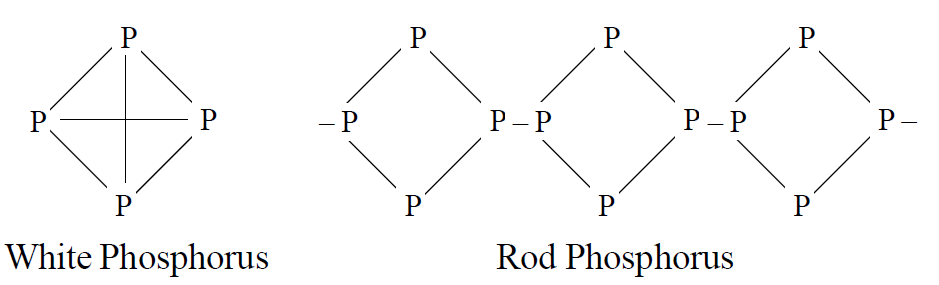
Draw the structures of white phosphorus and red phosphorus. Which one of these two types of phosphorus is more reactive and why?
Answer

White phosphorus is more reactive due to its discrete tetrahedral structure and angular strain.
View full question & answer
Question 412 Marks
Explain the role of:
  1. Cryolite in the electrolytic reduction of alumina.
  2. Carbon monoxide in the purification of nickel.
Answer
  1. Cryolite lowers the melting point of alumina. Or Molten cryolite dissolves alumina.
  2. Carbon monoxide forms a volatile complex with nickel which on heating de-composes to gives pure nickle.
View full question & answer
Question 422 Marks
Complete the following chemical reaction equations:
  1. $\text{P}_{4(\text{s})}+\text{NaoH}_{(\text{aq})}+\text{H}_{2}\text{O}_{(\text{l})}\rightarrow$
  2. $\text{I}^{-}_{(\text{aq})}+\text{H}_{2}\text{O}_{(\text{l})}+{O}_{3(\text{g})}\rightarrow$
Answer
  1. $\text{P}_{4}+\text{3NaOH}+\text{3H}_{2}\text{O}\rightarrow\text{PH}_{3}+\text{3NaOH}_{2}\text{PO}_{2}.$
  2. $\text{2I}^{-}+\text{H}_{2}\text{O}+\text{O}_{3}\rightarrow\text{2OH}^{-}+\text{I}_{2}+\text{O}_{2}.$
View full question & answer
Question 442 Marks
Assign a reason for each of the following statements:
  1. Ammonia is a stronger base than phosphine.
  2. Sulphur in vapour state exhibits a paramagnetic behaviour.
Answer
  1. The lone pair of electrons on $N$ atom in $NH_3$ is directed and not diffused/delocalized as it is in $PH_3$ due to larger size of $P.$
  2. $S_2$ molecule like $O_2,$ has two unpaired electrons in antibonding $\eth$* orbitals.
View full question & answer
Question 452 Marks
Write balanced chemical equations for the following reactions:
  1. Aluminium dissolves in aqueous hydrochloric acid.
  2. Tin reacts with a hot alkali solution.
Answer
  1. $\text{2Al}+\text{6HCl}+\text{12H}_2{O}\rightarrow\text{2[Al(H}_{2}\text{O})_{6}]\text{Cl}_{3}+3\text{H}_{2}$
  2. $\text{Sn}+\text{2KOH}+\text{4H}_{2}\text{O}\rightarrow\text{K}_{2}\text{[Sn(OH)}_{6}]+\text{2H}_{2}$
View full question & answer
Question 472 Marks
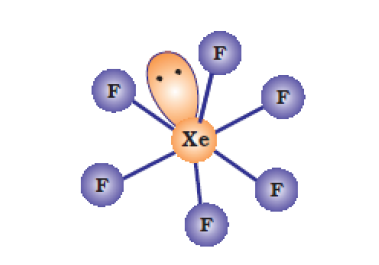
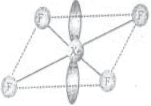
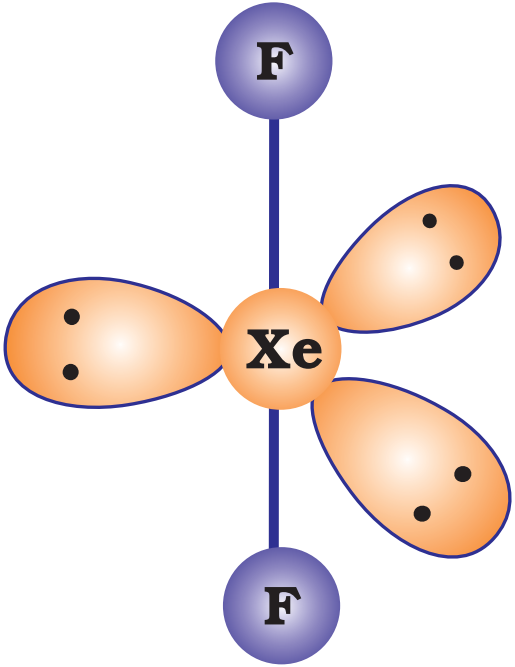
  1. Draw the structure of $XeF_2$ molecule.
  2. Write the outer electronic configuration of $Cr$ atom $(Z=24).$
Answer
  1. ​​​​​
  1. $3d^54s^1.$
View full question & answer
Question 482 Marks
Write balanced chemical equations for the following reactions:
  1. $Ca_3P_2 + H_2O \rightarrow$
  2. $XeF_6 + 3H_2O \rightarrow$
Answer
  1. $Ca_3P_2 + 6H_2O \rightarrow 2PH_3 + 3Ca(OH)_2.$
  2. $XeF_6 + 3H_2O \rightarrow XeO_3 + 6HF.$
View full question & answer
Question 492 Marks
Among the hydrides of Group-15 elements, which have the,
  1. Lowest boiling point?
  2. Maximum basic character?
  3. Highest bond angle?
  4. Maximum reducing character?
Answer
  1. $PH_3$ will have the lowest boiling point.
  2. Ammonia has the maximum basic character.
  3. $NH_3$ will have the highest bond angle.
  4. $BiH_3$ will have the maximum reducing character.
View full question & answer
2 Marks Questions - Chemistry STD 12 Science Questions - Vidyadip