Questions · Page 3 of 4

M.C.Q (1 Marks)

MCQ 1011 Mark
Which one of the following has a different crystal lattice from those of the rest?
  • A
    $Ag$
  • $V$
  • C
    $Cu$
  • D
    $Au$
Answer
Correct option: B.
$V$
Vanadium crystallizes in $\text{bcc}$ structures while $\text{Ag, Cu, Pt}$ and $Au$ crystallize in $\text{ccp}$ structures.
View full question & answer
MCQ 1021 Mark
The efficiency of packing is $68\%$ in:
  • A
    $\text{Hcp}$ structure
  • B
    $\text{Ccp}$ structure
  • C
    $\text{Fcc}$ structure
  • $\text{Bcc}$ structure
Answer
Correct option: D.
$\text{Bcc}$ structure
$\text{FCC}$ or $\text{CCP}$ packing efficiency $= 74\%$
$\text{HCP}$ Packing Efficiency $= 74\%$
$\text{BCC}$ Packing Efficiency $= 68\%​$
View full question & answer
MCQ 1031 Mark
Maximum possible numbers of two dimensional and three dimensional lattices are respectively $.......:$
  • $5$ and $14$
  • B
    $7$ and $14$
  • C
    $14$ and $4$
  • D
    $5$ and $13$
Answer
Correct option: A.
$5$ and $14$
View full question & answer
MCQ 1041 Mark
A pseudo solid is:
  • A
    Glass
  • B
    Pitch
  • C
    $\text{KCl}$
  • Glass and pitch both
Answer
Correct option: D.
Glass and pitch both
Pseudo solids $($such as glass $\ \&\ $ pitch$)$ lack a regular three$-$dimensional arrangement of atoms.
Pitch is a viscoelastic polymer which can be natural or manufactured, derived from petroleum.
Solids are most stable in crystalline form. However, if a solid is formed rapidly $($for example, when a liquid is cooled suddenly$),$ its atoms or molecules do not have time to align themselves and may become locked in positions other than those of a regular crystal. Such resulting solids are called Pseudo solids.
View full question & answer
MCQ 1051 Mark
The more efficient mode of packing of identical atoms in one layer is:
  • A
    Square close packing pattern
  • B
    Hexagonal close packing pattern
  • Trigonal closed packing
  • D
    None of the above
Answer
Correct option: C.
Trigonal closed packing
The more efficient mode of packing of identical atoms in one layer is hexagonal close packing pattern.
This is because the empty space in hexagonal closed packing is much less than that in square close packing.
View full question & answer
MCQ 1061 Mark
How many tetrahedral voids are occupied in diamond?
  • A
    $25\%$
  • $50\%$
  • C
    $75\%$
  • D
    $100\%$
Answer
Correct option: B.
$50\%$
One half or $50\%$ tetrahedral voids are occupied in diamond. Its unit cell is similar to face centered cubic unit cell.
View full question & answer
MCQ 1071 Mark
Which of the following cannot be regarded as molecular solid?
  • A
    $\text{SiC}$
  • B
    $\text{AlN}$
  • C
    Diamond
  • All of the above
Answer
Correct option: D.
All of the above
Silicon carbide $(\text{SiC}),$ Aluminium nitride $(\text{AlN}),$ and diamond are examples of network atomic solids as they have three$-$dimensional structure.
View full question & answer
MCQ 1081 Mark
A ferromagnetic substance becomes a permanent magnet when it is placed in a magnetic field becuase $......$
  • All the domains get oriented in the direction of magnetic field.
  • B
    All the domains get oriented in the direction opposite to the direction of magnetic field.
  • C
    Domains get oriented randomly.
  • D
    Domains are not affected by magnetic field.
Answer
Correct option: A.
All the domains get oriented in the direction of magnetic field.
Ferromagnetic solids can be permanently magnetised and then all the domains get oriented in the direction of applied magnetic field.
View full question & answer
MCQ 1091 Mark
To prepare $n-$type semiconductor the impurity to be added to silicon should have the following number of valence electrons:
  • A
    $2$
  • B
    $3$
  • C
    $4$
  • $5$
Answer
Correct option: D.
$5$
To prepare $n-$type semiconductor the impurity to be added to silicon should have $5$ valence electrons.
In $n-$type semiconductors, electrons are the majority carriers and holes are the minority carriers. $N-$type semiconductors are created by doping an intrinsic semiconductor with donor impurities.
View full question & answer
MCQ 1101 Mark
An element crystallises in a $\text{bcc}$ lattice. Nearest neighbours and percentage of volume occupied by spheres in the unit cell are:
  • A
    $8, 74\%$
  • $8, 68\%$
  • C
    $6, 74\%$
  • D
    $6, 68\%$
Answer
Correct option: B.
$8, 68\%$
There are $8$ nearest neighbours in $\text{BCC}.$ Percentage of volume occupied by spheres in the unit cell of $\text{BCC}$ is $68\%.$
View full question & answer
MCQ 1111 Mark
In $\text{FCC}$ unit cell, the percentage of unit cell not occupied by atoms is:
  • A
    $33\%$
  • B
    $29\%$
  • $26\%$
  • D
    $74\%$
Answer
Correct option: C.
$26\%$
In $\text{FCC}, 26\%$ of the total volume is not be recovered by atoms.
View full question & answer
MCQ 1121 Mark
$\text{AAA}$ type packing in $3D$ has a unit cell as:
  • Primitive
  • B
    $\text{FCC}$
  • C
    $\text{BCC}$
  • D
    $\text{CCP}$
Answer
Correct option: A.
Primitive
View full question & answer
MCQ 1131 Mark
Crystals have 'vacant sites' or 'defects' in them. When light strikes a photographic silver bromide paper, silver atoms move in through these defects to:
  • A
    Develop the film
  • B
    Form tiny clumps of silver atoms
  • Form negative images
  • D
    Form a colour image
Answer
Correct option: C.
Form negative images
When light strikes a photographer $(\text{AgBr})$ paper, it gives energy to the electrons present in the film. These energetic electrons when strike silver ions turn them to silver atoms. So eventually, ions leave their lattice site and occupy interstitial sites. Since silver atoms are black in color so whenever light strikes a silver ion the photographic film will turn black.
View full question & answer
MCQ 1141 Mark
Which of the following is not related to amorphous solids?
  • A
    They do not have sharp melting points
  • B
    They are rigid and hard
  • C
    They are not bound by plane surfaces
  • They give diffraction bands
Answer
Correct option: D.
They give diffraction bands
Strength, photovoltaic optical properties, no sharp melting points, not bound by plane surfaces, hard etc. are the features of amorphous solids. However, they do not give diffraction bands.
View full question & answer
MCQ 1151 Mark
An element exists as hexagonal close packed structure as well as cubic closed packed structure. In which case the element would have higher density?
  • A
    $\text{CCP}$
  • B
    $\text{HCP}$
  • Same in both
  • D
    Unpredictable
Answer
Correct option: C.
Same in both
The packing efficiencies of both hcp and $\text{ccp}$ is approximately same that is $74\%$ density of the element will be same in both the cases as two structures will have the same coordination number and hence, the same packing fraction and density.
View full question & answer
MCQ 1161 Mark
Which of the following is correct regarding defect in solid?
  • A
    Schottky defect has no effect on the physical properties of solids
  • B
    Frenkel defect is usually favoured by a very small difference in the sizes of cations and anions
  • Frenkel defect is a dislocation defect
  • D
    Trapping of protion in the lattice leads to the formation of $F-$centres
Answer
Correct option: C.
Frenkel defect is a dislocation defect
The Schottky defect has some effect on the physical properties of solids such as lower density, lower lattice energy or stability etc.
Frenkel defect is usually favoured by a large difference in the sizes of cations and anions. Cations are small in size than anions.
Frenkel defect is a dislocation defect. A cation moves to another position between two layers.
Trapping of electrons in the lattice leads to the formation of $F-$centers.
View full question & answer
MCQ 1171 Mark
Which type of crystals contains more than one Bravais lattice?
  • A
    Hexagonal
  • B
    Triclinic
  • C
    Rhombohedral
  • Monoclinic
Answer
Correct option: D.
Monoclinic
In the given options, Hexagonal, Triclinic and Rhombohedral crystals have only one Bravais lattice. Only Monoclinic Crystal has two Bravais lattice.
View full question & answer
MCQ 1181 Mark
Which of the following statement is not true about amorphous solids?
  • A
    On heating they may become crystalline at certain temperature.
  • B
    They may become crystalline on keeping for long time.
  • C
    Amorphous solids can be moulded by heating.
  • They are anisotropic in nature.
Answer
Correct option: D.
They are anisotropic in nature.
Amorphous solids are isotropic because they show thermal and optical properties, same in all directions.
View full question & answer
MCQ 1191 Mark
The compound with the largest lattice energy would be:
  • $\text{NaF}$
  • B
    $\text{KBr}$
  • C
    $\text{MgF}_2$
  • D
    All have equal
Answer
Correct option: A.
$\text{NaF}$
The lattice energy depends on the attraction between the oppositely charged ions.,
$\text{NaF}$ has largest lattice energy.
View full question & answer
MCQ 1201 Mark
Which of the following solid substance$(s)$ will have the same refractive index when measured in different directions?
  • A
    Rubber
  • $\text{NaCl}$
  • C
    Plastic
  • D
    Graphite
Answer
Correct option: B.
$\text{NaCl}$
Isotropic solids have same refractive index in all the directions. As amorphous solids are isotropic in nature.
Hence, amorphous solids like $\text{NaCl}$ will show same refractive index when measured in different directions.
View full question & answer
MCQ 1211 Mark
The compound $\text{MX}_4$​ is tetrahedral . The number of $\text{X−M−X}$ angles in the compound is:
  • A
    Three
  • B
    Four
  • C
    Five
  • Six
Answer
Correct option: D.
Six
$\text{MX}_2$​ is tetrahedral, therefore total number of angles $\text{XMX}$ is six.
View full question & answer
MCQ 1221 Mark
Which of the following is a primitive unit cell?
  • A
    Simple cubic
  • B
    Body$-$centred cubic
  • C
    Face$-$centred cubic
  • Both body$-$centred and face$-$centred cubic
Answer
Correct option: D.
Both body$-$centred and face$-$centred cubic
View full question & answer
MCQ 1231 Mark
How many kinds of space lattices are possible in a crystal?
  • A
    $23$
  • B
    $7$
  • C
    $30$
  • $14$
Answer
Correct option: D.
$14$
There are $14$ kinds of space lattices are possible for crystals these are called as Bravais lattice.
View full question & answer
MCQ 1241 Mark
In the cubic close packing, the unit cell has $.......$
  • A
    $4$ Tetrahedral voids each of which is shared by four adjacent unit cells.
  • B
    $4$ Tetrahedral voids within the unit cell.
  • C
    $8$ Tetrahedral voids each of the which is shared by four adjacent unit cells.
  • $8$ Tetrahedral voids within the unit cells.
Answer
Correct option: D.
$8$ Tetrahedral voids within the unit cells.
We know that in $\text{ccp}$ structure there are $4$ atoms per unit cell. The number of tetrahedral voids is twice the number of atoms $($i.e. eight tetrahedral voids per unit cell of cubic closed packing$.)$
View full question & answer
MCQ 1251 Mark
Which kind of defects are introduced by doping?
  • Dislocation defect.
  • B
    Schottky defect.
  • C
    Frenkel defects.
  • D
    Electronic defects.
Answer
Correct option: A.
Dislocation defect.
When electron rich or electron deficient impurity is added to a perfect crystal, it introduces electronic defect in them.
View full question & answer
MCQ 1261 Mark
The maximum percentage of available volume that can be filled in a face centred cubic system by an atom is:
  • $74\%$
  • B
    $68\%$
  • C
    $34\%$
  • D
    $26\%$
Answer
Correct option: A.
$74\%$
Face$-$centered cubic cells have $74\%$ packaging efficiency for spheres or ions of equal diameter.
Some examples of $\text{FCC}$ arrangements are aluminum, copper and buckminsterfullerenes$-C-60\ ($buckyballs$)$ etc.
View full question & answer
MCQ 1271 Mark
Which of the following statements are true for glasses?
  • A
    They are amorphous solids.
  • B
    They are supercooled liquids.
  • C
    They have long range order.
  • Both $A$ and $B$ are correct.
Answer
Correct option: D.
Both $A$ and $B$ are correct.
Glasses are amorphous solids. Amorphous solids do not have a specific arrangement pattern.
All amorphous solids have a tendency to flow though very slowly. Hence, glass is considered as a super cooled liquid. That is why, glass windows and doors become slightly thicker at the bottom than at the topwith time.
Amorphous solids do not exhibit long order arrangement.
View full question & answer
MCQ 1281 Mark
Which of the following statement is not true about the hexagonal close packing?
  • A
    The coordination number is $12.$
  • B
    It has $74\%$ packing efficiency.
  • Tetrahedral voids of the second layer are covered by the spheres of the third layer.
  • D
    In this arrangement spheres of the fourth layer are exactly aligned with those of the first layer.
Answer
Correct option: C.
Tetrahedral voids of the second layer are covered by the spheres of the third layer.
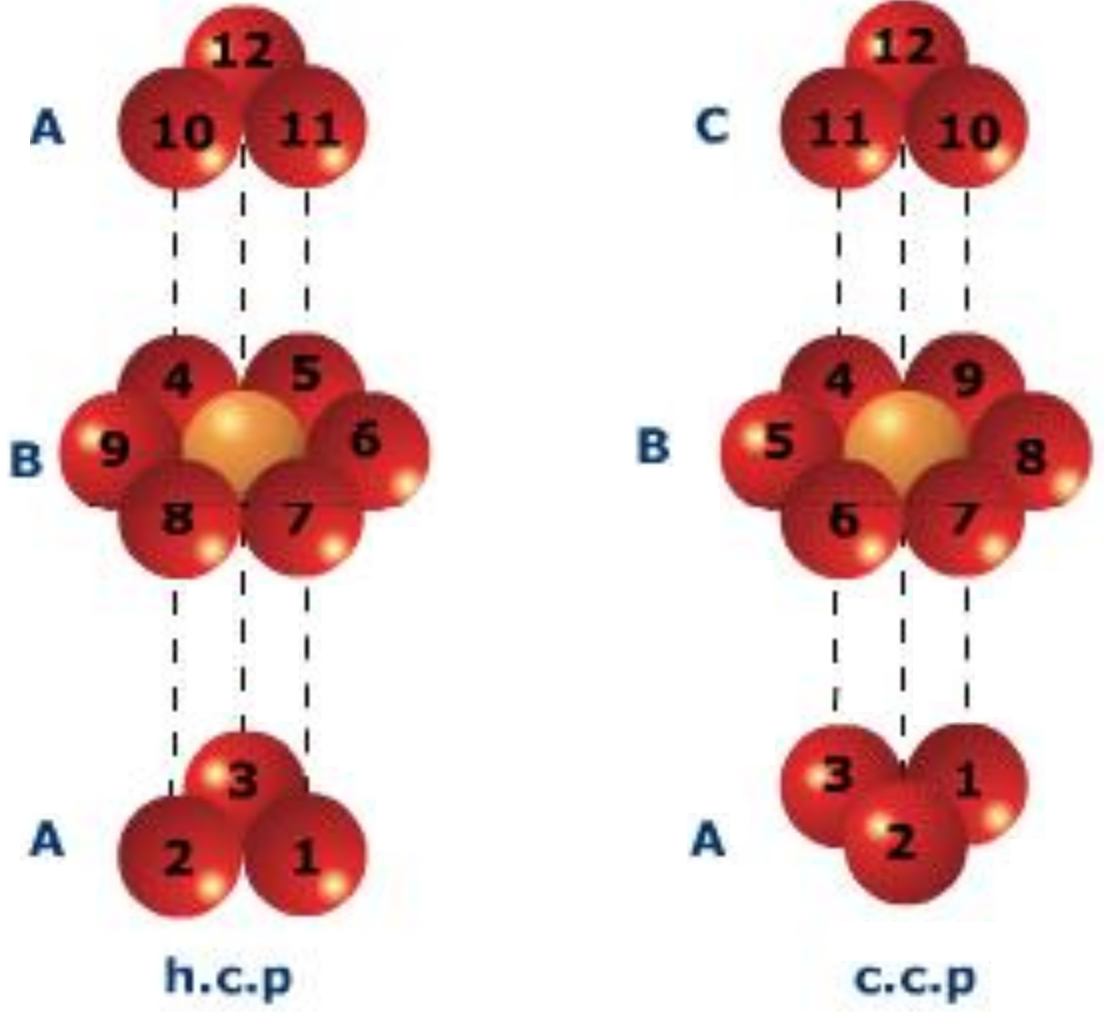
In hexagonal close packed structure there is $\text{ABAB} ......$ type pattern. This means that in this case spheres of third layer are exactly aligned with those of the first layer. Thus the pattern of spheres is repeated in alternate layers. Thus the statement at $(iv)$ is not true about hexagonal closed packing.
View full question & answer
MCQ 1291 Mark
Which type of 'defect' has the presence of cations in the interstitial sites ?
  • Frenkel defect
  • B
    Metal deficiency defect
  • C
    Schottky defect
  • D
    Vacancy defect
Answer
Correct option: A.
Frenkel defect
View full question & answer
MCQ 1301 Mark
Which of the following is amorphous?
  • A
    Sodium chloride
  • Quartz glass
  • C
    Powdered marble
  • D
    Cane sugar
Answer
Correct option: B.
Quartz glass
Amorphous is defined as a substance laking clear structure or shape.
In quartz glass, elements are not organized in a periodic array, so they don't have a proper shape or structure.
View full question & answer
MCQ 1311 Mark
Which of the following is an example for interstitial solid solution?
  • A
    $\text{SiC}$
  • $\text{TiC}$
  • C
    $Li_2​C_2$​
  • D
    $Al_4​C_3$​
Answer
Correct option: B.
$\text{TiC}$
Interstitial solid solution $-$ Interstitial solid solution forms when the solute atom is small enough to fit at interstitial sites between the solvent atoms.
example$-\text{TiC}.$
View full question & answer
MCQ 1321 Mark
What type of bonding results in compounds which are crystalline solids?
  • A
    Covalent
  • Ionic
  • C
    Metallic
  • D
    Dipole$-$Dipole
Answer
Correct option: B.
Ionic
Ionic bonding results in compounds which are crystalline solids.
As they are held by strong electrostatic forces, thus they have more organised structure, a definite melting point and are known as crystals.
View full question & answer
MCQ 1331 Mark
Which of the following oxides behaves as conductor or insulator depending upon temperature?
  • A
    $\text{TiO}.$
  • B
    $\text{SiO}_2$.
  • $\text{TiO}_3$.
  • D
    $\text{MgO}.$
Answer
Correct option: C.
$\text{TiO}_3$.
Certain metal oxides like $\text{VO, VO}_2, VO_3$ and $\text{TiO}_3$ show either metallic or insulating properties depending upon temperature.
View full question & answer
MCQ 1341 Mark
Most crystals that show good cleavage because their atoms, ions or molecules are:
  • A
    Weakly bonded together
  • B
    Strongly bonded together
  • C
    Spherically symmetrical
  • Arranged in planes
Answer
Correct option: D.
Arranged in planes
Most crystals show good cleavage as their atoms, ions or molecule are arranged in planes which is due to flat crystal face.
View full question & answer
MCQ 1351 Mark
Iodine molecules are held in the crystals lattice by $......$
  • London forces.
  • B
    Dipole$-$dipole interactions.
  • C
    Covalent bonds.
  • D
    Coulombic forces.
Answer
Correct option: A.
London forces.
Iodine molecule is a nonpolar covalent molecule. These molecules are electrically symmetical and have no dipole moment. The molecules are in a crystal lattice of iodine are, therefore, attracted together by weak 'London forces'.
View full question & answer
MCQ 1361 Mark
In case of cubic system, the number of types of space lattices?
  • A
    $3$
  • B
    $7$
  • $14$
  • D
    $12$
Answer
Correct option: C.
$14$
There are $14$ space lattices are possible in a crystal.
View full question & answer
MCQ 1371 Mark
Which of the following point defects are shown by $\text{AgBr(s)}$ crystals?
$A.$ Schottky defect.
$B.$ Frenkel defect.
$C.$ Metal excess defect.
$D.$ Metal deficiency defect.
  • $(A)$ and $(B).$
  • B
    $(C)$ and $(D).$
  • C
    $(A)$ and $(C).$
  • D
    $(B)$ and $(D).$
Answer
Correct option: A.
$(A)$ and $(B).$
$\text{AgBr}$ shows both Schottky and Frenkel defects. In $\text{AgBr},$ both $Ag^+$ and $Br$ ions are absent from the lattice causing Schottky defect. However$, Ag^+$ ions are mobile so they have a tendency to move aside the lattice and trapped in interstitial site, hence cause Frenkel defect.
View full question & answer
MCQ 1381 Mark
The three dimensional graph of lattice points which sets the pattern for the whole lattice is called:
  • A
    Space lattice
  • B
    Simple lattice
  • Unit cell
  • D
    Crystal lattice
Answer
Correct option: C.
Unit cell
The three dimensional graph of lattice points which sets the pattern for the whole lattice is called unit cell.
View full question & answer
MCQ 1391 Mark
The smallest repeating unit in space lattice which when repeated over and again results in the crystal of the given substance is called:
  • A
    Space lattice
  • B
    Crystal lattice
  • Unit Cell
  • D
    Isomorphism
Answer
Correct option: C.
Unit Cell
The smallest repeating unit in space lattice which when repeated over and again results in the crystal of the given substance is called unit cell.
The collection of all points in the crystal having similar environment is called space lattice.
The lattice points can be arranged in maximum of fourteen types. This arrangement is called Bravais lattice.
Two or more substances having the same crystal structure are said to be isomorphous.
View full question & answer
MCQ 1401 Mark
Which of the following represents correct order of conductivity in solids?
  • $\kappa_\text{metals} >> \kappa_\text{insulators} < \kappa_\text{semiconductors}.$
  • B
    $\kappa_\text{metals} << \kappa_\text{insulators} < \kappa_\text{semiconductors}.$
  • C
    $\kappa_\text{metals} < \kappa_\text{semiconductors}> \kappa_\text{insulators}=\text{zero}.$
  • D
    $\kappa_\text{metals} < \kappa_\text{semiconductors}> \kappa_\text{insulators} \neq \text{zero}.$
Answer
Correct option: A.
$\kappa_\text{metals} >> \kappa_\text{insulators} < \kappa_\text{semiconductors}.$
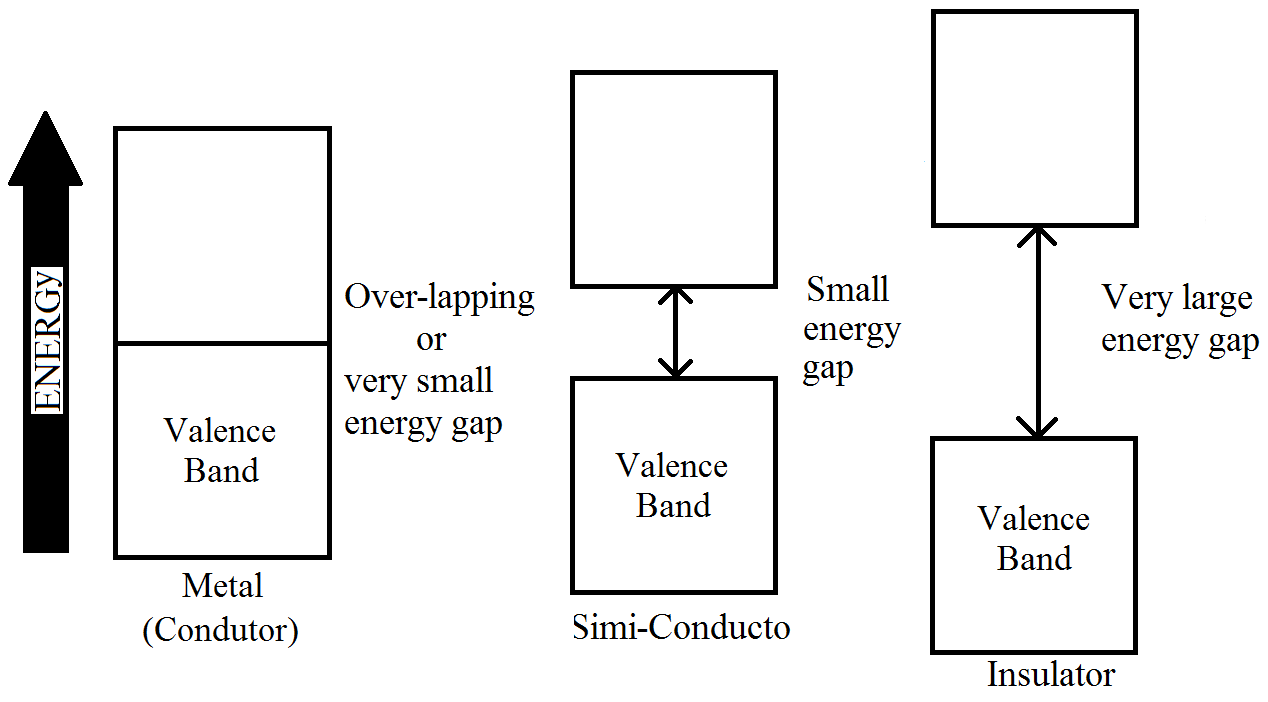
Conductivity of metal, insulator and semiconductors can be represented in the term of $k\ ($Kappa$)$ which depends upon energy gap between valence band and conduction band.

Valence and conductance bands in metals, semiconductors and insulatots.
 
Valued $\kappa\big(\Omega^{-1}\text{m}^{-1}\big)$
Metal
$ 10^4 \text { to } 10^7 $
Insulator
$ 10^{-20} \text { to } 10^{-10} $
Semiconductor
$ 10^{-6} \text { to } 10^4 $
View full question & answer
MCQ 1411 Mark
At zero kelvin, most of the ionic crystals possess:
  • A
    Frenkel defect
  • B
    Schottky defect
  • C
    metal excess defect
  • No defect
Answer
Correct option: D.
No defect
At zero kelvin, most of the ionic crystals posses no defect. This is due to presence of highly ordered arrangement.
View full question & answer
MCQ 1421 Mark
The vacant space in a $\text{bcc}$ unit cell is:
  • A
    $23\%$
  • $32\%$
  • C
    $26\%$
  • D
    $48\%$
Answer
Correct option: B.
$32\%$
Packing fraction of $\text{BCC}$ unit cell is $68\%.$ Therefore, the vacant space in $\text{BCC}$ unit cell is $32\%.$
View full question & answer
MCQ 1431 Mark
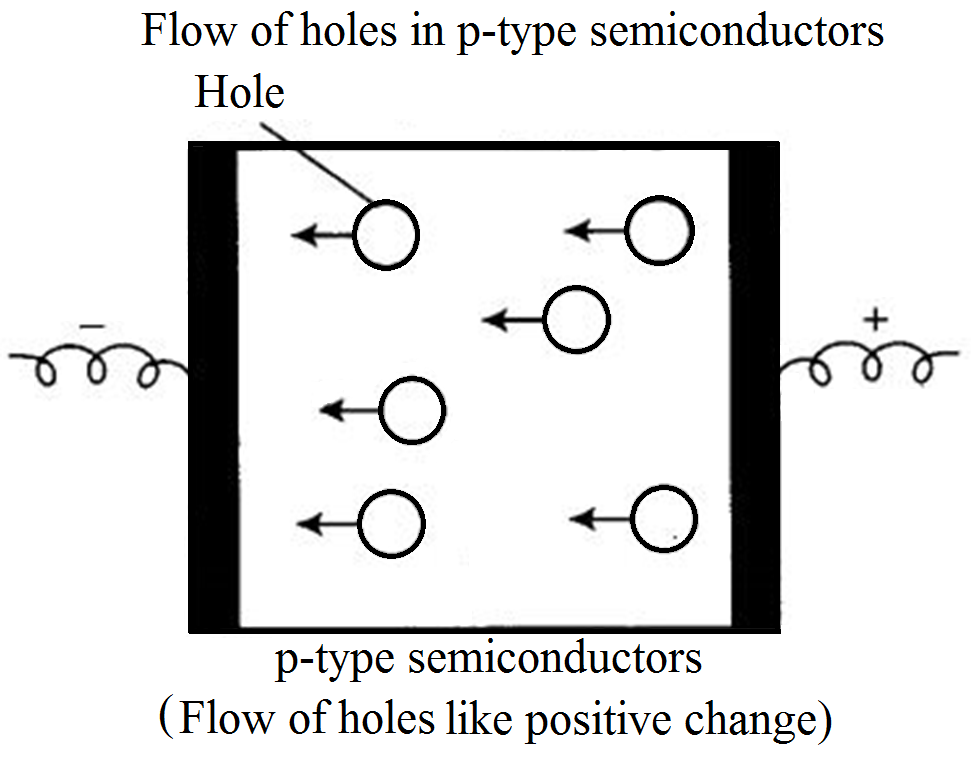
Under the influence of electric field, which of the following statements is true about the movement of electrons and holes in a $p-$type semi conductor?
$a.$ Electron will move towards the positvely charged plate through electron holes.
$b.$ Holes will appear to be moving towards the negatively charged plate.
$c.$ Both electrons and holes appear to move towards the positively charged plate.
$d.$ Movement of electrons is not related to the movement of holes.
  • $a$ and $b$
  • B
    $a$ and $c$
  • C
    $b$ and $c$
  • D
    $a$ and $d$
Answer
Correct option: A.
$a$ and $b$
In $p-$type semiconductor, the conductivity is due to existence of hole. When electric field is applied to $p-$type semiconductor hole starts moving towards negatively charged plate and electron towards positively charged plate. Flow of holes in $p-$type semiconductors Hole.

View full question & answer
MCQ 1441 Mark
The crystal structure of pure silicon is like:
  • Diamond
  • B
    Graphite
  • C
    Silver
  • D
    Zinc
Answer
Correct option: A.
Diamond
Silicon crystallizes in the same pattern as diamond, in a structure which Ashcroft and Mermin call "two interpenetrating face$-$centered cubic" primitive lattices.
View full question & answer
MCQ 1451 Mark
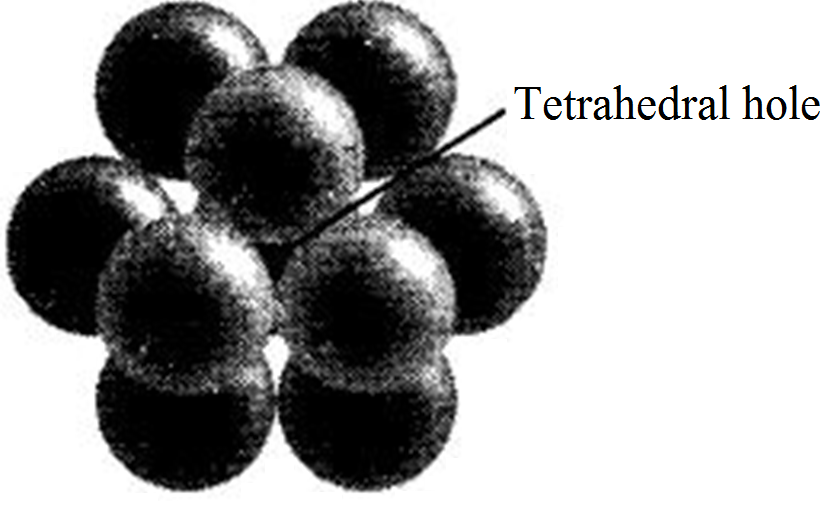
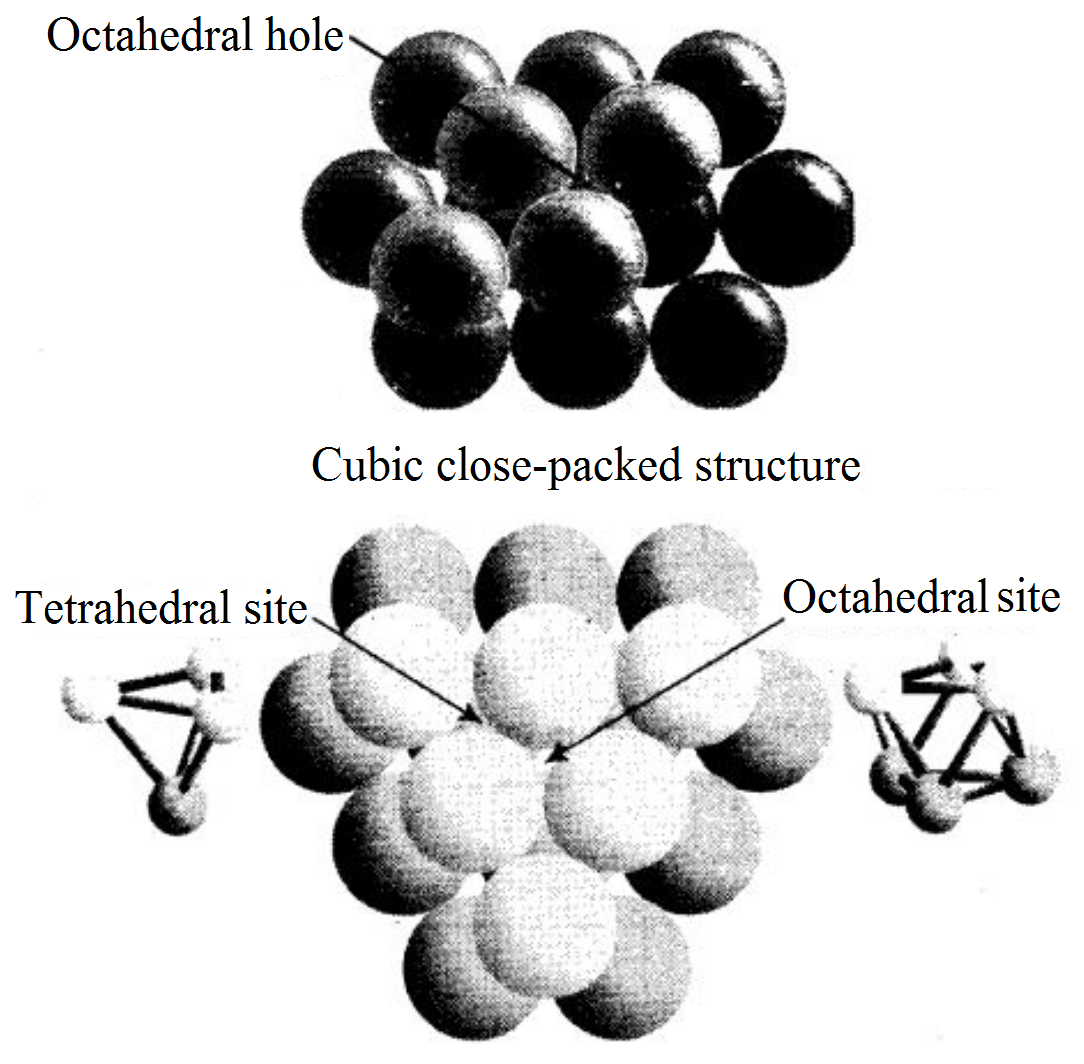
Which of the following is not true about the voids formed in $3$ dimensional hexagonal close packed structure?
$a.$ A tetrahedral void is formed when a sphere of the second layer is present above triangular void in the first layer.
$b.$ All the triangular voids are not covered by the spheres of the second layer.
$c.$ Tetrahedral voids are formed when the triangular voids in the second layer lie above the triangular voids in the first layer and the triangular shapes of these voids do not overlap.
$d.$ Octahedral voids are formed when the triangular voids in the second layer exactly overlap with similar voids in the first layer.
  • A
    $a$ and $b$
  • B
    $a$ and $c$
  • C
    $b$ and $c$
  • $c$ and $d$
Answer
Correct option: D.
$c$ and $d$
Tetrahedral voids are formed when the triangular void in the second layer lie exactly above the triangular voids in the first layer and the triangular shape of these voids oppositely overlap.

Octahedral voids are formed when triangular void of second layer is not exactly overlap with similar void in first layer.

View full question & answer
MCQ 1461 Mark
The crystal system possess by $\mathrm{K}_2 \mathrm{Cr}_2 \mathrm{O}_7$​ is:
  • A
    Tetragonal
  • B
    Cube
  • C
    Hexagonal
  • Triclinic
Answer
Correct option: D.
Triclinic
The crystal system possessed by $\mathrm{K}_2 \mathrm{Cr}_2 \mathrm{O}_7$​ is Triclinic. It has been determined by single$-$crystal $X−$ray diffraction.
View full question & answer
MCQ 1471 Mark
Which of the following is not true about the ionic solids?
  • A
    Bigger ions form the close packed structure.
  • B
    Smaller ions occupy either the tetrahedral or the octahedral voids depending upon their size.
  • C
    Occupation of all the voids is not necessary.
  • The fraction of octahedral or tetrahedral voids occupied depends upon the radii of the ions occupying the voids.
Answer
Correct option: D.
The fraction of octahedral or tetrahedral voids occupied depends upon the radii of the ions occupying the voids.
The fraction of octahedral or tetrahedral voids occupied depends upon the radii of the ions present at the lattice points. As we know the radii of octahedral or tetrahedral void is related to radii of atoms $(r)$ as Radius of octahedral void $(R_0) = 0.414r.$
Radius of tetrahedral void $(R_1) = 0.225r$ Where$, r =$ radius of bigger atom involved.
View full question & answer
MCQ 1481 Mark
Which is correct statement?
  • A
    Schottky defect occurs when radius of cation is smaller
  • When temperature increases then number of defects decreases
  • C
    Frenkel defect occurs when radius of cation is smaller
  • D
    None of these
Answer
Correct option: B.
When temperature increases then number of defects decreases
As temperature and number of defects are inversely propotional, with increase in temperature number of defects decreases.
In schottky effect, size of ions are almost same while in frenkel defect, size of cation is small.
View full question & answer
MCQ 1491 Mark
Crystal system in which maximum number of Bravais lattices are possible is:
  • A
    Cubic
  • B
    Triclinic
  • Orthorhombic
  • D
    Rhombohedral
Answer
Correct option: C.
Orthorhombic
Orthorhombic crystal system has all four lattices i.e. primitive, body$-$centered, face$-$centered and end$-$centered.
View full question & answer
MCQ 1501 Mark
Which of the following defects is also known as dislocation defect?
  • Frenkel defect.
  • B
    Schottky defect.
  • C
    Non$-$stoichiometric defect.
  • D
    Simple interstitial defect.
Answer
Correct option: A.
Frenkel defect.
In Frenkel defect, some cations occupy interstitial site and hence it is also called dislocation defect.
View full question & answer
M.C.Q (1 Marks) - Page 3 - Chemistry STD 12 Science Questions - Vidyadip