MCQ 511 Mark
A sinusoidal ac current flows through a resistor of resistance $R$. If the peak current is $I_p$, then the power dissipated is
- A
$I_p^2 R \cos \theta$
- ✓
$\frac{1}{2} I_p^2 R$
- C
$\frac{4}{\pi} I_p^2 R$
- D
$\frac{1}{\pi} I_p^2 R$
AnswerCorrect option: B. $\frac{1}{2} I_p^2 R$
(b) Power $=I^2 R=\left(\frac{I_p}{\sqrt{2}}\right)^2 R=\frac{I_p^2 R}{2}$
View full question & answer→MCQ 521 Mark
The peak value of an alternating e.m.f. $E$ is given by $E=E_0 \cos \omega t$ is 10 volts and its frequency is $50 Hz$. At time $t=\frac{1}{600} sec$, the instantaneous e.m.f. is
- A
$10 V$
- ✓
$5 \sqrt{3} V$
- C
$5 V$
- D
$1 V$
AnswerCorrect option: B. $5 \sqrt{3} V$
$E=E_0 \cos \omega t=E_0 \cos \frac{2 \pi t}{T} $
$ =10 \cos \frac{2 \pi \times 50 \times 1}{600}=10 \cos \frac{\pi}{6}=5 \sqrt{3} \text{volt. }$
View full question & answer→MCQ 531 Mark
A $20$ volts ac is applied to a circuit consisting of a resistance and a coil with negligible resistance. If the voltage across the resistance is $12\ V$, the voltage across the coil is
- ✓
$16$ volts
- B
$10$ volts
- C
$8$ volts
- D
$6$ volts
AnswerCorrect option: A. $16$ volts
The voltage across a $L-R$ combination is given by
$ V^2=V_R^2+V_L^2$
$ V_L=\sqrt{V^2-V_R^2}$
$=\sqrt{400-144}=\sqrt{256}=16 \text { volt. }$
View full question & answer→MCQ 541 Mark
In $L C R$ circuit, the capacitance is changed from $C$ to $4 C$. For the same resonant frequency, the inductance should be changed from $L$ to
- A
$2 L$
- B
$L / 2$
- ✓
$L / 4$
- D
$4 L$
AnswerCorrect option: C. $L / 4$
$ \omega=\frac{1}{\sqrt{L_1 C_1}}=\frac{1}{\sqrt{L_2 C_2}} \Rightarrow L_2=\frac{L_1}{4}$
View full question & answer→MCQ 551 Mark
Choke coil works on the principle of
MCQ 561 Mark
The maximum value of a.c. voltage in a circuit is $707 V$. Its $r m s$ value is
- A
$70.7 \ V$
- B
$100 \ V$
- ✓
$500\ V$
- D
$707\ V$
AnswerCorrect option: C. $500\ V$
$E_{r m s}=\frac{E_0}{\sqrt{2}}=\frac{707}{1.41}=500 \mathrm{~V}$
View full question & answer→MCQ 571 Mark
A $280$ ohm electric bulb is connected to $200 V$ electric line. The peak value of current in the bulb will be
View full question & answer→MCQ 581 Mark
The inductive reactance of an inductor of $\frac{1}{\pi}$ henry at $50 Hz$ frequency is
- A
$\frac{50}{\pi} ohm$
- ✓
$\frac{\pi}{50} ohm$
- C
$100 ohm$
- D
$50 ohm$
AnswerCorrect option: B. $\frac{\pi}{50} ohm$
View full question & answer→MCQ 591 Mark
A resistance of $20 ohms$ is connected to a source of an alternating potential $V=220 \sin (100 \pi t)$. The time taken by the current to change from its peak value to r.m.s value is
- A
$0.2 sec$
- B
$0.25 sec$
- C
$25 \times 10^{-3} sec$
- ✓
$2.5 \times 10^{-3} sec$
AnswerCorrect option: D. $2.5 \times 10^{-3} sec$
(d) Peak value to r.m.s. value means, current becomes $\frac{1}{\sqrt{2}}$ times.So from
$i=i_0 \sin 100 \pi t \Rightarrow \frac{1}{\sqrt{2}} \times i_0=i_0 \sin 100 \pi t$
$\Rightarrow \sin \frac{\pi}{4}=\sin 100 \pi t \Rightarrow t=\frac{1}{400} \mathrm{sec}=2.5 \times 10^{-3} \mathrm{sec} .$
View full question & answer→MCQ 601 Mark
A resistance of $40$ ohm and an inductance of $95.5$ millihenry are connected in series in a $50$ cycles/second ac circuit. The impedance of this combination is very nearly
- A
$30$ ohm
- B
$40$ ohm
- ✓
$50$ ohm
- D
$60$ ohm
AnswerCorrect option: C. $50$ ohm
$50$ ohm
View full question & answer→MCQ 611 Mark
The frequency for which a $5 \mu F$ capacitor has a reactance of $\frac{1}{1000}$ ohm is given by
- A
$\frac{100}{\pi} MHz$
- B
$\frac{1000}{\pi} H z$
- C
$\frac{1}{1000} H z$
- ✓
$1000 Hz$
AnswerCorrect option: D. $1000 Hz$
$1000 Hz$
View full question & answer→MCQ 621 Mark
In a $L-R$ circuit, the value of $L$ is $\left(\frac{0.4}{\pi}\right) h e n r y$ and the value of $R$ is $30 ohm$. If in the circuit, an alternating e.m.f. of $200 volt$ at 50 cycles per sec is connected, the impedance of the circuit and current will be
AnswerCorrect option: C. (c) $40.4 \Omega, 5 A$
(c) For series $R-L-C$ circuit, $Z=\sqrt{R^2+\left(X_L-X_C\right)^2}$$=\sqrt{(300)^2+\left(1000 \times 0.9-\frac{10^6}{1000 \times 2}\right)^2}=500 \Omega$
View full question & answer→MCQ 631 Mark
In a circuit, the value of the alternating current is measured by hot wire ammeter as 10 ampere. Its peak value will be
- A
$10 A$
- B
$20 A$
- ✓
$14.14 A$
- D
$7.07 A$
AnswerCorrect option: C. $14.14 A$
Hot wire ammeter reads $r m s$ value of current. Hence its peak value $=i_{r m s} \times \sqrt{2}=14.14 \mathrm{amp}$
View full question & answer→MCQ 641 Mark
An alternating e.m.f. is applied to purely capacitive circuit. The phase relation between e.m.f. and current flowing in the circuit is or In a circuit containing capacitance only
- A
e.m.f. is ahead of current by $\pi / 2$
- ✓
Current is ahead of e.m.f. by $\pi / 2$
- C
Current lags behind e.m.f. by $\pi$
- D
Current is ahead of e.m.f. by $\pi$
AnswerCorrect option: B. Current is ahead of e.m.f. by $\pi / 2$
(b) For purely capacitive circuit $e=e_0 \sin \omega t$ $i=i_o \sin \left(\omega t+\frac{\pi}{2}\right)$ i.e. current is ahead of emf by $\frac{\pi}{2}$
View full question & answer→MCQ 651 Mark
In a series $L C R$ circuit, operated with an ac of angular frequency $\omega$, the total impedance is
- A
(a) $\left[R^2+(L \omega-C \omega)^2\right]^{1 / 2}$
- ✓
(b) $\left[R^2+\left(L \omega-\frac{1}{C \omega}\right)^2\right]^{1 / 2}$
- C
(c) $\left[R^2+\left(L \omega-\frac{1}{C \omega}\right)^2\right]^{-1 / 2}$
- D
(d) $\left[(R \omega)^2+\left(L \omega-\frac{1}{C \omega}\right)^2\right]^{1 / 2}$
AnswerCorrect option: B. (b) $\left[R^2+\left(L \omega-\frac{1}{C \omega}\right)^2\right]^{1 / 2}$
(b) Reactance $=2 \pi \nu L \Rightarrow 100 \Omega=2 \times \frac{22}{7} \times 50 \times L$$\therefore L=0.32 \text { henry }$
View full question & answer→MCQ 661 Mark
$L, C$ and $R$ represent physical quantities inductance, capacitance and resistance respectively. The combination representing dimension of frequency is
AnswerCorrect option: C. $\left(\frac{L}{C}\right)^{-1 / 2}$
$\left(\frac{L}{C}\right)^{-1 / 2}$
View full question & answer→MCQ 671 Mark
A $10$ ohm resistance, $5 mH$ coil and $10 \mu F$ capacitor are joined in series. When a suitable frequency alternating current source is joined to this combination, the circuit resonates. If the resistance is halved, the resonance frequency
View full question & answer→MCQ 681 Mark
An alternating current source of frequency $100 Hz$ is joined to a combination of a resistance, a capacitance and a coil in series. The potential difference across the coil, the resistance and the capacitor is $46,8$ and $40$ volt respectively. The electromotive force of alternating current source in volt is
View full question & answer→MCQ 691 Mark
An ac generator produced an output voltage $E=170 \sin 377$ tvolts, where $t$ is in seconds. The frequency of ac voltage is
- A
$50 \ Hz$
- B
$110 \ Hz$
- ✓
$60\ Hz$
- D
$230\ Hz$
AnswerCorrect option: C. $60\ Hz$
$2 \pi v=377 \Rightarrow v=60.03 \mathrm{~Hz}$
View full question & answer→MCQ 701 Mark
A $120$ volt ac source is connected across a pure inductor of inductance $0.70$ henry. If the frequency of the source is $60\ Hz$, the current passing through the inductor is
Answer$ Z=X_L=2 \pi \times 60 \times 0.7 $
$ \therefore i=\frac{120}{Z}=\frac{120}{2 \pi \times 60 \times 0.7}=0.455 \text { ampere }$
View full question & answer→MCQ 711 Mark
A generator produces a voltage that is given by $V=240 \sin 120 t$, where $t$ is in seconds. The frequency and r.m.s. voltage are
- A
$60 Hz$ and $240 V$
- ✓
$19 Hz$ and $170 V$
- C
$19 Hz$ and $120 V$
- D
$754 Hz$ and $70 V$
AnswerCorrect option: B. $19 Hz$ and $170 V$
$ v=\frac{\omega}{2 \pi}=\frac{120 \times 7}{2 \times 22}=19 \mathrm{~Hz} $
$ V_{\text {r.m.s. }}=\frac{240}{\sqrt{2}}=120 \sqrt{2} \approx 170 \mathrm{~V}$
View full question & answer→MCQ 721 Mark
The r.m.s. value of an ac of $50 Hz$ is $10 amp$. The time taken by the alternating current in reaching from zero to maximum value and the peak value of current will be
- A
$2 \times 10^{\circ} sec$ and $14.14 amp$
- B
$1 \times 10^{-} sec$ and $7.07 amp$
- C
$5 \times 10 sec$ and $7.07 amp$
- ✓
$5 \times 10^{-3} sec$ and $14.14 \ amp$
AnswerCorrect option: D. $5 \times 10^{-3} sec$ and $14.14 \ amp$
(d) Time taken by the current to reach the maximum value
$ t=\frac{T}{4}=\frac{1}{4 v}=\frac{1}{4 \times 50}=5 \times 10^{-3} \mathrm{sec} $
$ \text { and } i_o=i_{m s} \sqrt{2}=10 \sqrt{2}=14.14 \mathrm{amp}$
View full question & answer→MCQ 731 Mark
Same current is flowing in two alternating circuits. The first circuit contains only inductance and the other contains only a capacitor. If the frequency of the e.m.f. of ac is increased, the effect on the value of the current will be
- A
Increases in the first circuit and decreases in the other
- B
Increases in both the circuits
- C
Decreases in both the circuits
- ✓
Decreases in the first circuit and increases in the other
AnswerCorrect option: D. Decreases in the first circuit and increases in the other
For the first circuit $i=\frac{V}{Z}=\frac{V}{\sqrt{R^2+\omega^2 L^2}}$
$\therefore$ Increase in $\omega$ will cause a decrease in $i$.
For the second circuit $i=\frac{V}{\sqrt{R^2+\frac{1}{\omega^2 C^2}}}$
$\therefore$ Increase in $\omega$ will cause an increase in $i$.
View full question & answer→MCQ 741 Mark
A $40\ \Omega$ electric heater is connected to a $200\ V, 50 \ Hz$ mains supply. The peak value of electric current flowing in the circuit is approximately
- A
$2.5\ A$
- B
$5.0\ A$
- ✓
$7\ A$
- D
$10\ A$
AnswerCorrect option: C. $7\ A$
$i_{r . m . s .}=\frac{V_{r . m . s .}}{R}=\frac{200}{40}=5 \mathrm{~A} $
$\Rightarrow i_0=i_{r . m . s .} \sqrt{2}=7.07 \mathrm{~A}$
View full question & answer→MCQ 751 Mark
In an ac circuit, $V$ and $l$ are given by $V=100 \sin (100 t)$ volts, $I=100 \sin \left(100 t+\frac{\pi}{3}\right) m A$. The power dissipated in circuit is
- A
$10$ watt
- B
$10$ watt
- ✓
$2.5$ watt
- D
$5$ watt
AnswerCorrect option: C. $2.5$ watt
$ P=V_{r . m . s .} \times i_{r . m . s .} \times \cos \phi=\frac{100}{\sqrt{2}} \times \frac{100 \times 10^{-3}}{\sqrt{2}} \times \cos \frac{\pi}{3} $
$ =\frac{10^4 \times 10^{-3}}{2} \times \frac{1}{2}=\frac{10}{4}=2.5 \mathrm{watt}$
View full question & answer→MCQ 761 Mark
A $220 V , 50 Hz$ ac source is connected to an inductance of $0.2 H$ and a resistance of $20$ ohm in series. What is the current in the circuit
- A
$10 A$
- B
$5 A$
- C
$33.3 A$
- ✓
$3.33 A$
AnswerCorrect option: D. $3.33 A$
$3.33 A$
View full question & answer→MCQ 771 Mark
If an ac main supply is given to be $220 V$. What would be the average e.m.f. during a positive half cycle
- ✓
$198 V$
- B
$386 V$
- C
$256 V$
- D
AnswerCorrect option: A. $198 V$
$ V_{a v}=\frac{2}{\pi} V_0=\frac{2}{\pi} \times\left(V_{r m s} \times \sqrt{2}\right)=\frac{2 \sqrt{2}}{\pi} \cdot V_{r m s} $
$ =\frac{2 \sqrt{2}}{\pi} \times 220=198 \mathrm{~V}$
View full question & answer→MCQ 781 Mark
Reactance of a capacitor of capacitance $C \mu F$ for ac frequency $\frac{400}{\pi} Hz$ is $25 \Omega$. The value $C$ is
- ✓
$50 \mu F$
- B
$25 \mu F$
- C
$100 \mu F$
- D
$75 \mu F$
AnswerCorrect option: A. $50 \mu F$
$50 \mu F$
View full question & answer→MCQ 791 Mark
The current in series $\text{LCR}$ circuit will be maximum when $\omega$ is
AnswerCorrect option: B. Equal o natural frequency of $\text{LCR}$ system
Equal o natural frequency of $\text{LCR}$ system
View full question & answer→MCQ 801 Mark
A coil has $L=0.04\ H$ and $R=12\ \Omega$. When it is connected to $220\ V , 50 \ Hz$ supply the current flowing through the coil, in amperes is
- A
$10.7$
- B
$11.7$
- C
$14.7$
- ✓
$12.7$
AnswerCorrect option: D. $12.7$
$ \text { Impedance } Z=\sqrt{R^2+4 \pi^2 v^2 L^2} $
$ =\sqrt{(12)^2+4 \times(3.14)^2 \times(50)^2 \times(0.04)}=17.37 \ A$
Now current $i=\frac{V}{Z}=\frac{220}{17.37}=12.7 \Omega$
View full question & answer→MCQ 811 Mark
A circuit has a resistance of $11\ \Omega$, an inductive reactance of $25\ \Omega$ and a capacitative resistance of $18\ \Omega$. It is connected to an ac source of $260 \ V$ and $50\ Hz$. The current through the circuit (in amperes) is
Answer$Z=\sqrt{R^2+\left(X_L-X_C\right)^2}=\sqrt{(11)^2+(25-18)^2}=13 \Omega$
$\text { Current } i=\frac{260}{13}=20 \mathrm{~A}$
View full question & answer→MCQ 821 Mark
A circuit has a resistance of $11 \Omega$, an inductive reactance of $25 \Omega$ and a capacitative resistance of $18 \Omega$. It is connected to an ac source of $260 V$ and $50 Hz$. The current through the circuit (in amperes) is
AnswerCorrect option: B. $R /\left(R^2+\omega L^2\right)^{1 / 2}$
$\cos \phi=\frac{R}{Z}=\frac{R}{\left(R^2+\omega L^2\right)^{1 / 2}}$
View full question & answer→MCQ 831 Mark
If an alternating voltage is represented as $\backslash(E=141 \backslash \sin (628 t ) \backslash)$, then the $\backslash( r m s \backslash)$ value of the voltage and the frequency are respectively
- A
$141 V , 628 Hz$
- B
$100 V , 50 Hz$
- ✓
$100 V , 100 Hz$
- D
$141 V , 100 Hz$
AnswerCorrect option: C. $100 V , 100 Hz$
$ E=141 \sin (628 t), $
$ E_{r m s}=\frac{E_0}{\sqrt{2}}=\frac{141}{1.41}=100 \mathrm{~V} \text { and } 2 \pi f=628 $
$ \Rightarrow f=100 \mathrm{~Hz}$
View full question & answer→MCQ 841 Mark
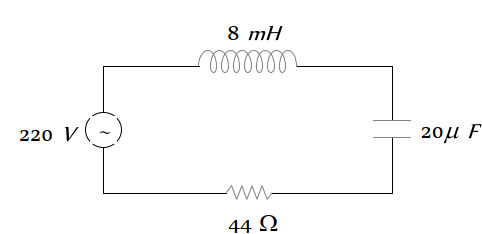
For the series LCR circuit shown in the figure, what is the resonance frequency and the amplitude of the current at the resonating frequency
- A
$2500 rad - s ^{-1}$ and $5 \sqrt{2} A$
- ✓
$2500 rad - s ^{-1}$ and $5 A$
- C
$2500 rad - s ^{-1}$ and $\frac{5}{\sqrt{2}} A$
- D
$25 rad - s ^{-1}$ and $5 \sqrt{2} A$
AnswerCorrect option: B. $2500 rad - s ^{-1}$ and $5 A$
(b) Resonance frequency
$ \omega=\frac{1}{\sqrt{L C}}=\frac{1}{\sqrt{8 \times 10^{-3} \times 20 \times 10^{-6}}}=2500 \mathrm{rad} / \mathrm{sec} $
$ \text { Resonance current }=\frac{V}{R}=\frac{220}{44}=5 \mathrm{~A}$
View full question & answer→MCQ 851 Mark
An oscillator circuit consists of an inductance of $0.5 mH$ and a capacitor of $20 \mu F$. The resonant frequency of the circuit is nearly
- A
$15.92 Hz$
- B
$159.2 Hz$
- ✓
$1592 Hz$
- D
$15910 Hz$
AnswerCorrect option: C. $1592 Hz$
$1592 Hz$
View full question & answer→MCQ 861 Mark
Voltage and current in an ac circuit are given by $V=5 \sin \left(100 \pi t-\frac{\pi}{6}\right)$ and $I=4 \sin \left(100 \pi t+\frac{\pi}{6}\right)$
- A
Voltage leads the current by $30^{\circ}$
- B
Current leads the voltage by $30^{\circ}$
- ✓
Current leads the voltage by $60^{\circ}$
- D
Voltage leads the current by $60^{\circ}$
AnswerCorrect option: C. Current leads the voltage by $60^{\circ}$
Phase difference $\Delta \phi=\phi_2-\phi_1=\frac{\pi}{6}-\left(\frac{-\pi}{6}\right)=\frac{\pi}{3}$
Current leads the voltage by $60^{\circ}$
View full question & answer→MCQ 871 Mark
In a series $\text{LCR}$ circuit, resistance $R=10 \Omega$ and the impedance $Z=20 \Omega$. The phase difference between the current and the voltage is
- A
$30^{\circ}$
- B
$45^{\circ}$
- ✓
$60^{\circ}$
- D
$90^{\circ}$
AnswerCorrect option: C. $60^{\circ}$
$60^{\circ}$
View full question & answer→MCQ 881 Mark
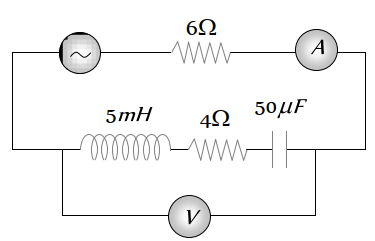
In the circuit shown in the figure, the ac source gives a voltage $V=20 \cos (2000 t)$. Neglecting source resistance, the voltmeter and ammeter reading will be
- A
$0 V , 0.47 A$
- B
$1.68 V , 0.47 A$
- C
$0 V, 1.4 A$
- D
$5.6 V , 1.4 A$
Answer$ Z=\sqrt{(R)^2+\left(X_L-X_C\right)^2} ; $
$ R=10 \Omega, X_L=\omega L=2000 \times 5 \times 10^{-3}=10 \Omega$
View full question & answer→MCQ 891 Mark
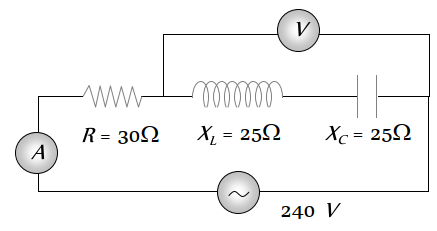
In the circuit shown in figure neglecting source resistance the voltmeter and ammeter reading will respectively, will be
- A
$0 V, 3 A$
- B
$150 V , 3 A$
- C
$150 V , 6 A$
- ✓
$0 V , 8 A$
AnswerCorrect option: D. $0 V , 8 A$
The voltage $V_L$ and $V_C$ are equal and opposite so voltmeter reading will be zero.
Also $R=30 \Omega, X_L=X_C=25 \Omega$
So $i=\frac{V}{\sqrt{R^2+\left(X_L-X_C\right)^2}}=\frac{V}{R}=\frac{240}{30}=8 \mathrm{~A}$
View full question & answer→MCQ 901 Mark
In an ac circuit the reactance of a coil is $\sqrt{3}$ times its resistance, the phase difference between the voltage across the coil to the current through the coil will be
- ✓
$\pi / 3$
- B
$\pi / 2$
- C
$\pi / 4$
- D
$\pi / 6$
AnswerCorrect option: A. $\pi / 3$
In LCR circuit; in the condition of resonance $X_L=X_C$
i.e. circuit behaves as resistive circuit. In resistive circuit power factor is maximum.
View full question & answer→MCQ 911 Mark
In a $L C R$ circuit the pd between the terminals of the inductance is $60 V$, between the terminals of the capacitor is $30 V$ and that between the terminals of resistance is $40 V$. the supply voltage will be equal to ......
- ✓
$50\ V$
- B
$70\ V$
- C
$130\ V$
- D
$10\ V$
AnswerCorrect option: A. $50\ V$
$V=\sqrt{V_R^2+\left(V_L-V_C\right)^2}$
$=\sqrt{(40)^2+(60-30)^2}=50 \mathrm{~V}$
View full question & answer→MCQ 921 Mark
In a series resonant circuit, the ac voltage across resistance $R$, inductance $L$ and capacitance $C$ are $5 V, 10 V$ and $10 V$ respectively. The ac voltage applied to the circuit will be
- A
$20 V$
- B
$10 V$
- ✓
$5 V$
- D
$25 V$
View full question & answer→MCQ 931 Mark
In an ac circuit, peak value of voltage is $423$ volts. Its effective voltage is
- A
$400$ volts
- B
$323$ volts
- ✓
$300$ volts
- D
$340$ volts
AnswerCorrect option: C. $300$ volts
Effective voltage $V_{\text {r.m.s. }}=\frac{V_o}{\sqrt{2}}=\frac{423}{\sqrt{2}}=300 \mathrm{~V}$
View full question & answer→MCQ 941 Mark
When an ac source of e.m.f. $e=E_0 \sin (100 t)$ is connected across a circuit, the phase difference between the e.m.f. $e$ and the current $i$ in the circuit is observed to be $\pi / 4$, as shown in the diagram. If the circuit consists possibly only of $R C$ or $L C$ in series, find the relationship between the two elements 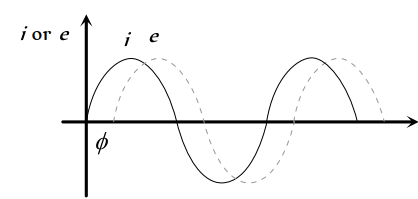
- ✓
(a) $R=1 k \Omega, C=10 \mu F$
- B
(b) $R=1 k \Omega, C=1 \mu F$
- C
(c) $R=1 k \Omega, L=10 H$
- D
(d) $\quad R=1 k \Omega, L=1 H$
AnswerCorrect option: A. (a) $R=1 k \Omega, C=10 \mu F$
(a) As the current $i$ leads the voltage by $\frac{\pi}{4}$, it is an $R C$ circuit, hence$\begin{aligned}& \tan \phi=\frac{X_C}{R} \Rightarrow \tan \frac{\pi}{4}=\frac{1}{\omega C R} \\& \Rightarrow \omega C R=1 \text { as } \omega=100 \mathrm{rad} / \mathrm{sec}\end{aligned}$$\Rightarrow C R=\frac{1}{100} \sec ^{-1} \text {. }$From all the given options only option (a) is correct.
View full question & answer→MCQ 951 Mark
The graphs given below depict the dependence of two reactive impedances $X$ and $X$ on the frequency of the alternating e.m.f. applied individually to them. We can then say that
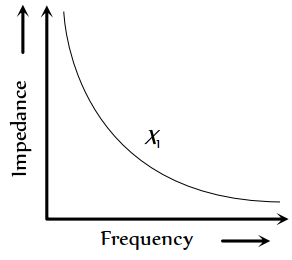
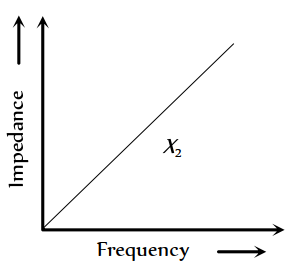
- A
$X$ is an inductor and $X$ is a capacitor
- B
$X$ is a resistor and $X$ is a capacitor
- ✓
$X$ is a capacitor and $X$ is an inductor
- D
$X$ is an inductor and $X$ is a resistor
AnswerCorrect option: C. $X$ is a capacitor and $X$ is an inductor
We have $X_C=\frac{1}{C \times 2 \pi f}$ and $X_L=L \times 2 \pi f$
View full question & answer→MCQ 961 Mark
In an ac circuit $l=100 \sin 200 \pi t$. The time required for the current to achieve its peak value will be
- A
$\frac{1}{100} \sec$
- B
$\frac{1}{200} \sec$
- C
$\frac{1}{300} \sec$
- ✓
$\frac{1}{400} \sec$
AnswerCorrect option: D. $\frac{1}{400} \sec$
The current takes $\frac{T}{4} \sec$ to reach the peak value.In the given question
$\frac{2 \pi}{T}=200 \pi \Rightarrow T=\frac{1}{100} \mathrm{sec}$
$\therefore$ Time to reach the peak value $=\frac{1}{400} \mathrm{sec}$
View full question & answer→MCQ 971 Mark
The average power dissipation in a pure capacitance in ac circuit is
- A
$\frac{1}{2} C V^2$
- B
$C V^2$
- C
$\frac{1}{4} C V^2$
- ✓
$0$
AnswerAverage power in ac circuits is given by $P=V_{r m s} i_{r m s} \cos \phi$
For pure capacitive circuit $\phi=90^{\circ}$ so $P=0$
View full question & answer→MCQ 981 Mark
Which of the following components of a LCR circuit, with ac supply, dissipates energy
MCQ 991 Mark
Power delivered by the source of the circuit becomes maximum, when
- A
$\omega L=\omega C$
- ✓
$\omega L=\frac{1}{\omega C}$
- C
$\omega L=-\left(\frac{1}{\omega C}\right)^2$
- D
$\omega L=\sqrt{\omega C}$
AnswerCorrect option: B. $\omega L=\frac{1}{\omega C}$
View full question & answer→MCQ 1001 Mark
An inductor $L$ and a capacitor $C$ are connected in the circuit as shown in the figure. The frequency of the power supply is equal to the resonant frequency of the circuit. Which ammeter will read zero ampere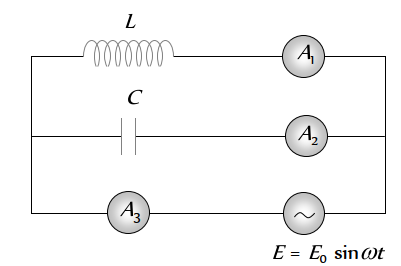
View full question & answer→