Question types

Current Electricity question types

445 questions across 2 question groups — pick any mix to generate a JEE physics paper with step-by-step answer keys.

445
Questions
2
Question groups
5
Question types
Sample Questions

Current Electricity questions

One sample from each question group in this chapter. Select any group above to see the full set with answer keys.

Assertion : The resistivity of a semiconductor increases with temperature.
Reason : The atoms of a semiconductor vibrate with larger amplitude at higher temperatures thereby increasing its resistivity\
View full solution
Assertion : In a simple battery circuit the point of lowest potential is positive terminal of the battery
Reason : The current flows towards the point of the higher potential as it flows in such a circuit from the negative to the positive terminal.
View full solution
Assertion : The temperature coefficient of resistance is positive for metals and negative for $p$-type semiconductor.
Reason : The effective charge carriers in metals are negatively charged whereas in $p$-type semiconductor they are positively charged.
View full solution
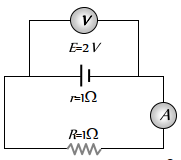
Assertion : In the following circuit emf is $2 \mathrm{~V}$ and internal resistance of the cell is $1 \Omega$ and $R=1 \Omega$, then reading of the voltmeter is $1 V$.

Image
Reason $\quad: V=E-i r$ where $E=2 V, i=\frac{2}{2}=1 A$ and $R=$ $1 \Omega$

View full solution
Q 6MCQ1 Mark
The following four wires are made of the same material and are at the same temperature. Which one of them has highest electrical resistance
  • Length $=50 \mathrm{~cm}$, diameter $=0.5 \mathrm{~mm}$
  • B
    Length $=100 \mathrm{~cm}$, diameter $=1 \mathrm{~mm}$
  • C
    Length $=200 \mathrm{~cm}$, diameter $=2 \mathrm{~mm}$
  • D
    Length $=300 \mathrm{~cm}$, diameter $=3 \mathrm{~mm}$

Answer: A.

View full solution
Q 7MCQ1 Mark
A wire of diameter $0.02$ metre contains $10-$ free electrons per cubic metre. For an electrical current of $100 \mathring A$, the drift velocity of the free electrons in the wire is nearly
  • A
    $1 \times 10^{-3} \mathrm{m} / \mathrm{s}$
  • B
    $5 \times 10^{-6} \mathrm{m} / \mathrm{s}$
  • $2 \times 10^{-4} . \mathrm{m} / \mathrm{s}$
  • D
    $8 \times 10 \mathrm{~m} / \mathrm{s}$

Answer: C.

View full solution
Q 8MCQ1 Mark
A voltmeter essentially consists of
  • A high resistance, in series with a galvanometer
  • B
    A low resistance, in series with a galvanometer
  • C
    A high resistance in parallel with a galvanometer
  • D
    A low resistance in parallel with a galvanometer

Answer: A.

View full solution
Q 9MCQ1 Mark
At room temperature, copper has free electron density of $8.4 \times 10^{28}$ per $\mathrm{m}^3$. The copper conductor has a cross-section of 10. $m$ and carries a current of $5.4 \mathrm{~A}$. The electron drift velocity in copper is
  • A
    $400 \mathrm{~m} / \mathrm{s}$
  • B
    $0.4 \mathrm{~m} / \mathrm{s}$
  • $0.4 \mathrm{~mm} / \mathrm{s}$
  • D
    $72 \mathrm{~m} / \mathrm{s}$

Answer: C.

View full solution
Q 10MCQ1 Mark
A $36\  \Omega$ galvanometer is shunted by resistance of $4 \ \Omega$. The percentage of the total current, which passes through the galvanometer is
  • A
    $8 \%$
  • B
    $9 \%$
  • $10 \%$
  • D
    $91 \%$

Answer: C.

View full solution

Generate a Current Electricity paper free

Pick question groups from the list above, set marks and difficulty, and export a branded PDF with step-by-step answer keys. First 3 chapters free — no signup.

Download App