MCQ 11 Mark
The following four wires are made of the same material and are at the same temperature. Which one of them has highest electrical resistance
- ✓
Length $=50 \mathrm{~cm}$, diameter $=0.5 \mathrm{~mm}$
- B
Length $=100 \mathrm{~cm}$, diameter $=1 \mathrm{~mm}$
- C
Length $=200 \mathrm{~cm}$, diameter $=2 \mathrm{~mm}$
- D
Length $=300 \mathrm{~cm}$, diameter $=3 \mathrm{~mm}$
AnswerCorrect option: A. Length $=50 \mathrm{~cm}$, diameter $=0.5 \mathrm{~mm}$
Length $=50 \mathrm{~cm}$, diameter $=0.5 \mathrm{~mm}$
View full question & answer→MCQ 21 Mark
A wire of diameter $0.02$ metre contains $10-$ free electrons per cubic metre. For an electrical current of $100 \mathring A$, the drift velocity of the free electrons in the wire is nearly
- A
$1 \times 10^{-3} \mathrm{m} / \mathrm{s}$
- B
$5 \times 10^{-6} \mathrm{m} / \mathrm{s}$
- ✓
$2 \times 10^{-4} . \mathrm{m} / \mathrm{s}$
- D
$8 \times 10 \mathrm{~m} / \mathrm{s}$
AnswerCorrect option: C. $2 \times 10^{-4} . \mathrm{m} / \mathrm{s}$
$ \text { By using } v_d=\frac{i}{n e A}=\frac{100}{10^{28} \times 1.6 \times 10^{-19} \times \frac{\pi}{4} \times(0.02)^2}$
$ =2 \times 10^{-4} \mathrm{~m} / \mathrm{sec}$
View full question & answer→MCQ 31 Mark
A voltmeter essentially consists of
- ✓
A high resistance, in series with a galvanometer
- B
A low resistance, in series with a galvanometer
- C
A high resistance in parallel with a galvanometer
- D
A low resistance in parallel with a galvanometer
AnswerCorrect option: A. A high resistance, in series with a galvanometer
View full question & answer→MCQ 41 Mark
At room temperature, copper has free electron density of $8.4 \times 10^{28}$ per $\mathrm{m}^3$. The copper conductor has a cross-section of 10. $m$ and carries a current of $5.4 \mathrm{~A}$. The electron drift velocity in copper is
- A
$400 \mathrm{~m} / \mathrm{s}$
- B
$0.4 \mathrm{~m} / \mathrm{s}$
- ✓
$0.4 \mathrm{~mm} / \mathrm{s}$
- D
$72 \mathrm{~m} / \mathrm{s}$
AnswerCorrect option: C. $0.4 \mathrm{~mm} / \mathrm{s}$
$V_d=\frac{i}{n A e}=\frac{5.4}{8.4 \times 10^{28} \times 10^{-6} \times 1.6 \times 10^{-19}}$
$ =0.4 \times 10^{-3} \mathrm{~m} / \mathrm{sec}=0.4 \mathrm{~mm} / \mathrm{sec} .$
View full question & answer→MCQ 51 Mark
A $36\ \Omega$ galvanometer is shunted by resistance of $4 \ \Omega$. The percentage of the total current, which passes through the galvanometer is
- A
$8 \%$
- B
$9 \%$
- ✓
$10 \%$
- D
$91 \%$
AnswerCorrect option: C. $10 \%$
(c) $\frac{i_g}{i}=\frac{S}{G+S}=\frac{4}{36+4}=\frac{1}{10}$ i.e. $10 \%$.
View full question & answer→MCQ 61 Mark
A Daniel cell is balanced on $125 \mathrm{~cm}$ length of a potentiometer wire. Now the cell is short-circuited by a resistance $2 \mathrm{ohm}$ and the balance is obtained at $100 \mathrm{~cm}$. The internal resistance of the Daniel cell is
- ✓
$0.5 \mathrm{ohm}$
- B
$1.5 \mathrm{ohm}$
- C
$1.25 \mathrm{ohm}$
- D
$4 / 5 \mathrm{ohm}$
AnswerCorrect option: A. $0.5 \mathrm{ohm}$
(a) $r=\left(\frac{l_1-l_2}{l_2}\right) R=\left(\frac{25}{100}\right) 2=0.5 \Omega$
View full question & answer→MCQ 71 Mark
Voltmeters $V$ and $V$ are connected in series across a D.C. line. $V$ reads 80 volts and has a per volt resistance of $200$ ohms. $V$ has a total resistance of $32$ kilo ohms. The line voltage is
- A
$120$ volts
- B
$160$ volts
- C
$220$ volts
- ✓
$240$ volts
AnswerCorrect option: D. $240$ volts
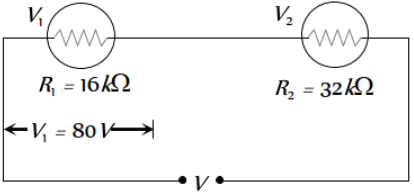
$R_1=80 \times 200=16000 \Omega=16 k \Omega$
Current flowing through $V_1=$ Current flowing through $V_2=$
$\frac{80}{16 \times 10^3}=5 \times 10^{-3} A$
So, potential differences across $V_2$ is
$V_2=5 \times 10^{-3} \times 32 \times 10^3=160 \text { volt }$
Hence, line voltage $V=V_1+V_2=80+160=240 V$. View full question & answer→MCQ 81 Mark
The conductivity of a superconductor is
Answer(d) Resistivity depends only on the material of the conductor.
View full question & answer→MCQ 91 Mark
For a cell of e.m.f. $2 \mathrm{~V}$, a balance is obtained for $50 \mathrm{~cm}$ of the potentiometer wire. If the cell is shunted by a $2 \Omega$ resistor and the balance is obtained across $40 \mathrm{~cm}$ of the wire, then the internal resistance of the cell is
- A
$0.25 \Omega$
- ✓
$0.50 \Omega$
- C
$0.80 \Omega$
- D
$1.00 \Omega$
AnswerCorrect option: B. $0.50 \Omega$
(b) $r=\left(\frac{l_1-l_2}{l_1}\right) R=0.5 \Omega$.
View full question & answer→MCQ 101 Mark
A microammeter has a resistance of $100 \Omega$ and full scale range of $50 \mu \mathrm{A}$. It can be used as a voltmeter or as a higher range ammeter provided a resistance is added to it. Pick the correct range and resistance combination
- A
$50 \mathrm{~V}$ range with $10 \mathrm{k} \Omega$ resistance in series
- ✓
$10 \mathrm{~V}$ range with $200 \mathrm{k} \Omega$ resistance in series
- C
$10 \mathrm{~mA}$ range with $1 \Omega$ resistance in parallel
- D
$10 \mathrm{~mA}$ range with $0.1 \Omega$ resistance in parallel
AnswerCorrect option: B. $10 \mathrm{~V}$ range with $200 \mathrm{k} \Omega$ resistance in series
$10 \mathrm{~V}$ range with $200 \mathrm{k} \Omega$ resistance in series
View full question & answer→MCQ 111 Mark
A voltmeter of resistance $1000 \Omega$ gives full scale deflection when a current of $100 \mathrm{~mA}$ flow through it. The shunt resistance required across it to enable it to be used as an ammeter reading $1 A$ at full scale deflection is
- A
$10000 \Omega$
- B
$9000 \Omega$
- C
$222 \Omega$
- ✓
$111 \Omega$
AnswerCorrect option: D. $111 \Omega$
$ \text { By using } \frac{i}{i_g}=1+\frac{G}{S} $
$ \Rightarrow \frac{i}{100 \times 10^{-3}}=1+\frac{1000}{S} \Rightarrow S=\frac{1000}{9}=111 \Omega$
View full question & answer→MCQ 121 Mark
In a potentiometer experiment, the galvanometer shows no deflection when a cell is connected across $60 \mathrm{~cm}$ of the potentiometer wire. If the cell is shunted by a resistance of $6 \Omega$, the balance is obtained across $50 \mathrm{~cm}$ of the wire. The internal resistance of the cell is
- A
$0.5 \Omega$
- B
$0.6 \Omega$
- ✓
$1.2 \Omega$
- D
$1.5 \Omega$
AnswerCorrect option: C. $1.2 \Omega$
(c) $r=\frac{\left(l_1-l_2\right)}{l_2} \times R^{\prime}=\left(\frac{60-50}{50}\right) \times 6=1.2 \Omega$
View full question & answer→MCQ 131 Mark
A current of $1 \mathrm{~mA}$ is flowing through a copper wire. How many electrons will pass a given point in one second $\left[e=1.6 \times 10^{-19}\right.$Coulomb $]$
- A
$6.25 \times 10^{19}$
- ✓
$6.25 \times 10^{15}$
- C
$6.25 \times 10^{31}$
- D
$6.25 \times 10^8$
AnswerCorrect option: B. $6.25 \times 10^{15}$
(b) $n=\frac{1 \times 10^{-3}}{1.6 \times 10^{-19}}=6.25 \times 10^{15}$.
View full question & answer→MCQ 141 Mark
A battery having $\text{e.m.f.}\ 5 V$ and internal resistance $0.5 \Omega$ is connected with a resistance of $4.5 \Omega$ then the voltage at the terminals of battery is
- ✓
$4.5 \mathrm{~V}$
- B
$4 V$
- C
$0 \mathrm{~V}$
- D
$2 \mathrm{~V}$
AnswerCorrect option: A. $4.5 \mathrm{~V}$
$4.5 \mathrm{~V}$
View full question & answer→MCQ 151 Mark
$1.6 \mathrm{~mA}$ current is flowing in conducting wire then the number of electrons flowing per second is
- A
$10^{15}$
- ✓
$10^{16}$
- C
$10^{-9}$
- D
$10^{-6}$
AnswerCorrect option: B. $10^{16}$
$i=\frac{n e}{t} \Rightarrow n=\frac{i t}{e}=\frac{1.6 \times 10^{-3} \times 1}{1.6 \times 10^{-19}}=10^{16}$.
View full question & answer→MCQ 161 Mark
$20 \mu \mathrm{A}$ current flows for 30 seconds in a wire, transfer of charge will be
- A
$2 \times 10^{-4} \mathrm{C}$
- B
$4 \times 10^{-4} \mathrm{C}$
- ✓
$6 \times 10^{-4} \mathrm{C}$
- D
$8 \times 10^{-4} \mathrm{C}$
AnswerCorrect option: C. $6 \times 10^{-4} \mathrm{C}$
(c) $Q=i t=20 \times 10 \times 30=6 \times 10^{-4} \cdot C$
View full question & answer→MCQ 171 Mark
Two rods of same material and length have their electric resistance in ratio $1: 2$. When both rods are dipped in water, the correct statement will be
- A
$A$ has more loss of weight
- ✓
$B$ has more loss of weight
- C
Both have same loss of weight
- D
Loss of weight will be in the ratio $1: 2$
AnswerCorrect option: B. $B$ has more loss of weight
$B$ has more loss of weight
View full question & answer→MCQ 181 Mark
In the diagram shown, the reading of voltmeter is $20 \mathrm{~V}$ and that of ammeter is $4 A$. The value of $R$ should be (Consider given ammeter and voltmeter are not ideal)
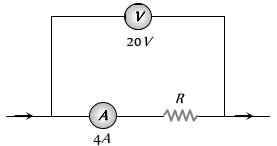
AnswerCorrect option: C. Less than $5 \Omega$
(c) If resistance of ammeter is $r$ then$20=(R+r) 4 \Rightarrow R+r=5 \Rightarrow R<5 \Omega$
View full question & answer→MCQ 191 Mark
Kirchhoff's second law is based on the law of conservation of
MCQ 201 Mark
An ammeter of $100\ \Omega$ resistance gives full deflection for the current of $10$ amp. Now the shunt resistance required to convert it into ammeter of $1$ amp. range, will be
- A
$10^{-4} \Omega$
- B
$10^{-5} \Omega$
- ✓
$10^{-3} \Omega$
- D
$10^{-1} \Omega$
AnswerCorrect option: C. $10^{-3} \Omega$
(c) $\frac{i}{i_g}=1+\frac{G}{S} \Rightarrow \frac{1}{10^{-5}}=1+\frac{100}{S} \Rightarrow S \approx \frac{100}{10^5}=10^{-3} \Omega$.
View full question & answer→MCQ 211 Mark
Two wires $A$ and $B$ of same material and same mass have radius 2 rand $r$. If resistance of wire $A$ is $34 \Omega$, then resistance of $B$ will be
- A
$544 \Omega$
- B
$272 \Omega$
- C
$68 \Omega$
- ✓
$17 \Omega$
AnswerCorrect option: D. $17 \Omega$
View full question & answer→MCQ 221 Mark
The resistance of $10$ metre long potentiometer wire is $1 \mathrm{ohm} /$ meter: A cell of e.m.f. $2.2$ volts and a high resistance box are connected in series to this wire. The value of resistance taken from resistance box for getting potential gradient of $2.2$ millivolt/metre will be
- A
$790 \Omega$
- B
$810 \Omega$
- ✓
$990 \Omega$
- D
$1000 \Omega$
AnswerCorrect option: C. $990 \Omega$
$ \text { Potential gradient } x=\frac{V}{L}=\frac{e}{\left(R+R_h+r\right)} \cdot \frac{R}{L}$
$ \Rightarrow 2.2 \times 10^{-3}=\frac{2.2}{\left(10+R_h\right)} \times 1 \Rightarrow R^{\prime}=990 \Omega$
View full question & answer→MCQ 231 Mark
If the resistivity of a potentiometer wire be and area of cross section be $A$, then what will be potential gradient along the wire
- ✓
$\frac{I \rho}{A}$
- B
$\frac{I}{A \rho}$
- C
$\frac{I A}{\rho}$
- D
$I A \rho$
AnswerCorrect option: A. $\frac{I \rho}{A}$
(a) Potential gradient $x=\frac{V}{L}=\frac{i R}{L}=\frac{i\left(\frac{\rho L}{A}\right)}{L}=\frac{i \rho}{A}$
View full question & answer→MCQ 241 Mark
A current $l$ is passing through a wire having two sections $P$ and $Q$ of uniform diameters $d$ and $d / 2$ respectively. If the mean drift velocity of electrons in sections $P$ and $Q$ is denoted by $v$ and $v_4$ respectively, then
- A
$v=v$
- B
$v=\frac{1}{2} v$
- ✓
$v=\frac{1}{4} v_4$
- D
$v=2 v$
AnswerCorrect option: C. $v=\frac{1}{4} v_4$
$\text { Drift velocity } v_d=\frac{i}{n e A} \Rightarrow v_d \propto \frac{1}{A} \text { or } v_d \propto \frac{1}{d^2} $
$ \Rightarrow \frac{v_P}{v_Q}=\left(\frac{d_Q}{d_P}\right)^2=\left(\frac{d / 2}{d}\right)^2=\frac{1}{4} \Rightarrow v_P=\frac{1}{4} v_Q.$
View full question & answer→MCQ 251 Mark
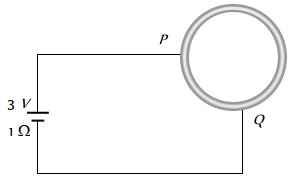
A wire of resistance $10 \Omega$ is bent to form a circle. $P$ and $Q$ are points on the circumference of the circle dividing it into a quadrant and are connected to a Battery of $3 V$ and internal resistance $1 \Omega$ as shown in the figure. The currents in the two parts of the circle are
- ✓
$\frac{6}{23} A$ and $\frac{18}{23} A$
- B
$\frac{5}{26} A$ and $\frac{15}{26} \mathrm{~A}$
- C
$\frac{4}{25} \mathrm{~A}$ and $\frac{12}{25} \mathrm{~A}$
- D
$\frac{3}{25} A$ and $\frac{9}{25} A$
AnswerCorrect option: A. $\frac{6}{23} A$ and $\frac{18}{23} A$
View full question & answer→MCQ 261 Mark
An ammeter with internal resistance $90 \Omega$ reads $1.85 A$ when connected in a circuit containing a battery and two resistors $700 \Omega$ and $410 \Omega$ in series. Actual current will be
AnswerCorrect option: B. Greater than $1.85 \mathrm{~A}$
(b) In general, ammeter always reads less than the actual value because of its resistance.
View full question & answer→MCQ 271 Mark
The resistance of a wire is $R$. If the length of the wire is doubled by stretching, then the new resistance will be
- A
$2 R$
- ✓
$4 R$
- C
$R$
- D
$\frac{R}{4}$
View full question & answer→MCQ 281 Mark
The current flowing through a coil of resistance $900 \mathrm{ohms}$ is to be reduced by $90 \%$. What value of shunt should be connected across the coil
- A
$90 \Omega$
- ✓
$100 \Omega$
- C
$9 \Omega$
- D
$10 \Omega$
AnswerCorrect option: B. $100 \Omega$
$\because i_g=(100-90) \% \text { of } i=\frac{i}{10} $
$ \Rightarrow \text { Required shunt } S=\frac{G}{(n-1)}=\frac{900}{(10-1)}=100 \Omega$
View full question & answer→MCQ 291 Mark
There is a current of 40 ampere in a wire of $10^{-6} \mathrm{~m}^2$ area of cross-section. If the number of free electron per $\mathrm{m}^3$ is $10^{29}$, then the drift velocity will be
- A
$1.25 \times 10^3 \mathrm{~m} / \mathrm{s}$
- ✓
$2.50 \times 10^{-3} \mathrm{~m} / \mathrm{s}$
- C
$25.0 \times 10^{-3} \mathrm{~m} / \mathrm{s}$
- D
$250 \times 10^{-3} \mathrm{~m} / \mathrm{s}$
AnswerCorrect option: B. $2.50 \times 10^{-3} \mathrm{~m} / \mathrm{s}$
$ V_d=\frac{i}{n e A}=\frac{40}{10^{29} \times 10^{-6} \times 1.6 \times 10^{-19}} $
$ =2.5 \times 10^{-3} \mathrm{~m} / \mathrm{sec} .$
View full question & answer→MCQ 301 Mark
The lead wires should have
- ✓
Larger diameter and low resistance
- B
Smaller diameter and high resistance
- C
Smaller diameter and low resistance
- D
Larger diameter and high resistance
AnswerCorrect option: A. Larger diameter and low resistance
View full question & answer→MCQ 311 Mark
A galvanometer with a resistance of 12 gives full scale deflection when a current of $3 \mathrm{~mA}$ is passed. It is required to convert it into a voltmeter which can read up to $18 \mathrm{~V}$. the resistance to be connected is
- A
$6000 \Omega$
- ✓
$5988 \Omega$
- C
$5000 \Omega$
- D
$4988 \Omega$
AnswerCorrect option: B. $5988 \Omega$
(b) $\quad R=\frac{V}{i_g}-G=\frac{18}{3 \times 10^{-3}}-12=5988 \Omega$
View full question & answer→MCQ 321 Mark
Electromotive force is the force, which is able to maintain a constant
Answer(d) Resistance of each part will be $\frac{R}{n}$; such $n$ parts are joined in parallel so $R_{e q}=\frac{R}{n^2}$.
View full question & answer→MCQ 331 Mark
A potentiometer consists of a wire of length $4 \mathrm{~m}$ and resistance $10\ \Omega$. It is connected to cell of emf $2\ V$. The potential difference per unit length of the wire will be
- ✓
$0.5 \mathrm{~V} / \mathrm{m}$
- B
$10 \mathrm{~V} / \mathrm{m}$
- C
$2 \mathrm{~V} / \mathrm{m}$
- D
$5 \mathrm{~V} / \mathrm{m}$
AnswerCorrect option: A. $0.5 \mathrm{~V} / \mathrm{m}$
(a) Potential difference per unit length $=\frac{V}{L}=\frac{2}{4}=0.5 \mathrm{~V} / \mathrm{m}$
View full question & answer→MCQ 341 Mark
A galvanometer coil of resistance $50 \Omega$, show full deflection of $100 \mu \mathrm{A}$. The shunt resistance to be added to the galvanometer, to work as an ammeter of range $10 \mathrm{~mA}$ is
- A
$5 \Omega$ in parallel
- B
$0.5 \Omega$ in series
- C
$5 \Omega$ in series
- ✓
$0.5 \Omega$ in parallel
AnswerCorrect option: D. $0.5 \Omega$ in parallel
(d) $S=\left(\frac{i_g}{i-i_g}\right) \times G=\frac{100 \times 10^{-6}}{\left(10 \times 10^{-3}-100 \times 10^{-6}\right)} \times 50 \approx 0.5 \Omega$ (in parallel)
View full question & answer→MCQ 351 Mark
In the given current distribution what is the value of $I$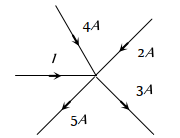
- A
$3 A$
- B
$8 \mathrm{~A}$
- ✓
$2 A$
- D
$5 A$
Answer(c) From Kirchoffs junction Law$\Rightarrow 4+2+i-5-3=0 \Rightarrow i=2 A$
View full question & answer→MCQ 361 Mark
In the circuit given, the correct relation to a balanced Wheatstone bridge is
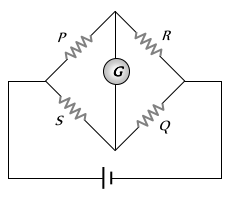
- A
$\frac{P}{Q}=\frac{R}{S}$
- B
$\frac{P}{Q}=\frac{S}{R}$
- ✓
$\frac{P}{R}=\frac{S}{Q}$
- D
AnswerCorrect option: C. $\frac{P}{R}=\frac{S}{Q}$
View full question & answer→MCQ 371 Mark
A cell of constant e.m.f. first connected to a resistance $R_1$ and then connected to a resistance $R_2$. If power delivered in both cases is then the internal resistance of the cell is
- ✓
$\sqrt{R_1 R_2}$
- B
$\sqrt{\frac{R_1}{R_2}}$
- C
$\frac{R_1-R_2}{2}$
- D
$\frac{R_1+R_2}{2}$
AnswerCorrect option: A. $\sqrt{R_1 R_2}$
$ \text { Power dissipated }=i^2 R=\left(\frac{E}{R+r}\right)^2 R$
$ \therefore\left(\frac{E}{R_1+r}\right)^2 R_1=\left(\frac{E}{R_2+r}\right)^2 R_2$
$ \Rightarrow R_1\left(R_2^2+r_2+2 R_2 r\right)=R_2\left(R_1^2+r^2+2 R_1 r\right)$
$ \Rightarrow R_2^2 R_1+R_1 r^2+2 R_2 r=R_1^2 R_2+R_2 r^2+2 R_1 R_2 r$
$ \Rightarrow\left(R_1-R_2\right) r^2=\left(R_1-R_2\right) r^2=\left(R_1-R_2\right) R_1 R_2 $
$ \Rightarrow r=\sqrt{R_1 R_2}$
View full question & answer→MCQ 381 Mark
The current in a conductor varies with time $t$ as $I=2 t+3 t^2$ where $l$ is in ampere and $t$ in seconds. Electric charge flowing through a section of the conductor during $t=2 \mathrm{sec}$ to $t=3 \mathrm{sec}$ is
- A
$10 \mathrm{C}$
- ✓
$24 C$
- C
$33 C$
- D
$44 C$
AnswerCorrect option: B. $24 C$
$ d Q=I d t \Rightarrow Q=\int_{t=2}^{t=3} I d t=\left[2 \int_2^3 t d t+3 \int_2^3 t^2 d t\right] $
$ =\left[t^2\right]_2^3+\left[t^3\right]_2^3=(9-4)+(27-8)=5+19=24 C .$
View full question & answer→MCQ 391 Mark
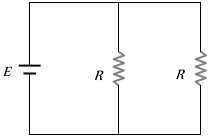
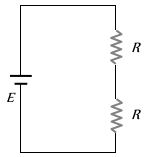
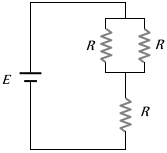
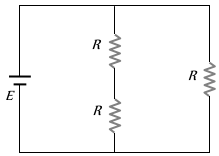
Consider four circuits shown in the figure below. In which circuit power dissipated is greatest (Neglect the internal resistance of the power supply)
AnswerThe circuit consists of three resistances $(2 R, 2 R$ and $R)$ connected in parallel.
View full question & answer→MCQ 401 Mark
Resistance in the two gaps of a meter bridge are $10 \mathrm{ohm}$ and 30 ohm respectively. If the resistances are interchanged the balance point shifts by
- A
$33.3 \mathrm{~cm}$
- B
$66.67 \mathrm{~cm}$
- C
$25 \mathrm{~cm}$
- ✓
$50 \mathrm{~cm}$
AnswerCorrect option: D. $50 \mathrm{~cm}$
$S=\left(\frac{100-l}{l}\right) \cdot R$ Initially, $30=\left(\frac{100-l}{l}\right) \times 10 \Rightarrow l=25 \mathrm{~cm}$
Finally, $10=\left(\frac{100-l}{l}\right) \times 30 \Rightarrow l=75 \mathrm{~cm}$
So, shift $=50 \mathrm{~cm}$.
View full question & answer→MCQ 411 Mark
A $50 \mathrm{ohm}$ galvanometer gets full scale deflection when a current of $0.01 A$ passes through the coil. When it is comvetted to a $10 A$ ammeter, the shunt resistance is
- A
$0.01 \Omega$
- ✓
$0.05 \Omega$
- C
$2000 \Omega$
- D
$5000 \Omega$
AnswerCorrect option: B. $0.05 \Omega$
(b) $i_g=i \frac{S}{G+S} \Rightarrow \frac{0.01}{10}=\frac{5}{50+S} \Rightarrow S=\frac{50}{999}=0.05 \Omega$.
View full question & answer→MCQ 421 Mark
Two resistances $R_1$ and $R_2$ are joined as shown in the figure to two batteries of $\text{e.m.f}. E_1$ and $E_2$. If $E_2$ is short $-$ circuited, the current through $R_1$ is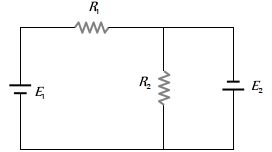
AnswerCorrect option: D. $E_1 /\left(R_2+R_1\right)$
$E_1 /\left(R_2+R_1\right)$
View full question & answer→MCQ 431 Mark
Two identical cells send the same current in $2 \Omega$ resistance, whether connected in series or in parallel. The internal resistance of the cell should be
- A
$1 \Omega$
- ✓
$2 \Omega$
- C
$\frac{1}{2} \Omega$
- D
$2.5 \Omega$
AnswerCorrect option: B. $2 \Omega$
$2 \Omega$
View full question & answer→MCQ 441 Mark
Which one is not the correct statement
- A
$1$ volt $\times 1$ coulomb $=1$ joule
- B
$1$ volt $\times 1$ ampere $=1$ joule/ second
- ✓
$1$ volt $\times 1$ watt $=1\ H.P$.
- D
Watt $-$ hour can be expressed in $\mathrm{eV}$
AnswerCorrect option: C. $1$ volt $\times 1$ watt $=1\ H.P$.
$1$ volt $\times 1$ watt $=1\ H.P$.
View full question & answer→MCQ 451 Mark
When a piece of aluminium wire of finite length is drawn through a series of dies to reduce its diameter to half its original value, its resistance will become
MCQ 461 Mark
The resistivity of a wire depends on its
MCQ 471 Mark
If only $2 \%$ of the main current is to be passed through a galvanometer of resistance $G$, then the resistance of shunt will be
- A
$\frac{G}{50}$
- ✓
$\frac{G}{49}$
- C
$50 G$
- D
$49 G$
AnswerCorrect option: B. $\frac{G}{49}$
(b) $i_g=2 \%$ of $i=\frac{i}{50} \Rightarrow S=\frac{G}{(n-1)}=\frac{G}{(50-1)}=\frac{G}{49}$
View full question & answer→MCQ 481 Mark
The current flowing in a coil of resistance $90 \Omega$ is to be reduced by $90 \%$. What value of resistance should be connected in parallel with it
- A
$9 \Omega$
- B
$90 \Omega$
- C
$1000 \Omega$
- ✓
$10 \Omega$
AnswerCorrect option: D. $10 \Omega$
(d) $i_g=\frac{i}{10} \Rightarrow$ Required shunt $S=\frac{G}{(n-1)}=\frac{90}{(10-1)}=10 \Omega$
View full question & answer→MCQ 491 Mark
What is the reading of voltmeter in the following figure
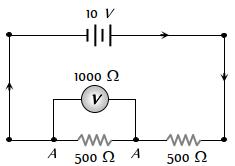
- A
$3 \mathrm{~V}$
- B
$2 \mathrm{~V}$
- C
$5 \mathrm{~V}$
- ✓
$4 \mathrm{~V}$
AnswerCorrect option: D. $4 \mathrm{~V}$
View full question & answer→MCQ 501 Mark
Resistance of $100 \mathrm{~cm}$ long potentiometer wire is $10 \Omega$, it is connected to a battery $(2 \mathrm{volt})$ and a resistance $R$ in series. A source of $10 \mathrm{mV}$ gives null point at $40 \mathrm{~cm}$ length, then external resistance $R$ is
- A
$490 \Omega$
- ✓
$790 \Omega$
- C
$590 \Omega$
- D
$990 \Omega$
AnswerCorrect option: B. $790 \Omega$
$E=\frac{e}{\left(R+R_h+r\right)} \cdot \frac{R}{L} \times l $
$ \Rightarrow 10 \times 10^{-3}=\frac{2}{(10+R+0)} \times \frac{10}{1} \times 0.4 \Rightarrow R=790 \Omega$
View full question & answer→