MCQ 511 Mark
A box is placed on an inclined plane and has to be pushed down. The angle of inclination is
- A
Equal to angle of friction
- B
More than angle of friction
- C
- ✓
Less than angle of repose
AnswerCorrect option: D. Less than angle of repose
(d) Because if the angle of inclination is equal to or more than angle of repose then box will automatically slides down the plane.
View full question & answer→MCQ 521 Mark
The coefficient of friction between a body and the surface of an inclined plane at $45^{\circ}$ is $0.5.$ If $g=9.8 \mathrm{~m} / \mathrm{s}^2$, the acceleration of the body downwards in $\mathrm{m} / \mathrm{s}^2$ is
- ✓
$\frac{4.9}{\sqrt{2}}$
- B
$4.9 \sqrt{2}$
- C
$19.6 \sqrt{2}$
- D
AnswerCorrect option: A. $\frac{4.9}{\sqrt{2}}$
$a =g(\sin \theta-\mu \cos \theta)=9.8\left(\sin 45^{\circ}-0.5 \cos 45^{\circ}\right) $
$=\frac{4.9}{\sqrt{2}} m / sec ^2$
View full question & answer→MCQ 531 Mark
A body of $10 \mathrm{~kg}$ is acted by a force of $129.4 \mathrm{~N}$ if $g=9.8 \mathrm{~m} / \mathrm{sec}^2$. The acceleration of the block is $10 \mathrm{~m} / \mathrm{s}^2$. What is the coefficient of kinetic friction
Answer(c) Net force on the body = Applied force - Friction
$m a=F-\mu_k m g \Rightarrow \mu_k=\frac{F-m a}{m g}=\frac{129.4-10 \times 10}{10 \times 9.8}=0.3$
View full question & answer→MCQ 541 Mark
Pulling force making an angle $\theta$ to the horizontal is applied on a block of weight $W$ placed on a horizontal table. If the angle of friction is $\alpha$, then the magnitude of force required to move the body is equal to
- A
$\frac{W \sin \alpha}{g \tan (\theta-\alpha)}$
- B
$\frac{W \cos \alpha}{\cos (\theta-\alpha)}$
- ✓
$\frac{W \sin \alpha}{\cos (\theta-\alpha)}$
- D
$\frac{W \tan \alpha}{\sin (\theta-\alpha)}$
AnswerCorrect option: C. $\frac{W \sin \alpha}{\cos (\theta-\alpha)}$
View full question & answer→MCQ 551 Mark
A lift is moving downwards with an acceleration equal to acceleration due to gravity. A body of mass $m$ kept on the floor of the lift is pulled horizontally. If the coefficient of friction is $\mu$, then the frictional resistance offered by the body is
- A
$m g$
- B
$\mu \mathrm{mg}$
- C
$2 \mu \mathrm{mg}$
- ✓
View full question & answer→MCQ 561 Mark
A uniform rope of length /lies on a table. If the coefficient of friction is $\mu$, then the maximum length $l_1$ of the part of this rope which can overhang from the edge of the table without sliding down is
- A
$\frac{l}{\mu}$
- B
$\frac{l}{\mu+l}$
- ✓
$\frac{\mu l}{1+\mu}$
- D
$\frac{\mu l}{\mu-1}$
AnswerCorrect option: C. $\frac{\mu l}{1+\mu}$
(c) For given condition we can apply direct formula
$l_1=\left(\frac{\mu}{\mu+1}\right) l$
View full question & answer→MCQ 571 Mark
A brick of mass $2 \mathrm{~kg}$ begins to slide down on a plane inclined at an angle of $45^{\circ}$ with the horizontal. The force of friction will be
- ✓
$19.6 \sin 45^{\circ}$
- B
$19.6 \cos 45^{\circ}$
- C
$9.8 \sin 45^{\circ}$
- D
$9.8 \cos 45^{\circ}$
AnswerCorrect option: A. $19.6 \sin 45^{\circ}$
(a) For angle of repose,Friction $=$ Component of weight along the plane $=m g \sin \theta=2 \times 9.8 \times \sin 45^{\circ}=19.6 \sin 45^{\circ}$
View full question & answer→MCQ 581 Mark
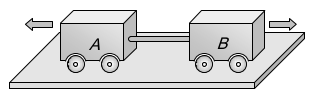
Two carts of masses $200 \mathrm{~kg}$ and $300 \mathrm{~kg}$ on horizontal rails are pushed apart. Suppose the coefficient of friction between the carts and the rails are same. If the $200 \mathrm{~kg}$ cart travels a distance of $36 \mathrm{~m}$ and stops, then the distance travelled by the cart weighing $300 \mathrm{~kg}$ is
- A
$32 \mathrm{~m}$
- B
$24 m$
- ✓
$16 \mathrm{~m}$
- D
$12 \mathrm{~m}$
AnswerCorrect option: C. $16 \mathrm{~m}$
For given condition
$s \propto \frac{1}{m^2} \therefore \frac{s_2}{s_1}=\left(\frac{m_1}{m_2}\right)^2=\left(\frac{200}{300}\right)^2$
$\Rightarrow s_2=s_1 \times \frac{4}{9}=36 \times \frac{4}{9}=16 m$
View full question & answer→MCQ 591 Mark
Which of the following statements is not true
- A
The coefficient of friction between two surfaces increases as the surface in contact are made rough
- B
The force of friction acts in a direction opposite to the applied force
- ✓
Rolling friction is greater than sliding friction
- D
The coefficient of friction between wood and wood is less than 1
AnswerCorrect option: C. Rolling friction is greater than sliding friction
(c) Sliding friction is greater than rolling friction.
View full question & answer→MCQ 601 Mark
The coefficient of static friction, $\mu_s$, between block $A$ of mass $2 \mathrm{~kg}$ and the table as shown in the figure is 0.2 . What would be the maximum mass value of block $B$ so that the two blocks do not move? The string and the pulley are assumed to be smooth and massless. $\left(g=10 \mathrm{~m} / \mathrm{s}^2\right)$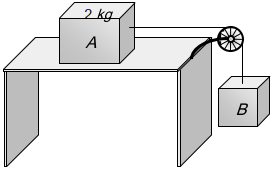
- A
$2.0 \mathrm{~kg}$
- B
$4.0 \mathrm{~kg}$
- C
$0.2 \mathrm{~kg}$
- ✓
$0.4 \mathrm{~kg}$
AnswerCorrect option: D. $0.4 \mathrm{~kg}$
(d) $\mu_s=\frac{m_B}{m_A} \Rightarrow 0.2=\frac{m_B}{2} \Rightarrow m_B=0.4 kg$
View full question & answer→MCQ 611 Mark
A vehicle of mass $m$ is moving on a rough horizontal road with momentum $P$. If the coefficient of friction between the tyres and the road be $\mu$, then the stopping distance is
AnswerCorrect option: D. $\frac{P^2}{2 \mu m^2 g}$
(d) $\quad S=\frac{u^2}{2 \mu g}=\frac{m^2 u^2}{2 \mu g m^2}=\frac{P^2}{2 \mu m^2 g}$
View full question & answer→MCQ 621 Mark
On the horizontal surface of a truck $(\mu=0.6)$, a block of mass $1 \mathrm{~kg}$ is placed. If the truck is accelerating at the rate of $5 \mathrm{~m} / \mathrm{sec}^2$ then frictional force on the block will be
- ✓
$5 \mathrm{~N}$
- B
$6 N$
- C
$5.88 \mathrm{~N}$
- D
$8 N$
AnswerCorrect option: A. $5 \mathrm{~N}$
(a) $F_l=\mu m g=0.6 \times 1 \times 9.8=5.88 N$Pseudo force on the block $=m a=1 \times 5=5 N$Pseudo is less then limiting friction hence static force of friction $=5 N$.
View full question & answer→MCQ 631 Mark
A block is at rest on an inclined plane making an angle $\alpha$ with the horizontal. As the angle $\alpha$ of the incline is increased, the block starts slipping when the angle of inclination becomes $\theta$. The coefficient of static friction between the block and the surface of the inclined plane is or A body starts sliding down at an angle $\theta$ to horizontal. Then coefficient of friction is equal to
- A
$\sin \theta$
- B
$\cos \theta$
- ✓
$\tan \theta$
- D
Independent of $\theta$
AnswerCorrect option: C. $\tan \theta$
(c) Coefficient of friction $=$ Tangent of angle of repose
$\therefore \mu=\tan \theta$
View full question & answer→MCQ 641 Mark
Consider a car moving along a straight horizontal road with a speed of $72 \mathrm{~km} / \mathrm{h}$. If the coefficient of kinetic friction between the tyres and the road is 0.5 , the shortest distance in which the car can be stopped is $\left[g=10 \mathrm{~ms}^{-2}\right]$
- A
$30 \mathrm{~m}$
- ✓
$40 \mathrm{~m}$
- C
$72 \mathrm{~m}$
- D
$20 \mathrm{~m}$
AnswerCorrect option: B. $40 \mathrm{~m}$
(b) $s=\frac{u^2}{2 \mu g}=\frac{(20)^2}{2 \times 0.5 \times 10}=40 m$
View full question & answer→MCQ 651 Mark
A heavy uniform chain lies on a horizontal table-top. If the coefficient of friction between the chain and table surface is 0.25 , then the maximum fraction of length of the chain, that can hang over one edge of the table is
- ✓
$20 \%$
- B
$25 \%$
- C
$35 \%$
- D
$15 \%$
AnswerCorrect option: A. $20 \%$
(a) $l^{\prime}=\left(\frac{\mu}{\mu+1}\right) l=\left(\frac{0.25}{0.25+1}\right) l=\frac{l}{5}=20 \%$ of $l$.
View full question & answer→MCQ 661 Mark
Starting from rest, a body slides down a $45^{\circ}$ inclined plane in twice the time it takes to slide down the same distance in the absence of friction. The coefficient of friction between the body and the inclined plane is
- A
$0.33$
- B
$0.25$
- ✓
$0.75$
- D
$0.8$
AnswerCorrect option: C. $0.75$
$ \mu=\tan \theta\left(1-\frac{1}{n^2}\right)$
$ \theta=45^{\circ} \text { and } n=2 \text { (Given) } $
$ \therefore \mu=\tan 45^{\circ}\left(1-\frac{1}{2^2}\right)=1-\frac{1}{4}=\frac{3}{4}=0.75$
View full question & answer→MCQ 671 Mark
It is easier to roll a barrel than pull it along the road. This statement is
MCQ 681 Mark
If a ladder weighing $250\ N$ is placed against a smooth vertical wall having coefficient of friction between it and floor is $0.3$ , then what is the maximum force of friction available at the point of contact between the ladder and the floor
- ✓
$75 \mathrm{~N}$
- B
$50 \mathrm{~N}$
- C
$35 \mathrm{~N}$
- D
$25 \mathrm{~N}$
AnswerCorrect option: A. $75 \mathrm{~N}$
View full question & answer→MCQ 691 Mark
A body of mass $m$ rests on horizontal surface. The coefficient of friction between the body and the surface is $\mu$. If the mass is pulled by a force $P$ as shown in the figure, the limiting friction between body and surface will be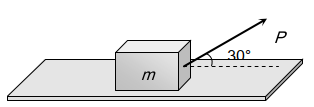
- A
$\mu \mathrm{mg}$
- B
$\mu\left[m g+\left(\frac{P}{2}\right)\right]$
- ✓
$\mu\left[m g-\left(\frac{P}{2}\right)\right]$
- D
$\mu\left[m g-\left(\frac{\sqrt{3} P}{2}\right)\right]$
AnswerCorrect option: C. $\mu\left[m g-\left(\frac{P}{2}\right)\right]$
View full question & answer→MCQ 701 Mark
A block of mass $50 \mathrm{~kg}$ slides over a horizontal distance of $1 \mathrm{~m}$. If the coefficient of friction between their surfaces is $0.2$ , then work done against friction is
- ✓
$98 \mathrm{~J}$
- B
$72 \mathrm{~J}$
- C
$56 \mathrm{~J}$
- D
$34 \mathrm{~J}$
AnswerCorrect option: A. $98 \mathrm{~J}$
(a) $W=\mu m g S=0.2 \times 50 \times 9.8 \times 1=98\ J$
View full question & answer→MCQ 711 Mark
To avoid slipping while walking on ice, one should take smaller steps because of the
MCQ 721 Mark
A body of mass $100 \mathrm{~g}$ is sliding from an inclined plane of inclination $30^{\circ}$. What is the frictional force experienced if $\mu=1.7$
- A
$1.7 \times \sqrt{2} \times \frac{1}{\sqrt{3}} N$
- ✓
$1.7 \times \sqrt{3} \times \frac{1}{2} \mathrm{~N}$
- C
$1.7 \times \sqrt{3} \mathrm{~N}$
- D
$1.7 \times \sqrt{2} \times \frac{1}{3} \mathrm{~N}$
AnswerCorrect option: B. $1.7 \times \sqrt{3} \times \frac{1}{2} \mathrm{~N}$
$F_k=\mu_k R=\mu_k m g \cos \theta$
$ F_k=1.7 \times 0.1 \times 10 \times \cos 30^{\circ}=1.7 \times \frac{\sqrt{3}}{2} N $
$ \text { (a) } \mu=\tan \theta\left(1-\frac{1}{n^2}\right)=\tan 30\left(1-\frac{1}{2^2}\right)=\frac{\sqrt{3}}{4}$
View full question & answer→MCQ 731 Mark
Maximum value of static friction is called
MCQ 741 Mark
A body is moving along a rough horizontal surface with an initial velocity $6 \mathrm{~m} / \mathrm{s}$. If the body comes to rest after travelling $9 \mathrm{~m}$, then the coefficient of sliding friction will be
Answer(b) We know $s=\frac{u^2}{2 \mu g} $
$ \therefore \mu=\frac{u^2}{2 g s}=\frac{(6)^2}{2 \times 10 \times 9}=0.2$
View full question & answer→MCQ 751 Mark
A $20 \mathrm{~kg}$ block is initially at rest on a rough horizontal surface. A horizontal force of $75 \mathrm{~N}$ is required to set the block in motion. After it is in motion, a horizontal force of $60\ N$ is required to keep the block moving with constant speed. The coefficient of static friction is
- ✓
$0.38$
- B
$0.44$
- C
$0.52$
- D
$0.6$
AnswerCorrect option: A. $0.38$
(a) Coefficient of friction $\mu_s=\frac{F_l}{R}=\frac{75}{m g}=\frac{75}{20 \times 9.8}=0.38$
View full question & answer→MCQ 761 Mark
Assuming the coefficient of friction between the road and tyres of a car to be $0.5$ , the maximum speed with which the car can move round a curve of $40.0 \mathrm{~m}$ radius without slipping, if the road is unbanked, should be
- A
$25 \mathrm{~m} / \mathrm{s}$
- B
$19 \mathrm{~m} / \mathrm{s}$
- ✓
$14 \mathrm{~m} / \mathrm{s}$
- D
$11 \mathrm{~m} / \mathrm{s}$
AnswerCorrect option: C. $14 \mathrm{~m} / \mathrm{s}$
(c) $v=\sqrt{\mu g r}=\sqrt{0.5 \times 9.8 \times 40}=\sqrt{196}=14 m / s$
View full question & answer→MCQ 771 Mark
If a ladder weighing $250 \mathrm{~N}$ is placed against a smooth vertical wall having coefficient of friction between it and floor is $0.3$, then what is the maximum force of friction available at the point of contact between the ladder and the floor
- ✓
$75 \mathrm{~N}$
- B
$50 \mathrm{~N}$
- C
$35 \mathrm{~N}$
- D
$25 \mathrm{~N}$
AnswerCorrect option: A. $75 \mathrm{~N}$
(a) $F=\mu R=0.3 \times 250=75 N$
View full question & answer→MCQ 781 Mark
A block of mass $10 \mathrm{~kg}$ is placed on a rough horizontal surface having coefficient of friction $\mu=0.5$. If a horizontal force of $100 \mathrm{~N}$ is acting on it, then acceleration of the block will be
- A
$0.5 \mathrm{~m} / \mathrm{s}^2$
- ✓
$5 \mathrm{~m} / \mathrm{s}^2$
- C
$10 \mathrm{~m} / \mathrm{s}^2$
- D
$15 \mathrm{~m} / \mathrm{s}^2$
AnswerCorrect option: B. $5 \mathrm{~m} / \mathrm{s}^2$
$ a=\frac{\text { Appliedforce }- \text { Kineticfriction }}{\text { mass }} $
$ =\frac{100-0.5 \times 10 \times 10}{10}=5 m / s ^2$
View full question & answer→MCQ 791 Mark
Consider a car moving on a straight road with a speed of $100 \mathrm{~m} / \mathrm{s}$. The distance at which car can be stopped is $\left[\mu_k=0.5\right]$
- A
$100 \mathrm{~m}$
- B
$400 \mathrm{~m}$
- C
$800 \mathrm{~m}$
- ✓
$1000 \mathrm{~m}$
AnswerCorrect option: D. $1000 \mathrm{~m}$
(d) $s=\frac{u^2}{2 \mu g}=\frac{(100)^2}{2 \times 0.5 \times 10}=1000 m$
View full question & answer→MCQ 801 Mark
A block rests on a rough inclined plane making an angle of $30^{\circ}$ with the horizontal. The coefficient of static friction between the block and the plane is 0.8 . If the frictional force on the block is $10 \mathrm{~N}$, the mass of the block (in $\mathrm{kg}$ ) is (take $g=10 \mathrm{~m} / \mathrm{s}^2$ )
Answer(a) Angle of repose $\alpha=\tan ^{-1}(\mu)=\tan ^{-1}(0.8)=38.6^{\circ}$
Angle of inclined plane is given $\theta=30^{\circ}$.
It means block is at rest therefore,Static friction = component of weight in downward direction
$=m g \sin \theta=10 N \quad \therefore m=\frac{10}{9 \times \sin 30^{\circ}}=2 \ kg$
View full question & answer→MCQ 811 Mark
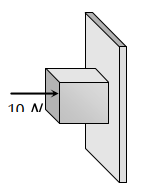
A horizontal force of $10 \mathrm{~N}$ is necessary to just hold a block stationary against a wall. The coefficient of friction between the block and the wall is $0.2.$ the weight of the block is
- ✓
$2 \mathrm{~N}$
- B
$20 \mathrm{~N}$
- C
$50 \mathrm{~N}$
- D
$100 \mathrm{~N}$
AnswerCorrect option: A. $2 \mathrm{~N}$
(a) $F=\frac{W}{\mu} \quad \therefore W=\mu F=0.2 \times 10=2 N$
View full question & answer→MCQ 821 Mark
A marble block of mass $2 \mathrm{~kg}$ lying on ice when given a velocity of $6 \mathrm{~m} / \mathrm{s}$ is stopped by friction in $10 \mathrm{~s}$. Then the coefficient of friction is
- A
$0.01$
- B
$0.02$
- C
$0.03$
- ✓
$0.06$
AnswerCorrect option: D. $0.06$
(d) $v=u-a t \Rightarrow u-\mu g t=0 \quad \therefore \quad \mu=\frac{u}{g t}=\frac{6}{10 \times 10}=0.06$
View full question & answer→MCQ 831 Mark
A block of mass $1 \mathrm{~kg}$ slides down on a rough inclined plane of inclination $60^{\circ}$ starting from its top. If the coefficient of kinetic friction is 0.5 and length of the plane is $1 \mathrm{~m}$, then work done against friction is (Take $g=9.8$ $\left.\mathrm{m} / \mathrm{s}^2\right)$
- A
$9.82 \mathrm{~J}$
- B
$4.94 \mathrm{~J}$
- ✓
$2.45 \mathrm{~J}$
- D
$1.96 \mathrm{~J}$
AnswerCorrect option: C. $2.45 \mathrm{~J}$
(c) $W=\mu m g \cos \theta S=0.5 \times 1 \times 9.8 \times \frac{1}{2} \times 1=2.45 J$
View full question & answer→MCQ 841 Mark
When two surfaces are coated with a lubricant, then they
Answer(b) Surfaces always slide over each other.
View full question & answer→MCQ 851 Mark
Work done by a frictional force is
Answer(d) Work done by friction can be positive, negative and zero depending upon the situation.
View full question & answer→MCQ 861 Mark
Which is a suitable method to decrease friction
Answer(d) Ball and bearing produce rolling motion for which force of friction is low. Lubrication and polishing reduce roughness of surface.
View full question & answer→MCQ 871 Mark
- ✓
Always greater than the dynamic friction
- B
Always less than the dynamic friction
- C
Equal to the dynamic friction
- D
Sometimes greater and sometimes less than the dynamic friction
AnswerCorrect option: A. Always greater than the dynamic friction
Always greater than the dynamic friction
View full question & answer→MCQ 881 Mark
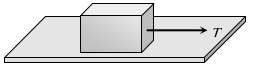
In the figure shown, a block of weight $10 \mathrm{~N}$ resting on a horizontal surface. The coefficient of static friction between the block and the surface $\mu_s=0.4$. A force of $3.5 \mathrm{~N}$ will keep the block in uniform motion, once it has been set in motion. A horizontal force of $3 N$ is applied to the block, then the block will
- A
Move over the surface with constant velocity
- B
Move having accelerated motion over the surface
- ✓
- D
First it will move with a constant velocity for some time and then will have accelerated motion
Answer$F_l=\mu_s R=0.4 \times m g=0.4 \times 10=4 N$ i.e. minimum $4 N$ force is required to start the motion of a body.
But applied force is only $3 N$.
So the block will not move.
View full question & answer→MCQ 891 Mark
The maximum static frictional force is
- A
Equal to twice the area of surface in contact
- ✓
Independent of the area of surface in contact
- C
Equal to the area of surface in contact
- D
AnswerCorrect option: B. Independent of the area of surface in contact
View full question & answer→MCQ 901 Mark
A force of $98\ N$ is required to just start moving a body of mass $100\ \mathrm{kg}$ over ice. The coefficient of static friction is
Answer$ \mu=\frac{F}{R}=\frac{F}{m g}=\frac{98}{100 \times 9.8}=\frac{1}{10}=0.1$
View full question & answer→MCQ 911 Mark
The coefficient of friction $\mu$ and the angle of friction $\lambda$ are related as
- A
$\sin \lambda=\mu$
- B
$\cos \lambda=\mu$
- ✓
$\tan \lambda=\mu$
- D
$\tan \mu=\lambda$
AnswerCorrect option: C. $\tan \lambda=\mu$
View full question & answer→MCQ 921 Mark
A block is kept on an inclined plane of inclination $\theta$ of length /. The velocity of particle at the bottom of inclined is (the coefficient of friction is $\mu$ )
- A
$\sqrt{2 g l(\mu \cos \theta-\sin \theta)}$
- ✓
$\sqrt{2 g l(\sin \theta-\mu \cos \theta)}$
- C
$\sqrt{2 g /(\sin \theta+\mu \cos \theta)}$
- D
$\sqrt{2 g l(\cos \theta+\mu \sin \theta)}$
AnswerCorrect option: B. $\sqrt{2 g l(\sin \theta-\mu \cos \theta)}$
Acceleration (a) $=g(\sin \theta-\mu \cos \theta)$ and $s=l$
$v=\sqrt{2 a s}=\sqrt{2 g l(\sin \theta-\mu \cos \theta)}$
View full question & answer→MCQ 931 Mark
A body takes time $t$ to reach the bottom of an inclined plane of angle $\theta$ with the horizontal. If the plane is made rough, time taken now is $2 t$. The coefficient of friction of the rough surface is
- ✓
$\frac{3}{4} \tan \theta$
- B
$\frac{2}{3} \tan \theta$
- C
$\frac{1}{4} \tan \theta$
- D
$\frac{1}{2} \tan \theta$
AnswerCorrect option: A. $\frac{3}{4} \tan \theta$
(a) $\quad \mu=\tan \theta\left(1-\frac{1}{n^2}\right)=\tan \theta\left(1-\frac{1}{2^2}\right)=\frac{3}{4} \tan \theta$
View full question & answer→MCQ 941 Mark
A $2 \mathrm{~kg}$ mass starts from rest on an inclined smooth surface with inclination $30^{\circ}$ and length $2 \mathrm{~m}$. How much will it travel before coming to rest on a frictional surface with frictional coefficient of 0.25
- ✓
$4 \mathrm{~m}$
- B
$6 \mathrm{~m}$
- C
$8 \mathrm{~m}$
- D
$2 \mathrm{~m}$
AnswerCorrect option: A. $4 \mathrm{~m}$
View full question & answer→MCQ 951 Mark
The force required just to move a body up an inclined plane is double the force required just to prevent the body sliding down. If the coefficient of friction is $0.25,$ the angle of inclination of the plane is
- ✓
$36.8^{\circ}$
- B
$45^{\circ}$
- C
$30^{\circ}$
- D
$42.6^{\circ}$
AnswerCorrect option: A. $36.8^{\circ}$
Retardation in upward motion $=g(\sin \theta+\mu \cos \theta)$
$\therefore$ Force required just to move up $F_{u p}=m g(\sin \theta+\mu \cos \theta)$
Similarly for down ward motion $a=g(\sin \theta-\mu \cos \theta)$
$\therefore$ Force required just to prevent the body sliding down
$F_{d n}=m g(\sin \theta-\mu \cos \theta)$
According to problem $F_{u p}=2 F_{d n}$
$ \Rightarrow m g(\sin \theta+\mu \cos \theta)=2 mg(\sin\theta-\mu \cos \theta)$
$ \Rightarrow \sin \theta+\mu \cos \theta=2 \sin \theta-2\mu \cos \theta $
$ \Rightarrow 3 \mu \cos \theta=\sin \theta$
$ \Rightarrow \tan \theta=3 \mu $
$\Rightarrow \theta=\tan^{-1}(3 \mu)=\tan^{-1}(3 \times 0.25)=\tan^{-1}(0.75)=36.8^{\circ}$
View full question & answer→MCQ 961 Mark
When a body is placed on a rough plane inclined at an angle $\theta$ to the horizontal, its acceleration is
- A
$g(\sin \theta-\cos \theta)$
- ✓
$g(\sin \theta-\mu \cos \theta)$
- C
$g(\mu \sin \theta 1-\cos \theta)$
- D
$g \mu(\sin \theta-\cos \theta)$
AnswerCorrect option: B. $g(\sin \theta-\mu \cos \theta)$
View full question & answer→MCQ 971 Mark
When a body is lying on a rough inclined plane and does not move, the force of friction
- A
is equal to $\mu R$
- ✓
is less than $\mu R$
- C
is greater than $\mu R$
- D
is equal to $R$
AnswerCorrect option: B. is less than $\mu R$
(b) When the body is at rest then static friction works on it, whic is less than limiting friction $(\mu R)$.
View full question & answer→MCQ 981 Mark
A horizontal force of $129.4 \mathrm{~N}$ is applied on a $10 \mathrm{~kg}$ block which rests on a horizontal surface. If the coefficient of friction is 0.3 , the acceleration should be
- A
$9.8 \mathrm{~m} / \mathrm{s}^2$
- ✓
$10 \mathrm{~m} / \mathrm{s}^2$
- C
$12.6 \mathrm{~m} / \mathrm{s}^2$
- D
$19.6 \mathrm{~m} / \mathrm{s}^2$
AnswerCorrect option: B. $10 \mathrm{~m} / \mathrm{s}^2$
(b) From the relation $F-\mu m g=m a$$a=\frac{F-\mu m g}{m}=\frac{129.4-0.3 \times 10 \times 9.8}{10}=10 m / s ^2$
View full question & answer→MCQ 991 Mark
A car turns a corner on a slippery road at a constant speed of $10 \mathrm{~m} / \mathrm{s}$. If the coefficient of friction is $0.5,$ the minimum radius of the arc in meter in which the car turns is
Answer$v=\sqrt{\mu g r} \Rightarrow r=\frac{v^2}{\mu g}=\frac{100}{0.5 \times 10}=20$
View full question & answer→MCQ 1001 Mark
A $60 \mathrm{~kg}$ body is pushed with just enough force to start it moving across a floor and the same force continues to act afterwards. The coefficient of static friction and sliding friction are $0.5$ and $0.4$ respectively. The acceleration of the body is
- A
$6 \mathrm{~m} / \mathrm{s}^2$
- B
$4.9 \mathrm{~m} / \mathrm{s}^2$
- C
$3.92 \mathrm{~m} / \mathrm{s}^2$
- ✓
$1 \mathrm{~m} / \mathrm{s}^2$
AnswerCorrect option: D. $1 \mathrm{~m} / \mathrm{s}^2$
Limiting friction $=\mu_s R=\mu_s m g=0.5 \times 60 \times 10=300\ N$
Kinetic friction $=\mu_k R=\mu_k m g=0.4 \times 60 \times 10=240 N$
Force applied on the body $=300 N$ and if the body is moving then, Net accelerating force
$=$ Applied force - Kinetic friction
$\Rightarrow m a=300-240=60$
$ \therefore a=\frac{60}{60}=1 m / s ^2$
View full question & answer→