MCQ 11 Mark
Two wires have resistance of $2 \Omega$ and $4 \Omega$ connected to same voltage, ratio of heat dissipated at resistance is
- A
$1: 2$
- B
$4: 3$
- ✓
$2: 1$
- D
$5: 2$
AnswerCorrect option: C. $2: 1$
(c) $H=\frac{V^2}{R} t \Rightarrow \frac{H_1}{H_2}=\frac{R_2}{R_1}=\frac{4}{2}=\frac{2}{1}$
View full question & answer→MCQ 21 Mark
Four identical electrical lamps are labelled $1.5 V , 0.5 A$ which describes the condition necessary for them to operate at normal brightness. A $12 V$ battery of negligible internal resistance is connected to lamps as shown, then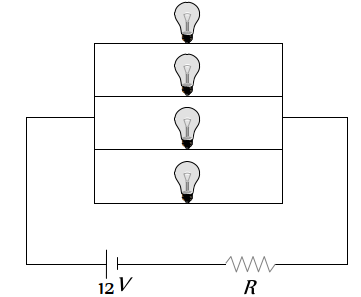
- A
The value of $R$ for normal brightness of each lamp is (3/4) $\Omega$
- ✓
The value of $R$ for normal brightness of each lamp is (21/4) $\Omega$
- C
Total power dissipated in circuit when all lamps are normally bright is $24 W$
- D
Power dissipated in $R$ is $21 W$ when all lamps are normally bright
AnswerCorrect option: B. The value of $R$ for normal brightness of each lamp is (21/4) $\Omega$
View full question & answer→MCQ 31 Mark
What is immaterial for an electric fuse wire
- A
Specific resistance of the wire
- ✓
- C
- D
Current flowing through the wire
View full question & answer→MCQ 41 Mark
The relation between Faraday constant $(F)$, chemical equivalent $(E)$ and electrochemical equivalent $(Z)$ is
- A
$F=E Z$
- B
$ F=\frac{Z}{E}$
- ✓
$F=\frac{E}{Z}$
- D
$F=\frac{E}{Z^2}$
AnswerCorrect option: C. $F=\frac{E}{Z}$
View full question & answer→MCQ 51 Mark
Electric room radiator which operates at $225$ volts has resistance of $50\ ohms$. Power of the radiator is approximately
- A
$100 \ W$
- B
$450\ W$
- C
$750 \ W$
- ✓
$1000\ W$
AnswerCorrect option: D. $1000\ W$
$P=\frac{V^2}{R}=\frac{(225)^2}{50}=1012.5 \approx 1000 \mathrm{~W}$
View full question & answer→MCQ 61 Mark
Two resistors of $6\ \Omega$ and $9\ \Omega$ are connected in series to a $120$ volt source. The power consumed by the $6\ \Omega$ resistor is
- ✓
$384\ W$
- B
$576 \ W$
- C
$1500\ W$
- D
$1200 \ W$
AnswerCorrect option: A. $384\ W$
(a) Current through the combination $i=\frac{120}{(6+9)}=8 \mathrm{~A}$So, power consumed by $6\ \Omega$ resistance$P=(8)^2 \times 6=384 \ W$
View full question & answer→MCQ 71 Mark
When a copper voltameter is connected with a battery of e.m.f. $12$ volts. $2\ gms$ of copper is deposited in $30$ minutes. If the same voltameter is connected across a $6$ volt battery, then the mass of copper deposited in $45$ minutes would be
- A
$1 \ gm$
- ✓
$1.5 \ gm$
- C
$2 \ gm$
- D
$2.5\ gm$
AnswerCorrect option: B. $1.5 \ gm$
$ m=Z i t \Rightarrow m=\frac{Z V t}{R} \Rightarrow m \propto V t$
$ \Rightarrow \frac{m_1}{m_2}=\frac{V_1 t_1}{V_2 t_2} $
$ \Rightarrow \frac{2}{m_2}=\frac{12 \times 30}{6 \times 45} \Rightarrow m_2=1.5 \ \mathrm{gm}$
View full question & answer→MCQ 81 Mark
Two resistors whose value are in ratio $2: 1$ are connected in parallel with one cell. Then ratio of power dissipated is
- A
$2: 1$
- B
$4: 1$
- ✓
$1: 2$
- D
$1: 1$
AnswerCorrect option: C. $1: 2$
It is given $R_{\text {Hot }}=10 R_{\text {Cold }}$ also resistance at rated temperature $R=\frac{V^2}{P}=\frac{200 \times 200}{100}=400 \Omega$.
So resistance when lamp not in use.$R_{\text {Cold }}=\frac{R_{\text {Hot }}}{10}=\frac{400}{10}=40 \Omega$
View full question & answer→MCQ 91 Mark
On giving $220\ V$ to a resistor the power dissipated is $40 \ W$ then value of resistance is
- ✓
$1210\ \Omega$
- B
$2000\ \Omega$
- C
$1000\ \Omega$
- D
AnswerCorrect option: A. $1210\ \Omega$
(a) $P=\frac{V^2}{R} \Rightarrow R=\frac{V^2}{P}=\frac{(220)^2}{40}=1210\ \Omega$
View full question & answer→MCQ 101 Mark
An electric kettle takes $4 A$ current at $220 V$. How much time will it take to boil $1 kg$ of water from room temperature $20^{\circ} C$ ? The temperature of boiling water is $100^{\circ} C$
- A
$6.4$ minutes
- ✓
$6.3$ minutes
- C
$12.6$ minutes
- D
$12.8$ minutes
AnswerCorrect option: B. $6.3$ minutes
Electric power consumed by kettle $P=220 \times 4 \mathrm{~W}$Heat required
$ H=1000 \times 1(100-20)=1000 \times 80 \mathrm{cal}=4200 \times 80 \mathrm{~J} $
$ P=\frac{H}{t} \Rightarrow H=P \times t $
$ \therefore 220 \times 4 \times t=4200 \times 80 \Rightarrow t=6.3 \text { minutes }$
View full question & answer→MCQ 111 Mark
The resistance of a cell does not depend on
- A
Current drawn from the cell
- B
Temperature of electrolyte
- C
Concentration of electrolyte
- ✓
Answer(d) The resistance of the cell is independent of e.m.f.
View full question & answer→MCQ 121 Mark
A steel wire has a resistance twice that of an aluminium wire. Both of them are connected with a constant voltage supply. More heat will be dissipated in
- A
Steel wire when both are connected in series
- B
Steel wire when both are connected in parallel
- ✓
Aluminium wire when both are connected in series
- D
Aluminium wire when both are connected in parallel
AnswerCorrect option: C. Aluminium wire when both are connected in series
Aluminium wire when both are connected in series
View full question & answer→MCQ 131 Mark
An expression for rate of heat generated, if a current of $I$ ampere flows through a resistance of $R \Omega$, is
- A
$I^2 R t$
- ✓
$I^2 R$
- C
$V^2 R$
- D
$I R$
AnswerCorrect option: B. $I^2 R$
View full question & answer→MCQ 141 Mark
How many calories of heat will be produced approximately in a $210$ watt electric bulb in $5$ minutes
- A
$80000 \ cal$
- B
$63000\ cal$
- C
$1050 \ cal$
- ✓
$15000 \ cal$
AnswerCorrect option: D. $15000 \ cal$
(d) $H=\frac{V^2 t}{R \times J}$ Calories $=\frac{P t}{J}=\frac{210 \times 5 \times 60}{4.2}=15000\ \mathrm{cal}$
View full question & answer→MCQ 151 Mark
Two bulbs of $100 \ W$ and $200 \ W$ working at $220$ volt are joined in series with $220$ volt supply. Total power consumed will be approximately.
- ✓
$65\ watt$
- B
$33 \ watt$
- C
$300\ watt$
- D
$100\ watt$
AnswerCorrect option: A. $65\ watt$
(a) $P_S=\frac{P_1 P_2}{P_1+P_2}=\frac{100 \times 200}{100+200}=\frac{200}{3} \approx 65\ \mathrm{watt}$
View full question & answer→MCQ 161 Mark
A hot electric iron has a resistance of $80 \Omega$ and is used on a $200 V$ source. The electrical energy spent, if it is used for two hours, will be
- A
$8000 Wh$
- B
$2000 Wh$
- ✓
$1000 Wh$
- D
$800 Wh$
AnswerCorrect option: C. $1000 Wh$
(c) Energy $\frac{V^2}{R} t=\frac{200 \times 200 \times 2}{80}=1000 \mathrm{Wh}$
View full question & answer→MCQ 171 Mark
A copper voltameter is connected in series with a heater coil of resistance $0.1 \Omega$. A steady current flows in the circuit for twenty minutes and mass of $0.99 g$ of copper is deposited at the cathode. If electrochemical equivalent of copper is $0.00033 gm / C$, then heat generated in the coil is
- ✓
$750 J$
- B
$650 J$
- C
$350 J$
- D
$250 J$
AnswerCorrect option: A. $750 J$
(a)$m=Z i t \Rightarrow i=\frac{m}{Z t}=\frac{0.99}{0.00033 \times 1200}=2.5 \mathrm{~A}$Hence heat generated in the coil is$H=i^2 R t=(2.5)^2 \times 0.1 \times 1200=750 \mathrm{~J}$
View full question & answer→MCQ 181 Mark
A $10 \quad V$ storage battery of negligible internal resistance is connected across a $50 \Omega$ resistor. How much heat energy is produced in the resistor in 1 hour
- ✓
$7200 J$
- B
$6200 J$
- C
$5200 J$
- D
$4200 J$
AnswerCorrect option: A. $7200 J$
(a) Energy $=\frac{V^2}{R} \times t=\frac{10 \times 10}{50} \times 3600=7200 \mathrm{~J}$
View full question & answer→MCQ 191 Mark
If two electric bulbs have $40 W$ and $60 W$ rating at $220 V$, then the ratio of their resistances will be
- A
$9: 4$
- B
$4: 3$
- C
$3: 8$
- ✓
$3: 2$
AnswerCorrect option: D. $3: 2$
(d) $P_{\text {Rated }} \propto \frac{1}{R} \Rightarrow \frac{R_1}{R_2}=\frac{P_2}{P_1}=\frac{60}{40}=\frac{3}{2}$
View full question & answer→MCQ 201 Mark
The current flowing in a copper voltameter is $3.2 A$. The number of copper ions $\left( Cu ^{2+}\right)$ deposited at the cathode per minute is
- A
$0.5 \times 10^{20}$
- B
$1.5 \times 10^{20}$
- C
$3 \times 10^{20}$
- ✓
$6 \times 10^{20}$
AnswerCorrect option: D. $6 \times 10^{20}$
(d) Charge supplied per minute $=3.2 \times 60=192 C$ Charge $2 e$ liberates one $\mathrm{Cu}^{+2}$
i on $\ (\therefore)$ No of $\mathrm{Cu}^{+2}$ ion liberate by $192 \mathrm{C}$$=\frac{192}{2 e}=\frac{192}{2 \times 1.6 \times 10^{-19}}=6 \times 10^{20}$
View full question & answer→MCQ 211 Mark
Three bulbs of $40 W , 60 W , 100 W$ are arranged in series with $220$ volt supply which bulb has minimum resistance
AnswerCorrect option: A. $100 W$
$100 W$
View full question & answer→MCQ 221 Mark
The resistor of resistance ' $R$ is connected to $25 V$ supply and heat produced in it is $25 J / sec$. The value of $R$ is
- A
$225 \Omega$
- B
$1 \Omega$
- ✓
$25 \Omega$
- D
$50 \Omega$
AnswerCorrect option: C. $25 \Omega$
(c) $P=\frac{V^2}{R} \Rightarrow R=\frac{V^2}{P}=\frac{25 \times 25}{25}=25 \Omega$
View full question & answer→MCQ 231 Mark
E.C.E. of $C u$ and $A g$ are $7 \times 10^{-6}$ and $1.2 \times 10^{-6}$. A certain current deposits $14 gm$ of $Cu$. Amount of $Ag$ deposited is
- A
$1.2 gm$
- B
$1.6 gm$
- ✓
$2.4 gm$
- D
$1.8 gm$
AnswerCorrect option: C. $2.4 gm$
(c) $\frac{m_1}{m_2}=\frac{Z_1}{Z_2} \Rightarrow m_2=\frac{m_1 Z_2}{Z_1}=\frac{14 \times 1.2 \times 10^{-6}}{7 \times 10^{-6}}=2.4 \mathrm{~g}$
View full question & answer→MCQ 241 Mark
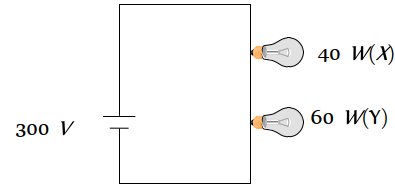
Two bulbs $X$ and $Y$ having same voltage rating and of power $40$ watt and $60$ watt respectively are connected in series across a potential difference of $300$ volt, then
- ✓
$X$ will glow brighter
- B
Resistance of $Y$ is greater than $X$
- C
Heat produced in $Y$ will be greater than $X$
- D
Voltage drop in $X$ will be greater than $Y$
AnswerCorrect option: A. $X$ will glow brighter
Resistance $\propto \frac{1}{\text { power }}$. Thus, $40 W$ bulb has a high resistance. Because of which there will be more potential drop across $40 W$ bulb. Thus $40 W$ bulb will glow brighter.
View full question & answer→MCQ 251 Mark
Ampere hour is the unit of
MCQ 261 Mark
Resistance of one carbon filament and one tungsten lamp are measured individually when the lamp are lit and compared with their respective resistances when cold. Which one of the following statements will be true
- A
Resistance of the carbon filament lamp will increase but that of the tungsten will diminish when hot
- ✓
Resistance of the tungsten filament lamp will increase but that of carbon will diminish when hot
- C
Resistances of both the lamps will increase when hot
- D
Resistances of both the lamps will decrease when
AnswerCorrect option: B. Resistance of the tungsten filament lamp will increase but that of carbon will diminish when hot
Resistance of the tungsten filament lamp will increase but that of carbon will diminish when hot
View full question & answer→MCQ 271 Mark
You are given three bulbs of $25,40$ and $60$ watt. Which of them has lowest resistance
- A
$25$ watt bulb
- B
$40$ watt bulb
- ✓
$60$ watt bulb
- D
Information is insufficient
AnswerCorrect option: C. $60$ watt bulb
$60$ watt bulb
View full question & answer→MCQ 281 Mark
If $R_1$ and $R_2$ are respectively the filament resistances of a 200 watt bulb and 100 watt bulb designed to operate on the same voltage, then
AnswerCorrect option: B. $R_2$ is two times $R_1$
(b)$P \propto \frac{1}{R} \Rightarrow \frac{P_1}{P_2}=\frac{R_2}{R_1} \Rightarrow \frac{200}{100}=\frac{R_2}{R_1} \Rightarrow R_2=2 R_1$
View full question & answer→MCQ 291 Mark
The electric bulbs have tungsten filaments of same length. If one of them gives $60$ watt and other $100$ watt, then
AnswerCorrect option: A. $100$ watt bulb has thicker filament
$100$ watt bulb has thicker filament
View full question & answer→MCQ 301 Mark
How much energy in kilowatt hour is consumed in operating ten $50$ watt bulbs for $10$ hours per day in a month ($30$ days).
- A
$1500$
- B
$5000$
- C
$15$
- ✓
$150$
Answer(d) Energy consumed in $k W h=\frac{\text { Watt } \times \text { hour }}{1000}$
$\Rightarrow$ For $30$ days, $P=\frac{10 \times 50 \times 10}{1000} \times 30=150 \mathrm{kWh}$
View full question & answer→MCQ 311 Mark
Two electric bulbs whose resistances are in the ratio of $1 : 2$ are connected in parallel to a constant voltage source. The powers dissipated in them have the ratio
- A
$1: 2$
- B
$1: 1$
- ✓
$2: 1$
- D
$1: 4$
AnswerCorrect option: C. $2: 1$
(c) We know that $\frac{P_1}{P_2}=\frac{R_2}{R_1}=\frac{2}{1}$
View full question & answer→MCQ 321 Mark
Two electric bulbs whose resistances are in the ratio of $1 : 2$ are connected in series. The powers dissipated in them have the ratio
- ✓
$1: 2$
- B
$2: 1$
- C
$1: 1$
- D
$1: 4$
AnswerCorrect option: A. $1: 2$
(a) In series, current is same in both the bulbs, hence$P \propto R\left(P=i^2 R\right) \quad \therefore \frac{P_1}{P_2}=\frac{R_1}{R_2}=\frac{1}{2}$
View full question & answer→MCQ 331 Mark
One kilowatt hour is equal to
- ✓
$36 \times 10^5$ joules
- B
$36 \times 10^3$ joules
- C
$10^3$ joules
- D
$10^5$ joules
AnswerCorrect option: A. $36 \times 10^5$ joules
$36 \times 10^5$ joules
View full question & answer→MCQ 341 Mark
A silver and zinc voltameter are connected in series and a current $i$ is passed through them for a time $t$ liberating $W gm$ of zinc. The weight of silver deposited is nearly
- A
$W$
- B
$2.4 W$
- C
$1.7 W$
- ✓
$3.5 W$
AnswerCorrect option: D. $3.5 W$
(d) $\frac{m_{Z n}}{m_{A g}}=\frac{E_{Z n}}{E_{A g}} \Rightarrow m_{A g}=W\left(\frac{E_{A g}}{E_{Z n}}\right)=3.3 \mathrm{~W}=3.5 \mathrm{~W}$
View full question & answer→MCQ 351 Mark
Forty electric bulbs are connected in series across a $220 V$ supply. After one bulb is fused, the remaining $39$ are connected again in series across the same supply. The illumination will be
- A
More with $40$ bulbs than with $39$
- ✓
More with $39$ bulbs than with $40$
- C
- D
In the ratio of $49^2: 39^2$
AnswerCorrect option: B. More with $39$ bulbs than with $40$
More with $39$ bulbs than with $40$
View full question & answer→MCQ 361 Mark
A heater coil is cut into two parts of equal length and one of them is used in the heater. The ratio of the heat produced by this half coil to that by the original coil is
- ✓
$2: 1$
- B
$1: 2$
- C
$1: 4$
- D
$4: 1$
AnswerCorrect option: A. $2: 1$
(a) $\quad P=\frac{V^2}{R} \Rightarrow P \propto \frac{1}{R}$ and $R \propto l \quad \therefore P \propto \frac{1}{l} \Rightarrow \frac{P_1}{P_2}=\frac{l_1}{l_2}=\frac{2}{1}$
View full question & answer→MCQ 371 Mark
In an electrolysis experiment, a current $i$ passes through two different cells in series, one containing a solution of $CuSO _4$ and the other a solution of $AgNO _3$. The rate of increase of the weight of the cathodes in the two cells will be
- A
In the ratio of the densities of $C u$ and $A g$
- B
In the ratio of the at. weights of $C u$ and $A g$
- ✓
In the ratio of half the atomic weight of $C u$ to the atomic weight of $Ag$
- D
In the ratio of half the atomic weight of $C u$ to half the atomic weight of $Ag$
AnswerCorrect option: C. In the ratio of half the atomic weight of $C u$ to the atomic weight of $Ag$
(c) As $\frac{m_{C u}}{m_{A g}}=\frac{E_{C u}}{E_{A g}}=\frac{\left.\frac{1}{2} \text { (Atomic weight }\right)_{C u}}{\text { (Atomic weight })_{A g}}$
View full question & answer→MCQ 381 Mark
Two electric bulbs, one of 200 volt 40 watt and the other 200 volt 100 watt are connected in a house wiring circuit
- A
They have equal currents through them
- B
The resistance of the filaments in both the bulbs is same
- ✓
The resistance of the filament in 40 watt bulb is more than the resistance in 100 watt bulb
- D
The resistance of the filament in 100 watt bulb is more than the resistance in 40 watt bulb
AnswerCorrect option: C. The resistance of the filament in 40 watt bulb is more than the resistance in 100 watt bulb
$\begin{aligned}& P=\frac{V^2}{R} \Rightarrow R_1=\frac{V_1^2}{P_1}=\frac{(200)^2}{40}=1000 \Omega \\& \text { and } R_2=\frac{V_2^2}{P_2}=\frac{(200)^2}{100}=400 \Omega\end{aligned}$
View full question & answer→MCQ 391 Mark
If 2.2 kilowatt power is transmitted through a $10 ohm$ line at 22000 volt, the power loss in the form of heat will be
- ✓
$0.1 watt$
- B
- C
$10 watt$
- D
AnswerCorrect option: A. $0.1 watt$
(a) For power transmission power loss in line $P_L=i^2 R$If power of electricity is $P$ and it is transmitted at voltage $V$, then $P=V i \Rightarrow i=\frac{P}{V}$$P_L=\left(\frac{P}{V}\right)^2 R=\frac{P^2 R}{V^2}=\frac{2.2 \times 10^3 \times 2.2 \times 10^3 \times 10}{22000 \times 22000}=0.1 \mathrm{~W}$
View full question & answer→MCQ 401 Mark
For electroplating a spoon, it is placed in the voltameter at
- A
- ✓
- C
Exactly in the middle of anode and the cathode
- D
Anywhere in the electrolyte
Answer(b) Positive ions get deposited on cathode.
View full question & answer→MCQ 411 Mark
Three identical resistances $A, B$ and $C$ are connected as shown in the given figure. The heat produced will be maximum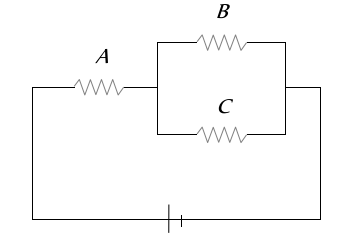
- A
$\ln B$
- B
$\ln B$ and $C$
- ✓
$\ln A$
- D
Same for $A, B$ and $C$
AnswerCorrect option: C. $\ln A$
Resistance of $A$ is greater than the resistance of combination of $B$ and $C$, hence voltage drop across $A$ will be greater than that across $B$ or $C$. Also $H=\frac{V^2 t}{R}$
$\Rightarrow H \propto V^2 \text { so } H_A > \left(H_B=H_C\right) (R=\text { constant })$
View full question & answer→MCQ 421 Mark
The chemical equivalent of silver is $108.$ If the current in a silver voltameter is $2$ Amp., the time required to deposit $27$ grams of silver will be
- A
$8.57$ hrs
- B
$6.70 hrs$
- ✓
$3.35$ hrs
- D
$12.50 hrs$
AnswerCorrect option: C. $3.35$ hrs
$ m=Z i t \Rightarrow t=\frac{m}{Z i}=\frac{m \times F}{E \times i} \quad\left(\because Z=\frac{E}{F}\right) $
$ t=\frac{27 \times 96500}{108 \times 2}=12062.5 \mathrm{sec}=\frac{12062.5}{3600} \mathrm{hr}=3.35 \mathrm{hr}$
View full question & answer→MCQ 431 Mark
If a $30 V , 90 W$ bulb is to be worked on a $120 V$ line, a resistance of how many ohms should be connected in series with the bulb
- A
$10 ohm$
- B
$20 ohm$
- ✓
$30 ohm$
- D
$40 ohm$
AnswerCorrect option: C. $30 ohm$
View full question & answer→MCQ 441 Mark
A bulb has specification of one kilowatt and 250 volts, the resistance of bulb is
- A
$125 \Omega$
- ✓
$62.5 \Omega$
- C
$0.25 \Omega$
- D
$625 \Omega$
AnswerCorrect option: B. $62.5 \Omega$
(b) $R=\frac{V^2}{P}=\frac{(250)^2}{10^3}=62.5 \Omega$
View full question & answer→MCQ 451 Mark
Two ends of a conductor are at different temperatures the electromotive force generated between two ends is
- A
Seebeck electro motive force (e.m.f.)
- B
Peltier electro motive force (e.m.f.)
- ✓
Thomson electro motive force (e.m.f.)
- D
AnswerCorrect option: C. Thomson electro motive force (e.m.f.)
View full question & answer→MCQ 461 Mark
Two electric bulbs rated $P_1$ watt $V$ volts and $P_2$ watt $V$ volts are connected in parallel and $V$ volts are applied to it. The total power will be
AnswerCorrect option: A. $P_1+P_2$ watt
(a) If resistances of bulbs are $R_1$ and $R_2$ respectively then in parallel
$\frac{1}{R_P}=\frac{1}{R_1}+\frac{1}{R_2} \Rightarrow \frac{1}{\left(\frac{V^2}{P_p}\right)}=\frac{1}{\left(\frac{V^2}{P_1}\right)}+\frac{1}{\left(\frac{V^2}{P_2}\right)} $
$ \Rightarrow P_P=P_1+P_2$
View full question & answer→MCQ 471 Mark
The temperature at which thermal electric power of a thermo couple becomes zero is called
AnswerThermo$-$electric power $P=\frac{d E}{d \theta}$; at $t_n, E \rightarrow$ maximum. So $P \rightarrow$ zero.
View full question & answer→MCQ 481 Mark
On passing $96500$ coulomb of charge through a solution $CuSO _4$ the amount of copper liberated is
- A
$64 gm$
- ✓
$32 gm$
- C
$32 kg$
- D
$64 kg$
AnswerCorrect option: B. $32 gm$
(b) 1 faraday $(96500 \mathrm{C})$ is the electricity which liberated that amount of substance which is equal to equivalent wt. So liberated amount of $\mathrm{Cu}$ is $\frac{63.5}{2}$ $=31.25 \mathrm{gm} \approx 32 \mathrm{gm}$
View full question & answer→MCQ 491 Mark
A 60 watt bulb operates on $220 V$ supply. The current flowing through the bulb is
- A
$11 / 3$ amp
- ✓
$3 / 11 amp$
- C
$3 amp$
- D
$6 amp$
AnswerCorrect option: B. $3 / 11 amp$
(b) $P=V i \Rightarrow i=\frac{P}{V}=\frac{60}{220}=\frac{3}{11} \mathrm{amp}$
View full question & answer→MCQ 501 Mark
Which of the following plots may represent the thermal energy produced in a resistor in a given time as a function of the electric current
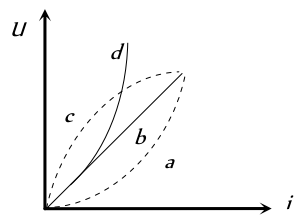
Answer(d) $U \propto i^2$, hence the graph between $U$ and $i$ is parabolic in nature and should be above graph $(b)$.
View full question & answer→