Question types

Heating and Chemical Effect of Current question types

329 questions across 2 question groups — pick any mix to generate a JEE physics paper with step-by-step answer keys.

329
Questions
2
Question groups
5
Question types
Sample Questions

Heating and Chemical Effect of Current questions

One sample from each question group in this chapter. Select any group above to see the full set with answer keys.

Assertion : The possibility of an electric bulb fusing is higher at the time of switching ON and OFF
Reason : Inductive effects produce a surge at the time of switch ON and OFF
View full solution
Assertion : A laser beam $0.2 W$ power can drill holes through a metal sheet, whereas $1000 W$ torch-light cannot.
Reason : The frequency of laser light is much higher then that of torch light.
View full solution
Assertion : Electric appliances with metallic body; e.g. heaters, presses etc, have three pin connections, whereas an electric bulb has a two pin connection.
Reason : Three pin connections reduce heating of connecting cables.
View full solution
Assertion : A domestic electrical appliance, working on a three pin will continue working even if the top pin is removed.
Reason : The third pin is used only as a safety device.
View full solution
Assertion : When temperature of cold junction of a thermocouple is lowered, the value of neutral temperature of this thermocouple is raised.
Reason : When the difference of temperature of two junction is raised, more thermo e.m.f. is produced.
View full solution
Q 6MCQ1 Mark
Two wires have resistance of $2 \Omega$ and $4 \Omega$ connected to same voltage, ratio of heat dissipated at resistance is
  • A
    $1: 2$
  • B
    $4: 3$
  • $2: 1$
  • D
    $5: 2$

Answer: C.

View full solution
Q 7MCQ1 Mark
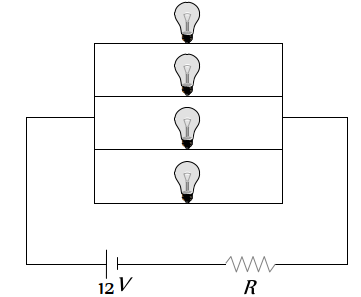
Four identical electrical lamps are labelled $1.5 V , 0.5 A$ which describes the condition necessary for them to operate at normal brightness. A $12 V$ battery of negligible internal resistance is connected to lamps as shown, then

Image

  • A
    The value of $R$ for normal brightness of each lamp is (3/4) $\Omega$
  • The value of $R$ for normal brightness of each lamp is (21/4) $\Omega$
  • C
    Total power dissipated in circuit when all lamps are normally bright is $24 W$
  • D
    Power dissipated in $R$ is $21 W$ when all lamps are normally bright

Answer: B.

View full solution
Q 8MCQ1 Mark
What is immaterial for an electric fuse wire
  • A
    Specific resistance of the wire
  • Radius of the wire
  • C
    Length of the wire
  • D
    Current flowing through the wire

Answer: B.

View full solution
Q 9MCQ1 Mark
The relation between Faraday constant $(F)$, chemical equivalent $(E)$ and electrochemical equivalent $(Z)$ is
  • A
    $F=E Z$
  • B
    $ F=\frac{Z}{E}$
  • $F=\frac{E}{Z}$
  • D
    $F=\frac{E}{Z^2}$

Answer: C.

View full solution
Q 10MCQ1 Mark
Electric room radiator which operates at $225$ volts has resistance of $50\  ohms$. Power of the radiator is approximately
  • A
    $100 \ W$
  • B
    $450\  W$
  • C
    $750 \ W$
  • $1000\  W$

Answer: D.

View full solution

Generate a Heating and Chemical Effect of Current paper free

Pick question groups from the list above, set marks and difficulty, and export a branded PDF with step-by-step answer keys. First 3 chapters free — no signup.

Download App