MCQ 2011 Mark
The pole pieces of the magnet used in a pivoted coil galvanometer are
- A
Plane surfaces of a bar magnet
- B
Plane surfaces of a horse-shoe magnet
- C
Cylindrical surfaces of a bar magnet
- ✓
Cylindrical surfaces of a horse-shoe magnet
AnswerCorrect option: D. Cylindrical surfaces of a horse-shoe magnet
View full question & answer→MCQ 2021 Mark
In a moving coil galvanometer, the deflection of the coil $\theta $ is related to the electrical current $i$ by the relation
AnswerCorrect option: B. $i \propto \theta $
(b) $i = \frac{{C\theta }}{{NAB}}$ $==>$ $i\, \propto \theta $
View full question & answer→MCQ 2031 Mark
A moving coil sensitive galvanometer gives at once much more deflection. To control its speed of deflection
- A
A high resistance is to be connected across its terminals
- ✓
A magnet should be placed near the coil
- C
A small copper wire should be connected across its terminals
- D
The body of galvanometer should be earthed
AnswerCorrect option: B. A magnet should be placed near the coil
(b)Magnet provides damping.
View full question & answer→MCQ 2041 Mark
The deflection in a moving coil galvanometer is
- A
Directly proportional to the torsional constant
- ✓
Directly proportional to the number of turns in the coil
- C
Inversely proportional to the area of the coil
- D
Inversely proportional to the current flowing
AnswerCorrect option: B. Directly proportional to the number of turns in the coil
(b)$\theta = \frac{{NiAB}}{C} \Rightarrow \theta \propto N$ (Number of turns)
View full question & answer→MCQ 2051 Mark
To make the field radial in a moving coil galvanometer
- A
The number of turns in the coil is increased
- B
Magnet is taken in the form of horse-shoe
- C
Poles are cylindrically cut
- D
Coil is wounded on aluminium frame
AnswerIn order to obtain the radial magnetic field in a moving coil galvanometer, the poles of the magnet are cut cylindrical.
View full question & answer→MCQ 2061 Mark
The ammeter has range $1\, ampere$ without shunt. the range can be varied by using different shunt resistances. The graph between shunt resistance and range will have the nature
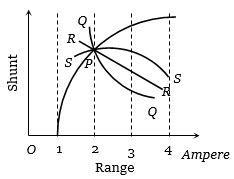
Answer(b) To make range $n$ times, the galvanometer resistance should be $G /n$, where $G$ is initial resistance.
View full question & answer→MCQ 2071 Mark
The graph which represents the relation between the total resistance $R$ of a multi range moving coil voltmeter and its full scale deflection $V$ is
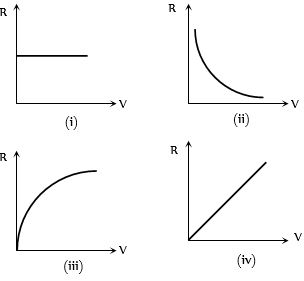
- A
$(i)$
- B
$(ii)$
- C
$(iii)$
- D
$(iv)$
AnswerFor conversion of a galvanometer into a voltmeter
$\frac{V}{{R + G}} = {i_g}$ $ \Rightarrow $ $\frac{V}{{{R_V}}} = {i_g}$;
where $R_V = R + G = $
Total resistance $ \Rightarrow $ ${R_V} = \frac{V}{{{i_g}}}$ $ \Rightarrow $ ${R_V} \propto V$
View full question & answer→MCQ 2081 Mark
A microammeter has a resistance of $100\,\Omega $ and full scale range of $50\,\mu A$. It can be used as a voltmeter or as a higher range ammeter provided a resistance is added to it. Pick the correct range and resistance combination
- A
$50\, V$ range with $10\,k\Omega $ resistance in series
- ✓
$10\, V$ range with $200\,k\Omega $ resistance in series
- C
$10\, mA$ range with $1\,\Omega $ resistance in parallel
- D
$10\, mA$ range with $0.1\,\Omega $ resistance in parallel
AnswerCorrect option: B. $10\, V$ range with $200\,k\Omega $ resistance in series
(b) To convert a galvanometer into an ammeter, a shunt $S = \frac{{{I_g}}}{{I - {I_g}}}G$ is connected in parallel with it. To convert a galvanometer into a voltmeter, a resistance $R = \frac{V}{{{I_g}}} - G$ is connected in series with it.
View full question & answer→MCQ 2091 Mark
A galvanometer coil of resistance $50 \,\Omega$, show full deflection of $100\,\mu A$. The shunt resistance to be added to the galvanometer, to work as an ammeter of range $10\, mA$ is
AnswerCorrect option: D. $0.5$ $\Omega$ in parallel
(d) $S = \left( {\frac{{{i_g}}}{{i - {i_g}}}} \right)\, \times G$$ = \frac{{100 \times {{10}^{ - 6}}}}{{(10 \times {{10}^{ - 3}} - 100 \times {{10}^{ - 6}})}} \times 50 \times 0.5\,\Omega $ (in parallel)
View full question & answer→MCQ 2101 Mark
The maximum current that can be measured by a galvanometer of resistance $40 \,\Omega$ is $10\, mA$. It is converted into a voltmeter that can read upto $50\, V$. The resistance to be connected in series with the galvanometer is ... (in $ohm$)
- A
$5040$
- ✓
$4960$
- C
$2010$
- D
$4050$
AnswerCorrect option: B. $4960$
(b) ${i_g} = \frac{{50}}{{10 \times {{10}^{ - 3}}}} - 40 = 4960\,\Omega $
View full question & answer→MCQ 2111 Mark
The current flowing in a coil of resistance $90 \,\Omega$ is to be reduced by $90\%$. What value of resistance should be connected in parallel with it ............. $\Omega $
Answer(d) ${i_g} = \frac{i}{{10}}$ $ \Rightarrow $ Required shunt $S = \frac{G}{{(n - 1)}} = \frac{{90}}{{(10 - 1)}} = 10\,\Omega $
View full question & answer→MCQ 2121 Mark
A galvanometer, having a resistance of $50 \,\Omega$ gives a full scale deflection for a current of $0.05\, A$. The length in meter of a resistance wire of area of cross-section $2.97× 10^{-2} \,cm^2$ that can be used to convert the galvanometer into an ammeter which can read a maximum of $5\, A$ current is (Specific resistance of the wire = $5 × {10^{ - 7}}\,\Omega m$)
Answer(c) $\frac{i}{{{i_g}}} = 1 + \frac{G}{S} \Rightarrow \frac{5}{{0.05}} = 1 + \frac{{50}}{S}$
$ \Rightarrow $ $S = \frac{{50}}{{99}} = \frac{{\rho \times l}}{A}$
$ \Rightarrow $ $l = \frac{{50}}{{99}} \times \frac{{2.97 \times {{10}^{ - 2}} \times {{10}^{ - 4}}}}{{5 \times {{10}^{ - 7}}}} = 3\,m$.
View full question & answer→MCQ 2131 Mark
A $50\, ohm$ galvanometer gets full scale deflection when a current of $0.01\, A$ passes through the coil. When it is converted to a $10\, A$ ammeter, the shunt resistance is ........... $\Omega $
- A
$0.01$
- ✓
$0.05$
- C
$2000$
- D
$5000$
AnswerCorrect option: B. $0.05$
(b) ${i_g} = i\frac{S}{{G + S}}$
$ \Rightarrow $$\frac{{0.01}}{{10}} = \frac{5}{{50 + S}}$
$ \Rightarrow $ $S = \frac{{50}}{{999}} = 0.05\,\Omega $.
View full question & answer→MCQ 2141 Mark
An ammeter of $100$ $\Omega$ resistance gives full deflection for the current of $10^{-5} \,amp$. Now the shunt resistance required to convert it into ammeter of $1\, amp$. range, will be
- A
${10^{ - 4}}$ $\,\Omega$
- B
${10^{ - 5}}$ $\Omega$
- ✓
${10^{ - 3}}$ $\Omega$
- D
${10^{ - 1}}$ $\Omega$
AnswerCorrect option: C. ${10^{ - 3}}$ $\Omega$
(c) $\frac{i}{{{i_g}}} = 1 + \frac{G}{S} \Rightarrow \frac{1}{{{{10}^{ - 5}}}} = 1 + \frac{{100}}{S}$$ \Rightarrow \,\,S \approx \frac{{100}}{{{{10}^5}}} = {10^{ - 3}}\,\Omega $.
View full question & answer→MCQ 2151 Mark
A $100\, ohm$ galvanometer gives full scale deflection at $10\, mA$. How much shunt is required to read $100\, mA$ .............. $ohm$
- ✓
$11.11$
- B
$9.9$
- C
$1.1$
- D
$4.4$
AnswerCorrect option: A. $11.11$
(a) ${i_g} = i\frac{S}{{G + S}}$
$ \Rightarrow $ $10 \times {10^{ - 3}} = \frac{S}{{100 + S}} \times 100 \times {10^{ - 3}}$
$90\;S = 1000 \Rightarrow $$S = \frac{{1000}}{{90}} = 11.11\;\Omega $.
View full question & answer→MCQ 2161 Mark
To convert a $800\, mV$ range milli voltmeter of resistance $40 \,\Omega$ into a galvanometer of $100\, mA$ range, the resistance to be connected as shunt is .............. $\Omega $
Answer$\frac{i}{{{i_g}}} = 1 + \frac{G}{S}$$ \Rightarrow \frac{{i.G}}{{{V_g}}} = 1 + \frac{G}{S} \Rightarrow \frac{{100 \times {{10}^{ - 3}} \times 40}}{{800 \times {{10}^{ - 3}}}} = 1 + \frac{{40}}{S}$
$ \Rightarrow $ $S = 10\,\Omega $.
View full question & answer→MCQ 2171 Mark
There are three voltmeters of the same range but of resistances $10000\,\Omega $, $8000\,\Omega $ and $4000\,\Omega $ respectively. The best voltmeter among these is the one whose resistance is ................ $\Omega $
- ✓
$10000$
- B
$8000$
- C
$4000$
- D
AnswerCorrect option: A. $10000$
(a) Resistance of voltmeter should be high.
View full question & answer→MCQ 2181 Mark
A galvanometer of resistance $20 \,\Omega$ is to be converted into an ammeter of range $1\, A$. If a current of $1\, mA$ produces full scale deflection, the shunt required for the purpose is ................ $\Omega $
- A
$0.01 $
- B
$0.05$
- ✓
$0.02$
- D
$0.04$
AnswerCorrect option: C. $0.02$
(c) $\frac{i}{{{i_g}}} = 1 + \frac{G}{S}$$ \Rightarrow \,\,\,\,\,\frac{1}{{{{10}^{ - 3}}}} = 1 + \frac{{20}}{S} \Rightarrow S = \frac{{20}}{{999}} \approx 0.02\,\Omega $.
View full question & answer→MCQ 2191 Mark
An ammeter and a voltmeter of resistance $R$ are connected in series to an electric cell of negligible internal resistance. Their readings are $A$ and $V$ respectively. If another resistance $R$ is connected in parallel with the voltmeter
- A
Both $A$ and $V$ will increase
- B
Both $A$ and $V$ will decrease
- C
$A$ will decrease and $V$ will increase
- ✓
$A$ will increase and $V$ will decrease
AnswerCorrect option: D. $A$ will increase and $V$ will decrease
(d) After connecting a resistance $R$ in parallel with voltmeter its effective resistance decreases. Hence less voltage appears across it i.e. $V$ will decreases. Since overall resistance decreases so more current will flow i.e. $A$ will increase.
View full question & answer→MCQ 2201 Mark
A $36 \,\Omega$ galvanometer is shunted by resistance of $4\,\Omega$. The percentage of the total current, which passes through the galvanometer is
Answer(c) $\frac{{{i_g}}}{i} = \frac{S}{{G + S}} = \frac{4}{{36 + 4}} = \frac{1}{{10}}\,\,i.e.\,10\% .$
View full question & answer→MCQ 2211 Mark
A voltmeter has a range $0-V$ with a series resistance $R$. With a series resistance $2R$, the range is $0-V'$. The correct relation between $V$ and $V'$ is
- A
$V' = 2V$
- B
$V' > 2V$
- C
$V' > > 2V$
- ✓
$V' < 2V$
AnswerCorrect option: D. $V' < 2V$
(d) For conversion of galvanometer (of resistances) into voltmeter, a resistance $R$ is connected in series.
${i_g} = \frac{{{V_1}}}{{R + G}}$ and ${i_g} = \frac{{{V_2}}}{{2R + G}}$
$==>$ $\frac{{{V_1}}}{{R + G}} = \frac{{{V_2}}}{{2R + G}}$ $==>$ $\frac{{{V_2}}}{{{V_1}}} = \frac{{2R + G}}{{R + G}} = \frac{{2(R + G) - G}}{{(R + G)}}$
$ = 2 - \frac{G}{{(R + G)}}$ $==>$ ${V_2} = 2{V_1} - \frac{{{V_1}G}}{{(R + G)}}$ $==>$ ${V_2} < 2{V_1}$
View full question & answer→MCQ 2221 Mark
A milliammeter of range $10\, mA$ has a coil of resistance $1 \,\Omega$. To use it as voltmeter of range $10\, volt$, the resistance that must be connected in series with it, will be ............. $\Omega $
Answer(a) $R = \frac{V}{{{i_g}}} - G = \frac{{10}}{{10 \times {{10}^{ - 3}}}} - 1 = 999\,\Omega $.
View full question & answer→MCQ 2231 Mark
A voltmeter having resistance of $50 × 10^3$ $Omega$ is used to measure the voltage in a circuit. To increase the range of measurement $3$ times the additional series resistance required is
- ✓
$10^5 \,\Omega$
- B
$150\, k.ohm$
- C
$900 \,k.ohm$
- D
$9 × 10^6 \,ohm$
AnswerCorrect option: A. $10^5 \,\Omega$
(a) $R = G(n - 1) = 50 \times {10^3}(3 - 1) = {10^5}\,\Omega $.
View full question & answer→MCQ 2241 Mark
In a circuit $5$ percent of total current passes through a galvanometer. If resistance of the galvanometer is $G$ then value of the shunt is
- A
$19\, G$
- B
$20\, G$
- C
$\frac{G}{{20}}$
- ✓
$\frac{G}{{19}}$
AnswerCorrect option: D. $\frac{G}{{19}}$
(d) $\frac{{{i_g}}}{i} = \frac{S}{{G + S}}$
$ \Rightarrow $ $\frac{5}{{100}} = \frac{S}{{G + S}}$
$ \Rightarrow $ $S = \frac{G}{{19}}$
View full question & answer→MCQ 2251 Mark
An ammeter gives full deflection when a current of $2\, amp$. flows through it. The resistance of ammeter is $12 \,\Omega$. If the same ammeter is to be used for measuring a maximum current of $5\, amp$., then the ammeter must be connected with a resistance of
AnswerCorrect option: C. $8 \,\Omega$ in parallel
(c) $\frac{i}{{{i_g}}} = 1 + \frac{G}{S}$$ \Rightarrow \,\,\,\frac{5}{2} = 1 + \frac{{12}}{S} \Rightarrow S = 8\,\Omega .$ (In parallel).
View full question & answer→MCQ 2261 Mark
A galvanometer has $30$ divisions and a sensitivity $16\,\mu A/{\rm{div}}{\rm{.}}$ It can be converted into a voltmeter to read $3\, V$ by connecting
- ✓
Resistance nearly $6 \,k\,\Omega $ in series
- B
$6\,k\,\Omega $ in parallel
- C
$500\,\Omega $ in series
- D
AnswerCorrect option: A. Resistance nearly $6 \,k\,\Omega $ in series
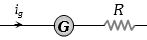
(a) $(R + G)\,{i_g} = V$
$ \Rightarrow $ $(R + G) = \frac{V}{{{i_g}}}$
$ = \frac{3}{{30 \times 16 \times {{10}^{ - 6}}}} = 6.25\,k\Omega $
$\therefore $ Value of $R$ is nearly equal to $6\,k\Omega $
This is connected in series in a voltmeter.
View full question & answer→MCQ 2271 Mark
A galvanometer has a resistance of $25\, ohm$ and a maximum of $0.01\, A$ current can be passed through it. In order to change it into an ammeter of range $10\, A$, the shunt resistance required is
- A
$5/999\,\Omega $
- B
$10/999 \,\Omega $
- C
$20/999 \,\Omega $
- ✓
$25/999 \,\Omega $
AnswerCorrect option: D. $25/999 \,\Omega $
(d) ${i_g} = i\frac{S}{{G + S}}$
$ \Rightarrow $ $0.01 = 10\frac{S}{{25 + S}}$
$ \Rightarrow \,\,\,1000S = 25 + S$
$ \Rightarrow $ $S = \frac{{25}}{{999}}\,\Omega $.
View full question & answer→MCQ 2281 Mark
A galvanometer of $25 \,\Omega$ resistance can read a maximum current of $6\,mA$. It can be used as a voltmeter to measure a maximum of $6\, V$ by connecting a resistance to the galvanometer. Identify the correct choice in the given answers
- A
$1025 \,\Omega$ in series
- B
$1025 \,\Omega$ in parallel
- ✓
$975 \,\Omega$ in series
- D
$975 \,\Omega$ in parallel
AnswerCorrect option: C. $975 \,\Omega$ in series
(c) $R = \frac{V}{{{i_g}}} - G = \frac{6}{{6 \times {{10}^{ - 3}}}} - 25 = 975\,\Omega $(In series).
View full question & answer→MCQ 2291 Mark
The resistance of an ideal ammeter is
Answer(d) Ammeter is a device that is applied in series to the circuit through which we want to calculate the current.
An Ammeter if have resistance can make equivalent circuit resistance more than that of the actual circuit resistance. and which in turn reduces the current and hence we face error in the current.
In practical there is no any conductor whose resistance is zero, but practical ammeters have very low resistances which causes very low error and which can be negligible.
But for the ideal or perfect ammeter we need zero resistance so that the property of measuring instrument cannot affect the readings of the circuit.
View full question & answer→MCQ 2301 Mark
A galvanometer with a resistance of $12 \,\Omega$ gives full scale deflection when a current of $3\, mA$ is passed. It is required to convert it into a voltmeter which can read up to $18\, V$. the resistance to be connected is ............... $\Omega $
- A
$6000$
- ✓
$5988 $
- C
$5000 $
- D
$4988$
AnswerCorrect option: B. $5988 $
(b) $R = \frac{V}{{{i_g}}} - G = \frac{{18}}{{3 \times {{10}^{ - 3}}}} - 12 = 5988\,\Omega $
View full question & answer→MCQ 2311 Mark
If an ammeter is connected in parallel to a circuit, it is likely to be damaged due to excess
Answer(a) When ammeter is connected in parallel to the circuit, net resistance of the circuit decreases. Hence more current is drawn from the battery, which damages the ammeter.
View full question & answer→MCQ 2321 Mark
The resistance of a galvanometer coil is $R$. What is the shunt resistance required to convert it into an ammeter of range $4$ times
- A
$\frac{R}{5}$
- B
$\frac{R}{4}$
- ✓
$\frac{R}{3}$
- D
$4\, R$
AnswerCorrect option: C. $\frac{R}{3}$
(c) $\frac{i}{{{i_g}}} = 1 + \frac{G}{S} \Rightarrow \frac{4}{1} = 1 + \frac{R}{S}$$ \Rightarrow S = \frac{R}{3}$.
View full question & answer→MCQ 2331 Mark
A voltmeter has resistance of $2000\, ohms$ and it can measure upto $2\,V$. If we want to increase its range to $10\, V$, then the required resistance in series will be ........... $\Omega $
- A
$2000$
- B
$4000$
- C
$6000$
- ✓
$8000$
AnswerCorrect option: D. $8000$
(d) Here $n = \frac{{10}}{2} = 5$
$R = (n - 1)G$$ = (5 - 1)2000 = 8000\,\Omega $
View full question & answer→MCQ 2341 Mark
A voltmeter of resistance $1000\,\Omega $ gives full scale deflection when a current of $100\, mA$ flow through it. The shunt resistance required across it to enable it to be used as an ammeter reading $1\, A$ at full scale deflection is ............... $\Omega $
- A
$10000$
- B
$9000$
- C
$222$
- ✓
$111$
Answer(d) By using $\frac{i}{{{i_g}}} = 1 + \frac{G}{S}$
$ \Rightarrow $ $\frac{i}{{100 \times {{10}^{ - 3}}}} = 1 + \frac{{1000}}{S}$
$ \Rightarrow $ $S = \frac{{1000}}{9} = 111\,\Omega $
View full question & answer→MCQ 2351 Mark
A galvanometer whose resistance is $120\,\Omega $ gives full scale deflection with a current of $0.05\, A$ so that it can read a maximum current of $10\, A$. A shunt resistance is added in parallel with it. The resistance of the ammeter so formed is .............. $\Omega $
- A
$0.06$
- B
$0.006$
- ✓
$0.6$
- D
$6$
Answer(c) Resistance of shunted ammeter$ = \frac{{GS}}{{G + S}}$
Also $\frac{i}{{{i_g}}} = 1 + \frac{G}{S}$
$ \Rightarrow $ $\frac{{GS}}{{G + S}} = \frac{{{i_g}.G}}{i}$
$ \Rightarrow $ $\frac{{GS}}{{G + S}} = \frac{{0.05 \times 120}}{{10}}$= $0.6 \,\Omega$
View full question & answer→MCQ 2361 Mark
An ammeter whose resistance is $180\,\Omega $ gives full scale deflection when current is $2\, mA$. The shunt required to convert it into an ammeter reading $20\, mA$ (in $ohms$) is
Answer(b) Given ${i_g} = 2\,mA,$ $i = 20\,mA,\,G = 180\,\Omega $
$\frac{{{i_g}}}{i} = \frac{S}{{G + S}}$
$ \Rightarrow $ $180 + S = 10S$
$ \Rightarrow $ $S = \frac{{180}}{9} = 20\,\Omega $
View full question & answer→MCQ 2371 Mark
A galvanometer has resistance of $7\,\Omega $ and gives a full scale deflection for a current of $1.0\, A$. How will you convert it into a voltmeter of range $10\, V$
- ✓
$3\,\Omega $ in series
- B
$3\,\Omega $ in parallel
- C
$17\,\Omega $ in series
- D
$30\,\Omega $ in series
AnswerCorrect option: A. $3\,\Omega $ in series
(a) By connecting a series resistance
$R = \frac{V}{{{i_g}}} - G = \frac{{10}}{1} - 7 = 3\,\Omega $
View full question & answer→MCQ 2381 Mark
The resistance of an ideal voltmeter is
Answer(d)The resistance of an ideal voltmeter is considered as infinite.
View full question & answer→MCQ 2391 Mark
If only $2\,%$ of the main current is to be passed through a galvanometer of resistance $G$, then the resistance of shunt will be
- A
$\frac{G}{{50}}$
- ✓
$\frac{G}{{49}}$
- C
$50\,G$
- D
$49\,G$
AnswerCorrect option: B. $\frac{G}{{49}}$
(b) ${i_g} = 2\% $ of $i = \frac{i}{{50}}$
$ \Rightarrow $ $S = \frac{G}{{(n - 1)}} = \frac{G}{{(50 - 1)}} = \frac{G}{{49}}$
View full question & answer→MCQ 2401 Mark
Which of the following is correct
- A
Ammeter has low resistance and is connected in series
- B
Ammeter has low resistance and is connected in parallel
- C
Voltmeter has low resistance and is connected in parallel
- D
AnswerAmmeter used for measuring current, and connected in series. To not disturb original circuit, it have low resistance. so correct statement is Ammeter has low resistance and is connected in series
View full question & answer→MCQ 2411 Mark
The resistance of a galvanometer is $25\, ohm$ and it requires $50\,\mu A$ for full deflection. The value of the shunt resistance required to convert it into an ammeter of $5\, amp$ is
Answer$S = \frac{G}{{\frac{i}{{{i_g}}} - 1}} = \frac{{25}}{{\frac{5}{{50 \times {{10}^{ - 6}}}} - 1}}$$ = \frac{{25}}{{{{10}^5} - 1}} = \frac{{25}}{{{{10}^5}}} = 2.5 \times {10^{ - 4}}\,\Omega $
View full question & answer→MCQ 2421 Mark
A galvanometer of resistance $25\,\Omega $ gives full scale deflection for a current of $10$ milliampere, is to be changed into a voltmeter of range $100\, V$ by connecting a resistance of $‘R’$ in series with galvanometer. The value of resistance $R$ in $\Omega $ is
- A
$10000$
- B
$10025$
- C
$975$
- ✓
$9975$
AnswerCorrect option: D. $9975$
(d) $R = \frac{V}{{{i_g}}} - G = \frac{{100}}{{10 \times {{10}^{ - 3}}}} - 25 = 9975\,\Omega $
View full question & answer→MCQ 2431 Mark
The current flowing through a coil of resistance $900\, ohms $ is to be reduced by $90\,\%$. What value of shunt should be connected across the coil ............. $\Omega $
Answer${i_g} = (100 - 90)\% $ of $i = \frac{i}{{10}}$
$ \Rightarrow $ Required shunt $S = \frac{G}{{(n - 1)}} = \frac{{900}}{{(10 - 1)}} = 100\,\Omega $
View full question & answer→MCQ 2441 Mark
A moving coil galvanometer has a resistance of $50\,\Omega $ and gives full scale deflection for $10\, mA$. How could it be converted into an ammeter with a full scale deflection for $1\,A$
- A
$50/99\,\Omega $ in series
- B
$50/99\,\Omega $ in parallel
- C
$0.01\,\Omega $ in series
- D
$0.01\,\Omega $ in parallel
Answer$S = \frac{{{i_g} \times G}}{{i - {i_g}}} = \frac{{10 \times {{10}^{ - 3}} \times 50}}{{1 - {{10}^{ - 3}} \times 10}} = \frac{{50}}{{99}}\,\Omega $ in parallel.
View full question & answer→MCQ 2451 Mark
Which of the following statement is wrong
- A
Voltmeter should have high resistance
- B
Ammeter should have low resistance
- ✓
Ammeter is placed in parallel across the conductor in a circuit
- D
Voltmeter is placed in parallel across the conductor in a circuit
AnswerCorrect option: C. Ammeter is placed in parallel across the conductor in a circuit
(c)Ammeter is always connected in series with circuit.
View full question & answer→MCQ 2461 Mark
A voltmeter has a resistance of $G\, ohms$ and range $V\, volts$. The value of resistance used in series to convert it into a voltmeter of range $nV$ $volts$ is
- A
$nG$
- B
$(n - 1)G$
- C
$\frac{G}{n}$
- D
$\frac{G}{{(n - 1)}}$
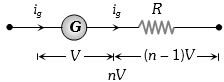
Answer Suppose resistance $R$ is connected in series with voltmeter as shown.
By Ohm's law
${i_g}.R = (n - 1)V$
$ \Rightarrow $ $R = (n - 1)G$ (where ${i_g} = \frac{V}{G})$
View full question & answer→MCQ 2471 Mark
The resistance of a galvanometer is $90\, ohms$. If only $10$ percent of the main current may flow through the galvanometer, in which way and of what value, a resistor is to be used
- A
$10\, ohms$ in series
- ✓
$10\, ohms$ in parallel
- C
$810\, ohms$ in series
- D
$810\, ohms$ in parallel
AnswerCorrect option: B. $10\, ohms$ in parallel
(b) ${i_g} = 10\% $ of $i = \frac{i}{{10}}$ $ \Rightarrow $ $S = \frac{G}{{(n - 1)}} = \frac{{90}}{{(10 - 1)}} = 10\,\Omega $
View full question & answer→MCQ 2481 Mark
A galvanometer of $10 \,\Omega$ resistance gives full scale deflection with $0.01$ ampere of current. It is to be converted into an ammeter for measuring $10$ ampere current. The value of shunt resistance required will be
AnswerCorrect option: A. $\frac{{10}}{{999}}$$\Omega$
(a) $S = \frac{{{i_g}G}}{{i - {i_g}}} = \frac{{10 \times 0.01}}{{10 - 0.01}} = \frac{{10}}{{999}}$ $\Omega$
View full question & answer→MCQ 2491 Mark
The tangent galvanometer, when connected in series with a standard resistance can be used as
- A
- ✓
- C
- D
Both an ammeter and a voltmeter
View full question & answer→MCQ 2501 Mark
When a $12\,\Omega $ resistor is connected with a moving coil galvanometer then its deflection reduces from $50$ divisions to $10$ divisions. The resistance of the galvanometer is ............. $\Omega $
Answer${i_g} = \frac{{iS}}{{S + G}}$ $ \Rightarrow $ $10 = \frac{{50 \times 12}}{{12 + G}}$ $ \Rightarrow $ $12 + G = 60$ $ \Rightarrow $ $G = 48\,\Omega $
View full question & answer→