MCQ 1511 Mark
In a cyclotron experiment, if we assume that maximum radius attained by any charged particle is equal to radius of dees, then minimum kinetic energy gained by the particles will be for
Answer$K{E_{\max }}\, \propto \,\,\frac{{{q^2}}}{m}$
so, it is minimum for deutron.
View full question & answer→MCQ 1521 Mark
In a cyclotron, a charged particle
- A
Undergoesd acceleration all the time
- B
Speeds up between the dees because of the magnetic field
- C
- D
Slows down within a dee and speeds up between dees
AnswerThe charged particle undergoes acceleration as
$(i)$ Speeds up between the dees because of the oscillating electric field and
$(ii)$ Speed remains the same inside the dees because of the magnetic field but direction undergoes change continuously.
View full question & answer→MCQ 1531 Mark
Consider three quantities $x = E/B,$ $y =\sqrt {1/{\mu _0}{\varepsilon _0}} $ and $z = l$ . Here, $l$ is the length of a wire, $C$ is a $CR$ capacitance and $R$ is a resistance. All other symbols have standard meanings.
- A
$x, y$ have the same dimensions
- B
$y, z$ have the same dimensions
- C
$z, x$ have the same dimensions
- D
View full question & answer→MCQ 1541 Mark
The dimensional formula for the physical quantityis $\frac{{{E^2}{\mu _0}{\varepsilon _0}}}{{{B^2}}}$ ($E =$ electric field and $B =$ magnetic field)
- A
$L^0M^0T^0$
- B
$L^1M^0T^{-1}$
- C
$L^{-1}M^0T^1$
- D
$L^{1/2}M^0T^{-1/2}$
AnswerWe know,
$\mu_0 \varepsilon_0=\frac{1}{ c ^2}$
$\frac{E}{B}=c$
$\frac{ E ^2 \mu_0 \varepsilon_0}{ B ^2}=1$
Dimension of $1=\left[ M ^0 L ^0 T ^0\right]$
View full question & answer→MCQ 1551 Mark
The dimension of where $\sqrt {\frac{\mu }{ \in }} $ is permeability $\& \varepsilon$ is permittivity is same as :
AnswerThe dimension of $\sqrt{\mu / t}$ is Resistance. $\mu$ is permeability $\epsilon$ is permitivity
View full question & answer→MCQ 1561 Mark
In a cyclotron, the angular frequency of a charged particle is independent of
Answer(b) $\omega = \frac{{2\pi }}{T} = \frac{{qB}}{m}$ $==>$ $\omega \propto v^\circ $
View full question & answer→MCQ 1571 Mark
The phosphor bronze strip is used in a moving coil galvanometer because
- ✓
It is torsional constant is small
- B
- C
- D
AnswerCorrect option: A. It is torsional constant is small
(a)
Option $B-$It does not oxidise easily.
Option $C-$It has low torsional constant.
Option $D-$It is non-magnetic.
Hase,Option $A$ Is Correct Answer.
View full question & answer→MCQ 1581 Mark
The current sensitivity of a moving coil galvanometer increases by $20 \%$ when its resistance is doubled. Calculate, by what factor does the voltage sensitivity change?
- ✓
Becomes $\frac{3}{5}$ times
- B
Becomes $\frac{2}{5}$ times
- C
- D
Decreases by a factor of $\frac{7}{5}$
AnswerCorrect option: A. Becomes $\frac{3}{5}$ times
(a)
$S_{i_1}=\frac{N i A B}{k i}=\frac{N A B}{k}$
$S_{i_2}=\frac{1.2 N A B}{k}$
$S_{v_1}=\frac{N A B}{k R}=\frac{S_{i_1}}{R}$
$S_{v_2}=\frac{S_{i_2}}{2 R}=\frac{1.2(N A B)}{k(2 R)}$
View full question & answer→MCQ 1591 Mark
A galvenometer has a resistance of $100 \,\Omega $ and a full scale range of $50\, \mu A$ . It can be used as a voltmeter or as a high range ammeter provided a resistance is added to it. Pick the correct range and resistance combination
- A
$50\, V$ range with $10\, k\Omega $ resistance in series
- B
$10\, V$ range with $200\, k\Omega $ resistance in series
- C
$5 \,mA$ range with $10\,\Omega $ resistance in parallel
- D
$5\,mA$ range with $0.1\,\Omega$ resistance in parallel
AnswerA galvenometer of resistance $\mathrm{G}$ can be used as a voltmeter of range $\mathrm{V}$ if a high resistance $\mathrm{R}$ is connected in its series where.
$\mathrm{R}=\frac{\mathrm{V}}{\mathrm{I}_{8}}-\mathrm{G}$
$\mathrm{I}_{\mathrm{R}}$ is the current in the galvenometer for full scale deflection.
For the choice $( 1)$
${\rm{R}} = \frac{{50}}{{50 \times {{10}^{ - 6}}}} - 100 \ne 10{\rm{k}}\Omega $
For the choice $(2)$
$\mathrm{R}=\frac{10}{50 \times 10^{-6}} -100=2 \times 10^{5}-100 $
$ \simeq 2 \times {10^5}\Omega $
$ \simeq 200{\rm{k}}\Omega $
Hence, the choice $( 2)$ is conrect.
Further, the galvanometer may be converted inte an ammeter if a small resistance $'s'$ is connectec (or shunted) in parallel with the galvenometer.
where $S = \frac{{{I_g}}}{{I - {I_g}}} \times G$
$I$ is the range of the annmeter.
For the choice $( 3)$
$S = \frac{{50 \times {{10}^{ - 6}}}}{{5 \times {{10}^{ - 3}} - 50 \times {{10}^{ - 6}}}} \times 100$
$ \simeq \frac{{50 \times {{10}^{ - 6}}}}{{5 \times {{10}^{ - 3}}}} \times 100$
$ \simeq 1\Omega $
Hence. the choices $( 3)$ and $( 4)$ are not contect.
View full question & answer→MCQ 1601 Mark
A long solenoid of radius $2\, cm$ has $100\, turns/cm$ and carries a current of $5\,A$. A coil of radius $1\, cm$ having $100\, turns$ and a total resistance of $20\,\Omega $ is placed inside the solenoid coaxially. The coil is connected to a galvanometer. If the current in the solenoid is reversed in direction, find the charge flown through the galvanometer
- A
$2 \times {10^{ - 4}}\,C$
- B
$4 \times {10^{ - 4}}\,C$
- C
$6 \times {10^{ - 4}}\,C$
- D
$8 \times {10^{ - 4}}\,C$
AnswerInduced charge $=\frac{\mathrm{d} \phi}{\mathrm{R}} $
$= \frac{2 \mathrm{NAB}_{\mathrm{s}}}{\mathrm{R}} $
$=\frac{2 \times 100 \times \pi \times\left(1 \times 10^{-2}\right)^{2} \times \mu_{0} \mathrm{nI}}{20}$
$=2 \times 10^{-4} \mathrm{\,C}$
View full question & answer→MCQ 1611 Mark
When a shunt of $4\,\Omega $ is attached to a galvanometer the deflection reduces to $\frac{1}{5} th$. If an additional shunt of $4\,\Omega $ is attached. What will be the deflection.
- A
$\frac{I}{13}$
- B
$\frac{I}{11}$
- C
$\frac{I}{9}$
- D
$\frac{I}{3}$
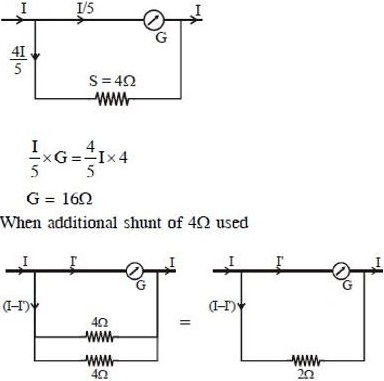
AnswerInitial condition when shunt of $4\, \Omega$ is used
${\frac{I}{5} \times G=\frac{4}{5} I \times 4} $
${G=16\, \Omega}$
When additional shunt of $4\, \Omega$ used
${\rm{I'}} \times 16 = 2({\rm{I}} - {\rm{I'}})$
$16{\rm{I}} = 2{\rm{I}} - 2{\rm{I'}}$
$18{\rm{I'}} = 2{\rm{I}}$
${\rm{I'}} = \frac{{\rm{I}}}{9}$
View full question & answer→MCQ 1621 Mark
A galvanometer having a coil resistance of $60\,\Omega $ shows full scale deflection when a current of $1.0\, amp$ passes through it. It can be converted into an ammeter to read currents upto $5.0\, amp$ by
- A
putting in parallel a resistance of $15\,\Omega $
- B
putting in parallel a resistance of $240\,\Omega $
- C
putting in series a resistance of $15\,\Omega $
- D
putting in series a resistance of $240\,\Omega $
Answer$\mathrm{I}_{\mathrm{g}} \cdot \mathrm{G}=\left(\mathrm{I}-\mathrm{I}_{\mathrm{g}}\right) \cdot S$
$\therefore S=\frac{I_{g} \cdot G}{\left(I-I_{g}\right)}$
Given $\mathrm{I}=5 \mathrm{\,A}, \mathrm{I}_{\mathrm{g}}=1 \mathrm{\,Amp} ., \mathrm{G}=60 \mathrm{\,M}$
$\therefore \quad S=\frac{60 \times 1}{4}=15\, \Omega$ in parallel
View full question & answer→MCQ 1631 Mark
A galvanometer coil has a resistance of $12\,\Omega $ and meter shows full scale deftection for a current of $3\,mA$ then to convert it into a voltmeter of range $0\,-18\, V$ a resistance should be added
- A
In series of $6000\,\,\Omega$
- B
In parallel of $6000\,\,\Omega$
- C
In series of $5998\,\,\Omega$
- D
In parallel of $5998\,\,\Omega$
Answer$\mathrm{R}_{\mathrm{g}}=12\, \Omega, \mathrm{I}_{\mathrm{g}}=3 \mathrm{\,mA}$
$\mathrm{R}_{\mathrm{g}}=\frac{\mathrm{V}_{\mathrm{R}}}{\mathrm{R}_{\mathrm{g}}+\mathrm{R}_{\mathrm{H}}}$
$\Rightarrow \mathrm{R}_{\mathrm{H}}=\frac{\mathrm{V}_{\mathrm{R}}}{\mathrm{I}_{\mathrm{g}}}-\mathrm{R}_{\mathrm{g}}$
$\Rightarrow \mathrm{R}_{\mathrm{H}}=5988\, \Omega$

View full question & answer→MCQ 1641 Mark
The sensitivity of a Galvenometer of resistance $171\,\Omega $ becomes $20\,times$ when we used shunt of $x \,\Omega .$ Find $x$ ................. $\Omega$
Answer$S=\frac{i_{g}}{i-i_{g}} G=\left(\frac{1}{i / i_{g}-1}\right) G \Rightarrow S=\left(\frac{1}{20-1}\right) 171$
View full question & answer→MCQ 1651 Mark
Two moving coil meters $M_1$ and $M_2$ having the following particulars :-
$R_1 = 10\,\Omega , N_1 = 30, A_1 = 3.6\times10^{-3}\, m^2, B_1 = 0.25\, T$
$R_2 = 14\,\Omega , N_2 = 42, A_2 = 1.8\times10^{-3}\, m^2, B_2 = 0.50\, T$
(The spring constants are identical for the two meters). Determine the ratio of voltage sensitivity of $M_2$ and $M_1$
AnswerUsing the formula of voltage sensitivity,
$\mathrm{V}=\frac{\mathrm{NAB}}{\mathrm{kR}}$
$\therefore \frac{V_{s_{2}}}{V_{s_{1}}}=\frac{n_{2} B_{2} A_{2} \cdot k_{1} R_{1}}{k_{2} R_{2} n_{1} B_{1} A_{1}}$
$=\frac{42 \times 0.50 \times 1.8 \times 10^{-3} \times \mathrm{k} \times 10}{\mathrm{k} \times 14 \times 30 \times 0.25 \times 3.6 \times 10^{-3}}=1$
View full question & answer→MCQ 1661 Mark
A galvanometer of resistance $40\,\Omega $ gives a deflection of $5\, divisions$ per $mA$. There are $50\, divisions$ on the scale. The maximum current that can pass through it when a shunt resistance of $2\,\Omega $ is connected is ................ $mA$
Answer$I_{G}=\frac{50}{5}=10 \mathrm{\,mA} ; \mathrm{R}_{\mathrm{G}}=40\, \Omega, \mathrm{R}_{\mathrm{s}}=2\, \Omega$
Maximum current,
$\mathrm{I}=\frac{\mathrm{R}_{\mathrm{G}}+\mathrm{R}_{\mathrm{S}}}{\mathrm{R}_{\mathrm{G}}} \times \mathrm{I}_{\mathrm{G}}=\frac{(40+2) \times 10}{2}=210 \mathrm{\,mA}$
View full question & answer→MCQ 1671 Mark
$20\%$ of main current passes through the galvanometer. If the resistance of the galvanometer is $G$ , then the resistance of the shunt will be
- A
$\frac {G}{50}$
- B
$\frac {G}{4}$
- C
$50\,G$
- D
$9\,G$
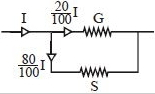
Answer$\frac{20}{100} \mathrm{IG}=\frac{80}{100} \mathrm{IS} \quad \Rightarrow \mathrm{S}=\frac{\mathrm{G}}{4}$
View full question & answer→MCQ 1681 Mark
The resistance of a galvanometer is $50\,\Omega $ and it requires $2\,\mu A$ per two division deflection. The value of the shunt required in order to convert this galvanometer into ammeter of range $5\,A$ is (The number of divisions on the galvanometer scale on one side is $30$)
- A
$0.2\,\Omega $
- B
$0.002\,\Omega $
- C
$3 \times {10^{ - 4}}\,\Omega $
- D
$4 \times {10^{ - 6}}\,\Omega $
AnswerThe shunt $\mathrm{S}$ to be connected is given by
$\mathrm{S}=\frac{\mathrm{I}_{\mathrm{g}} \mathrm{G}}{\mathrm{I}-\mathrm{I}_{\mathrm{g}}}$
$\mathrm{I}_{\mathrm{g}}=\left(\frac{\mathrm{I}}{\theta}\right) \times \mathrm{N}=\left(\frac{2 \times 10^{-6}}{2}\right) \times 30$
$\Rightarrow \mathrm{I}_{\mathrm{g}}=30 \times 10^{-6} \mathrm{\,A}$
$\therefore \mathrm{S}=\frac{30 \times 10^{-6} \times 50}{5-30 \times 10^{-6}} \cong 3 \times 10^{-4}\, \Omega$
View full question & answer→MCQ 1691 Mark
A galvanometer has $36\,\Omega $ resistance. If a $4\,\Omega $ shunt is added to this, the fraction of current that passes through the shunt is
- A
$\frac{1}{4}$
- B
$\frac{1}{9}$
- C
$\frac{1}{10}$
- D
$\frac{9}{10}$
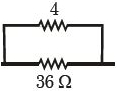
Answer$\mathrm{R}_{\mathrm{S}}: \mathrm{R}_{\mathrm{G}}=\frac{1}{9}$
$\therefore {{\rm{I}}_a}:{{\rm{I}}_g} = \frac{9}{1}$
$\frac{9}{10}$ th current goes through shunt
View full question & answer→MCQ 1701 Mark
In a moving coil galvanometer, to make the field radial
- A
coil is wound on wooden frame
- B
magnetic poles are cylindrically cut
- C
a horse shoe magnet is used
- D
the number of windings in the coil is decreased
View full question & answer→MCQ 1711 Mark
A galvanometer having a resistance $G$ and current $I_g$ flowing in it, produces full scale defection. If $S_1$ is the value of shunt which converts it into an ammeter of range $0-I$ and $S_2$ is the value of shunt for range $0-8I$ . Then the ratio $\frac {S_1}{S_2}$ will be
Answer$\frac{{{S_1}}}{{{S_2}}} = \frac{{\frac{{{I_g}{R_g}}}{{I - {I_g}}}}}{{\frac{{{I_g}{R_g}}}{{8I - {I_g}}}}} = \frac{{8I - {I_g}}}{{I - {I_g}}}$
View full question & answer→MCQ 1721 Mark
The sensitivity of a galvanometer of resistance $406\, ohm$ is decreased by $30\, times$. The shunt used is .................. $\Omega$
Answer$\frac{\mathrm{i}}{\mathrm{i}_{\mathrm{g}}}=30 .$ The shunt $\mathrm{S}=\frac{\mathrm{Gi}_{\mathrm{g}}}{\mathrm{i}-\mathrm{i}_{\mathrm{g}}}=\frac{406}{29}=14\, \Omega.$
View full question & answer→MCQ 1731 Mark
A milli voltmeter of $25\,millivolt$ range is to be converted in to an ammeter of $25\,A$ range. The value (in $ohm$) of necessary shunt will be
- A
$0.001$
- B
$0.01$
- C
$1$
- D
$0.05$
AnswerMost of current passes through shunt
$25 \times {10^{ - 3}} = 25{{\rm{R}}_{\rm{s}}}$
$ \Rightarrow {{\rm{R}}_{\rm{s}}} = 0.001$
View full question & answer→MCQ 1741 Mark
A galvanometer having a coil resistance of $30\,\Omega $ shows full scale deflection when a current of $2\,A$ passes through it. It can be converted into an ammeter to read currents upto $10\,A$ by
- A
by putting in series a resistance of $240\,\Omega $
- B
by putting in parallel a resistance of $240\,\Omega $
- C
by putting in series a resistance of $7.5\,\Omega $
- D
by putting in parallel a resistance of $7.5\,\Omega $
Answer$S = \frac{{{I_g}{R_g}}}{{I - {I_g}}} = \frac{{(2)(30)}}{{10 - 2}} = \frac{{2 \times 30}}{8} = \frac{{15}}{2} = 7.5\,\Omega $
View full question & answer→MCQ 1751 Mark
The coil in a moving coil Galvanometer experiences torque proportional to current passed through it. If a steady current $i$ is passed through it the deflection of the coil is found to be $90^o$ . Now the steady current is switched off and a charge $Q$ is suddenly passed through the coil. If the coil has $N$ turns of area $A$ each and its moment of inertia is $I$ about the axis it is going to rotate then the maximum angle through which it deflects upon passing $Q$ is
- A
$Q\sqrt {\frac{{\pi NAB}}{{2iI}}} $
- B
$\frac{{\pi Q}}{2}\sqrt {\frac{{NAB}}{{iI}}} $
- C
$\pi Q\sqrt {\frac{{NAB}}{{2iI}}} $
- D
$Q\sqrt {\frac{{\pi NAB}}{{iI}}} $
Answer$\tau=\mathrm{MB}=\mathrm{C} \theta$
$ \Rightarrow {\rm{N}}i{\rm{AB}} = {\rm{C}}\frac{\pi }{2} \Rightarrow {\rm{C}} = \frac{{2{\rm{N}}i{\rm{AB}}}}{\pi }$ ........$(1)$
When $Q$ is passed,
$\int \tau dt = \int {Ni} ABdt$
$\mathrm{I} \omega=\mathrm{N} \mathrm{A} \mathrm{B} \mathrm{Q}$ ........$(2)$
Also, maximum deflection happens when entire $\frac{1}{2} \mathrm{I} \omega^{2}$ converts to $\frac{1}{2} \mathrm{C} \theta_{\mathrm{max}}^{2}$
So ${\theta _{\max }} = \sqrt {\frac{{{\rm{I}}{\omega ^2}}}{{\rm{C}}}} = \frac{1}{{\sqrt {{\rm{IC}}} }}{\rm{I}}\omega = \frac{{{\rm{NABQ}}}}{{\sqrt {{\rm{IC}}} }}$ (from $(1)$)
View full question & answer→MCQ 1761 Mark
To convert galvanometer into ammeter, shunt of $0.01\,\Omega $ is used. Resistance of galvanometer coil is $50\,\Omega $ and its maximum deflection current is $20\ mA$ . Range of ammeter is
- A
$0-1\ A$
- B
$0-10\ A$
- C
$0-100\ A$
- D
$0-1000\ A$
Answer$\mathrm{i}_{\mathrm{S}} \mathrm{R}_{\mathrm{S}}=\mathrm{i}_{\mathrm{g}} \mathrm{R}_{\mathrm{g}}$
$\frac{20 \times 50}{1000}=i_{S} \times 0.01$
$\mathrm{i}_{\mathrm{S}}=100 \mathrm{\,A}$
View full question & answer→MCQ 1771 Mark
The coil in a moving coil galvanometer experiences torque proportional to current passes through it. If a steady current $i$ is passed through it the steady deflection of the coil is found to be $90^o$ . Now the steady current is switched off and a charge $q$ is suddenly passed through coil. If the coil has $N$ turns of area $A$ and its moment of inertia is $I$ about the axis it is going to rotate then the maximum angle through which it deflects upon passing charge $q$ is
- A
$q\sqrt {\frac{{\pi NAB}}{{2iI}}} $
- B
$\frac{{\pi q}}{2}\sqrt {\frac{{NAB}}{{iI}}} $
- C
$\pi q\sqrt {\frac{{NAB}}{{2iI}}} $
- D
$q\sqrt {\frac{{\pi NAB}}{{iI}}} $
Answer$\mathrm{NiAB}=\frac{\mathrm{C} \pi}{2}$
$C=\frac{2 N i A B}{\pi}$
$\mathrm{I} \omega=\mathrm{NABQ} \Rightarrow \frac{1}{2} \mathrm{I} \omega^{2}=\frac{1}{2} \mathrm{C} \quad \theta_{\max }^{2}$
View full question & answer→MCQ 1781 Mark
The circular coil of a galvanometer has fifty turns. The coil has a radius of $1\ cm$. The coil is placed in a radial magnetic field of $0. 010\ T$. The torsion coefficent of the spring on which the coil hangs is $3 \times 10^{-7}\ N-m-rad^{-1}$. Determine the deviation of the galvanometer's hand if the current through the coil is $1.0\ mA$......$^o$
Answer$\phi=\frac{N A B i}{k}$
$\phi=\frac{\pi}{6}=30^{\circ}$
View full question & answer→MCQ 1791 Mark
Which one of the following modifications may ncrease the sensitivity of moving coil galvanometer?
$1^{st}$ Way : By using spring of smaller torsion constant.
$2^{nd}$ Way : By using a smaller coil
$3^{rd}$ Way : By using a stronger magnet
$4^{th}$ Way : By using a coil having fewer number of turns.
- A
$1^{st}$ and $4^{th}$ ways only
- B
$1^{st}$ and $3^{th}$ ways only
- C
$1^{st}$ and $2^{nd}$ and $3^{th}$ ways only
- D
$2^{nd}$ and $4^{th}$ only
AnswerSensitivity $=\frac{\mathrm{BNA}}{\mathrm{K}},$ by increasing $\mathrm{B}$ (stronger magnet) and decreasing torsion constant, $k$ (weaker springs)
View full question & answer→MCQ 1801 Mark
A circular coil of $500$ turns encloses an area of $0.04 \,m^2.$ A uniform magnetic field of induction $0.25\, Wb/m^2$ is applied perpendicular to the plane of the coil. The coil is rotated by $90^o$ in $0.1$ second at a constant angular velocity about one of its diameters. A galvanometer of resistance $25\Omega$ was connected in series with the the coil. The total charge that will pass through the galvanometer is.......$C$
AnswerInduced current
$\mathrm{I}=\frac{\mathrm{E}}{\mathrm{R}} \Rightarrow \frac{\mathrm{dq}}{\mathrm{dt}}=\frac{\mathrm{E}}{\mathrm{R}}=\left(\frac{\mathrm{d} \phi}{\mathrm{dt}}\right) \frac{1}{\mathrm{R}}$
$\Rightarrow \mathrm{q}=\frac{\Delta \phi}{\mathrm{R}}=\frac{\mathrm{NBA}}{\mathrm{R}}$
Total charge $q=\frac{500 \times 0.25 \times 0.04}{25}=0.2 \mathrm{\,C}$
View full question & answer→MCQ 1811 Mark
A galvanometer $G$ deflects full scale when a potential difference of $0.50 $ $V$ is applied. The internal resistance of the galvanometer $r_g$ is $25$ $ohms$. An ammeter is constructed by incorporating the galvanometer and an additional resistance $R_S$. The ammeter deflects full scale when a measurement of $2.0$ $A$ is made. The resistance $R_S$ is closest to : ................. $\Omega$
- A
$0.25$
- B
$2.5$
- C
$0.45$
- D
$0.1$
Answerwe know to costruct ammeter from galvanometer we add shunt of low reistance in paralle with galvano meter.
$I = i _{ g +} I _{ S }$
$I =2$,
$V$ across $A B=0.50 v$.
$Ig =0.5 / 25=0.02\,V$
$I_{ S }=2-0.02=1.98\,v$
$Rs =0.5 / 1.98=0.252\,V$
View full question & answer→MCQ 1821 Mark
A galvanometer gives full scale reading of $50\ mA$ , when a $p.d.$ , across its terminals is $0.15\ V$ . It can be used as an ammeter of range $0 - 100\ A$ by connecting a shunt resistance of
- A
$0.00075 \Omega $
- B
$0.00045 \Omega $
- C
$0.0015 \Omega $
- D
$3 \Omega $
Answer$G=\frac{0.15}{5 \times 10^{-2}}=3\, \Omega$
$\mathrm{i}_{\mathrm{g}} \mathrm{G}=\left(\mathrm{i}-\mathrm{i}_{\mathrm{g}}\right) \mathrm{R}_{\mathrm{S}}$
$50 \times 10^{-3} \mathrm{r}^{3}=(1-0.05) \times \mathrm{R}$
View full question & answer→MCQ 1831 Mark
$A$ microammeter has a resistance of $100\,\Omega$ and $a$ full scale range of $50\,\mu$ $A$. It can be used as a voltmeter or a higher range ammeter provided a resistance is added to it. Pick the correct range and resistance combination $(s)$.
- A
$50\, V$ range with $10\, k\Omega$ resistance in series.
- B
$10\, V$ range with $200 \,k\Omega$ resistance in series.
- C
$5\, mA$ range with $1\, \Omega$ resistance in parallel.
- D
Both $(B)$ and $(C)$
AnswerTo increase the range of ammeter a parallel resistance (called shunt) is required which is given by $S=\left(\frac{i_{g}}{i-i_{g}}\right) G$
$ S=\left(\frac{50 \times 10^{-6}}{95 \times 10^{-50} \times 10^{-60}}\right)(100) \approx 1 \Omega$
To change it in voltmeter a high resistance $R$ is put in series, where $R$ is given by $R=\frac{V}{i_{g}}-G$
$R=\frac{10}{50 \times 10^{-6}}-100 \approx 200 k \Omega$
View full question & answer→MCQ 1841 Mark
Mark out the correct options.
- A
An ammeter should have small resistance.
- B
An ammeter should have large resistance.
- C
Avoltmeter should have large resistance.
- D
Both $(A)$ and $(C)$
AnswerSmaller the resistance of an ammeter more accurate will be its reading. An ammeter is said to be ideal if its resistance is zero, i.e. it shows actual (value of) current flowing through the circuit. Also, greater the resistance of voltmeter, more accurate will be its reading. A voltmeter is said to be ideal if its resistance is infinite, i.e, it draws no current from the circuit element for its operation. Hence, an ammeter should have small resistance and a voltmeter should have large resistance.
View full question & answer→MCQ 1851 Mark
$A$ galvanometer may be converted into ammeter or voltmeter. In which of the following cases the resistance of the device will be the largest ? (Asssume maximum range of galvanometer $= 1\, mA$)
- A
an ammeter of range $10\,A$
- B
a voltmeter of range $5\, V$
- C
an ammeter of range $5 \,A$
- D
a voltmeter of range $10\, V.$
AnswerAs shown in figure $1$
$v=I_{g} R_{x}=I \times 10^{-3} \times R_{x}$
As $R_{x}=$ very large voltmeter, $v_{0}$ range will be more.
Maximum voltage may be of range $10 \mathrm{v}$.
View full question & answer→MCQ 1861 Mark
A galvanometer coil has a resistance $90\, \Omega$ and full scale deflection current $10\, mA$ . A $910\,\Omega$ resistance is connected in series with the galvanometer to make a voltmeter. If the least count of the voltmeter is $0.1\,V$, the number of divisions on its scale is
Answer$V=I R=1 \times(90+910)=1000 \mathrm{V}$
Given least count of voltmeter $=0.1 V$ i.e. $0.1$ volts$/$division
hence, $V=\frac{\text { Total no. of divisions }}{\text { least count }}$
$1000=\frac{\text { Total no. of divisions }}{0.1}$
Total no. of divisions $=100$
View full question & answer→MCQ 1871 Mark
A galvanometer has a resistance of $20\,\Omega$ and reads full-scale when $0.2\, V$ is applied across it. To convert it into a $10\, A$ ammeter, the galvanometer coil should have a
- A
$0.01\,\Omega$ resistor connected across it
- B
$0.02\,\Omega$ resistor connected across it
- C
$200\,\Omega$ resistor connected in series with it
- D
$2000\, \Omega$ resistor connected in series with it
AnswerGiven, $V=0.2 V, R_{g}=20 \Omega$ and $I=10 A$
Hence, $I_{g}=\frac{0.2}{2}=0.01 A$
To convert galvanometer into a $10 \mathrm{A}$ ammeter, the galvanometer coil should have to connect a shunt resistance in parallel, given by
$S=\frac{R_{g} I_{g}}{I-I_{g}}$
$S=\frac{(20)(0.01)}{10-0.01}$
$S=\frac{0.2}{9.99}=0.02 A$
View full question & answer→MCQ 1881 Mark
When a galvanometer is shunted with a $4\,\Omega$ resistance, the deflection is reduced to one-fifth. If the galvanometer is further shunted with $2\,\Omega$ wire, the further reduction in the deflection will be (the main current remains same)
- A
$\frac{8}{{13}}$ of the deflection when shunted with $4\,\Omega$ only
- B
$\frac{5}{{13}}$ of the deflection when shunted with $4\,\Omega$ only
- C
$\frac{3}{{4}}$ of the deflection when shunted with $4\,\Omega$ only
- D
$\frac{3}{{13}}$ of the deflection when shunted with $4\,\Omega$ only
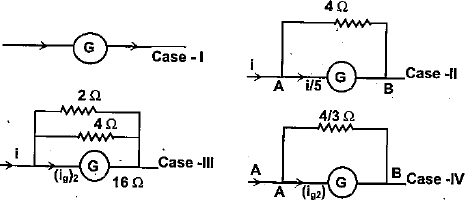
AnswerWhen only $4 \Omega$ resistance is shunted $\left(i_{g}\right)_{1}=i / 5$
$G \times 1 / 5=4 \times(4 / 5)=16 \Omega$
$\left(i_{g}\right)_{2}=\frac{4 / 3}{16+(4 / 3)} i=\frac{1}{13} i$
View full question & answer→MCQ 1891 Mark
In a galvanometer, the deflection becomes one half when the galvanometer is shunted by a $20\,\,\Omega$ resistor. The galvanometer resistance is ............... $\Omega$
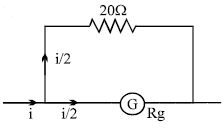
Answer$I_{g}=\frac{20}{20+R_{g}} I \Rightarrow \frac{1}{2}=\frac{20}{20+R_{g}}$
$20+R_{g}=40 \Rightarrow R_{g}=20 \Omega$
View full question & answer→MCQ 1901 Mark
A moving coil galvanometer has $48$ $turns$ and area of coil is $4 \times {10^{ - 2}}\,{m^2}.$ If the magnetic field is $0.2\, T$, then to increase the current sensitivity by $25\%$ without changing area $(A)$ and field $(B)$ the number of turns should become
Answer(c) As we know
Current sensitivity ${S_i} = \frac{{NBA}}{C}$
$==>$ ${S_i} \propto N$ $==>$ $\frac{{{{({S_i})}_1}}}{{{{({S_i})}_2}}} = \frac{{{N_1}}}{{{N_2}}}$ $==>$ $\frac{{100}}{{125}} = \frac{{48}}{{{N_2}}}$
$==>$ ${N_2} = 60$.
View full question & answer→MCQ 1911 Mark
A moving coil galvanometer is converted into an ammeter reading upto $0.03\,A$ by connecting a shunt of resistance $4r$ across it and into an ammeter reading upto $0.06\,A$ when a shunt of resistance $r$ is connected across it. What is the maximum current which can be sent through this galvanometer if no shunt is used ............... $A$
- A
$0.01$
- B
$0.02$
- C
$0.03$
- D
$0.04$
Answer$\frac{{{i_g}}}{i} = \frac{S}{{G + S}} \Rightarrow {i_g}G = (i - {i_g})S$
$\therefore $ ${i_g}G = (0.03 - {i_g})4r$ ..... $(i)$
and ${i_g}G = (0.06 - {i_g})r$ ..... $(ii)$
From $(i)$ and $(ii)$
$0.12 - 4{i_g} = 0.06 - {i_g}$ $ \Rightarrow {i_g} = 0.02A$.
View full question & answer→MCQ 1921 Mark
If the current is doubled, the deflection is also doubled in
- A
- ✓
A moving coil galvanometer
- C
Both $(a)$ and $(b)$
- D
AnswerCorrect option: B. A moving coil galvanometer
(b) In moving coil galvanometer $i \propto \theta .$
View full question & answer→MCQ 1931 Mark
Two galvanometers $A$ and $B$ require $3\,mA$ and $5\,mA$ respectively to produce the same deflection of $10$ divisions. Then
- ✓
$A$ is more sensitive than $B$
- B
$B$ is more sensitive than $A$
- C
$A$ and $B$ are equally sensitive
- D
Sensitiveness of $B$ is $5/3$ times that of $A$
AnswerCorrect option: A. $A$ is more sensitive than $B$
(a) Sensitivity $(S)$ =$\frac{\theta }{i}$ $==>$ $\frac{{{S_A}}}{{{S_B}}} = \frac{{{i_B}}}{{{i_A}}} = \frac{5}{3} \Rightarrow {S_A} > {S_B}$
View full question & answer→MCQ 1941 Mark
A small cylindrical soft iron piece is kept in a galvanometer so that
- A
A radial uniform magnetic field is produced
- B
A uniform magnetic field is produced
- C
There is a steady deflection of the coil
- D
AnswerA soft iron core is used in a moving coil galvanometer. The soft iron core attracts the magnetic lines of force and hence the strength of the magnetic field increases if we use soft iron core. Thus the sensitivity of galvanometer increases. Also the use of soft iron core makes the magnetic field radial (i.e the plane of the coil will be always parallel to the direction of magnetic field).
View full question & answer→MCQ 1951 Mark
What is shape of magnet in moving coil galvanometer to make the radial magnetic field
MCQ 1961 Mark
The relation between voltage sensitivity (${\sigma _V}$) and current sensitivity $({\sigma _i})$ of a moving coil galvanometer is (Resistance of Galvanometer = $G$)
- ✓
$\frac{{{\sigma _i}}}{G} = {\sigma _V}$
- B
$\frac{{{\sigma _{_V}}}}{G} = {\sigma _i}$
- C
$\frac{G}{{{\sigma _V}}} = {\sigma _i}$
- D
$\frac{G}{{{\sigma _i}}} = {\sigma _V}$
AnswerCorrect option: A. $\frac{{{\sigma _i}}}{G} = {\sigma _V}$
(a) ${\sigma _i} = \frac{\theta }{i} = \frac{\theta }{{iG}} \cdot G = {\sigma _{_V}}G$ $==>$ $\frac{{{\sigma _i}}}{G} = {\sigma _V}$
View full question & answer→MCQ 1971 Mark
In order to increase the sensitivity of a moving coil galvanometer, one should decrease
- A
The strength of its magnet
- ✓
The torsional constant of its suspension
- C
The number of turns in its coil
- D
AnswerCorrect option: B. The torsional constant of its suspension
(b) Sensitivity $ = \frac{{NAB}}{C}$
View full question & answer→MCQ 1981 Mark
The current sensitivity of a moving coil galvanometer can be increased by
- A
Increasing the magnetic field of the permanent magnet
- B
Increasing the area of the deflecting coil
- C
Increasing the number of turns in the coil
- ✓
Answer(d) Sensitivity $\frac{\theta }{i} = \frac{{NAB}}{C}$
View full question & answer→MCQ 1991 Mark
The coil of a galvanometer consists of $100$ $turns$ and effective area of $1\, square-cm$. The restoring couple is ${10^{ - 8}}\,N - m/radian$. The magnetic field between the pole pieces is $5\, T$. The current sensitivity of this galvanometer will be
- A
$5 \times {10^4}\,rad/\mu \,amp$
- B
$5 \times {10^{ - 6}}\,per\,amp$
- C
$2 \times {10^{ - 7}}\,per\,amp$
- ✓
$5\,rad/\mu \,amp$
AnswerCorrect option: D. $5\,rad/\mu \,amp$
(d) Current sensitivity $\frac{\theta }{i} = \frac{{NBA}}{C}$
$ \Rightarrow \frac{\theta }{i} = \frac{{100 \times 5 \times {{10}^{ - 4}}}}{{{{10}^{ - 8}}}} = 5\;rad/\mu \;Amp$
View full question & answer→MCQ 2001 Mark
The sensitiveness of a moving coil galvanometer can be increased by decreasing
- A
The number of turns in the coil
- B
- C
- ✓
The couple per unit twist of the suspension
AnswerCorrect option: D. The couple per unit twist of the suspension
(d) Sensitivity $S = \frac{\theta }{i} = \frac{{nBA}}{C}$
View full question & answer→