MCQ 1011 Mark
Two short magnets with their axes horizontal and perpendicular to the magnetic meridian are placed with their centres $40 \mathrm{~cm}$ east and $50 \mathrm{~cm}$ west of magnetic needle. If the needle remains undeflected, the ratio of their magnetic moments $M_1: M_2$ is
- A
$4: 5$
- B
$16: 25$
- ✓
$64: 125$
- D
$2: \sqrt{5}$
AnswerCorrect option: C. $64: 125$
For null deflection $\frac{M_1}{M_2}=\left(\frac{d_1}{d_2}\right)^3=\left(\frac{40}{50}\right)^3=\frac{64}{125}$
View full question & answer→MCQ 1021 Mark
If the angles of dip at two places are $30$ and $45$ respectively, then the ratio of horizontal components of earth's magnetic field at the two places will be
- ✓
$\sqrt{3}: \sqrt{2}$
- B
$1: \sqrt{2}$
- C
$1: \sqrt{3}$
- D
$1: 2$
AnswerCorrect option: A. $\sqrt{3}: \sqrt{2}$
The horizontal components are $\left(B_H\right)_1=B \cos \phi_1$ and
$\left(B_H\right)_2=B \cos \phi_2 $
$ \therefore \frac{\left(B_H\right)_1}{\left(B_H\right)_2}=\frac{\cos \phi_1}{\cos \phi_2}=\frac{\cos 30^{\circ}}{\cos 45^{\circ}}=\frac{\sqrt{3}}{2} \times \sqrt{2}=\frac{\sqrt{3}}{\sqrt{2}}$
View full question & answer→MCQ 1031 Mark
The angle of dip at the magnetic equator is
- ✓
$0^{\circ}$
- B
$45^{\circ}$
- C
$30^{\circ}$
- D
$90^{\circ}$
AnswerCorrect option: A. $0^{\circ}$
View full question & answer→MCQ 1041 Mark
Magnetic intensity for an axial point due to a short bar magnet of magnetic moment $M$ is given by
- A
$\frac{\mu_0}{4 \pi} \times \frac{M}{d^3}$
- B
$\frac{\mu_0}{4 \pi} \times \frac{M}{d^2}$
- ✓
$\frac{\mu_0}{2 \pi} \times \frac{M}{d^3}$
- D
$\frac{\mu_0}{2 \pi} \times \frac{M}{d^2}$
AnswerCorrect option: C. $\frac{\mu_0}{2 \pi} \times \frac{M}{d^3}$
$B_a=\frac{\mu_0}{4 \pi} \frac{2 M}{d^3}=\frac{\mu_0}{2 \pi} \frac{M}{d^3}$
View full question & answer→MCQ 1051 Mark
The angle of dip at a place is $60^{\circ}$. At this place the total intensity of earth's magnetic field is $0.64$ units. The horizontal intensity of earth's magnetic field at this place is
- A
$1.28$ units
- B
$0.64$ units
- C
$0.16$ units
- ✓
$0.32$ units
AnswerCorrect option: D. $0.32$ units
$B_H=B \cos \phi=0.64 \times \cos 60^{\circ}=0.64 \times \frac{1}{2}=0.32$ units
View full question & answer→MCQ 1061 Mark
A magnetic needle is made to vibrate in uniform field $H$, then its time period is $T$. If it vibrates in the field of intensity $4 H$, its time period will be
- A
$2 T$
- ✓
$T / 2$
- C
$2 / T$
- D
$T$
AnswerCorrect option: B. $T / 2$
$T / 2$
View full question & answer→MCQ 1071 Mark
A bar magnet is placed north-south with its north pole due north. The points of zero magnetic field will be in which direction from the centre of the magnet
- A
- ✓
- C
North-east and south-west
- D
North-west and south-east
View full question & answer→MCQ 1081 Mark
A magnetic needle suspended by a silk thread is vibrating in the earth's magnetic field. If the temperature of the needle is increased by $500^{\circ} \mathrm{C}$, then
- A
The time period decreases
- B
The time period remains unchanged
- ✓
The time period increases
- D
The needle stops vibrating
AnswerCorrect option: C. The time period increases
$T \propto \frac{1}{\sqrt{M}}$. Since magnetic moment decreases with increase in temperature hence time period $T$ increases.
View full question & answer→MCQ 1091 Mark
The small magnets each of magnetic moment $10\ A-m$ are placed end-on position $0.1 \mathrm{~m}$ apart from their centres. The force acting between them is
AnswerCorrect option: C. $0.6 \mathrm{~N}$
$F=\frac{\mu_0}{4 \pi}\left(\frac{6 M M^{\prime}}{d^4}\right)$ in end-on position between two small magnets.
$\therefore F=10^{-7}\left(\frac{6 \times 10 \times 10}{(0.1)^4}\right)=0.6 \mathrm{~N}$
View full question & answer→MCQ 1101 Mark
The angle between the magnetic meridian and geographical meridian is called
MCQ 1111 Mark
The magnetic induction in air at a distance $d$ from an isolated point pole of strength $m$ unit will be
- A
$\frac{m}{d}$
- ✓
$\frac{m}{d^2}$
- C
$m d$
- D
$m d^2$
AnswerCorrect option: B. $\frac{m}{d^2}$
$B=\frac{m}{d^2}$ in C.G.S. system.
View full question & answer→MCQ 1121 Mark
The line on the earth's surface joining the points where the field is horizontal is
- A
- B
- C
- ✓
Magnetic equator/ lsogonic line
AnswerCorrect option: D. Magnetic equator/ lsogonic line
View full question & answer→MCQ 1131 Mark
The lines joining the places of the same horizontal intensity are known as
AnswerCorrect option: D. Agonic lines $/$ Isodynamic lines
Agonic lines $/$ Isodynamic lines
View full question & answer→MCQ 1141 Mark
The angle between the earth's magnetic and the earth's geographical axes is
- A
- ✓
$17^{\circ}$
- C
$23^{\circ}$
- D
AnswerCorrect option: B. $17^{\circ}$
View full question & answer→MCQ 1151 Mark
Curies law can be written as
- A
$\chi \propto\left(T-T_c\right)$
- B
$\chi \propto \frac{1}{T-T_c}$
- ✓
$\chi \propto \frac{1}{T}$
- D
$\chi \propto T$
AnswerCorrect option: C. $\chi \propto \frac{1}{T}$
View full question & answer→MCQ 1161 Mark
The period of oscillations of a magnet is $2 \mathrm{sec}$. When it is remagnetised so that the pole strength is 4 times its period will be
- A
$4 \mathrm{sec}$
- B
$2 \mathrm{sec}$
- ✓
$1 \mathrm{sec}$
- D
$1 / 2 \mathrm{sec}$
AnswerCorrect option: C. $1 \mathrm{sec}$
(c) $T \propto \frac{1}{\sqrt{M}} \Rightarrow T \propto \frac{1}{\sqrt{m}}$; if $m \rightarrow 4$ times.$T \rightarrow \frac{1}{2} \text { times i.e. } T^{\prime}=\frac{T}{2}=\frac{2}{2}=1 \mathrm{sec}$
View full question & answer→MCQ 1171 Mark
A small rod of bismuth is suspended freely between the poles of a strong electromagnet. It is found to arrange itself at right angles to the magnetic field. This observation establishes that bismuth is
MCQ 1181 Mark
Which of the following statement is not the true
- ✓
While taking reading of tangent galvanometer, the plane of the coil must be set at right angles to the earth's magnetic meridian
- B
A short magnet is used in a tangent galvanometer since a long magnet would be heavy and may not easily move
- C
Measurements with the tangent galvanometer will be more accurate when the deflection is around 45
- D
A tangent galvanometer can not be used in the polar region
AnswerCorrect option: A. While taking reading of tangent galvanometer, the plane of the coil must be set at right angles to the earth's magnetic meridian
(a) In tangent galvanometer experiment. The plane of the coil firstly set in the magnetic meridian.
View full question & answer→MCQ 1191 Mark
Which of the following relation is correct in magnetism
- ✓
$I^2=V^2+H^2$
- B
$I=V+H$
- C
$V=I^2+H^2$
- D
$V^2=I+H$
AnswerCorrect option: A. $I^2=V^2+H^2$
View full question & answer→MCQ 1201 Mark
The relative permeability is represented by $\mu$ and the susceptibility is denoted by $\chi$ for a magnetic substance. Then for a paramagnetic substance
- A
$\mu<1, \chi<0$
- B
$\mu<1, \chi>0$
- C
$\mu>1, \chi<0$
- ✓
$\mu>1, \chi>0$
AnswerCorrect option: D. $\mu>1, \chi>0$
View full question & answer→MCQ 1211 Mark
The use of study of hysteresis curve for a given material is to estimate the
MCQ 1221 Mark
Curie-Weiss law is obeyed by iron at a temperature
- A
- ✓
- C
At Curie temperature only
- D
View full question & answer→MCQ 1231 Mark
A bar magnet is oscillating in the earth's magnetic field with time period $T$. If its mass is increased four times then its time period will be
Answer(b) $T=2 \pi \sqrt{\frac{I}{M B_H}}$; where $I=\frac{\mathrm{w}\left(L^2+b^2\right)}{12}$ ( $w$ =Mass of magnet) $\Rightarrow T \propto \sqrt{\mathrm{w}}$, If $\mathrm{w} \rightarrow$ four times then $T \rightarrow$ Two times
View full question & answer→MCQ 1241 Mark
A superconductor exhibits perfect
MCQ 1251 Mark
The variation of the intensity of magnetisation (I) with respect to the magnetising field $(H)$ in a diamagnetic substance is described by the graph
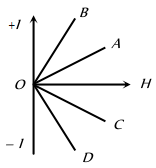
Answer(b) Intensity of magnetisation of diamagnetic substance is very small and negative.
View full question & answer→MCQ 1261 Mark
Identify the paramagnetic substance
MCQ 1271 Mark
Relative permeability of iron is $5500$ , then its magnetic susceptibility will be
- A
$5500 \times 10$
- B
$5500 \times 10$
- C
$5501$
- ✓
$5499$
AnswerCorrect option: D. $5499$
(d) $\chi_m=\left(\mu_r-1\right) \Rightarrow \chi_m=(5500-1)=5499$
View full question & answer→MCQ 1281 Mark
An example of a diamagnetic substance is
MCQ 1291 Mark
The only property possessed by ferromagnetic substance is
- ✓
- B
- C
- D
Attracting magnetic substances
View full question & answer→MCQ 1301 Mark
A short magnetic needle is pivoted in a uniform magnetic field of strength $1 T$. When another magnetic field of strength $\sqrt{3} T$ is applied to the needle in a perpendicular direction, the needle deflects through an angle $\theta$, where $\theta$ is
- A
$30^\circ$
- B
$45^\circ$
- C
$90^\circ$
- ✓
$60^\circ$
AnswerCorrect option: D. $60^\circ$
View full question & answer→MCQ 1311 Mark
A magnet of magnetic moment $M$ is rotated through $360^{\circ}$ in a magnetic field $H$, the work done will be
- A
$\mathrm{MH}$
- B
$2 M H$
- C
$2 \pi M H$
- ✓
$0$
Answer(d) $W=M B\left(\cos \theta_1-\cos \theta_2\right) ; \theta_1=0^{\circ}$ and $\theta_2=360^{\circ} \Rightarrow W=0$
View full question & answer→MCQ 1321 Mark
The material of permanent magnet has
- A
High retentivity, low coercivity
- B
Low retentivity, high coercivity
- C
Low retentivity, low coercivity
- ✓
High retentivity, high coercivity
AnswerCorrect option: D. High retentivity, high coercivity
(d) From the characteristic of $B-H$ curve.
View full question & answer→MCQ 1331 Mark
The period of oscillation of a vibration magnetometer depends on which of the following factors where $l$ is the moment of inertia of the magnet about the axis of suspension, $M$ is the magnetic moment of the magnet and $H$ is the external magnetic field
AnswerCorrect option: D. $I, M$ and $\mathrm{H}$ only
View full question & answer→MCQ 1341 Mark
The bob of a simple pendulum is replaced by a magnet. The oscillations are set along the length of the magnet. A copper coil is added so that one pole of the magnet passes in and out of the coil. The coil is short-circuited. Then which one of the following happens
Answer(c) It is due to the magnetic field produced by coil.
View full question & answer→MCQ 1351 Mark
The magnet can be completely demagnetized by
- A
Breaking the magnet into small pieces
- B
- C
Droping it into ice cold water
- ✓
A reverse field of appropriate strength
AnswerCorrect option: D. A reverse field of appropriate strength
View full question & answer→MCQ 1361 Mark
If a piece of metal was thought to be magnet, which one of the following observations would offer conclusive evidence
- A
It attracts a known magnet
- ✓
- C
- D
It attracts a steel screw driver
Answer(b) Repulsion is the sure test of magnetism.
View full question & answer→MCQ 1371 Mark
The north pole of the earth's magnet is near the geographical
MCQ 1381 Mark
For protecting a sensitive equipment from the external magnetic field, it should be
- A
Placed inside an aluminium cane
- ✓
Placed inside an iron cane
- C
Wrapped with insulation around it when passing current through it
- D
Surrounded with fine copper sheet
AnswerCorrect option: B. Placed inside an iron cane
(b) Concept of magnetic screening.
View full question & answer→MCQ 1391 Mark
A compass needle will show which one of the following directions at the earth's magnetic pole
AnswerAt poles magnetic field is perpendicular to the surface of earth.
View full question & answer→MCQ 1401 Mark
The magnetism of magnet is due to
- ✓
The spin motion of electron
- B
- C
Pressure of big magnet inside the earth
- D
AnswerCorrect option: A. The spin motion of electron
View full question & answer→MCQ 1411 Mark
When two magnetic moments are compared using equal distance method the deflections produced are 45 and 30 . If the length of magnets are in the ratio $1: 2$, the ratio of their pole strengths is
- A
$3: 1$
- B
$3: 2$
- C
$\sqrt{3}: 1$
- ✓
$2 \sqrt{3}: 1$
AnswerCorrect option: D. $2 \sqrt{3}: 1$
$ \frac{M_1}{M_2}=\frac{\tan \theta_1}{\tan \theta_2} \Rightarrow \frac{m_1 L_1}{m_2 L_2}=\frac{\tan \theta_1}{\tan \theta_2} $
$ \Rightarrow \frac{m_1}{m_2}=\frac{2}{1} \times \frac{\tan 45^{\circ}}{\tan 30^{\circ}}=\frac{2 \sqrt{3}}{1}$
View full question & answer→MCQ 1421 Mark
Two like magnetic poles of strength 10 and $40 \mathrm{Sl}$ units are separated by a distance $30 \mathrm{~cm}$. The intensity of magnetic field is zero on the line joining them
AnswerCorrect option: B. At a point $20 \mathrm{~cm}$ from the stronger pole
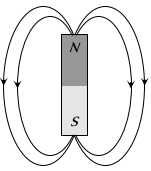
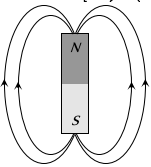
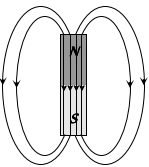
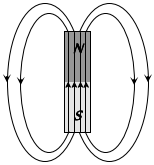
View full question & answer→MCQ 1431 Mark
The magnetic field lines due to a bar magnet are correctly shown in
MCQ 1441 Mark
Two identical short bar magnets, each having magnetic moment $M$, are placed a distance of $2 d$ apart with axes perpendicular to each other in a horizontal plane. The magnetic induction at a point midway between them is
- A
$\frac{\mu_0}{4 \pi}(\sqrt{2}) \frac{M}{d^3}$
- B
$\frac{\mu_0}{4 \pi}(\sqrt{3}) \frac{M}{d^3}$
- C
$\left(\frac{2 \mu_0}{\pi}\right) \frac{M}{d^3}$
- ✓
$\frac{\mu_0}{4 \pi}(\sqrt{5}) \frac{M}{d^3}$
AnswerCorrect option: D. $\frac{\mu_0}{4 \pi}(\sqrt{5}) \frac{M}{d^3}$
View full question & answer→MCQ 1451 Mark
Ratio between total intensity of magnetic field at equator to poles is
- A
$1: 1$
- ✓
$1: 2$
- C
$2: 1$
- D
$1: 4$
AnswerCorrect option: B. $1: 2$
View full question & answer→MCQ 1461 Mark
The magnetic field of earth is due to
- ✓
Motion and distribution of some material in and outside the earth
- B
Interaction of cosmic rays with the current of earth
- C
A magnetic dipole buried at the centre of the earth
- D
Induction effect of the sun
AnswerCorrect option: A. Motion and distribution of some material in and outside the earth
View full question & answer→MCQ 1471 Mark
Two short magnets having magnetic moments in the ratio $27: 8$, when placed on opposite sides of a deflection magnetometer, produce no deflection. If the distance of the weaker magnet is $0.12 \mathrm{~m}$ from the centre of deflection magnetometer, the distance of the stronger magnet from the centre is
- A
$0.06 \mathrm{~m}$
- B
$0.08 \mathrm{~m}$
- C
$0.12 \mathrm{~m}$
- ✓
$0.18 \mathrm{~m}$
AnswerCorrect option: D. $0.18 \mathrm{~m}$
$ \frac{M_1}{M_2}=\left(\frac{d_1}{d_2}\right)^3 \Rightarrow\frac{27}{8}=\left(\frac{d_1}{0.12}\right)^3$
$ \Rightarrow \frac{3}{2}=\frac{d_1}{0.12} \Rightarrow 0.18 \mathrm{~m}$
View full question & answer→MCQ 1481 Mark
A bar magnet when placed at an angle of 30 to the direction of magnetic field induction of $5 \times 10^{-2} . T$, experiences a moment of couple $25 \times 10^{-6} \ \mathrm{N}-\mathrm{m}$. If the length of the magnet is $5 \mathrm{~cm}$ its pole strength is
AnswerCorrect option: A. $2 \times 10^{-2} A-m$
$ \tau=M B \sin \theta \Rightarrow \tau=(m L) B \sin \theta$
$ \Rightarrow 25 \times 10^{-6}=\left(m \times 5 \times 10^{-2}\right) \times 5 \times 10^{-2} \times \sin 30 $
$ \Rightarrow m=2 \times 10^{-2} A-m .$
View full question & answer→MCQ 1491 Mark
A bar magnet of magnetic moment $3.0 \mathrm{~A}-\mathrm{m}$ is placed in a uniform magnetic induction field of $2 \times 10 . T$. If each pole of the magnet experiences a force of $6 \times 10^{-4}$, the length of the magnet is
- A
$0.5 \mathrm{~m}$
- B
$0.3 \mathrm{~m}$
- C
$0.2 \mathrm{~m}$
- ✓
$0.1 \mathrm{~m}$
AnswerCorrect option: D. $0.1 \mathrm{~m}$
$ F=m B \Rightarrow F=\frac{M}{L} \times B $
$ \Rightarrow 6 \times 10^{-4}=\frac{3}{L} \times 2 \times 10^{-5} \Rightarrow L=0.1 \mathrm{~m} .$
View full question & answer→MCQ 1501 Mark
There is no couple acting when two bar magnets are placed coaxially separated by a distance because
- A
There are no forces on the poles
- B
The forces are parallel and their lines of action do not coincide
- C
The forces are perpendicular to each other
- ✓
The forces act along the same line
AnswerCorrect option: D. The forces act along the same line
View full question & answer→