MCQ 1511 Mark
Two similar bar magnets $P$ and $Q$, each of magnetic moment $M$, are taken, If $P$ is cut along its axial line and $Q$ is cut along its equatorial line, all the four pieces obtained have
AnswerCorrect option: C. Magnetic moment $\frac{M}{2}$
View full question & answer→MCQ 1521 Mark
If a diamagnetic substance is brought near north or south pole of a bar magnet, it is
- A
- ✓
- C
Repelled by the north pole and attracted by the south pole
- D
Attracted by the north pole and repelled by the south pole
AnswerRepelled due to induction of similar poles.
View full question & answer→MCQ 1531 Mark
Two identical short bar magnets, each having magnetic moment of $10 \mathrm{Am}$, are arranged such that their axial lines are perpendicular to each other and their centres be along the same straight line in a horizontal plane. If the distance between their centres is $0.2 \mathrm{~m}$, the resultant magnetic induction at a point midway between them is
$\left(\mu_0=4 \pi \times 10^{-7} \mathrm{Hm}^{-1}\right)$
- A
$\sqrt{2} \times 10^{-7}$ Tesla
- B
$\sqrt{5} \times 10^{-7}$ Tesla
- C
$\sqrt{2} \times 10^{-3}$ Tesla
- ✓
$\sqrt{5} \times 10^{-3}$ Tesla
AnswerCorrect option: D. $\sqrt{5} \times 10^{-3}$ Tesla
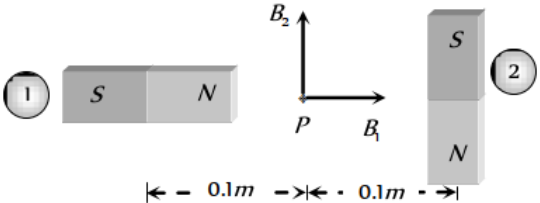
From figure $B_{n e t}=\sqrt{B_a{ }^2+B_e{ }^2}$
$=\sqrt{\left(\frac{\mu_0}{4 \pi} \cdot \frac{2 M}{d^3}\right)^2+\left(\frac{\mu_0}{4 \pi} \cdot \frac{M}{d^3}\right)^2} $
$=\sqrt{5} \cdot \frac{\mu_0}{4 \pi} \cdot \frac{M}{d^3}=\sqrt{5} \times 10^{-7} \times \frac{10}{(0.1)^3}=\sqrt{5} \times 10^{-3} \text { Tesla. }$ View full question & answer→MCQ 1541 Mark
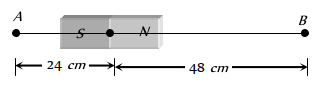
A bar magnet of length $3 \mathrm{~cm}$ has points $A$ and $B$ along its axis at distances of $24 \mathrm{~cm}$ and $48 \mathrm{~cm}$ on the opposite sides. Ratio of magnetic fields at these points will be
- ✓
$8$
- B
$1 / 2 \sqrt{2}$
- C
$3$
- D
$4$
AnswerBoth points $A$ and $B$ lying on the axis of the magnet and on axial position
$B \propto \frac{1}{d^3} \Rightarrow \frac{B_A}{B_B}=\left(\frac{d_B}{d_A}\right)^3=\left(\frac{48}{24}\right)^3=\frac{8}{1}$
View full question & answer→MCQ 1551 Mark
The effective length of a magnet is $31.4 \mathrm{~cm}$ and its pole strength is $0.5 \mathrm{Am}$. The magnetic moment, if it is bent in the form of a semicircle will be
- ✓
$0.1 \mathrm{Am}^2$
- B
$0.01 \mathrm{Am}^2$
- C
$0.2 \mathrm{Am}^2$
- D
$1.2 \mathrm{Am}^2$
AnswerCorrect option: A. $0.1 \mathrm{Am}^2$
(a) Similar to solution (1) New magnetic moment $M^{\prime}=\frac{2 M}{\pi}=\frac{2 m L}{\pi}=\frac{2 \times 0.5 \times 31.4 \times 10^{-2}}{3.14}=0.1 \mathrm{amp} \times \mathrm{m}^2$
View full question & answer→MCQ 1561 Mark
The magnetic moment of a magnet of length $10 \mathrm{~cm}$ and pole strength $4.0 \mathrm{Am}$ will be
- ✓
$0.4 \mathrm{Am}^2$
- B
$1.6 \mathrm{Am}^2$
- C
$20 \mathrm{Am}^2$
- D
$8.0 \mathrm{Am}^2$
AnswerCorrect option: A. $0.4 \mathrm{Am}^2$
(a) $M=m L=4 \times 10 \times 10^{-2}=0.4 \mathrm{~A} \times \mathrm{m}^2$
View full question & answer→MCQ 1571 Mark
Keeping dissimilar poles of two magnets of equal pole strength and length same side, their time period will be
Answer(c) $T=2 \pi \sqrt{\frac{I_1+I_2}{\left(M_1-M_2\right) B_H}}$Here $M_1=M_2=M, \therefore T=\infty$
View full question & answer→MCQ 1581 Mark
Unit of magnetic flux density (or magnetic induction) is
MCQ 1591 Mark
Demagnetisation of magnets can be done by
- A
- B
- C
Magnetising in the opposite direction
- ✓
View full question & answer→MCQ 1601 Mark
A dip circle is adjusted so that its needle moves freely in the magnetic meridian. In this position, the angle of dip is $40^{\circ}$. Now the dip circle is rotated so that the plane in which the needle moves makes an angle of $30^{\circ}$ with the magnetic meridian. In this position the needle will dip by an angle
- A
$40^{\circ}$
- B
$30^{\circ}$
- ✓
More than $40^{\circ}$
- D
Less than $40^{\circ}$
AnswerCorrect option: C. More than $40^{\circ}$
$\tan \theta=\frac{B_V}{B_H}$If apparent dip is $\theta^{\prime}$ then
$ \tan \theta^{\prime}=\frac{B_V^{\prime}}{B_H^{\prime}}=\frac{B_V}{B_H \cos 30^{\circ}}=\frac{B_V}{B_H \times \frac{\sqrt{3}}{2}} $
$ \Rightarrow \tan \theta^{\prime}=\left(\frac{2}{\sqrt{3}}\right) \tan \theta$
$ \Rightarrow \tan\theta^{\prime}>\tan \theta \Rightarrow \theta^{\prime}>\theta$
View full question & answer→MCQ 1611 Mark
In the hysteresis cycle, the value of $H$ needed to make the intensity of magnetisation zero is called
View full question & answer→MCQ 1621 Mark
If a ferromagnetic material is inserted in a current carrying solenoid, the magnetic field of solenoid
MCQ 1631 Mark
A magnet of magnetic moment $2 \ J T^{-1}$ is aligned in the direction of magnetic field of $0.1 \mathrm{~T}$. What is the net work done to bring the magnet normal to the magnetic field
- A
$0.1 \mathrm{~J}$
- ✓
$0.2 \mathrm{~J}$
- C
$1 \mathrm{~J}$
- D
$2 \mathrm{~J}$
AnswerCorrect option: B. $0.2 \mathrm{~J}$
(b) $W=M B(1-\cos \theta)=2 \times 0.1 \times\left(1-\cos 90^{\circ}\right) = 0.2 \mathrm{~J}$
View full question & answer→MCQ 1641 Mark
At the magnetic poles of the earth, a compass needle will be
- A
- ✓
- C
- D
Inclined at 45 to the horizontal
View full question & answer→MCQ 1651 Mark
Curie temperature is the temperature above which
- A
A paramagnetic material becomes ferromagnetic
- ✓
A ferromagnetic material becomes paramagnetic
- C
A paramagnetic material becomes diamagnetic
- D
A ferromagnetic material becomes diamagnetic
AnswerCorrect option: B. A ferromagnetic material becomes paramagnetic
View full question & answer→MCQ 1661 Mark
Which of the following is diamagnetism
MCQ 1671 Mark
If a magnetic substance is kept in a magnetic field, then which of the following is thrown out
AnswerDiamagnetic substances are repelled by magnetic field.
View full question & answer→MCQ 1681 Mark
The universal property of all substances is
MCQ 1691 Mark
At a certain place the angle of dip is $30^{\circ}$ and the horizontal component of earth's magnetic field is 0.50 Oersted. The earth's total magnetic field is
- A
$\sqrt{3}$
- B
$1$
- ✓
$\frac{1}{\sqrt{3}}$
- D
$\frac{1}{2}$
AnswerCorrect option: C. $\frac{1}{\sqrt{3}}$
(c) $B_H=B \cos \phi ; \therefore B=\frac{B_H}{\cos \phi}=\frac{0.5}{\cos 30^{\circ}}=\frac{0.5}{\sqrt{3} / 2}=\frac{1}{\sqrt{3}}$
View full question & answer→MCQ 1701 Mark
A small bar magnet of moment $M$ is placed in a uniform field $H$. If magnet makes an angle of $30^{\circ}$ with field, the torque acting on the magnet is
- A
$\mathrm{MH}$
- ✓
$\frac{M H}{2}$
- C
$\frac{M H}{3}$
- D
$\frac{M H}{4}$
AnswerCorrect option: B. $\frac{M H}{2}$
(b) $\tau=M H \sin \theta=M H \sin 30^{\circ}=\frac{M H}{2}$
View full question & answer→MCQ 1711 Mark
Points $A$ and $B$ are situated perpendicular to the axis of a $2 \mathrm{~cm}$ long bar magnet at large distances $X$ and $3 X$ from its centre on opposite sides. The ratio of the magnetic fields at $A$ and $B$ will be approximately equal to
- A
$1: 9$
- ✓
$27: 1$
- C
$2: 9$
- D
$9: 1$
AnswerCorrect option: B. $27: 1$
$B \propto \frac{1}{x^3} \Rightarrow \frac{B_1}{B_2}=\left(\frac{x_2}{x_1}\right)^3=\left(\frac{3 x}{x}\right)^3=\frac{27}{1}$
View full question & answer→MCQ 1721 Mark
A very small magnet is placed in the magnetic meridian with its south pole pointing north. The null point is obtained $20 \mathrm{~cm}$ away from the centre of the magnet. If the earth's magnetic field (horizontal component) at this point be $0.3$ gauss, the magnetic moment of the magnet is
- A
$8.0 \times 10^2$ e.m.u.
- ✓
$1.2 \times 10^3$ e.m.u.
- C
$2.4 \times 10^3$ e.m.u.
- D
$3.6 \times 10^3$ e.m.u.
AnswerCorrect option: B. $1.2 \times 10^3$ e.m.u.
View full question & answer→MCQ 1731 Mark
Two normal uniform magnetic field contain a magnetic needle making an angle $60^{\circ}$ with $F$. Then the ratio of $\frac{F}{H}$ is
- A
$1: 2$
- B
$2: 1$
- C
$\sqrt{3}: 1$
- ✓
$1: \sqrt{3}$
AnswerCorrect option: D. $1: \sqrt{3}$
View full question & answer→MCQ 1741 Mark
Force between two unit pole strength placed at a distance of one metre is
AnswerCorrect option: C. $10^{-7} \mathrm{~N}$
(c) $F=10^{-7} \times \frac{m^2}{r^2}=\frac{10^{-7}(1)^2}{(1)^2}=10^{-7} \mathrm{~N}$
View full question & answer→MCQ 1751 Mark
A line passing through places having zero value of magnetic dip is called
MCQ 1761 Mark
The correct relation is (Where $B_H=$ Horizontal component of earth's magnetic field; $B_V=$ Vertical component of earth's magnetic field and $B=$ Total intensity of earth's magnetic field)
- A
$\boldsymbol{B}=\frac{B_V}{B_H}$
- B
$\boldsymbol{B}=B_V \times B_H$
- ✓
$|\boldsymbol{B}|=\sqrt{B_H^2+B_V^2}$
- D
$\boldsymbol{B}=B_H+B_V$
AnswerCorrect option: C. $|\boldsymbol{B}|=\sqrt{B_H^2+B_V^2}$
View full question & answer→MCQ 1771 Mark
The figure below shows the north and south poles of a permanent magnet in which $n$ turn coil of area of cross-section $A$ is resting, such that for a current $i$ passed through the coil, the plane of the coil makes an angle $\theta$ with respect to the direction of magnetic field B. If the plane of the magnetic field and the coil are horizontal and vertical respectively, the torque on the coil will be
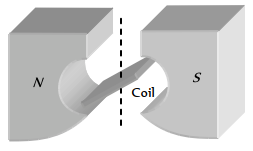
AnswerCorrect option: A. $\tau=n i A B \cos \theta$
Plane of coil is having angle $\theta$ with the magnetic field.
$\therefore \tau=M B \sin (90-\theta) \text { or } \tau=n i A B \cos \theta \quad[\text { As } M=n i A]$
View full question & answer→MCQ 1781 Mark
A uniform magnetic field, parallel to the plane of the paper existed in space initially directed from left to right. When a bar of soft iron is placed in the field parallel to it, the lines of force passing through it will be represented by
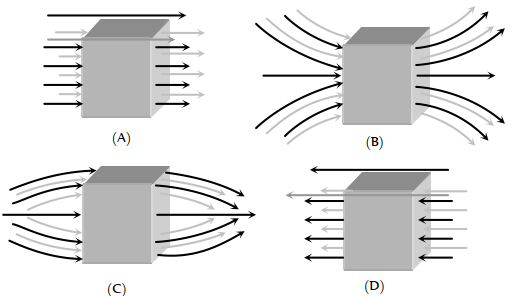
Answer(b) Permeability of soft iron is maximum, so maximum lines of force tries to pass through the soft iron.
View full question & answer→MCQ 1791 Mark
A long magnet is cut in two parts in such a way that the ratio of their lengths is $2: 1$. The ratio of pole strengths of both the section is
- ✓
- B
In the ratio of $2: 1$
- C
In the ratio of $1: 2$
- D
In the ratio of $4: 1$
View full question & answer→MCQ 1801 Mark
The lines of forces due to earth's horizontal component of magnetic field are
MCQ 1811 Mark
Answer(c) Magnetic flux $\phi=B A \Rightarrow B=\frac{\phi}{A}=\frac{\text { Weber }}{m^2}=$ Tesla
View full question & answer→MCQ 1821 Mark
A magnetic needle suspended horizontally by an unspun silk fibre, oscillates in the horizontal plane because of the restoring force originating mainly from
- A
The torsion of the silk fibre
- B
- ✓
The horizontal component of earth's magnetic field
- D
AnswerCorrect option: C. The horizontal component of earth's magnetic field
View full question & answer→MCQ 1831 Mark
Two small bar magnets are placed in a line with like poles facing each other at a certain distance $d$ apart. If the length of each magnet is negligible as compared to $d$, the force between them will be inversely proportional to
- A
$d$
- B
$d^2$
- C
$\frac{1}{d^2}$
- ✓
$d^4$
Answer(d) $F=\frac{\mu_0}{4 \pi}\left(\frac{6 M M^{\prime}}{d^4}\right)$ in end-on position.
View full question & answer→MCQ 1841 Mark
Ratio of magnetic intensities for an axial point and a point on broad side-on position at equal distance $d$ from the centre of magnet will be or The magnetic field at a distance $d$ from a short bar magnet in longitudinal and transverse positions are in the ratio
- A
$1: 1$
- B
$2: 3$
- ✓
$2: 1$
- D
$3: 2$
AnswerCorrect option: C. $2: 1$
(c) $B_1=\frac{2 M}{d^3} \cdot B_2=\frac{M}{d^3} ; \therefore \frac{B_1}{B_2}=2: 1$
View full question & answer→MCQ 1851 Mark
What happens to the force between magnetic poles when their pole strength and the distance between them are both doubled
- A
Force increases to two times the previous value
- ✓
- C
Force decreases to half the previous value
- D
Force increases to four times the previous value
View full question & answer→MCQ 1861 Mark
The angle of dip is the angle
- A
Between the vertical component of earth's magnetic field and magnetic meridian
- B
Between the vertical component of earth's magnetic field and geographical meridian
- ✓
Between the earth's magnetic field direction and horizontal direction
- D
Between the magnetic meridian and the geographical meridian
AnswerCorrect option: C. Between the earth's magnetic field direction and horizontal direction
View full question & answer→MCQ 1871 Mark
At magnetic poles of earth, angle of dip is
MCQ 1881 Mark
Which of the following statement is true about magnetic moments of atoms of different elements
- A
All have a magnetic moment
- B
None has a magnetic moment
- C
All acquire a magnetic moment under external magnetic field and in same direction as the field
- ✓
None of the above statements are accurate
AnswerCorrect option: D. None of the above statements are accurate
View full question & answer→MCQ 1891 Mark
In the case of bar magnet, lines of magnetic induction
- A
Start from the north pole and end at the south pole
- ✓
Run continuously through the bar and outside
- C
Emerge in circular paths from the middle of the bar
- D
Are produced only at the north pole like rays of light from a bulb
AnswerCorrect option: B. Run continuously through the bar and outside
View full question & answer→MCQ 1901 Mark
The period of oscillation of a magnet in vibration magnetometer is $2$ sec. The period of oscillation of a magnet whose magnetic moment is four times that of the first magnet is
- ✓
$1 \mathrm{sec}$
- B
$8 \mathrm{sec}$
- C
$4 \mathrm{sec}$
- D
$0.5 \mathrm{sec}$
AnswerCorrect option: A. $1 \mathrm{sec}$
$\frac{T_1}{T_2}=\sqrt{\frac{M_2}{M_1}}=\sqrt{\frac{4 M}{M}}=2 \Rightarrow \frac{2}{T_2}=2 \Rightarrow T_2=1 \mathrm{sec}$
View full question & answer→MCQ 1911 Mark
If the magnetic flux is expressed in weber, then magnetic induction can be expressed in
AnswerCorrect option: A. (a) Weber $/ m$
(a) Flux $=B \times A ; \therefore B=\frac{\text { Flux }}{A}=W e b e r / m^2$
View full question & answer→MCQ 1921 Mark
A sensitive magnetic instrument can be shielded very effectively from outside magnetic fields by placing it inside a box of
- A
- B
- ✓
Soft iron of high permeability
- D
A metal of high conductivity
AnswerCorrect option: C. Soft iron of high permeability
View full question & answer→MCQ 1931 Mark
The time period of oscillation of a freely suspended bar magnet with usual notations is given by
- ✓
$T=2 \pi \sqrt{\frac{I}{M B_H}}$
- B
$T=2 \pi \sqrt{\frac{M B_H}{I}}$
- C
$T=\sqrt{\frac{I}{M B_H}}$
- D
$T=2 \pi \sqrt{\frac{B_H}{M I}}$
AnswerCorrect option: A. $T=2 \pi \sqrt{\frac{I}{M B_H}}$
View full question & answer→MCQ 1941 Mark
The magnetic field due to a short magnet at a point on its axis at distance $X \mathrm{~cm}$ from the middle point of the magnet is $200$ Gauss. The magnetic field at a point on the neutral axis at a distance $X \mathrm{~cm}$ from the middle of the magnet is
- ✓
$100$ Gauss
- B
$400$ Gauss
- C
$50$ Gauss
- D
$200$ Gauss
AnswerCorrect option: A. $100$ Gauss
Along the axis of magnet $B_a=\frac{2 M}{X^3}=200$ guass$\Rightarrow B_a=\frac{M}{X^3}=100 \text { guass }$
View full question & answer→MCQ 1951 Mark
If the magnetic dipole moment of an atom of diamagnetic material, paramagnetic material and ferromagnetic material denoted by $\mu_d, \mu_p, \mu_f$ respectively then
- A
(a) $\mu_d \neq 0$ and $\mu_f \neq 0$
- B
(b) $\mu_p=0$ and $\mu_f \neq 0$
- ✓
(c) $\mu_d=0$ and $\mu_p \neq 0$
- D
(d) $\mu_d \neq 0$ and $\mu_p=0$
AnswerCorrect option: C. (c) $\mu_d=0$ and $\mu_p \neq 0$
View full question & answer→MCQ 1961 Mark
A bar magnet is oscillating in the Earth's magnetic field with a period $T$. What happens to its period and motion if its mass is quadrupled
- ✓
Motion remains $\text{S.H.M.}$ with time period $=2 T$
- B
Motion remains $\text{S.H.M.}$ with time period $=4 T$
- C
Motion remains $\text{S.H.M.}$ and period remains nearly constant
- D
Motion remains $\text{S.H.M.}$ with time period $=\frac{T}{2}$
AnswerCorrect option: A. Motion remains $\text{S.H.M.}$ with time period $=2 T$
Motion remains $\text{S.H.M.}$ with time period $=2 T$
View full question & answer→MCQ 1971 Mark
The magnetic susceptibility does not depend upon the temperature in
MCQ 1981 Mark
A bar magnet is held perpendicular to a uniform magnetic field. If the couple acting on the magnet is to be halved by rotating it, then the angle by which it is to be rotated is
Answer$ \tau=M B \sin \theta \Rightarrow \tau \propto \sin \theta $
$\Rightarrow \frac{\tau_1}{\tau_2}=\frac{\sin \theta_1}{\sin \theta_2} \Rightarrow\frac{\tau}{\tau / 2}=\frac{\sin 90}{\sin \theta_2} $
$ \Rightarrow \sin \theta_2=\frac{1}{2} \Rightarrow \theta_2=30^{\circ}$
$ \Rightarrow \text { angle of rotation }=0 A-30=60^{\circ}$
View full question & answer→MCQ 1991 Mark
Due to the earth's magnetic field, charged cosmic ray particles
- A
Require greater kinetic energy to reach the equator than the poles
- B
Require less kinetic energy to reach the equator than the poles
- ✓
Can never reach the equator
- D
Can never reach the poles
AnswerCorrect option: C. Can never reach the equator
As they enter the magnetic field of the earth, they are deflected away from the equator.
View full question & answer→MCQ 2001 Mark
The work done in turning a magnet of magnetic moment ' $M$ by an angle of $90^{\circ}$ from the meridian is ' $n$ ' times the corresponding work done to turn it through an angle of $60^{\circ}$, where ' $n$ ' is given by
Answer$ W_1=M B\left(\cos 0^{\circ}-\cos 90^{\circ}\right)=M B(1-0)=M B$
$ W_2=M B\left(\cos 0^{\circ}-\cos 60^{\circ}\right)=M B\left(1-\frac{1}{2}\right)=\frac{M B}{2} $
$\therefore W_1=2 W_2 \Rightarrow n=2$
View full question & answer→