MCQ 1511 Mark
particle is dropped from a height and another particle is thrown in horizontal direction with speed of $5 m / sec$ from the same height. The correct statement is
AnswerCorrect option: A. Both particles will reach at ground simultaneously
(a) For both cases $t=\sqrt{\frac{2 h}{g}}=$ constant.Because vertical downward component of velocity will be zero for both the particles.
View full question & answer→MCQ 1521 Mark
Two bodies of mass $10 kg$ and $5 kg$ moving in concentric orbits of radii $R$ and $r$ such that their periods are the same. Then the ratio between their centripetal acceleration is
- ✓
$R \quad r$
- B
$r R$
- C
$R \quad r$
- D
$r \quad R$
AnswerCorrect option: A. $R \quad r$
(a) $\frac{a_R}{a_r}=\frac{\omega_R^2 \times R}{\omega_r^2 \times r}=\frac{T_r^2}{T_R^2} \times \frac{R}{r}=\frac{R}{r}$$[$ As $T=T]$
View full question & answer→MCQ 1531 Mark
The maximum speed of a car on a road-turn of radius $30 m$, if the coefficient of friction between the tyres and the road is 0.4 , will be
- A
$10.84 m / sec$
- ✓
$9.84 m / sec$
- C
$8.84 m / sec$
- D
$6.84 m / sec$
AnswerCorrect option: B. $9.84 m / sec$
(b) $v=r \omega=0.5 \times 70=35 m / s$
View full question & answer→MCQ 1541 Mark
A body of mass $0.4 kg$ is whirled in a vertical circle making 2 $rev / sec$. If the radius of the circle is $2 m$, then tension in the string when the body is at the top of the circle, is
- A
$41.56 N$
- B
$89.86 N$
- ✓
$109.86 N$
- D
$115.86 N$
AnswerCorrect option: C. $109.86 N$
(c) Minimum angular velocity $\omega_{\min }=\sqrt{g / R}$
$\therefore T_{\max }=\frac{2 \pi}{\omega_{\min }}=2 \pi \sqrt{\frac{R}{g}}=2 \pi \sqrt{\frac{2}{10}}=2 \sqrt{2} \cong 3 s$
View full question & answer→MCQ 1551 Mark
A stone tied with a string, is rotated in a vertical circle. The minimum speed with which the string has to be rotated
- A
Is independent of the mss of the stone
- B
Is independent of the length of the string
- C
Decreases with increasing mass of the stone
- ✓
Decreases with increasing in length of the string
AnswerCorrect option: D. Decreases with increasing in length of the string
(d) In non-uniform circular motion particle possess both centripetal as well as tangential acceleration.
View full question & answer→MCQ 1561 Mark
A ball of mass $0.25 kg$ attached to the end of a string of length 1.96 $m$ is moving in a horizontal circle. The string will break if the tension is more than $25 N$. What is the maximum speed with which the ball can be moved
- A
$14 m / s$
- ✓
$3 m / s$
- C
$3.92 m / s$
- D
$5 m / s$
AnswerCorrect option: B. $3 m / s$
(b) Centripetal force $=m r \omega^2=5 \times 1 \times(2)^2=20 N$
View full question & answer→MCQ 1571 Mark
A body is whirled in a horizontal circle of radius $20 cm$. It has angular velocity of $10 rad / s$. What is its linear velocity at any point on circular path
- A
$10 m / s$
- B
$2 m / s$
- C
$20 m / s$
- ✓
$\sqrt{2} m / s$
AnswerCorrect option: D. $\sqrt{2} m / s$
(d) $v_{\max }=\sqrt{\mu \operatorname{rg}}=\sqrt{0.2 \times 100 \times 9.8}=14 m / s$
View full question & answer→MCQ 1581 Mark
The angular speed of a fly wheel making 120 revolutions/minute is
- A
$2 \pi rad / s$
- B
$4 \pi^2 rad / s$
- C
$\pi rad / s$
- ✓
$4 \pi rad / s$
AnswerCorrect option: D. $4 \pi rad / s$
(d) $120 rev / min =120 \times \frac{2 \pi}{60} rad / sec =4 \pi rad / sec$
View full question & answer→MCQ 1591 Mark
A particle moves in a circular orbit under the action of a central attractive force inversely proportional to the distance ' $r$ '. The speed of the particle is
- A
Proportional to $r^2$
- ✓
Independent of $r$
- C
Proportional to $r$
- D
Proportional to $1 / r$
AnswerCorrect option: B. Independent of $r$
(b) $\frac{m v^2}{r} \propto \frac{K}{r} \Rightarrow v \propto r^{\circ}$
View full question & answer→MCQ 1601 Mark
When a body moves with a constant speed along a circle
- ✓
- B
No acceleration is produced in the body
- C
No force acts on the body
- D
Its velocity remains constant
Answer(a) When speed is constant in circular motion, it means work done by centripetal force is zero.
View full question & answer→MCQ 1611 Mark
A particle of mass $M$ is moving in a horizontal circle of radius $R$ with uniform speed $V$. When it moves from one point to a diametrically opposite point, its
- A
Kinetic energy changes by $MV ^2 / 4$
- B
- ✓
Momentum changes by $2 MV$
- D
Kinetic energy changes by $MV ^2$
AnswerCorrect option: C. Momentum changes by $2 MV$
Momentum changes by $2 MV$
View full question & answer→MCQ 1621 Mark
If a body $A$ of mass $M$ is thrown with velocity $V$ at an angle of $30^{\circ}$ to the horizontal and another body $B$ of the same mass is thrown with the same speed at an angle of $60^{\circ}$ to the horizontal. The ratio of horizontal range of $A$ to $B$ will be
- A
$1: 3$
- ✓
$1: 1$
- C
$1: \sqrt{3}$
- D
$\sqrt{3}: 1$
AnswerCorrect option: B. $1: 1$
(b) For complementary angles range will be equal.
View full question & answer→MCQ 1631 Mark
An electric fan has blades of length $30 cm$ as measured from the axis of rotation. If the fan is rotating at 1200 r.p.m. The acceleration of a point on the tip of the blade is about
- A
$1600 m / sec ^2$
- ✓
$4740 m / sec ^2$
- C
$2370 m / sec ^2$
- D
$5055 m / sec ^2$
AnswerCorrect option: B. $4740 m / sec ^2$
(b) $\omega^2 r=4 \pi^2 n^2 r=4 \pi^2\left(\frac{1200}{60}\right)^3 \times 30=4740 m / s ^2$
View full question & answer→MCQ 1641 Mark
A stone of mass $1 kg$ tied to a light inextensible string of length $L=\frac{10}{3} m$ is whirling in a circular path of radius $L$ in a vertical plane. If the ratio of the maximum tension in the string to the minimum tension in the string is 4 and if $g$ is taken to be $10 m / sec ^2$, the speed of the stone at the highest point of the circle is
- A
$20 m / sec$
- B
$10 \sqrt{3} m / sec$
- C
$5 \sqrt{2} m / sec$
- ✓
$10 m / sec$
AnswerCorrect option: D. $10 m / sec$
Since the maximum tension $T_B$ in the string moving in the vertical circle is at the bottom and minimum tension $T_T$ is at the top.
$\therefore T_B=\frac{m v_B^2}{L}+m g \text { and } T_T=\frac{m v_T^2}{L}-m g $
$\therefore \frac{T_B}{T_T}=\frac{\frac{m v_B^2}{L}+m g}{\frac{m v_T^2}{L}-m g}=\frac{4}{1} \text { or } \frac{v_B^2+g L}{v_T^2-g L}=\frac{4}{1}$
or $v_B^2+g L=4 v_T^2-4 g L$ but $v_B^2=v_T^2+4 g L$
$\therefore v_T^2+4 g L+g L=4 v_T^2-4 g L \Rightarrow 3 v_T^2=9 g L$
$\therefore v_T^2=3 \times g \times L=3 \times 10 \times \frac{10}{}$ or $v_T=10 m / sec$
View full question & answer→MCQ 1651 Mark
A particle is kept at rest at the top of a sphere of diameter $42 m$. When disturbed slightly, it slides down. At what height ' $h$ ' from the bottom, the particle will leave the sphere
- A
$14 m$
- B
$28 m$
- ✓
$35 m$
- D
$7 m$
AnswerCorrect option: C. $35 m$
(c)
$x=\alpha t^3 \text { and } y=\beta t^3 \text { (given) } $
$ v_x=\frac{d x}{d t}=3 \alpha t^2 \text { and } v_y=\frac{d y}{d t}=3 \beta t^2 $
$\text {Resultant velocity}=v=\sqrt{v_x^2+v_y^2}=3 t^2 \sqrt{\alpha^2+\beta^2}$
View full question & answer→MCQ 1661 Mark
A string of length $L$ is fixed at one end and carries a mass $M$ at the other end. The string makes $2 / \pi$ revolutions per second around the vertical axis through the fixed end as shown in the figure, then tension in the string is
- A
$M L$
- B
$2 ML$
- C
$4 ML$
- ✓
$16 ML$
AnswerCorrect option: D. $16 ML$
View full question & answer→MCQ 1671 Mark
A car moves on a circular road. It describes equal angles about the centre in equal intervals of time. Which of the following statement about the velocity of the car is true
- A
Magnitude of velocity is not constant
- B
Both magnitude and direction of velocity change
- C
Velocity is directed towards the centre of the circle
- ✓
Magnitude of velocity is constant but direction changes
AnswerCorrect option: D. Magnitude of velocity is constant but direction changes
(d) As body covers equal angle in equal time intervals. its angular velocity and hence magnitude of linear velocity is constant.
View full question & answer→MCQ 1681 Mark
A ball is thrown upwards at an angle of 60 to the horizontal. It falls on the ground at a distance of $90 m$. If the ball is thrown with
- A
$30 m$
- B
$60 m$
- ✓
$90 m$
- D
$120 m$
AnswerCorrect option: C. $90 m$
(c) Range will be equal for complementary angles.
View full question & answer→MCQ 1691 Mark
A ball is thrown upwards and it returns to ground describing a parabolic path. Which of the following remains constant
- A
Kinetic energy of the ball
- B
- ✓
Horizontal component of velocity
- D
Vertical component of velocity
AnswerCorrect option: C. Horizontal component of velocity
(c) Because there is no accelerating or retarding force available in horizontal motion.
View full question & answer→MCQ 1701 Mark
A fan is making $600$ revolutions per minute. If after some time it makes $1200$ revolutions per minute, then increase in its angular velocity is
- A
$10 \pi rd / sec$
- ✓
$20 \pi rad / sec$
- C
$40 \pi rad / sec$
- D
$60 \pi rad / sec$
AnswerCorrect option: B. $20 \pi rad / sec$
Initial angular velocity $=\omega_1=2 \pi n_1$
Final angular velocity $=\omega_2=2 \pi n_2$
Increment in angular velocity $\omega=2 \pi\left(n_2-n_1\right)$
$\omega=2 \pi(1200-600) \frac{ rad }{ min }=\frac{2 \pi \times 600}{60} \frac{ rad }{ s }=20 \pi \frac{ rad }{ s }$
View full question & answer→MCQ 1711 Mark
A particle is moving in a circle of radius $R$ with constant speed $v$, if radius is double then its centripetal force to keep the same speed should be
Answer(b) $\quad F=\frac{m v^2}{r}$. For same mass and same speed if radius is doubled then force should be halved.
View full question & answer→MCQ 1721 Mark
A stone is thrown at an angle $\theta$ to the horizontal reaches a maximum height $H$. Then the time of flight of stone will be
AnswerCorrect option: B. $2 \sqrt{\frac{2 H}{g}}$
(b) $\quad H=\frac{u^2 \sin ^2 \theta}{2 g}$ and $T=\frac{2 u \sin \theta}{g} \Rightarrow T^2=\frac{4 u^2 \sin ^2 \theta}{g^2}$ $\therefore \frac{T^2}{H}=\frac{8}{g} \Rightarrow T=\sqrt{\frac{8 H}{g}}=2 \sqrt{\frac{2 H}{g}}$
View full question & answer→MCQ 1731 Mark
The coordinates of a moving particle at any time ' $t$ ' are given by $x=$ $\alpha t$ and $y=\beta t$. The speed of the particle at time ' $t$ ' is given by
- ✓
$3 t \sqrt{\alpha^2+\beta^2}$
- C
$3 t^2 \sqrt{\alpha^2+\beta^2}$
- D
$t^2 \sqrt{\alpha^2+\beta^2}$
AnswerCorrect option: B. $3 t \sqrt{\alpha^2+\beta^2}$
View full question & answer→MCQ 1741 Mark
Four bodies $P, Q, R$ and $S$ are projected with equal velocities having angles of projection $15,30,45$ and 60 with the horizontal respectively. The body having shortest range is
Answer(a) When the angle of projection is very far from $45^{\circ}$ then range will be minimum.
View full question & answer→MCQ 1751 Mark
For a particle in a non-uniform accelerated circular motion
- A
Velocity is rdil nd ccelertion is trnsverse only
- B
Velocity is transverse and acceleration is radial only
- ✓
Velocity is radial and acceleration has both radial and transverse components
- D
Velocity is transverse and acceleration has both radial and transverse components
AnswerCorrect option: C. Velocity is radial and acceleration has both radial and transverse components
View full question & answer→MCQ 1761 Mark
Figure shows four paths for a kicked football. lgnoring the effects of air on the flight, rank the paths according to initial horizontal velocity component, highest first
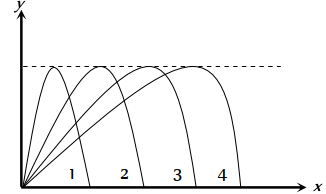
AnswerCorrect option: D. $4,3,2,1$
(d)$R=\frac{u^2 \sin 2 \theta}{g}=\frac{2 u_x v_y}{g}$$\therefore$ Range $\propto$ horizontal initial velocity $(u)$In path 4 range is maximum so football possess maximum horizontal velocity in this path.
View full question & answer→MCQ 1771 Mark
A ball is rolled off the edge of a horizontal table at a speed of 4 $m /$ second. It hits the ground after 0.4 second. Which statement given below is true
- A
It hits the ground at a horizontal distance $1.6 m$ from the edge of the table
- B
The speed with which it hits the ground is $4.0 m / second$
- C
Height of the table is $0.8 m$
- ✓
AnswerVertical component of velocity of ball at point $P$
$v_V=0+g t=10 \times 0.4=4 m / s$
Horizontal component of velocity $=$ initial velocity
$\Rightarrow v_H=4 m / s$
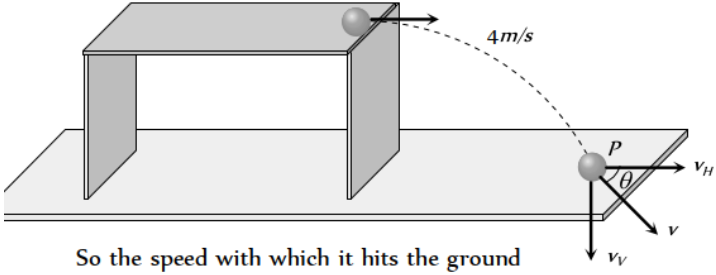
$v=\sqrt{v_H^2+v_V^2}=4 \sqrt{2} m / s$
and $\tan \theta=\frac{v_V}{v_H}=\frac{4}{4}=1 \Rightarrow \theta=45^{\circ}$
It means the ball hits the ground at an angle of $45^{\circ}$ to the horizontal.
Height of the table $h=\frac{1}{2} g t^2=\frac{1}{2} \times 10 \times(0.4)^2=0.8 m$
Horizontal distance travelled by the ball from the edge of table $h=u t=4 \times 0.4=1.6 m$ View full question & answer→MCQ 1781 Mark
A body of mass $m$ is thrown upwards at an angle $\theta$ with the horizontal with velocity $v$. While rising up the velocity of the mass after $t$ seconds will be
- A
$\sqrt{(v \cos \theta)^2+(v \sin \theta)^2}$
- B
$\sqrt{(v \cos \theta-v \sin \theta)^2-g t}$
- ✓
$\sqrt{v^2+g^2 t^2-(2 v \sin \theta) g t}$
- D
$\sqrt{v^2+g^2 t^2-(2 v \cos \theta) g t}$
AnswerCorrect option: C. $\sqrt{v^2+g^2 t^2-(2 v \sin \theta) g t}$
(c) Instantaneous velocity of rising mass after $t$ sec will be$v_t=\sqrt{v_x^2+v_y^2}$where $v_x=v \cos \theta=$ Horizontal component of velocity$\begin{aligned}& v_y=v \sin \theta-g t=\text { Vertical component of velocity } \\& v_t=\sqrt{(v \cos \theta)^2+(v \sin \theta-g t)^2} \\& v_t=\sqrt{v^2+g^2 t^2-2 v \sin \theta g t}\end{aligned}$
View full question & answer→MCQ 1791 Mark
If the range of a gun which fires a shell with muzzle speed $V$ is $R$, then the angle of elevation of the gun is
- A
$\cos ^{-1}\left(\frac{V^2}{R g}\right)$
- B
$\cos ^{-1}\left(\frac{g R}{V^2}\right)$
- C
$\frac{1}{2}\left(\frac{V^2}{R g}\right)$
- ✓
$\frac{1}{2} \sin ^{-1}\left(\frac{g R}{V^2}\right)$
AnswerCorrect option: D. $\frac{1}{2} \sin ^{-1}\left(\frac{g R}{V^2}\right)$
(d) $R=\frac{v^2 \sin 2 \theta}{g} \Rightarrow \theta=\frac{1}{2} \sin ^{-1}\left(\frac{g R}{v^2}\right)$
View full question & answer→MCQ 1801 Mark
If a cyclist moving with a speed of $4.9 m / s$ on a level road can take a sharp circular turn of radius $4 m$, then coefficient of friction between the cycle tyres and road is
Answer(c) $\mu=\frac{v^2}{r g}=\frac{(4.9)^2}{4 \times 9.8}=0.61$
View full question & answer→MCQ 1811 Mark
A body is projected at such an angle that the horizontal range is three times the greatest height. The angle of projection is
- A
$25^{\circ} 8^{\prime}$
- B
$33^{\circ} 7^{\prime}$
- C
$42^{\circ} 8^{\prime}$
- ✓
$53^{\circ} 8^{\prime}$
AnswerCorrect option: D. $53^{\circ} 8^{\prime}$
(d) $R=4 H \cot \theta$, if $R=3 H$ then $\cot \theta=\frac{3}{4} \Rightarrow \theta=53^{\circ} 8^{\prime}$
View full question & answer→MCQ 1821 Mark
If the equation for the displacement of a particle moving on a circular path is given by $(\theta)=2 t^3+0.5$, where $\theta$ is in radians and $t$ in seconds, then the angular velocity of the particle after $2 \sec$ from its start is
- A
$8 rd / sec$
- B
$12 rad / sec$
- ✓
$24 rad / \sec$
- D
$36 rad / sec$
AnswerCorrect option: C. $24 rad / \sec$
$24 rad / \sec$
View full question & answer→MCQ 1831 Mark
A particle reaches its highest point when it has covered exactly one half of its horizontal range. The corresponding point on the displacement time graph is characterised by
- A
Negative slope and zero curvature
- ✓
Zero slope and negative curvature
- C
Zero slope and positive curvature
- D
Positive slope and zero curvature
AnswerCorrect option: B. Zero slope and negative curvature
View full question & answer→MCQ 1841 Mark
A wheel is subjected to uniform angular acceleration about its axis. Initially its angular velocity is zero. In the first $2 sec$, it rotates through an angle $\theta_1$. In the next $2 sec$, it rotates through an additional angle $\theta_2$. The ratio of $\theta_2 / \theta_1$ is
Answer(a)$m g=1 \times 10=10 N, \quad \frac{m v^2}{r}=\frac{1 \times(4)^2}{1}=16$Tension at the top of circle $=\frac{m v^2}{r}-m g=6 N$Tension at the bottom of circle $=\frac{m v^2}{r}+m g=26 N$
View full question & answer→MCQ 1851 Mark
7. A $1 kg$ stone at the end of $1 m$ long string is whirled in a vertical circle at constant speed of $4 m / sec$. The tension in the string is $6 N$, when the stone is at $(g=10 m / sec )$
AnswerFor critical condition at the highest point $\omega=\sqrt{g / R}$$\Rightarrow T=\frac{2 \pi}{\omega}=2 \pi \sqrt{R / g}=2 \times 3.14 \sqrt{4 / 9.8}=4 sec .$
View full question & answer→MCQ 1861 Mark
A train is moving towards north. At one place it turns towards north-east, here we observe that
- ✓
The radius of curvature of outer rail will be greater than that of the inner rail
- B
The radius of the inner rail will be greater than that of the outer rail
- C
The radius of curvature of one of the rails will be greater
- D
The radius of curvature of the outer and inner rails will be the same
AnswerCorrect option: A. The radius of curvature of outer rail will be greater than that of the inner rail
View full question & answer→MCQ 1871 Mark
Two bodies are projected with the same velocity. If one is projected at an angle of $30^{\circ}$ and the other at an angle of $60^{\circ}$ to the horizontal, the ratio of the maximum heights reached is
- A
$3: 1$
- ✓
$1: 3$
- C
$1: 2$
- D
$2: 1$
AnswerCorrect option: B. $1: 3$
(b) As $H=\frac{u^2 \sin ^2 \theta}{2 g} \therefore \frac{H_1}{H_2}=\frac{\sin ^2 \theta_1}{\sin \theta_2}=\frac{\sin ^2 30^{\circ}}{\sin ^2 60}=\frac{1 / 4}{3 / 4}=\frac{1}{3}$
View full question & answer→MCQ 1881 Mark
Which of the following statements is false for a particle moving in a circle with a constant angular speed
- A
The velocity vector is tangent to the circle
- ✓
The acceleration vector is tangent to the circle
- C
The acceleration vector points to the centre of the circle
- D
The velocity and acceleration vectors are perpendicular to each other
AnswerCorrect option: B. The acceleration vector is tangent to the circle
View full question & answer→MCQ 1891 Mark
A ball is thrown from a point with a speed $v_o$ at an angle of projection $\theta$. From the same point and at the same instant a person starts running with a constant speed $v_o / 2$ to catch the ball. Will the person be able to catch the ball? If yes, what should be the angle of projection
- ✓
Yes, $60^{\circ}$
- B
Yes, $30^{\circ}$
- C
- D
Yes, $45^{\circ}$
AnswerCorrect option: A. Yes, $60^{\circ}$
(a) Person will catch the ball if its velocity will be equal to horizontal component of velocity of the ball.$\frac{v_0}{2}=v_0 \cos \theta \Rightarrow \cos \theta=\frac{1}{2} \Rightarrow \theta=60^{\circ}$
View full question & answer→MCQ 1901 Mark
The maximum velocity (in $m s$ ) with which a car driver must traverse a flat curve of radius $150 m$ and coefficient of friction 0.6 to avoid skidding is
Answer(b) $v=\sqrt{\mu \operatorname{rg}}=\sqrt{0.6 \times 150 \times 10}=30 m / s$
View full question & answer→MCQ 1911 Mark
In a projectile motion, velocity at maximum height is
AnswerCorrect option: B. $u \cos \theta$
(b) Only horizontal component of velocity $(u \cos \theta)$.
View full question & answer→MCQ 1921 Mark
The maximum horizontal range of a projectile is $400 m$. The maximum value of height attained by it will be
- A
$100 m$
- ✓
$200 m$
- C
$400 m$
- D
$800 m$
AnswerCorrect option: B. $200 m$
(b)
$R_{\max }=\frac{u^2}{g}=400 m $ $\theta=45^{\circ}$
$H_{\max }=\frac{u^2}{2 g}=\frac{400}{2}=200 m$(For $\theta=90^{\circ}$ )
View full question & answer→MCQ 1931 Mark
A bucket full of water is revolved in vertical circle of radius $2 m$. What should be the maximum time-period of revolution so that the water doesn't fall off the bucket
- ✓
$1 sec$
- B
$2 sec$
- C
$3 sec$
- D
$4 sec$
AnswerCorrect option: A. $1 sec$
(a)$|\overrightarrow{\Delta v}|=2 v \sin (\theta / 2)=2 v \sin \left(\frac{90}{2}\right)=2 v \sin 45=v \sqrt{2}$
View full question & answer→MCQ 1941 Mark
A motor cycle driver doubles its velocity when he is having a turn The force exerted outwardly will be
Answer(c) $F=\frac{m v^2}{r} \Rightarrow F \propto v^2$ i.e. force will become 4 times.
View full question & answer→MCQ 1951 Mark
A car is moving with high velocity when it has a turn. A force acts on it outwardly because of
MCQ 1961 Mark
An aeroplane moving horizontally with a speed of $720 km / h$ drops a food pocket, while flying at a height of $396.9 m$. the time taken by a food pocket to reach the ground and its horizontal range is (Take $g=9.8 m / sec )$
- A
$3 sec$ and $2000 m$
- B
$5 sec$ and $500 m$
- C
$8 sec$ and $1500 m$
- ✓
$9 sec$ and $1800 m$
AnswerCorrect option: D. $9 sec$ and $1800 m$
(d) $t=\sqrt{\frac{2 h}{g}}=\sqrt{\frac{2 \times 396.9}{9.8}} \simeq 9 sec$ and $u=720 km / hr =200 m / s$ $\therefore R=u \times t=200 \times 9=1800 m$
View full question & answer→MCQ 1971 Mark
The magnitude of the centripetal force acting on a body of mass $m$ executing uniform motion in a circle of radius $r$ with speed $v$ is
- ✓
$m v r$
- B
$m v^2 / r$
- C
$v / r^2 m$
- D
$v / r m$
AnswerCorrect option: A. $m v r$
(a) $T=m \omega^2 r \Rightarrow 10=0.25 \times \omega^2 \times 0.1 \Rightarrow \omega=20rad / s$
View full question & answer→MCQ 1981 Mark
A car when passes through a convex bridge exerts a force on it which is equal to
- ✓
$M g+\frac{M v^2}{r}$
- B
$\frac{M v^2}{r}$
- C
$M g$
- D
AnswerCorrect option: A. $M g+\frac{M v^2}{r}$
(a) $\omega=\frac{2 \pi}{T}=\frac{2 \pi}{60}=\frac{\pi}{30} rad / s$
View full question & answer→MCQ 1991 Mark
A car sometimes overturns while taking a turn. When it overturns, it is
- ✓
The inner wheel which leaves the ground first
- B
The outer wheel which leaves the ground first
- C
Both the wheels leave the ground simultaneously
- D
Either wheel leaves the ground first
AnswerCorrect option: A. The inner wheel which leaves the ground first
(a) Because the reaction on inner wheel decreases and becomes zero. So it leaves the ground first.
View full question & answer→MCQ 2001 Mark
A long horizontal rod has a bead which can slide along its length, and initially placed at a distance $L$ from one end $A$ of the rod. The rod is set in angular motion about $A$ with constant angular acceleration $\alpha$. If the coefficient of friction between the rod and the bead is $\mu$, and gravity is neglected, then the time after which the bead starts slipping is
- ✓
$\sqrt{\frac{\mu}{\alpha}}$
- B
$\frac{\mu}{\sqrt{\alpha}}$
- C
$\frac{1}{\sqrt{\mu \alpha}}$
- D
AnswerCorrect option: A. $\sqrt{\frac{\mu}{\alpha}}$
View full question & answer→