MCQ 1011 Mark
An aeroplane is flying with a uniform speed of $100 m / s$ along a circular path of radius $100 m$. the angular speed of the aeroplane will be
- A
$1 rad / sec$
- B
$2 rad / sec$
- ✓
$3 rad / sec$
- D
$4 rad / sec$
AnswerCorrect option: C. $3 rad / sec$
(c) $\quad \alpha=\frac{d \omega}{d t}=0$(As $\omega=$ constant)
View full question & answer→MCQ 1021 Mark
A particle describes a horizontal circle in a conical funnel whose inner surface is smooth with speed of $0.5 m / s$. What is the height of the plane of circle from vertex of the funnel ?
- A
$0.25 cm$
- B
$2 cm$
- C
$4 cm$
- ✓
$2.5 cm$
AnswerCorrect option: D. $2.5 cm$
View full question & answer→MCQ 1031 Mark
If two bodies are projected at 30 and 60 respectively, with the same velocity, then
- ✓
- B
- C
Their times of flight are same
- D
Answer(a) For complementary angles range is same.
View full question & answer→MCQ 1041 Mark
A body is thrown with a velocity of $9.8 m / s$ making an angle of 30 . with the horizontal. It will hit the ground after a time
- A
$1.5 s$
- ✓
$1 s$
- C
$3 s$
- D
$2 s$
Answer(b) $T=\frac{2 u \sin \theta}{g}=\frac{2 \times 9.8 \times \sin 30}{9.8}=1 s$
View full question & answer→MCQ 1051 Mark
A ball is moving to and fro about the lowest point $A$ of a smooth hemispherical bowl. If it is able to rise up to a height of $20 cm$ on either side of $A$, its speed at $A$ must be (Take $=10 m / s$, mass of the body 5 g)
- A
$0.2 m / s$
- B
$2 m / s$
- C
$4 m / s$
- ✓
$4.5 ms$
AnswerCorrect option: D. $4.5 ms$
(d)$\begin{aligned}& T=m g+m \omega^2 r=m\left\{g+4 \pi^2 n^2 r\right\} \\& =m\left\{g+\left(4 \pi^2\left(\frac{n}{60}\right)^2 r\right)\right\}=m\left\{g+\left(\frac{\pi^2 n^2 r}{900}\right)\right\}\end{aligned}$
View full question & answer→MCQ 1061 Mark
An unbanked curve has a radius of $60 m$. The maximum speed at which a car can make a turn if the coefficient of static friction is 0.75 , is
- ✓
$2.1 m / s$
- B
$14 m / s$
- C
$21 m / s$
- D
$7 m / s$
AnswerCorrect option: A. $2.1 m / s$
(a) Distance covered in ' $n$ ' revolution $=n 2 \pi r=n \pi D$$\begin{aligned}& \Rightarrow 2000 \pi D=9500[\text { As } n=2000, \text { distance }=9500 m ] \\& \Rightarrow D=\frac{9500}{2000 \times \pi}=1.5 m\end{aligned}$
View full question & answer→MCQ 1071 Mark
A particle comes round a circle of radius $1 m$ once. The time taken by it is $10 sec$. The average velocity of motion is
- A
$0.2 \pi m / s$
- B
$2 \pi m / s$
- ✓
$2 m / s$
- D
AnswerCorrect option: C. $2 m / s$
(c) $v_{\max }=\sqrt{\mu \operatorname{rg}}=\sqrt{0.75 \times 60 \times 9.8}=21 m / s$
View full question & answer→MCQ 1081 Mark
A ball thrown by a boy is caught by another after $2 sec$. some distance away in the same level. If the angle of projection is 30 , the velocity of projection is
- ✓
$19.6 m / s$
- B
$9.8 m / s$
- C
$14.7 m / s$
- D
AnswerCorrect option: A. $19.6 m / s$
(a) $T=\frac{2 u \sin \theta}{g} \Rightarrow u=\frac{T \times g}{2 \sin \theta}=\frac{2 \times 9.8}{2 \times \sin 30}=19.6 m / s$
View full question & answer→MCQ 1091 Mark
A pendulum bob on a $2 m$ string is displaced 60 from the vertical and then released. What is the speed of the bob as it passes through the lowest point in its path
- A
$\sqrt{2} m / s$
- ✓
$\sqrt{9.8} m / s$
- C
$4.43 m / s$
- D
$1 / \sqrt{2} m / s$
AnswerCorrect option: B. $\sqrt{9.8} m / s$
(b) Increment in angular velocity $\omega=2 \pi\left(n_2-n_1\right)$$\omega=2 \pi(1200-600) \frac{ rad }{ min }=\frac{2 \pi \times 600}{60} \frac{ rad }{ s }=20 \pi \frac{ rad }{ s }$
View full question & answer→MCQ 1101 Mark
A body of mass $m$ hangs at one end of a string of length $I$, the other end of which is fixed. It is given a horizontal velocity so that the string would just reach where it makes an angle of $60^{\circ}$ with the vertical. The tension in the string at mean position is
- ✓
$2 m g$
- B
$m g$
- C
$3 m g$
- D
$\sqrt{3} m g$
AnswerCorrect option: A. $2 m g$
View full question & answer→MCQ 1111 Mark
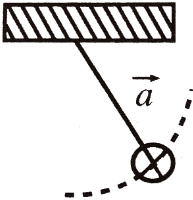
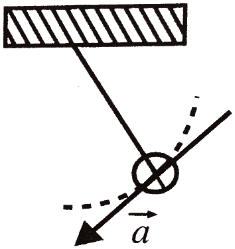
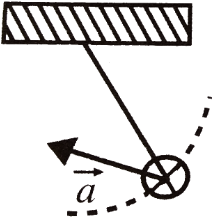
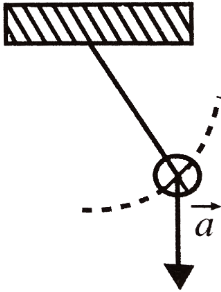
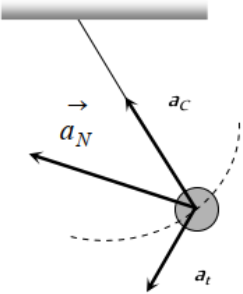
A simple pendulum is oscillating without damping. When the displacement of the bob is less than maximum, its acceleration vector $\vec{a}$ is correctly shown in
Answer$a_c=$ centripetal acceleration
$a_t=$ tangential acceleration
$a_N=$ net acceleration $=$ Resultant of $a_c$ and $a_1$
View full question & answer→MCQ 1121 Mark
A particle moves in a circular path with decreasing speed. Choose the correct statement.
AnswerCorrect option: A. ngulr momentum remins constnt
(a) Difference in kinetic energy = $2 mg r=2 \times 1 \times 10 \times 1=20 J$
View full question & answer→MCQ 1131 Mark
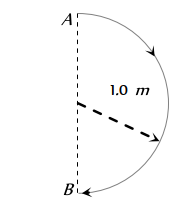
In $1.0 s$, a particle goes trom point $A$ to point $B$, moving in a semicircle of radius $1.0 m$ (see figure). The magnitude of the average velocity is
- A
$3.14 m / s$
- ✓
$2.0 m / s$
- C
$1.0 m / s$
- D
AnswerCorrect option: B. $2.0 m / s$
(b) Average velocity $=\frac{\text { Total displacement }}{\text { Total time }}=\frac{2 m }{1 s }=2 ms ^{-1}$
View full question & answer→MCQ 1141 Mark
The coordinates of a particle moving in a plane are given by $x(t)=a \cos (p t)$ and $y(t)=b \sin (p t)$ where $a, b$
- The path of the particle is an ellipse
- The velocity and acceleration of the particle are normal to each other at $t=\pi /(2 p)$
- The acceleration of the particle is always directed towards a focus
- The distance travelled by the particle in time interval $t=0$ to $t=\pi /(2 p)$ is $a$
- ✓
$1$ and $2$
- B
$2$ and $3$
- C
$3$ and $4$
- D
$2$ and $4$
AnswerCorrect option: A. $1$ and $2$
$x=a \cos (p t)$ and $y=b \sin (p t) ($given$)$
$\therefore \cos p t=\frac{x}{a} $ and $\sin p t=\frac{y}{b}$
By squaring and adding
$\cos ^2(p t)+\sin ^2(p t)=\frac{x^2}{a^2}+\frac{y^2}{b^2}=1$
Hence path of the particle is ellipse.
Now differentiating $x$ and $y \ w.r.t.$ time
$v_x=\frac{d x}{d t}=\frac{d}{d t}(a \cos (p t))=-a p \sin (p t)$
$v_y=\frac{d y}{d t}=\frac{d}{d t}(b \sin (p t))=b p \cos (p t)$
$\therefore \vec{v}=v_x \hat{i}+v_y \hat{j}=-a p \sin (p t) \hat{i}+b p \cos (p t) \hat{j}$
Acceleration $\vec{a}=\frac{d \vec{v}}{d t}=\frac{d}{d t}[-a p \sin (p t) \hat{i}+b p \cos (p t) \hat{j}]$
$\vec{a}=-a p^2 \cos (p t) \hat{i}-b p^2 \sin (p t) \hat{j}$
Velocity at $t=\frac{\pi}{2 p}$
$\vec{v}=-a p \sin p\left(\frac{\pi}{2 p}\right) \hat{i}+b p \cos p\left(\frac{\pi}{2 p}\right) \hat{j}=-a p \hat{i}$
Acceleration at $t=\frac{\pi}{2 p}$
$\vec{a}=a p^2 \cos p\left(\frac{\pi}{2 p}\right) \hat{i}-b p^2 \sin p\left(\frac{\pi}{2 p}\right) \hat{j}=-b p^2 \hat{j}$
As $\vec{v} \cdot \vec{a}=0$
Hence velocity and acceleration are perpendicular to each other at $t=\frac{\pi}{2 p}$.
View full question & answer→MCQ 1151 Mark
A stone tied to a string of length $L$ is whirled in a vertical circle with the other end of the string at the centre. At a certain instant of time, the stone is at its lowest position and has a speed $u$. The magnitude of the change in its velocity as it reaches a position where the string is horizontal is
AnswerCorrect option: D. $\sqrt{2\left(u^2-g L\right)}$
(d)$\begin{aligned}& \frac{1}{2} m u^2-\frac{1}{2} m v^2=m g L \\& \Rightarrow v=\sqrt{u^2-2 g L} \\& |\vec{v}-\vec{u}|=\sqrt{u^2+v^2}=\sqrt{u^2+u^2-2 g L}=\sqrt{2\left(u^2-g L\right)}\end{aligned}$
View full question & answer→MCQ 1161 Mark
A particle of mass $m$ is moving in a circular path of constant radius $r$ such that its centripetal acceleration $a_c$ is varying with time $t$ as, $a_c=k^2 r t^2$, The power delivered to the particle by the forces acting on it is
AnswerCorrect option: B. $m k^2 r^2 t$
View full question & answer→MCQ 1171 Mark
A car is moving in a circular horizontal track of radius $10 m$ with a constant speed of $10 m / sec$. A plumb bob is suspended from the roof of the car by a light rigid rod of length $1.00 m$. The angle made by the rod with track is
- A
- B
$30^{\circ}$
- ✓
$45^{\circ}$
- D
$60^{\circ}$
AnswerCorrect option: C. $45^{\circ}$
View full question & answer→MCQ 1181 Mark
A tube of length $L$ is filled completely with an incompressible liquid of mass $M$ and closed at both the ends. The tube is then rotated in a horizontal plane about one of its ends with a uniform angular velocity $\omega$. The force exerted by the liquid at the other end is
AnswerCorrect option: A. $\frac{M L \omega^2}{2}$
View full question & answer→MCQ 1191 Mark
A particle is acted upon by a force of constant magnitude which is always perpendicular to the velocity of the particle. The motion of the particle takes place in a plane. It follows that
- A
- B
It moves in a circular path
- C
Kinetic energy is constant
- ✓
AnswerIn the given condition, the particle undergoes uniform circular motion and for uniform circular motion the velocity and acceleration vector changes continuously but kinetic energy is constant for every point.
View full question & answer→MCQ 1201 Mark
Four persons $K, L, M$ and $N$ are initially at the corners of a square of side of length $d$. If every person starts moving, such that $K$ is always headed towards $L, L$ towards $M, M$ is headed directly towards $N$ and $N$ towards $K$, then the four persons will meet after
AnswerCorrect option: A. $\frac{d}{v} \sec$
View full question & answer→MCQ 1211 Mark
A particle is moving eastwards with velocity of $5 m / s$. In $10 sec$ the velocity changes to $5 m / s$ northwards. The average acceleration in this time is
- A
- ✓
$\frac{1}{\sqrt{2}} m / s ^2$ toward north-west
- C
$\frac{1}{\sqrt{2}} m / s ^2$ toward north-east
- D
$\frac{1}{2} m / s ^2$ toward north-west
AnswerCorrect option: B. $\frac{1}{\sqrt{2}} m / s ^2$ toward north-west
View full question & answer→MCQ 1221 Mark
For a projectile, the ratio of maximum height reached to the square of flight time is $(g=10 ms )$
- ✓
$5: 4$
- B
$5: 2$
- C
$5: 1$
- D
$10: 1$
AnswerCorrect option: A. $5: 4$
(a) $\quad H=\frac{u^2 \sin ^2 \theta}{2 g}$ and $T=\frac{2 u \sin \theta}{g}$So $\frac{H}{T^2}=\frac{u^2 \sin ^2 \theta / 2 g}{4 u^2 \sin ^2 \theta / g^2}=\frac{g}{8}=\frac{5}{4}$
View full question & answer→MCQ 1231 Mark
If a particle of mass $m$ is moving in a horizontal circle of radius $r$ with a centripetal force $\left(-k / r^2\right)$, the total energy is
- A
$-\frac{k}{2 r}$
- B
$-\frac{k}{r} \quad$
- C
$-\frac{2 k}{r}$
- ✓
$-\frac{4 k}{r}$
AnswerCorrect option: D. $-\frac{4 k}{r}$
(d)$\begin{aligned}& \text { Maximum tension }=\frac{m v^2}{r}=16 N \\& \Rightarrow \frac{16 \times v^2}{144}=16 \Rightarrow v=12 m / s\end{aligned}$
View full question & answer→MCQ 1241 Mark
A bomb is dropped from an aeroplane moving horizontally at constant speed. When air resistance is taken into consideration, the bomb
- A
Falls to earth exactly below the aeroplane
- ✓
Fall to earth behind the aeroplane
- C
Falls to earth ahead of the aeroplane
- D
AnswerCorrect option: B. Fall to earth behind the aeroplane
(b) Due to air resistance, it's horizontal velocity will decrease so it will fall behind the aeroplane.
View full question & answer→MCQ 1251 Mark
The tension in the string revolving in a vertical circle with a mass $m$ at the end which is at the lowest position
- A
$\frac{m v^2}{r}$
- B
$\frac{m v^2}{r}-m g$
- ✓
$\frac{m v^2}{r}+m g$
- D
$m g$
AnswerCorrect option: C. $\frac{m v^2}{r}+m g$
(c) $T = $ Centrifugal force +weight $ = \frac{m v^2}{r}+m g$.
View full question & answer→MCQ 1261 Mark
An object is projected with a velocity of $20 m / s$ making an angle of 45 with horizontal. The equation for the trajectory is $h=A x-B x$ where $h$ is height, $x$ is horizontal distance, $A$ and $B$ are constants. The ratio $A: B$ is $(g=10 ms )$
- A
$1: 5$
- B
$5: 1$
- C
$1: 40$
- ✓
$40: 1$
AnswerCorrect option: D. $40: 1$
View full question & answer→MCQ 1271 Mark
A stone projected with a velocity $u$ at an angle $\theta$ with the horizontal reaches maximum height $H$. When it is projected with velocity $u$ at an angle $\left(\frac{\pi}{2}-\theta\right)$ with the horizontal, it reaches maximum height $H$. The relation between the horizontal range $R$ of the projectile, $H$ and $H$ is
AnswerCorrect option: A. $R=4 \sqrt{H_1 H_2}$
View full question & answer→MCQ 1281 Mark
A gun is aimed at a target in a line of its barrel. The target is released and allowed to fall under gravity at the same instant the gun is fired. The bullet will
- A
- B
- ✓
- D
Certainly miss the target
Answer(c) Became vertical downward displacement of both (barrel and bullet) will be equal.
View full question & answer→MCQ 1291 Mark
In a vertical circle of radius $r$, at what point in its path a particle has tension equal to zero if it is just able to complete the vertical circle
Answer(c) Tension = Centrifugal force + weight $=\frac{m v^2}{r}+m g$
View full question & answer→MCQ 1301 Mark
The force required to keep a body in uniform circular motion is
MCQ 1311 Mark
A ball is projected upwards from the top of tower with a velocity $50-1$ making an angle 30 with the horizontal. The height of tower is $70 m$. After how many seconds from the instant of throwing will the ball reach the ground
Answer(c) The vertical component of velocity of projection
$=-50 \sin 30^{\circ}=-25 m / s$
If $t$ be the time taken to reach the ground,$h=u t+\frac{1}{2} g t^2 \Rightarrow 70=-25 t+\frac{1}{2} \times 10 t^2$
$\Rightarrow 70=-25 t+5 t^2 \Rightarrow t^2-5 t-14=0$
$ \Rightarrow t=-2 s$ and $7 s$
Since, $t=-2 s$ is not valid $\therefore t=7 s$
View full question & answer→MCQ 1321 Mark
A tachometer is a device to measure
MCQ 1331 Mark
An object is moving in a circle of radius $100 m$ with a constant speed of $31.4 m / s$. What is its average speed for one complete revolution
AnswerCorrect option: B. $31.4 m / s$
(b) As the speed is constant throughout the circular motion therefore its average speed is equal to instantaneous speed.
View full question & answer→MCQ 1341 Mark
In uniform circular motion, the velocity vector and acceleration vector are
- ✓
Perpendicular to each other
- B
- C
- D
Not related to each other
AnswerCorrect option: A. Perpendicular to each other
(a) Because velocity is always tangential and centripetal acceleration is radial.
View full question & answer→MCQ 1351 Mark
If $a_r$ and $a_t$ represent radial and tangential accelerations, the motion of a particle will be uniformly circular if
AnswerCorrect option: C. $a_r \neq 0$ but $a_t=0$
(c) In uniform circular motion tangential acceleration remains zero but magnitude of radial acceleration remains constant.
View full question & answer→MCQ 1361 Mark
The maximum velocity at the lowest point, so that the string just slack at the highest point in a vertical circle of radius $l$
- A
$\sqrt{g l}$
- B
$\sqrt{3 g l}$
- ✓
$\sqrt{5 g l}$
- D
$\sqrt{7 g l}$
AnswerCorrect option: C. $\sqrt{5 g l}$
(c)$\omega=\frac{d \theta}{d t}=\frac{d}{d t}\left(2 t^3+0.5\right)=6 t^2$at $t =2 s , \omega=6 \times(2)^2=24 rad / s$
View full question & answer→MCQ 1371 Mark
Find the maximum velocity for skidding for a car moved on a circular track of radius $100 m$. The coefficient of friction between the road and tyre is 0.2
- A
$0.14 m / s$
- B
$140 m / s$
- C
$1.4 km / s$
- ✓
$14 m / s$
AnswerCorrect option: D. $14 m / s$
(d) $F=m g-\frac{m v^2}{r}$
View full question & answer→MCQ 1381 Mark
An aeroplane is flying horizontally with a velocity of $600 km / h$ at a height of $1960 m$. When it is vertically at a point A on the ground, a bomb is released from it. The bomb strikes the ground at point $B$. The distance $A B$ is
- A
$1200 m$
- B
$0.33 km$
- ✓
$3.33 km$
- D
$33 km$
AnswerCorrect option: C. $3.33 km$
(c) Horizontal displacement of the bomb $AB =$ Horizontal velocity $\times$ time available $A B=u \times \sqrt{\frac{2 h}{g}}=600 \times \frac{5}{18} \times \sqrt{\frac{2 \times 1960}{9.8}}=3.33 Km$.
View full question & answer→MCQ 1391 Mark
A sphere of mass $m$ is tied to end of a string of length $l$ and rotated through the other end along a horizontal circular path with speed $v$. The work done in full horizontal circle is
AnswerCorrect option: B. $\left(\frac{m v^2}{l}\right) \cdot 2 \pi l$
(b) $v=r \omega=20 \times 10 cm / s =2 m / s$
View full question & answer→MCQ 1401 Mark
A small disc is on the top of a hemisphere of radius $R$. What is the smallest horizontal velocity $v$ that should be given to the disc for it to leave the hemisphere and not slide down it ? $[$There is no friction$]$
- A
$v=\sqrt{2 g R}$
- ✓
$v=\sqrt{g R}$
- C
$v=\frac{g}{R}$
- D
$v=\sqrt{g^2 R}$
AnswerCorrect option: B. $v=\sqrt{g R}$
$v=\sqrt{g R}$
View full question & answer→MCQ 1411 Mark
A cane filled with water is revolved in a vertical circle of radius 4 meter and the water just does not fall down. The time period of revolution will be
- A
$1 sec$
- ✓
$10 sec$
- C
$8 sec$
- D
$4 sec$
AnswerCorrect option: B. $10 sec$
(b) $m g=20 N$ and $\frac{m v^2}{r}=\frac{2 \times(4)^2}{1}=32 N$ It is clear that $52 N$ tension will be at the bottom of thecircle. Because we know that $T_{\text {Bottom }}=m g+\frac{m v^2}{r}$
View full question & answer→MCQ 1421 Mark
The height $y$ and the distance $x$ along the horizontal plane of a projectile on a certain planet (with no surrounding atmosphere) aregiven by $y=\left(8 t-5 t^2\right)$ meter and $x=6 t$ meter, where $t$ is in second. The velocity with which the projectile is projected is
- A
$8 m / sec$
- B
$6 m / sec$
- ✓
$10 m / sec$
- D
Not obtainable from the data
AnswerCorrect option: C. $10 m / sec$
(c) $v_y=\frac{d y}{d t}=8-10 t, v_x=\frac{d x}{d t}=6$at the time of projection i.e. $v_y=\frac{d y}{d t}=8$ and $v_x=6$$\therefore v=\sqrt{v_x^2+v_y^2}=\sqrt{6^2+8^2}=10 m / s$
View full question & answer→MCQ 1431 Mark
Referring to the above two questions, the acceleration due to gravity is given by
- ✓
$10 m / sec ^2$
- B
$5 m / sec ^2$
- C
$20 m / sec ^2$
- D
$2.5 m / sec ^2$
AnswerCorrect option: A. $10 m / sec ^2$
(a) $a_x=\frac{d}{d t}\left(v_x\right)=0, a_y=\frac{d}{d t}\left(v_y\right)=-10 m / s ^2$$\therefore$ Net acceleration $a=\sqrt{a_x^2+a_y^2}=\sqrt{0^2+10^2}=10 m / s$
View full question & answer→MCQ 1441 Mark
Referring to above question, the angle with the horizontal at which the projectile was projected is
- A
$\tan ^{-1}(3 / 4)$
- ✓
$\tan ^{-1}(4 / 3)$
- C
$\sin ^{-1}(3 / 4)$
- D
Not obtainable from the given data
AnswerCorrect option: B. $\tan ^{-1}(4 / 3)$
(b) The angle of projection is given $\theta=\tan ^{-1}\left(\frac{v_y}{v_x}\right)=\tan^{-1}\left(\frac{4}{3}\right)$
View full question & answer→MCQ 1451 Mark
In a circus stuntman rides a motorbike in a circular track of radius $R$ in the vertical plane. The minimum speed at highest point of track will be
- A
$2 R$
- B
$R / 2$
- C
$R$
- ✓
$4 R$
Answer(d) Minimum speed at the highest point of vertical circular path $v=\sqrt{g R}$
View full question & answer→MCQ 1461 Mark
If the body is moving in a circle of radius $r$ with a constant speed $v$, its angular velocity is
- A
$v^2 / r$
- B
$v r$
- ✓
$v / r$
- D
$r / v$
AnswerCorrect option: C. $v / r$
(c) $v=r \omega \Rightarrow \omega=\frac{v}{r}=$ constant [As $v$ and $r$ are constant $]$
View full question & answer→MCQ 1471 Mark
A cyclist turns around a curve at 15 miles/hour. If he turns at double the speed, the tendency to overturn is
Answer(b) $F=\frac{m v^2}{r} \Rightarrow F \propto v^2$. If $v$ becomes double then $F$ (tendency to overturn) will become four times.
View full question & answer→MCQ 1481 Mark
A body of mass $m$ moves in a circular path with uniform angular velocity. The motion of the body has constant
View full question & answer→MCQ 1491 Mark
If a particle moves in a circle describing equal angles in equal times, its velocity vector
- A
- B
- ✓
- D
Changes both in magnitude and direction
Answer(c) lt is always directed in a direction of tangent to circle.
View full question & answer→MCQ 1501 Mark
A stone ties to the end of a string $1 m$ long is whirled in a horizontal circle with a constant speed. If the stone makes 22 revolution in 44 seconds, what is the magnitude and direction of acceleration of the stone
- A
$\frac{\pi^2}{4} m s^{-2}$ and direction along the radius towards the centre
- B
$\pi^2 ms ^{-2}$ and direction along the radius away from the centre
- ✓
$\pi^2 m s^{-2}$ and direction along the radius towards the centre
- D
$\pi^2 m s^{-2}$ and direction along the tangent to the circle
AnswerCorrect option: C. $\pi^2 m s^{-2}$ and direction along the radius towards the centre
(c) $a=\frac{v^2}{r}=\omega^2 r=4 \pi^2 n^2 r=4 \pi^2\left(\frac{22}{44}\right)^2 \times 1=\pi^2 m / s ^2$ and its direction is always along the radius and towards the centre.
View full question & answer→