MCQ
Newton's first law of motion describes the following
  • A
    Energy
  • B
    Work
  • Inertia
  • D
    Moment of inertia

Answer

Correct option: C.
Inertia
(c) Newton's first law of motion defines the inertia of body. It states that every body has a tendency to remain in its state (either rest or motion) due to its inerta.

Need a full question paper?

Generate a complete, print-ready paper with questions like this in minutes — across 16+ boards, with answer keys.
Start Generating Free

Similar questions

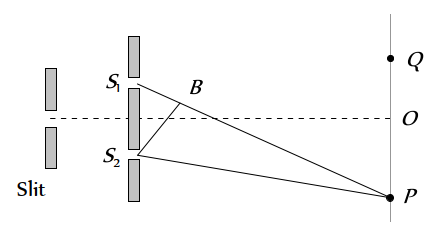
In the figure is shown Young's double slit experiment. $Q$ is the position of the first bright fringe on the right side of $O . P$ is the $11^*$fringe on the other side, as measured from $Q$. If the wavelength of the light used is $6000 \times 10^{-10} m$, then $S _1 B$ will be equal to

Image

The continuous X-rays spectrum produced by an X-ray machine at constant voltage has
A tuning fork of frequency $340 \mathrm{~Hz}$ is vibrated just above the tube of $120 \mathrm{~cm}$ height. Water is poured slowly in the tube. What is the minimum height of water necessary for the resonance (speed of sound in the air $=340 \mathrm{~m} / \mathrm{sec}$ )
Which of the following statements is correct
Which of the following system of units is not based on units of mass, length and time alone
A mass of $10 \mathrm{gm}$ moving with a velocity of $100 \mathrm{~cm} / \mathrm{s}$ strikes a pendulum bob of mass $10 \mathrm{gm}$. The two masses stick together. The maximum height reached by the system now is $\left(g=10 \mathrm{~m} / \mathrm{s}^2\right)$
In an insulator, the forbidden energy gap between the valence band and conduction band is of the order of
Two resistors of $6\  \Omega$ and $9\  \Omega$ are connected in series to a $120$ volt source. The power consumed by the $6\  \Omega$ resistor is
The temperature of the cold junction of a thermocouple is $0^{\circ} C$ and temperature of the hot junction is $T^o C$. The thermo e.m.f. is given by the relation $E=A T-\frac{1}{2} B T^2$ (where $A=16$ and $B=$ $0.08)$. The temperature of inversion is
If $2.2 kW$ power is transmitted through a $100 \Omega$ line at $22,000 V$, the power loss in the form of heat will be