Questions

Assertion & Reason

Take a timed test

23 questions · self-marked practice — reveal the answer and mark yourself.

Question 11 Mark
Assertion : Consider motion for a mass spring system under gravity, motion of $M$ is not a simple harmonic motion unless $M g$ is negligibly small.
Reason : For simple harmonic motion acceleration must be proportional to displacement and is directed towards the mean position
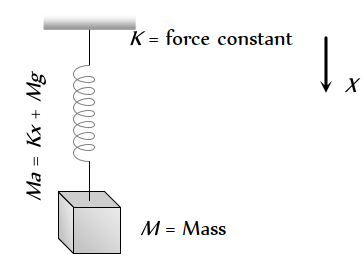
Image

Answer
(e)
View full question & answer
Question 21 Mark
Assertion : In simple harmonic motion, the velocity is maximum when acceleration is minimum
Reason : Displacement and velocity of S.H.M. differ is phase by
Answer
(b) $x=a \sin \omega t$ and $v=\frac{d x}{d t}=a \omega \cos \omega t$It is clear phase difference between ' $x$ ' and ' $a$ ' is $\pi / 2$.
View full question & answer
Question 31 Mark
Assertion : Resonance is special case of forced vibration in which the natural frequency of vibration of the body is the same as the impressed frequency of external periodic force and the amplitude of forced vibration is maximum.
Reason : The amplitude of forced vibrations of a body increases with an increase in the frequency of the externally impressed periodic force.
Answer
(c) Amplitude of oscillation for a forced, damped oscillator is $A=\frac{F_0 / m}{\sqrt{\left(\omega^2-\omega_0^2\right)+(b \omega / m)^2}}$, where $b$ is constant related to the strength of the resistive force, $\omega_0=\sqrt{k / m}$ is natural frequency of undamped oscillator $(b=0)$.When the frequency of driving force $(\omega) \approx \omega_0$, then amplitude $A$ is very larger.For $\omega<\omega$ or $\omega>\omega$, the amplitude decrease.
View full question & answer
Question 41 Mark
Assertion : The amplitude of an oscillating pendulum decreases gradually with time
Reason : The frequency of the pendulum decreases with time
Answer
(c) The amplitude of an oscillating pendulum decreases with time because of friction due to air. Frequency of pendulum is independent $\left(T=\frac{1}{2 \pi} \sqrt{\frac{g}{l}}\right)$ of amplitude.
View full question & answer
Question 51 Mark
Assertion : In S.H.M., the motion is 'to and fro' and periodic.
Reason : Velocity of the particle $v \sqrt{k \quad x}$ (where $x$ is the displacement and $k$ is amplitude)
Answer
(b)
View full question & answer
Question 61 Mark
Assertion : Soldiers are asked to break steps while crossing the bridge.
Reason : The frequency of marching may be equal to the natural frequency of bridge and may lead to resonance which can break the bridge.
Answer
(a) If the soldiers while crossing a suspended bridge march in steps, the frequency of marching steps of soldiers may match with the natural frequency of oscillations of the suspended bridge. In that situation resonance will take place, then the amplitude of oscillation of the suspended bridge will increase enormously, which may cause the collapsing of the bridge. To avoid situations the soldiers are advised to go out steps on suspended bridge.
View full question & answer
Question 71 Mark
Assertion : The amplitude of oscillation can never be infinite.
Reason : The energy of oscillator is continuously dissipated.
View full question & answer
Question 81 Mark
Assertion : In extreme position of a particle executing S.H.M., both velocity and acceleration are zero.
Reason $\quad:$ In S.H.M., acceleration always acts towards mean position.
Answer
(e) In simple harmonic motion the velocity is given by, $v=\omega \sqrt{a^2-y^2}$ at extreme position, $y=a$.$\therefore v=0$. But acceleration $A=-\omega^2 a$, which is maximum at extreme position.
View full question & answer
Question 91 Mark
Assertion : The periodic time of a hard spring is less as compared to that of a soft spring.
Reason : The periodic time depends upon the spring constant, and spring constant is large for hard spring.
Answer
(a) The time period of a oscillating spring is given by,$T=2 \pi \sqrt{\frac{m}{k}} \Rightarrow T \propto \frac{1}{\sqrt{k}}$. Since the spring constant is large for hard spring, therefore hard spring has a less periodic time as compared to soft spring.
View full question & answer
Question 101 Mark
Assertion : The spring constant of a spring is $k$. When it is divided into $n$ equal parts, then spring constant of one piece is $k / n$.
Reason : The spring constant is independent of material used for the spring.
Answer
(e) Spring constant propto \frac{1}{\text { Lengthof spring }} \\& \Rightarrow k^{\prime}=\frac{k}{n}\end{aligned}$Also, spring constant depends on material properties of the spring.Hence assertion is false, but reason is true.
View full question & answer
Question 111 Mark
Assertion : For an oscillating simple pendulum, the tension in the string is maximum at the mean position and minimum at the extreme position.
Reason : The velocity of oscillating bob in simple harmonic motion is maximum at the mean position.
View full question & answer
Question 121 Mark
Assertion : If the amplitude of a simple harmonic oscillator is doubled, its total energy becomes four times.
Reason : The total energy is directly proportional to the square of amplitude of vibration of the harmonic oscillator.
Answer
(a) Total energy of the harmonic oscillator,$E=\frac{1}{2} m \omega^2 a^2$ i.e., $E \propto a^2$.Therefore $\frac{E^{\prime}}{F}=\left(\frac{2 a}{a}\right)^2$ or, $E^{\prime}=4 E$.
View full question & answer
Question 131 Mark
Assertion : In a S.H.M., kinetic and potential energies become equal when the displacement is $1 / \sqrt{2}$ times the amplitude.
Reason : In SHM, kinetic energy is zero when potential energy is maximum.
Answer
(b) In SHM. K.E. $=\frac{1}{2} m \omega^2\left(a^2-y^2\right)$ and P.E. $=\frac{1}{2} m \omega^2 y^2$.For K.E. $=$ P.E. $\Rightarrow 2 y^2=a^2 \Rightarrow y=a / \sqrt{2}$. Since total energy remains constant through out the motion, which is $E=K . E .+P . E$. So, when P.E. is maximum then K.E. is zero and viceversa.
View full question & answer
Question 141 Mark
Assertion : Damped oscillation indicates loss of energy.
Reason : The energy loss in damped oscillation may be due to friction, air resistance etc.
Answer
(b) Energy of damped oscillator at an any instant $t$ is given by $E=E_0 e^{-b t / m} \quad\left[\right.$ where $E_0=\frac{1}{2} k x^2=$ maximum energy $]$Due to damping forces the amplitude of oscillator will go on decreasing with time whose energy is expressed by above equation.
View full question & answer
Question 151 Mark
Assertion : The frequency of a second pendulum in an elevator moving up with an acceleration half the acceleration due to gravity is $0.612 s$.
Reason : The frequency of a second pendulum does not depend upon acceleration due to gravity.
Answer
(c) Frequency of second pendulum $n=(1 / 2) s^{-1}$. When elevator is moving upwards with acceleration $g / 2$, the effective acceleration due to gravity is$g=g+a=g+g / 2=3 g / 2 .$As $n=\frac{1}{2 \pi} \sqrt{\frac{g}{l}}$ so $n^2 \propto g$.$\begin{aligned}& \therefore \frac{n_1^2}{n_2^2}=\frac{g_1}{g}=\frac{3 g / 2}{g}=\frac{3}{2} \text { or, } \frac{n_1}{n}=\sqrt{\frac{3}{2}}=1.225 \\& \text { or, } n_1=1.225 n=1.225 \times(1 / 2)=0.612 \mathrm{~s}^{-1} .\end{aligned}$
View full question & answer
Question 161 Mark
Assertion : The percentage change in time period is $1.5 \%$, if the length of simple pendulum increases by $3 \%$.
Reason : Time period is directly proportional to length of pendulum.
Answer
(c) Time period of simple pendulum of length $/$ is,$\begin{aligned}& T=2 \pi \sqrt{\frac{l}{g}} \Rightarrow T \propto \sqrt{l} \Rightarrow \sqrt{\frac{\Delta T}{T}}=\frac{1}{2} \frac{\Delta l}{l} \\& \therefore \frac{\Delta T}{T}=\frac{1}{2} \times 3=1.5 \%\end{aligned}$
View full question & answer
Question 171 Mark
Assertion : The graph of total energy of a particle in SHM w.r.t., position is a straight line with zero slope.
Reason : Total energy of particle in $SHM$ remains constant throughout its motion.
View full question & answer
Question 181 Mark
Assertion : When a simple pendulum is made to oscillate on the surface of moon, its time period increases.
Reason : Moon is much smaller as compared to earth.
Answer
(b) $T=2 \pi \sqrt{\frac{l}{g}}$. On moon, $g$ is much smaller compared to $g$ on earth. Therefore, $T$ increases.
View full question & answer
Question 191 Mark
Assertion : The graph between velocity and displacement for a harmonic oscillator is a parabola.
Reason : Velocity does not change uniformly with displacement in harmonic motion.
Answer
(e) $\ln \mathrm{SHM}, v=\omega \sqrt{a^2-y^2}$ or $v^2=\omega^2 a^2-\omega^2 y^2$.Dividing both sides by $\omega^2 a^2, \frac{v^2}{\omega^2 a^2}+\frac{y^2}{a^2}=1$. This is the equation of an ellipse. Hence the graph between $v$ and $y$ is an ellipse not a parabola.
View full question & answer
Question 201 Mark
Assertion : Sine and cosine functions are periodic functions.
Reason : Sinusoidal functions repeats it values after a definite interval of time.
View full question & answer
Question 211 Mark
Assertion : Acceleration is proportional to the displacement. This condition is not sufficient for motion in simple harmonic.
Reason : In simple harmonic motion direction of displacement is also considered.
Answer
(a) In SHM, the acceleration is always in a direction opposite to that of the displacement i.e., proportional to $(-y)$.
View full question & answer
Question 221 Mark
Assertion : Simple harmonic motion is a uniform motion.
Reason : Simple harmonic motion is the projection of uniform circular motion.
Answer
(e) In simple harmonic motion, $v=\omega \sqrt{a^2-y^2}$ as $y$ changes, velocity $v$ will also change. So simple harmonic motion is not uniform motion. But simple harmonic motion may be defined as the projection of uniform circular motion along one of the diameter of the circle.
View full question & answer
Question 231 Mark
Assertion : All oscillatory motions are necessarily periodic motion but all periodic motion are not oscillatory.
Reason : Simple pendulum is an example of oscillatory motion.
Answer
(b) Both assertion and reason are correct but reason is not the correct explanation of assertion.
View full question & answer